
TL;DR:
- Employers should start workplace volunteering programs by appointing a coordinator and running a pilot day within 8 to 12 weeks. Supporting volunteering increases employee participation, enhances mental health, and strengthens community relationships. Using governance standards and tracking meaningful outcomes ensure programs benefit both employees and organizations effectively.
Yes — employers should run workplace volunteering programmes, and the best place to start is simple: appoint one person to own it, identify one or two community priorities that connect to your business, and run a single pilot day of service. That is enough to begin. The Canadian Code for Employer-Supported Volunteering, published by Volunteer Canada, gives you the governance framework to build from there. And the evidence from Statistics Canada's General Social Survey on Giving, Volunteering and Participating (GSS GVP) is clear: employees with employer support are more likely to volunteer than those without it, a notably higher rate among employees with employer support than among those without it.
- Appoint a programme owner before anything else.
- Map one or two community priorities that align with business goals.
- Run a pilot day of service within your first 8–12 weeks.
- Govern the programme using the Canadian Code for Employer-Supported Volunteering.
Table of Contents
- Why workplace volunteering matters in Canada
- What types of employer-supported volunteering can you offer?
- How do you build and launch a programme step by step?
- What HR, health and safety rules apply in Canada?
- How do you measure the impact of your programme?
- How do you find and work with community partners across Canada?
- What are the most common pitfalls and how do you fix them?
- Key takeaways
- What I keep coming back to
- The MentorWell can help you connect volunteering to mental health
- Useful Canada-focused resources
- FAQ
Why workplace volunteering matters in Canada
The GSS GVP data does more than confirm that support increases participation. Supported volunteers also give more hours than unsupported ones. That gap is the business case in a single sentence: when you make it easier, people show up more and contribute more time.
The benefits run in both directions.
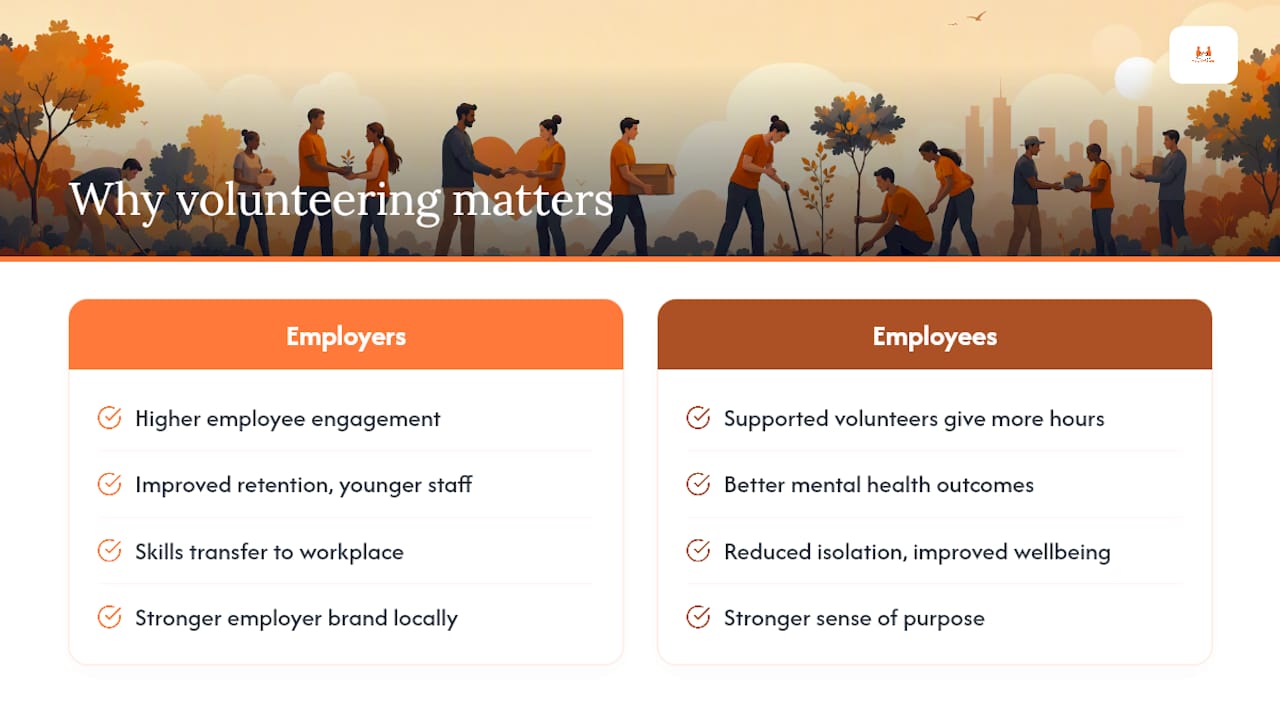
For the business: employee engagement rises when people feel their work connects to something larger. Retention improves, particularly among younger employees who weigh purpose alongside pay. Skills developed through volunteering, especially in skills-based placements, transfer back to the workplace. Your employer brand strengthens in communities where you recruit.
For employees: the mental health connection is real. Research cited by Benefits Canada links employer support for volunteering to better mental health outcomes among Canadian workers. Paula Allen of Telus Health has noted that employers who support passion projects and community engagement help reduce isolation and protect wellbeing. That matters when youth mental health impacts productivity across every level of an organization.
"Employees who volunteer report better mental health, and employers who actively support volunteering are contributing to that outcome — not just observing it." — Benefits Canada survey commentary, citing Telus Health research
Three Canadian employers show what this looks like in practice. Keurig Canada has used team days of service to build community relationships alongside employee engagement. PwC Canada has moved toward skills-based placements that develop professional capabilities while delivering real value to non-profits. The Home Depot Canada has integrated in-kind support and group volunteering into its broader community investment strategy. Different models, same principle: intentional design produces measurable results.
What types of employer-supported volunteering can you offer?
Employer-supported volunteering (ESV) is the industry term for what many HR teams call an "employee volunteering programme." The Canadian Code for Employer-Supported Volunteering recognises several distinct models, and most employers combine two or three.
- Paid volunteer leave: — employees receive paid time off to volunteer independently. Works well for any size of employer; low administrative overhead.
Trends from Volunteer Canada's Leading with Intention research show a growing preference for short, well-organised micro-projects and skills-based placements that produce outcomes employees can see and measure.
Pro Tip: Don't force a single model on your whole workforce. Let employees self-select from a menu of options, from a two-hour micro-task to a full skills-based placement. Autonomy drives sustained participation more reliably than a mandatory group day.
How do you build and launch a programme step by step?
The 8–12 week pilot roadmap
- Weeks 1–2 — Scoping: — Align the programme to your Community Investment strategy and at least one business priority (recruitment, skills development, or wellbeing). Assign a programme owner and two or three volunteer ambassadors.
- Weeks 2–3 — Partner selection: Use Volunteer Canada's corporate group volunteering checklist to vet one or two non-profit partners. Confirm capacity, costs, accessibility, and insurance requirements.
| Governance element | Who owns it | Key output |
|---|---|---|
| Programme strategy | HR lead / programme owner | Alignment to Community Investment plan |
| Partner relationships | Community liaison | Signed partnership agreement |
| Employee communications | Internal comms | Pre-event briefing and post-event story |
| Health & safety sign-off | Facilities / legal | Site safety checklist completed |
| Measurement | Programme owner | Participation rate, hours, feedback scores |
Pro Tip: Brief managers before you brief employees. A manager who understands the programme and endorses it publicly is the single biggest driver of uptake. Give them a one-page talking-points sheet, not a policy document.
When vetting a partner, ask these questions early: What is your capacity for a group of our size? Who covers liability for volunteers on your site? What lead time do you need? What does success look like for you? That last question is the one most employers skip, and skipping it is how partner strain starts.
What HR, health and safety rules apply in Canada?
A workplace volunteering policy needs a few non-negotiable elements before you go live.
- Eligibility: — define which employees qualify (full-time, part-time, contract) and how much paid volunteer time each receives annually.
Pro Tip: For remote or virtual activities, confirm that your corporate cyber-security and privacy policies cover employees using personal devices to complete online volunteer tasks on behalf of a non-profit.
Consult your legal counsel and HR team before finalising policy language, particularly around paid time accounting and liability coverage. This article is general information, not legal advice.
How do you measure the impact of your programme?
Measurement is where most programmes lose credibility. Tracking hours is not enough. You need to show what changed.
| Metric | Definition | Data source |
|---|---|---|
| Participation rate | % of eligible employees who volunteered | HR system / sign-up records |
| Volunteer hours | Total hours logged per quarter | Time-recording system |
| Skills outcomes | % of participants reporting skill gain | Post-event survey |
| Retention differential | Turnover rate: volunteers vs. non-volunteers | HR analytics |
| Community outputs | Activities completed, people served | Partner report |
| Employee wellbeing score | Pre/post wellbeing survey delta | Internal survey tool |
Earlier Statistics Canada research found that employer-supported volunteers reported acquiring job-related skills more often than unsupported volunteers, 46% versus 29%. That gap is worth tracking in your own post-event surveys.
Report monthly to your programme owner, quarterly to leadership, and annually to community partners. Keep the annual report short: participation rate, total hours, one or two community outcomes, and one employee story. Leaders read what fits on a page.
- Set a KPI baseline before the pilot.
- Run a five-question post-event survey for employees and a separate one for partners.
- Compare volunteer retention rates to non-volunteer rates after 12 months.
- Report outcomes, not just outputs, to your leadership team.
How do you find and work with community partners across Canada?
Volunteer Canada's corporate services are the most direct route to vetted partners and facilitation support, particularly for national employers who need regional coordination. Local volunteer centres, listed through Volunteer Canada's network, are the right starting point for single-location employers.
- Search Volunteer Canada's directory for local volunteer centres in your region.
- Ask your existing non-profit relationships whether they have capacity for group days.
- Check sector networks relevant to your business (food security, literacy, environment) for organisations already working in your community.
When you make contact, discuss costs and staff time expectations before you discuss dates. Non-profits absorb real costs when hosting corporate groups, including staff time, materials, and coordination. Budget a modest contribution for partner costs from the start. It signals respect and reduces the strain that makes partners reluctant to say yes a second time.
For national employers, assign a regional contact at each partner site and give them a single point of contact at your company. Centralise the standards; decentralise the relationships.
Pro Tip: Plan group days at least eight weeks out. Six weeks is the minimum for a partner to prepare safely. Anything shorter puts the burden on the non-profit, not on you.
What are the most common pitfalls and how do you fix them?
- Low uptake: the fix is manager endorsement, not more communications. If a manager has not publicly said "I think this matters," employees assume it doesn't.
- Performative perception: embed volunteering in a business objective, report community outcomes publicly, and let employees choose causes they care about. Authenticity is not a communications strategy; it is a design choice.
- Partner strain: co-plan with partners from the start, budget for their costs, and give them realistic timelines. Last-minute requests damage relationships that took years to build.
- Scheduling friction: offer staggered options, protect paid volunteer hours from being overridden by project deadlines, and give managers a simple toolkit to approve requests without escalation.
Pro Tip: Build a recognition moment into every volunteering activity, not a trophy, but a five-minute debrief where employees say what they noticed. That reflection is what makes the experience stick.
- Audit uptake by team after the pilot. Low-participation teams almost always have a manager who did not engage.
- Review partner feedback before planning a second activity. If the partner found the group unprepared, fix the orientation, not the partner.
Key takeaways
Employer-supported volunteering, governed by the Canadian Code for Employer-Supported Volunteering and grounded in GSS GVP evidence, is one of the most cost-effective ways to improve employee wellbeing, retention, and community relationships simultaneously.
| Point | Details |
|---|---|
| Employer support doubles participation | Employees with employer support volunteer at 55% vs. 37% for those without it. |
| Start with one pilot day | Appoint an owner, select one partner, and run a pilot within 8–12 weeks before scaling. |
| Measure outcomes, not just hours | Track skills gain, retention differential, and community outputs alongside participation rate. |
| Align to the Canadian Code | The Canadian Code for Employer-Supported Volunteering sets the governance standard for Canadian ESV programmes. |
| The MentorWell supports the mental health link | The MentorWell's manager workshops help employers connect volunteering to employee wellbeing and early mental health awareness. |
What I keep coming back to
I think about the people who are quietly struggling inside your organization right now. Not the ones who have said something. The ones who haven't.
Volunteering does not fix that. But it opens something. It gives people a reason to be present, to feel useful, to connect with something outside the four walls of their own worry. I have seen what happens when that connection is missing, not just in workplaces, but in families. The silence that fills the space where purpose used to be.
When you build a programme that actually means something, when it is not a checkbox but a real invitation, you are doing more than meeting a corporate social responsibility target. You are keeping doors open for people who might not know they needed one.
That is worth the eight weeks it takes to do it right.
The MentorWell can help you connect volunteering to mental health
Most workplace volunteering programmes are designed without a mental health lens. They track hours. They count participants. They miss the part that matters most: whether employees feel less alone, more purposeful, and more connected to the people around them.

The MentorWell offers manager workshops and programme alignment sessions that help employers build volunteering initiatives with wellbeing at the centre. Managers learn to recognise early signs of distress, to lead with care rather than compliance, and to create the kind of environment where volunteering feels like an invitation rather than an obligation. The workshops plug directly into a pilot programme, providing training before launch, measurement templates during, and a debrief session after.
If you are building a programme and want it to do more than look good in an annual report, connect with The MentorWell to book a manager workshop or alignment session.
Useful Canada-focused resources
| Resource | Best used for |
|---|---|
| Canadian Code for Employer-Supported Volunteering | Programme design and governance framework |
| Volunteer Canada corporate services | Partner sourcing, facilitation, and national support |
| Volunteer Canada at Work | HR integration and corporate membership resources |
| Group volunteering checklist | Operational planning and health & safety sign-off |
| GSS GVP — Statistics Canada | Evidence base for participation and employer support |
| Volunteering on company time — Statistics Canada | Skills outcomes and ROI evidence |
| Leading with Intention — Volunteer Canada | Canadian employer case studies (Keurig, PwC, Home Depot) |
Open the Canadian Code first for design. Go to Volunteer Canada's corporate services page for partner sourcing. Use the Statistics Canada reports when you need to make the business case to leadership.
FAQ
What is employer-supported volunteering?
Employer-supported volunteering (ESV) is any formal arrangement where an employer facilitates, funds, or provides paid time for employees to volunteer. The Canadian Code for Employer-Supported Volunteering sets the national standard for how these programmes should be designed and governed.
How much paid volunteer time should employers offer?
There is no legislated minimum in Canada; most employers start with one to three paid days per year. The right amount depends on your workforce size, budget, and programme model.
Does workplace volunteering actually improve employee retention?
Research from Statistics Canada's GSS GVP shows that employees with employer support volunteer at higher rates and give more hours, and separate data links volunteering to better mental health outcomes, both of which correlate with stronger retention.
Where do Canadian employers find non-profit partners?
Volunteer Canada's network of local volunteer centres is the most direct starting point. Volunteer Canada's corporate services also offers facilitation and partner-matching support for employers building or scaling a programme.
How does volunteering connect to employee mental health?
Survey data cited by Benefits Canada links employer support for volunteering to better mental health among Canadian employees. The MentorWell's workplace wellness resources and manager workshops help employers make that connection explicit within their programmes.