

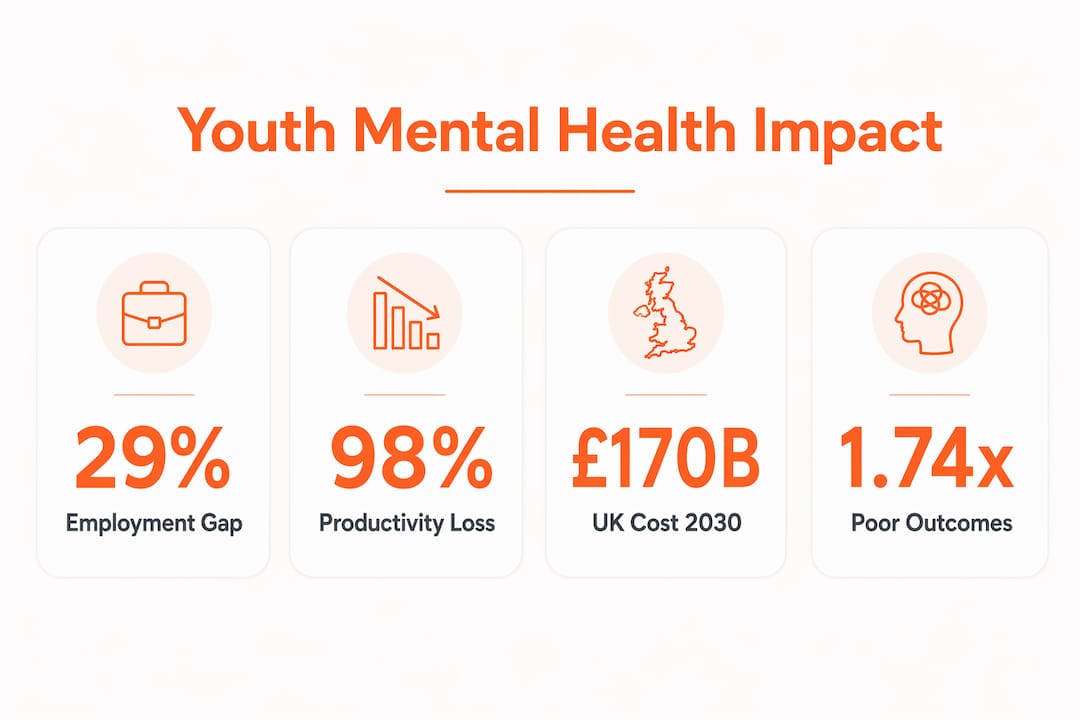
Youth mental health is a direct driver of workforce productivity, not a peripheral concern for HR departments. Mental health related productivity losses in the UK are projected to exceed £170 billion annually by 2030, representing over 5% of GDP. The dominant cause is not short-term sick days. It is long-term workforce inactivity among young people who disengage from education and employment entirely. For employers, managers, and educators, understanding how youth mental health impacts productivity is the first step toward reversing a trend that is quietly draining organisations and communities alike.
How youth mental health impacts productivity: the statistical case
The numbers connecting youth mental health to productivity are stark and specific. A systematic review found that mental health problems in childhood and adolescence increase the odds of poorer adult educational outcomes by a factor of 1.84 and poorer labour market outcomes by a factor of 1.74. That means a young person who struggles with anxiety, depression, or emotional dysregulation before age 18 is nearly twice as likely to face barriers to employment as an adult. The compounding effect on workforce supply is significant.
Mental disorders including depression and anxiety often emerge during adolescence and are directly correlated with school dropout, social marginalisation, and reduced future workforce participation. This is not a temporary dip in performance. It is a structural withdrawal from the labour market that begins in the classroom and follows young people into adulthood.
The UK data makes the productivity mechanism clearer. Mental health challenges create a 29 percentage point employment gap, with affected individuals showing an employment rate of 53% compared to 82% for those without conditions. That gap is one of the widest globally. It signals that the problem is not primarily about presenteeism or reduced output on the job. It is about young people never entering the workforce in the first place.

| Productivity loss driver | Contribution to total losses |
|---|---|
| Reduced workforce participation (long-term inactivity) | 98% of total losses |
| Short-term sickness absence | 2% of total losses |
The table above reframes the conversation entirely. Managers who focus only on sick-day counts are measuring the wrong thing. The real cost accumulates invisibly, in the form of young people who are simply not there.
How do labour market conditions worsen youth mental health?
Labour market instability and youth mental health form a feedback loop that is difficult to break once it starts. Labour economist Professor David Bell at the University of Stirling links rising NEET rates to labour market instabilities, arguing that precarious work conditions, high youth unemployment, and limited career pathways are worsening mental health outcomes across the UK. NEET stands for young people not in education, employment, or training. It is the clearest indicator of disengagement.
The NEET population carries a disproportionate mental health burden. Approximately 1 in 8 UK youth fall into NEET status, and mental health conditions are significantly more prevalent in this group than among their employed or enrolled peers. Once a young person becomes economically inactive due to mental health issues, the longer they remain so, the less likely they are to re-engage with employment or education. The window for intervention narrows fast.
For employers and educators, the practical implications are direct:
- Young workers in precarious or zero-hours contracts report higher rates of anxiety and depression than those in stable roles.
- Youth who experience early job loss or repeated rejection are more likely to withdraw from job-seeking entirely.
- NEET status in early adulthood predicts lower lifetime earnings, reduced tax contributions, and higher public health costs.
- Educators who fail to flag early warning signs miss the last structured opportunity to intervene before a young person exits the system.
Pro Tip: If your organisation employs young people aged 16–25, assign a designated point of contact for mental health conversations before a crisis occurs. A named person lowers the barrier to disclosure significantly.
What role do digital pressures play in youth mental health and performance?
Digital environments are reshaping the mental health conditions that young people bring into classrooms and workplaces. The OECD's 2026 report on child, adolescent, and youth mental health identifies digital device overuse and social media as contributors to disrupted sleep and anxiety symptoms in youth. Disrupted sleep alone degrades concentration, decision-making, and emotional regulation. All three are prerequisites for productive work or study.
The relationship between social media and mental wellbeing is not straightforwardly negative. Platforms can provide peer support, community, and access to mental health resources. But the OECD notes that excessive use correlates with poorer outcomes, particularly for adolescent girls. The question for employers and educators is not whether to ban devices, but how to build the skills young people need to manage digital environments without burning out.
Beyond screens, broader social anxieties are compounding the picture. Climate change, geopolitical instability, and economic uncertainty are sources of genuine distress for many young people. The OECD report advocates for multi-sectoral early interventions that address these layered pressures rather than treating mental health as a single-issue problem. Social-emotional learning programmed in schools and resilience-building workshops in workplaces are two evidence-informed responses. Understanding the full picture, including social media's role in teen anxiety, helps managers and educators respond with context rather than assumption.
How can employers and educators support youth mental health to improve productivity?
Practical support for youth mental wellbeing does not require a clinical background. It requires structure, consistency, and early action. The following approaches are grounded in current evidence and applicable across both educational and workplace settings.
-
Implement mental health literacy training. Managers and teachers who understand the signs of anxiety, depression, and burnout can act before a young person reaches crisis point. Resilience-building and mental health literacy programmed in schools are proven early interventions that reduce long-term productivity deficits. The same logic applies to workplace induction programmes for young hires.
-
Create structured return-to-work pathways. Employees who have been off work for less than 12 months are nearly five times more likely to return to the workforce than this absent longer. Acting within that window is not optional if you want to retain young talent. Phased returns, adjusted workloads, and regular check-ins are the practical tools.
-
Build stigma-free environments. Young people are less likely to disclose mental health struggles in workplaces or schools where they fear judgement or professional consequences. Normalising mental health conversations at team meetings and in classroom settings reduces the silence that allows problems to escalate.
-
Equip managers for first conversations. Most managers have never been trained to open a mental health conversation with a young employee. Resources like first conversation coaching guides give managers a practical framework without requiring them to act as therapists.
-
Engage parents and caregivers early. For young people aged 8–25, the home environment is a critical factor in mental health outcomes. Employers whose staff are parents of struggling teenagers benefit from resources that help families recognise warning signs before a crisis forces a workplace absence.
Pro Tip: Review your current school mental health programme against student feedback. Research shows that the majority of students feel existing programmes do not meet their needs. Closing that gap is where real prevention happens.
Key takeaways
Youth mental health is the single most underestimated driver of long-term workforce productivity loss, and the evidence demands a coordinated response from employers, managers, and educators before young people disengage entirely.
| Point | Details |
|---|---|
| Workforce inactivity is the core cost | 98% of mental health productivity losses come from long-term disengagement, not sick days. |
| Early mental health problems double risk | Youth mental health issues nearly double the odds of poor adult employment outcomes. |
| Labour market instability worsens outcomes | Precarious work and NEET status create a feedback loop that deepens mental health struggles. |
| Digital pressures compound the problem | Excessive screen use disrupts sleep and emotional regulation, reducing performance potential. |
| Early intervention changes the trajectory | Structured support within 12 months of disengagement makes re-engagement five times more likely. |
Why I think we are solving the wrong problem
When I started Thementorwell after losing my daughter Maddie, I kept hearing the same conversation in boardrooms and staffrooms. People were counting sick days, tracking absences, and measuring presenteeism scores. They were looking at the wrong data entirely.
The young people I have spoken with over the years did not disappear from work or school because they had a bad week. They disappeared because no one caught the signals weeks or months earlier, when a conversation could still have changed the outcome. The 98% figure on workforce inactivity is not an abstraction to me. It represents young people who were already struggling long before they stopped showing up.
What I have learned is that employers and educators are not powerless. They are often just untrained and unsupported. A manager who knows how to have one honest conversation with a struggling young employee can change that person's entire trajectory. A teacher who recognises emotional withdrawal as a warning sign rather than a discipline issue can keep a student in the system long enough to get help.
The research from the OECD and labour economists like Professor Bell confirms what I have seen directly. The causes are layered: digital pressure, economic instability, social anxiety, and the absence of early support structures. None of those causes are solved by a single wellness app or a poster in the break room. They are solved by people who are willing to pay attention and act early.
Mental wellness is not a soft benefit. It is the foundation on which every other productivity measure sits. If you are an employer or educator reading this, the question is not whether youth mental health affects your outcomes. The question is what you are doing about it before the next young person walks out the door.
— Chris
Thementorwell resources for employers and educators
Youth mental health does not resolve itself without the right support structures in place. Thementorwell was built specifically to help employers, managers, and educators recognise early warning signs and act before a young person reaches crisis point.

The platform offers workshops, coaching, and practical tools including the Teen Signal Check, an assessment designed to identify subtle distress signals in young people aged 8–25. Whether you manage a team of young employees or work with students daily, Thementorwell's resources give you a clear framework for early intervention. For organisations looking to build a structured mental health response, the MentorWell info guide is a practical starting point. When a young person in your orbit is struggling, the time to act is before the absence report lands on your desk.
FAQ
What is the economic cost of youth mental health on productivity?
Mental health related productivity losses in the UK are projected to exceed £170 billion annually by 2030, representing over 5% of GDP. The vast majority of that cost comes from long-term workforce inactivity, not short-term absence.
How does mental health affect a young person's employment chances?
Youth mental health problems nearly double the odds of poor adult labour market outcomes, with an odds ratio of 1.74 for employment difficulties. People with mental health conditions in the UK have an employment rate 29 percentage points lower than those without.
What is NEET status and why does it matter for productivity?
NEET refers to young people not in education, employment, or training. 1 in 8 UK youth fall into this category, and mental health conditions are significantly more prevalent in this group. Long-term NEET status is a primary driver of lifetime productivity loss.
How can managers support young employees with mental health challenges?
Structured return-to-work support, mental health literacy training, and stigma-free workplace cultures are the three most effective approaches. Employees who receive support within 12 months of disengagement are nearly five times more likely to return to work.
How does social media affect youth productivity and mental wellbeing?
Excessive digital device use is linked to disrupted sleep and heightened anxiety in young people, both of which reduce concentration and emotional regulation. The OECD recommends multi-sectoral early interventions rather than blanket restrictions on digital access.
Recommended
- When Your Employee’s Teen Is in Crisis: A Leadership Test for HR and CEOs — THE MENTOR WELL
- 95% of Students Said School Mental Health Programs Fail Them — THE MENTOR WELL
- Mental Health Belongs on LinkedIn. Here Is Why Your Business Depends on It. — THE MENTOR WELL
- A Father’s Story: Loss, Mental Health & The Mentor Well — THE MENTOR WELL