
TL;DR:
- Creating a peer support network for young employees begins with defining scope and connecting to formal referral pathways before supporting anyone. Proper training, supervision, leadership backing, and clear boundaries are essential for sustainable success, with small pilots advised initially. Connecting youth to clinical care and managing supporter burnout ensures programs stay effective and safe over time.
You can create a safe, effective peer support network for young employees right now. The first move is not a policy document or a budget request. It is a conversation. Define who you are trying to reach, set clear role limits from day one (peer supporters are not therapists), and connect the network to a formal referral pathway before a single peer conversation happens.
The Canadian Mental Health Association (CMHA) identifies training, supervision, clear boundaries, and organisational backing as the non-negotiable foundations of any workplace peer support programme. Peer Support Canada adds that visible leadership commitment is the single most critical factor for long-term success. The MentorWell offers workshops, coaching, and the Teen Signal Check assessment to help parents and employers act before a crisis arrives.
Start this week:
- Identify your audience: employees in the youth and young adult range, the job types included, and whether support will be in-person, virtual, or both.
- Name one owner for the programme and one clinical liaison connected to your Employee Assistance Program (EAP) or a community service.
- Contact CMHA or Peer Support Canada for orientation materials.
- Set a date for your first peer-supporter recruitment conversation.
Pro Tip: Do not wait for a perfect policy before you start. A two-page handbook and one trained peer supporter is a programme. Waiting for perfect is how the window closes.
Table of Contents
- What does a 30/60/90-day launch look like?
- How do you scope, govern, and launch the network?
- How do you select and train peer supporters?
- What can peer supporters do, and what are the legal lines for youth?
- How do you connect peer support to EAPs and manage a crisis?
- How do you keep peer supporters from burning out?
- How do you measure whether the network is working?
- Practical templates to get you started
- Key takeaways
- What I would do differently
- The MentorWell can help you take the first step
- Authoritative Canadian sources and next steps
- FAQ
What does a 30/60/90-day launch look like?
| Phase | Who | Actions | Time estimate |
|---|---|---|---|
| Days 1–30 | HR lead or parent organiser | Define scope, recruit 2–5 peer supporters, draft a short handbook, schedule training | 4–8 hours total |
| — | Peer supporters + clinical liaison | Complete core training, set supervision cadence, integrate EAP referral paths, run mock conversations | 2–8 hours total |
| — | All stakeholders | Measure early use, gather anonymous feedback, iterate handbook, brief leadership on resourcing | 2–4 hours per review |
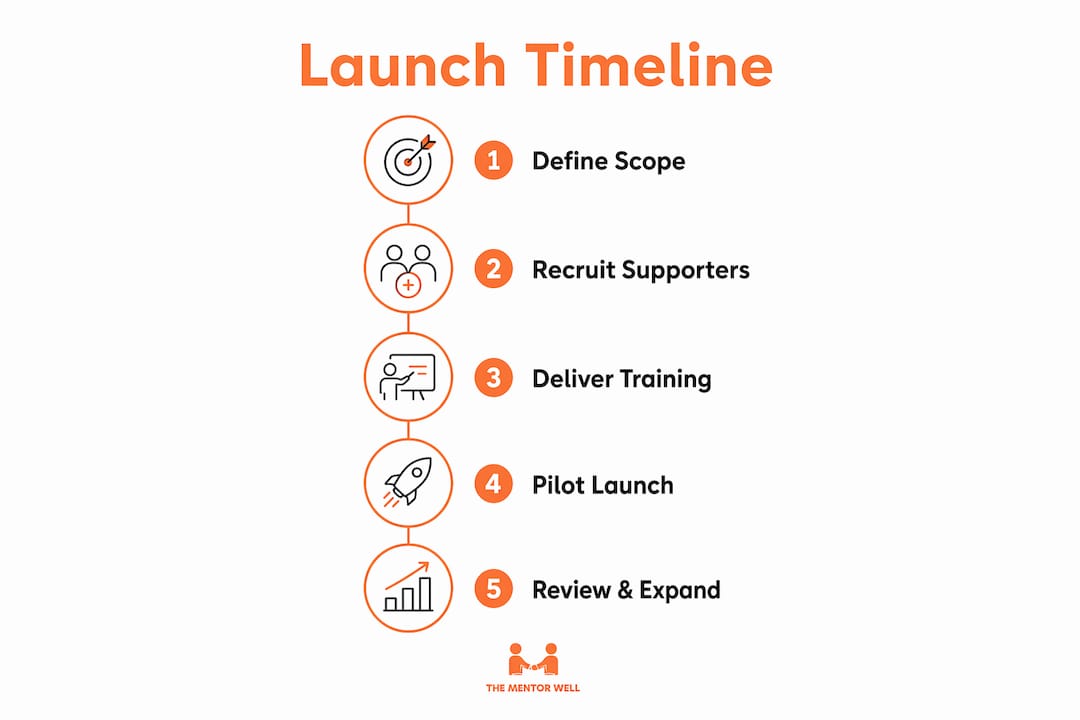
Keep the pilot small. A small number of peer supporters and participants is enough to learn from. Expand only after the first 90-day review.
How do you scope, govern, and launch the network?
A peer support network for young employees needs a clear boundary before it needs anything else.
Scope decisions to make first:
- Age range and job types included (the 8–25 range spans very different legal and developmental realities; see the consent section below).
- Contact modes: in-person drop-in, scheduled virtual sessions, or a secure messaging channel.
- Operating hours and response-time expectations.
Governance:
Assign one programme owner with protected time. Secure a written commitment from senior leadership, because organisational commitment is what keeps peer supporters from burning out when the programme gets hard. Appoint a clinical liaison, whether that is an internal EAP contact or an external community partner, who peer supporters can reach within 24 hours.
Documentation before launch:
- A short handbook covering purpose, roles, confidentiality, escalation steps, and training schedule.
- A signed role agreement for each peer supporter.
- A confidentiality statement that every participant receives.
- A documented escalation protocol with named contacts.
Launch checklist: run a 30-minute orientation session, send a plain-language communications note to all eligible staff, open a simple sign-up process, and set a pilot evaluation date at 90 days.

How do you select and train peer supporters?
Selection matters more than most employers expect. The wrong person in the role, even a well-meaning one, can do harm.
Selection criteria:
- Voluntary participation only. Never assign this role.
- Relatable lived experience or demonstrated empathy, not credentials.
- Trustworthiness and discretion, assessed through a brief interview.
- No direct management authority over the people they will support.
- Representation across cultures, languages, and backgrounds, because inclusive peer support requires peer workers who share meaningful lived experience with the people they serve.
Recruitment tip: use opt-in language. "We are looking for people who want to be a safe ear for a colleague" lands differently than "we need volunteers."
Training curriculum (aligned with MHCC guidelines):
- Active listening: full attention, no interrupting, paraphrasing to confirm understanding.
- Confidentiality and role boundaries.
- Recognising signs of crisis in youth.
- Referral procedures: EAP, Kids Help Phone, and local clinical services.
- Self-care and supporter wellbeing.
Delivery: a short orientation session covers basic guidance; a 2–8 hour core workshop covers the full curriculum. Annual refreshers keep skills current.
Statistic callout: A systematic review of youth peer support programmes found peer support improves young people's attitudes toward disclosure and help-seeking, though the authors noted the overall evidence base remains limited and recommended ongoing evaluation.
Pro Tip: Active listening is a skill, not a personality trait. Teach it explicitly, practise it in role-plays, and assess it before a supporter goes live.
What can peer supporters do, and what are the legal lines for youth?
Peer supporters are listeners and connectors. That is the whole job.
What they do:
- Check in, listen without judgement, and help a colleague feel less alone.
- Share information about available resources (EAP, Kids Help Phone, community services).
- Escalate to a clinical liaison when a concern exceeds their role.
What they do not do:
- Diagnose, counsel, or provide therapy.
- Keep secrets about imminent risk.
- Act as a line manager or performance reviewer.
Age-specific considerations for the 8–25 range:
- Under 18: parental or guardian consent is generally required before a minor participates in a formal programme. Check your provincial privacy legislation and workplace policy.
- 18–25: standard adult privacy rules apply, but many young adults in this group are still navigating their first workplace. Clear, plain-language confidentiality statements matter.
- Mandatory reporting: peer supporters must know that confidentiality has limits. If a young person discloses abuse or imminent risk of harm to themselves or others, the supporter must escalate immediately. This is not optional and must be documented in the role agreement.
Document these limits in writing. Every peer supporter signs the role agreement before their first conversation.
This article is general information, not legal or clinical advice. Confirm current provincial requirements with a qualified professional or your provincial child welfare authority.
How do you connect peer support to EAPs and manage a crisis?
Peer support without a referral pathway is a dead end. The connection to formal care is what makes it safe.
| Escalation level | Triggers | Immediate steps | Referral contacts |
|---|---|---|---|
| Low concern | General stress, isolation, work adjustment | Listen, validate, share EAP info | EAP provider, peer supporter check-in |
| Moderate concern | Persistent distress, withdrawal, declining function | Notify clinical liaison, encourage EAP contact | EAP, Kids Help Phone, community mental health |
| Imminent risk | Expressed suicidal ideation, self-harm, or threat to others | Stay with the person, contact clinical liaison immediately, call 911 if needed | 911, crisis line, EAP crisis support |
Numerous federal departments receive EAP services through Health Canada. If you are outside the federal system, ask HR for your provider's name and crisis line number before you launch.
Recordkeeping: log contact dates and referral actions without identifying clinical details. Store records securely, limit access to the clinical liaison and programme owner, and follow your provincial privacy rules.
How do you keep peer supporters from burning out?
Peer supporters carry weight. Without structure, they carry it alone.
Statistic callout: Peer Support Canada advises that formal organisational support, including dedicated time and visible leadership backing, is the primary safeguard against supporter burnout and the top determinant of programme sustainability.
Supervision model: the clinical liaison or an external community partner holds weekly or bi-weekly check-ins with peer supporters, especially in the first three months. Monthly group debriefs let supporters process difficult conversations together.
Workload safeguards: build in a maximum number of active support relationships per supporter (a reasonable small number is advisable). Create a clear mechanism for a supporter to pause their duties without stigma when they need rest. This is not a nice-to-have. A supporter who is struggling cannot hold space for someone else.
Managers play a direct role here. The role of managers in youth mental health support includes protecting the time and wellbeing of peer supporters, not just the people they serve.
How do you measure whether the network is working?
Measure early and measure simply.
Core metrics:
- Uptake: number of peer support contacts per month.
- Referral rate: percentage of contacts that resulted in an EAP or clinical referral.
- User satisfaction: anonymous pulse survey at 30 and 90 days post-launch.
- Connectedness: self-reported sense of belonging, using a simple 1–5 scale question.
Survey questions to ask youth (anonymous):
- "Did you feel heard during your peer support conversation?"
- "Did you learn about a resource you did not know about before?"
- "Would you use peer support again?"
The CADTH health technology assessment on youth peer support recommends focusing evaluations on recovery-oriented outcomes and involving youth throughout the process. Ask young people what they want measured, not just what is easy to count.
Run a formal review at 90 days. Use qualitative feedback to adapt language, cultural representation, and access modes before expanding.
Practical templates to get you started
Sample handbook outline
- Purpose: what the programme is and is not.
- Roles: peer supporter responsibilities and explicit limits.
- Confidentiality: what is kept private and what must be escalated.
- Escalation protocol: named contacts and trigger levels.
- Training and supervision schedule.
- Sign-up steps for both supporters and participants.
Sample role agreement language
"I understand that my role as a peer supporter is to listen, offer connection, and refer to appropriate resources. I will not provide therapy or counselling. I will escalate any concern involving imminent risk to [clinical liaison name] immediately. I will maintain confidentiality except where mandatory reporting obligations apply."
Adapt this language for participants under 18 to include parental consent language and reference your provincial child welfare reporting requirements.
Starter scripts
Check-in script: "Hey, I noticed you seemed a bit off today. I'm not here to pry, but I'm around if you want to talk. No pressure."
Referral script: "What you're describing sounds like more than I can help with on my own. There's a resource called [EAP/Kids Help Phone] that's confidential and free. Would it be okay if I shared their number with you?"
These scripts are grounded in recovery-based practice. Adapt the language to your workplace culture and the age of the person you are supporting. Always check your local labour and child welfare rules before finalising any written materials.
Key takeaways
A peer support network for young employees works when it is scoped clearly, trained properly, supervised consistently, and connected to formal clinical care from day one.
| Point | Details |
|---|---|
| Scope and role limits first | Define who is included, set written role limits, and get a signed agreement before any peer conversation happens. |
| Training is non-negotiable | Cover active listening, confidentiality, crisis recognition, and referral procedures; annual refreshers keep skills current. |
| Connect to EAPs and crisis lines | Link every peer supporter to an EAP contact and Kids Help Phone before launch; imminent risk always escalates immediately. |
| Supervision prevents burnout | Weekly or bi-weekly check-ins with a clinical liaison, plus a clear mechanism to pause duties, protect supporter wellbeing. |
| The MentorWell as a starting point | The MentorWell's workshops, coaching, and Teen Signal Check give parents and employers a structured way to act before a crisis arrives. |
What I would do differently
I remember sitting in a waiting room after Maddie was gone, thinking about all the moments I had read as "just a phase." The quiet at dinner. The shorter answers. The way she stopped asking me to come to things.
Peer support would not have replaced the clinical care she needed. Nothing replaces that. But a peer, someone her age who had been through something similar and knew how to say "I see you," might have kept a door open long enough for us to walk through it together.
What I would do differently is not wait for a crisis to build the connection. I would have normalised the conversation earlier, at school, at work, at home. I would have made sure there was someone trained to listen before the silence got too loud.
That is why I believe in this work. Not because it fixes everything. Because sometimes early connection changes the trajectory before anyone realises the trajectory has changed.
The MentorWell can help you take the first step
Building a peer support network takes structure, and most employers and parents are starting from scratch. The MentorWell offers practical workshops for workplaces and families, one-on-one coaching for HR leads and parents, and the Teen Signal Check assessment, a digital tool designed to help you spot early warning signs in youth aged 8–25 before they become a crisis.
These services map directly to the steps in this guide: workshops cover training and role clarity, coaching supports governance and supervision planning, and the Teen Signal Check gives you a structured way to assess what you are seeing at home or at work. Packages are available for both employers running a formal programme and parents navigating this on their own. Visit The MentorWell to find the right starting point for your situation.
Authoritative Canadian sources and next steps
For parents:
- Kids Help Phone — 24/7 crisis and support line for youth.
- CMHA workplace peer support factsheet — start here for programme design basics.
- Mental health support checklist for families — a practical checklist to use at home.
For HR leads and employers:
- Peer Support Canada — training standards, organisational guidance, and a national network.
- Mental Health Commission of Canada — guidelines for peer support practice and training.
- CCOHS Young Workers Zone — psychological health and safety guidance specific to young workers.
- Canada.ca EAP resources — find your federal EAP provider.
- Role of peer support in the workplace — how peer support complements your existing resources.
For small employers: read the CMHA factsheet first, then contact Peer Support Canada for a consultation before you spend anything on training.
FAQ
What is the first step to create a peer support network for young employees?
Define your scope and assign one programme owner before recruiting anyone. Connect the network to an EAP or clinical referral pathway on day one.
Do peer supporters need professional mental health credentials?
No. Peer supporters need lived experience or relatable empathy, basic training in active listening and crisis recognition, and a clear escalation path to clinical care.
How do you handle consent for employees under 18?
Parental or guardian consent is generally required for minors in a formal programme. Document this in your handbook and confirm requirements with your provincial privacy authority.
How long does it take to launch a pilot?
A small pilot with 2–5 trained peer supporters can be operational within 60–90 days, following the 30/60/90-day checklist in this guide.
How does The MentorWell support peer support programme development?
The MentorWell offers workshops, coaching, and the Teen Signal Check assessment to help employers and parents build early-detection and peer support capacity for youth aged 8–25.