
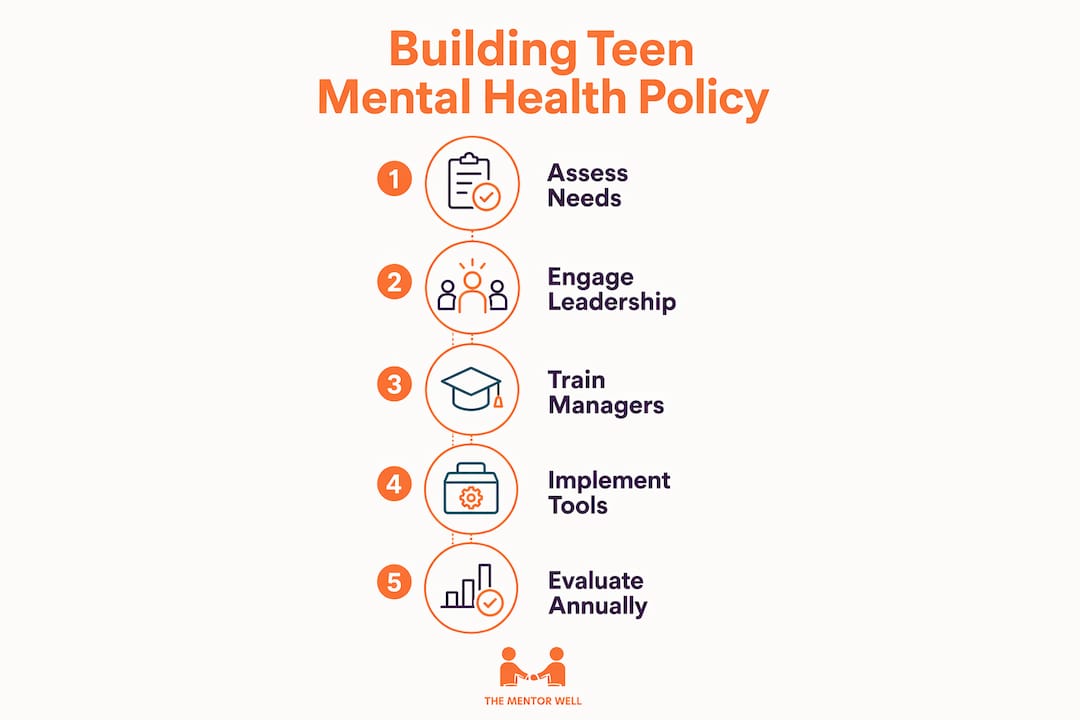
Building an effective teen mental health policy in a Canadian workplace starts with one honest admission: most workplaces were not designed with young people in mind. The National Standard of Canada for Psychological Health and Safety in the Workplace gives employers a voluntary but authoritative framework to assess psychosocial risks before launching any programme. From there, the core elements of a youth-focused policy look like this:
- Psychological safety: Create conditions where teens can speak without fear of judgment or career harm.
- Stigma reduction: Train leaders and peers to normalise mental health conversations openly.
- Flexible accommodations: Offer predictable scheduling and workload adjustments for young workers.
- Leadership engagement: Require managers to model openness and complete mental health training.
- Early intervention tools: Use structured assessments to catch distress signals before they become crises.
- Cultural sensitivity: Build policies that reflect the diversity of your youth workforce, including newcomers and underemployed youth.
- Ongoing evaluation: Measure policy effectiveness regularly and adjust based on what you find.
- Community collaboration: Connect teen employees to external mental health professionals and Canadian community resources.
None of this is complicated in theory. In practice, it asks something harder: the willingness to pay attention before the window closes.
Table of Contents
- How to build a supportive workplace culture for teen mental health
- Practical ways to promote mental wellness among young workers
- How leadership reduces stigma and opens the door for young staff
- Early identification and community tools that actually reach teen workers
- The MentorWell is built for exactly this moment
- Key takeaways
- FAQ
How to build a supportive workplace culture for teen mental health
Psychological safety is not a perk. Under the Canada Occupational Health and Safety Regulations, employers are legally required to take reasonable action in creating and maintaining psychologically healthy workplaces. For teen employees, that obligation carries extra weight.
4.6 million youth in Canada require mental health support annually. Young Canadians report poor mental health at roughly twice the rate of older Canadians, with underemployed youth and newcomers facing steep barriers. These are not abstract numbers. They are the young people already working your shifts.
Building a culture that actually holds them requires more than a poster in the break room:
- Use inclusive, non-clinical language in all workplace communications about mental health.
- Offer positive, specific feedback regularly so young workers feel seen, not just evaluated.
- Keep scheduling predictable. Erratic hours are a documented stressor for youth in precarious employment.
- Train all staff to recognise early distress signals: withdrawal, missed shifts, declining performance.
- Involve teen employees in shaping the mental health programmes meant to serve them.
Culture is what happens when no one is watching the policy document. Get the daily habits right, and the policy follows.
Practical ways to promote mental wellness among young workers
Resilience is not something teens either have or don't. It builds, or it erodes, depending on what surrounds them at work. Employers who want to support teen mental wellness need to move beyond Employee Assistance Programmes that most young workers never use.
Young workers increasingly view comprehensive therapy coverage as a baseline expectation, not a bonus. That shift matters when you are designing benefits. Consider:
- Flexible scheduling: Allow shift swaps and reduced hours during high-stress periods like exam season.
- Visible mental health resources: Post benefit information in physical and digital spaces teens actually use, not just the HR intranet.
- Supervisor training: Equip managers with youth-specific communication skills, not generic wellness talking points.
- Peer support programmes: Pair newer young workers with trained peer supporters who understand the pressures of early employment.
- EDI integration: Ensure mental health initiatives explicitly address the experiences of racialized youth, LGBTQ+ teens, and newcomers.
- Resilience activities: Offer structured, optional group activities that build connection without forcing participation.
The goal is not to fix teenagers. It is to stop the workplace from making things worse.
How leadership reduces stigma and opens the door for young staff

57% of employed Canadians would not disclose a mental health challenge at work because they fear what it would cost them professionally. For teen employees, that fear is amplified. They have less job security, less experience reading workplace culture, and more to lose from being labelled.

Leadership is the single most powerful variable here. When a manager says plainly, "I've struggled with anxiety, and I got help," the silence in the room changes. That is not a communications strategy. It is just honesty, and it works.
Concrete steps for leaders:
- Complete mandatory mental health training before managing young workers, not after a problem surfaces.
- Address mental health explicitly in team meetings, not only in crisis moments.
- Know your legal obligations. Canadian human rights legislation requires reasonable accommodation for mental health conditions, and that applies to teen employees.
- Partner with HR to build clear, confidential reporting pathways that teens trust.
Pro Tip: Embed a brief, optional mental health check-in at the start of weekly team meetings. Even 90 seconds of "how is everyone doing, honestly?" signals that the question is welcome. Over time, that signal accumulates into culture.
Silence isn't safety. Every week a young employee spends wondering whether it's safe to speak is a week the window narrows.
Early identification and community tools that actually reach teen workers
I built The MentorWell after losing my daughter Maddie. What I know now, and wish I had known then, is that the signs were there. They always are. The question is whether anyone in the young person's life has been taught to read them.
Employers currently allocate 86% of mental health budgets to addressing downstream impacts. That means most of the money arrives after the crisis. Shifting even a portion of that investment upstream, toward early identification and prevention, changes outcomes.
Warning signs in teen workers to watch for:
- Sudden withdrawal from colleagues or reduced communication.
- Increased absenteeism or chronic lateness without explanation.
- Visible changes in energy, concentration, or emotional regulation.
- Expressions of hopelessness, even framed as jokes.
The MentorWell's Teen Signal Check is a structured digital assessment designed to help adults, including managers supporting youth mental health, identify subtle warning signs in young people aged 8 to 25. It is built for early action, not crisis response.
Collaboration with community resources extends what any single employer can do. In Canada, options include provincial mental health crisis lines, school-based counsellors for youth still in education, and community health centres offering sliding-scale services.
| Resource type | Workplace application |
|---|---|
| Teen Signal Check (The MentorWell) | Early warning assessment for managers and HR |
| Employee Assistance Programme | Confidential short-term counselling referrals |
| Provincial mental health crisis lines | Immediate support for acute distress |
| Community health centres | Ongoing care for youth without private coverage |
| School-based counsellors | Coordination support for student workers |
Evaluate your policy at least annually. Track utilisation rates, absenteeism data, and direct feedback from young employees. What you measure is what you can improve.
The MentorWell is built for exactly this moment
Most workplace mental health programmes were designed for adults in stable careers. Teen workers, especially those in part-time or seasonal roles, fall through the gaps. The MentorWell was built to close that gap.
The platform offers workshops, coaching, and the Teen Signal Check, a practical tool that gives HR professionals and workplace leaders a structured way to identify early distress signals in youth aged 8 to 25, before those signals become crises. It was founded by Chris Coulter in memory of his daughter Maddie, and every resource on it reflects what early intervention actually looks like when it is taken seriously.
If you are building or revising a youth mental health policy for your workplace, The MentorWell is a concrete next step. Book a workshop, run the Teen Signal Check with your management team, and give your young employees something most workplaces never offer them: someone paying attention early enough to matter.
Key takeaways
Building an effective teen mental health policy in a Canadian workplace requires early intervention, leadership accountability, and structural supports grounded in the National Standard of Canada for Psychological Health and Safety in the Workplace.
| Point | Details |
|---|---|
| Start with national standards | The National Standard of Canada for Psychological Health and Safety in the Workplace is the foundational framework for policy design. |
| Address stigma at the leadership level | 57% of employed Canadians would not disclose mental health challenges due to fear of negative career consequences, making leadership openness non-optional. |
| Shift investment upstream | 86% of mental health budgets address downstream impacts; early identification tools reduce long-term costs and harm. |
| Reach the scale of the need | 4.6 million youth in Canada require mental health support annually, many of them already in your workforce. |
| Use The MentorWell's tools | The Teen Signal Check and workplace workshops give HR teams a structured, early-action approach to youth mental health. |
FAQ
What is the National Standard of Canada for Psychological Health and Safety in the Workplace?
It is a voluntary framework published by the Mental Health Commission of Canada that guides employers in identifying and addressing psychosocial risks at work. It is the most authoritative starting point for any Canadian workplace mental health policy.
Why do teen employees need a separate mental health policy approach?
Young Canadians report poor mental health at roughly twice the rate of older Canadians, and many work in precarious roles with limited awareness of their rights. Standard adult-focused programmes often miss them entirely.
How can HR professionals address mental health stigma among young staff?
Require mental health training for all managers, create confidential reporting pathways, and have leaders speak openly about their own experiences. When leadership models vulnerability, young workers are more likely to seek help.
What early warning signs should managers watch for in teen employees?
Withdrawal from colleagues, increased absenteeism, visible changes in energy or focus, and expressions of hopelessness are key signals. The MentorWell's Teen Signal Check gives managers a structured tool to identify these signs early.
How often should a workplace teen mental health policy be evaluated?
At minimum annually, using utilisation data, absenteeism trends, and direct feedback from young employees to identify gaps and adjust the policy accordingly.