
You already know something is off. You've watched a young employee go quiet in meetings, show up late three days running, or stop asking questions they used to ask constantly. You noticed. Most managers do. The question is what happens next.
The role of managers in youth mental health support is not about becoming a therapist. It is about being the person who doesn't look away. Over 28% of Canadian youth aged 15 to 24 need mental health support every year, yet only 19% access services, leaving the majority without adequate help. That gap lives, in part, inside your workplace. Managers are more influential on employee mental health than pay or benefits. That's not a motivational line. It's a structural reality with real consequences.
Key responsibilities for managers supporting youth mental health:
- Build psychologically safe environments where youth feel comfortable disclosing concerns
- Reduce stigma by normalizing mental health conversations in team settings
- Recognise early warning signs of distress before a crisis develops
- Connect youth to professional resources, including Employee Assistance Programs (EAPs)
- Meet legal obligations under frameworks like Ontario's Accessible Employment Standard (AODA)
- Collaborate with the Canadian Mental Health Association (CMHA) and the Mental Health Commission of Canada framework
How do you build a safe workplace for youth mental health?
Psychological safety is not a poster on a break room wall. It's the feeling a 22-year-old gets when they consider telling you something hard, and they decide it's worth the risk.

Start with clear policies. Zero tolerance for bullying and harassment must be written, communicated, and enforced. Youth employees, particularly those from LGBTQ2S+ communities and racialized backgrounds, are more likely to experience mental health challenges and need to see those protections reflected in actual workplace culture, not just documentation.
Peer support and mentorship programmes make a measurable difference. When a young worker sees someone a few years ahead of them talking openly about stress or asking for help, the permission structure shifts. You can build that by pairing new youth employees with mentors and by making mental health a normal part of team conversations, not a crisis-only topic.
Confidentiality is the foundation. Only 36% of employees would discuss a mental health concern with a manager. That number goes up when trust is consistent, not situational.
Supporting day-to-day mental wellness for young workers
The daily experience of work shapes mental health more than any single programme. Workload, tone, flexibility, and whether someone feels heard — these things accumulate.
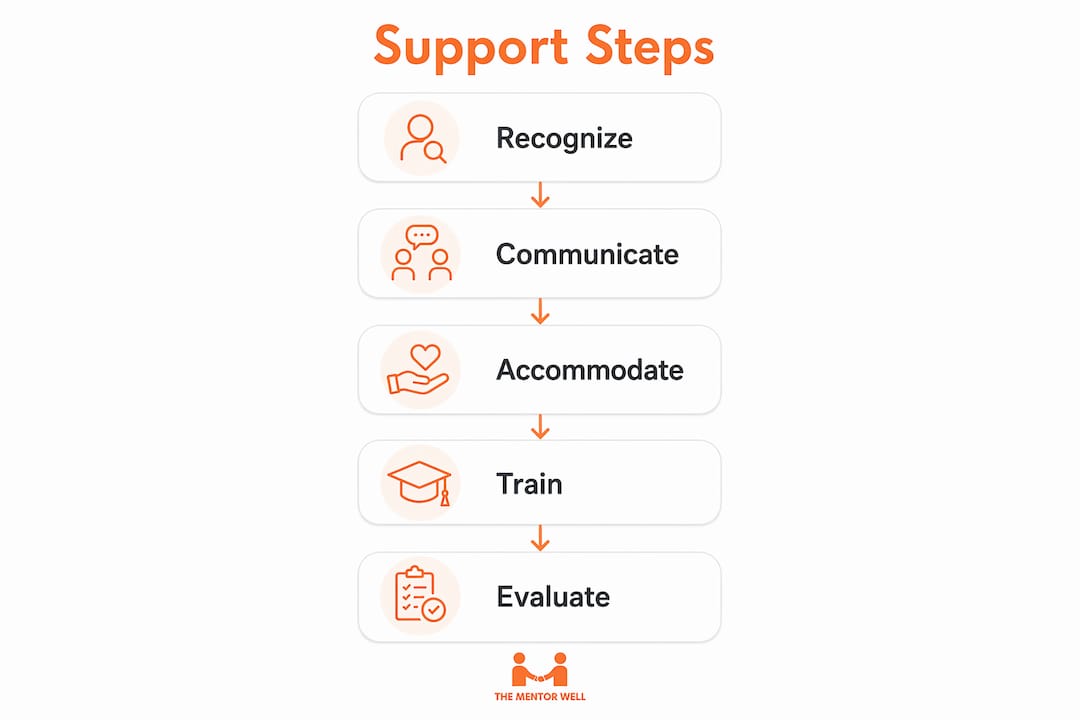
Active listening is a skill, not a personality trait. When a young employee comes to you, put the phone down. Reflect back what you hear. Don't rush to fix it. Young workers in precarious jobs face elevated psychosocial hazards, including job insecurity and unpredictable scheduling, and they often carry that anxiety silently because they don't feel safe enough to say anything.
Practical steps that actually work:
- Schedule brief, regular wellness check-ins, not performance reviews disguised as care
- Adjust workloads during high-stress periods and document those adjustments
- Encourage genuine breaks, not performative ones
- Offer mental health literacy training to the whole team, not just managers
- Empower youth by including them in decisions that affect their work
The mental health impact on productivity is well documented. When young workers feel supported day-to-day, they stay longer, perform better, and ask for help before things get serious.
How do you talk about mental health with a young employee?
This is the conversation most managers avoid. Not because they don't care, but because they're afraid of saying the wrong thing.
The CMHA's Mental Health Works programme is clear: focus conversations on work performance, not on diagnosing what's wrong. If an employee discloses a mental health concern during that conversation, treat it as a secondary effect of the discussion, not the opening you were waiting for. This protects their rights and keeps you out of territory you're not trained to navigate.
A few principles that hold:
- Use one-on-one meetings to build the relationship before any crisis emerges
- Maintain confidentiality every single time, without exception
- Never attempt to counsel or diagnose; your job is to listen and refer
- Remind employees about EAPs and available supports regularly, not just in hard moments
- Normalise mental health conversations in group settings to reduce the weight of individual disclosure
Your role, as the Government of Canada's workplace guidance puts it plainly, is not that of a therapist. It is to demonstrate active listening, empathy, and awareness of available resources. That's it. That's enough, when done consistently.
Pro Tip: Set a recurring five-minute slot at the start of team meetings to acknowledge stress, share a resource, or simply ask how people are doing. It costs nothing and signals that mental health belongs in the room.
What are your legal obligations for mental health accommodations in Canada?
Ontario's Accessible Employment Standard under the Accessibility for Ontarians with Disabilities Act (AODA) sets out specific requirements for how employers must support employees with disabilities, including mental health conditions. This is not optional guidance. It is law.
The CMHA and the Canadian Centre for Occupational Health and Safety (CCOHS) both recommend a person-centred approach to accommodation, meaning you work with the employee to find solutions that fit their actual needs, rather than applying a standard template.
Key accommodation responsibilities for managers:
- Respond to any accommodation request promptly; delayed responses can create legal liability
- Document all requests and every step taken to address them
- Collaborate with the employee on solutions; they must be part of the process
- Cover any costs associated with accommodation, such as physician notes
- Adjust performance appraisal methods to account for mental health needs (written feedback instead of verbal, for example)
- Ensure all team leaders understand their obligation to prevent harassment related to mental illness
| Standard / Framework | Key Requirement | Manager's Role |
|---|---|---|
| Ontario AODA (Accessible Employment Standard) | Accommodate employees with disabilities, including mental health conditions | Respond promptly, document all steps, collaborate on solutions |
| CMHA Mental Health Works | Person-centred, collaborative accommodation | Work with employee to design supports, not impose them |
| CCOHS Psychological Health and Safety | Identify and address psychosocial hazards | Assess workload, job insecurity, and workplace culture |
| Mental Health Commission of Canada | Normalise mental health dialogue | Routine reminders about supports in team and individual meetings |
Early intervention: what to watch for and how to respond
I built The MentorWell because I missed the signs in my own daughter, Maddie. I watched her struggle and told myself she was fine. I was wrong. That is the weight I carry, and it is why I believe so strongly that the people closest to youth, including managers, need practical tools to see what's actually there.
Common early warning signs in young workers:
- Withdrawal from team interactions or social settings they previously enjoyed
- Noticeable decline in work quality or missed deadlines without explanation
- Increased absenteeism or frequent late arrivals
- Visible changes in mood, energy, or concentration
- Expressions of hopelessness, worthlessness, or excessive self-criticism
- Difficulty making decisions or following through on tasks
- Physical complaints like headaches or fatigue with no clear medical cause
Knowing what to look for is only half of it. The other half is having the training to respond without making it worse.
Mental Health First Aid (MHFA), developed by the Mental Health Commission of Canada, is the most widely used evidence-based mental health training in Canada. It gives managers the skills to recognise signs of distress and respond appropriately, without crossing into clinical territory.
Mental Health First Aid training is the most effective single intervention available to managers supporting youth mental health in the workplace. It is practical, evidence-based, and widely available across Canada. Pair it with behavioural staff training to build a team that can respond with consistency and care.
Stigma reduction is part of this work. When managers talk openly about mental health, use accurate language, and share their own experiences with stress or struggle, they lower the threshold for youth to come forward. One in three employees would leave their current job for better mental health supports, and that rate doubles among young Canadians.
For crisis situations, the protocol is clear: if an employee is at risk of harming themselves or others, call 9-1-1 and request responders trained in mental health crisis de-escalation. Then contact your EAP and notify your occupational health and safety coordinator. Do not try to manage a crisis alone.
Evaluating what's working:
| Initiative | What to Measure | How Often |
|---|---|---|
| Mental Health First Aid training | Completion rate, manager confidence | Annually |
| EAP utilisation | Uptake rate, employee feedback | Quarterly |
| Wellness check-ins | Frequency, employee-reported comfort | Monthly |
| Accommodation plans | Timeliness of response, employee satisfaction | Per case |
| Team culture surveys | Psychological safety scores | Bi-annually |
Ongoing evaluation keeps your mental health initiatives honest. Programmes that aren't measured tend to drift. The mental health and workplace safety connection is direct: workplaces that track and adjust their mental health efforts see better outcomes for everyone, especially young workers.
Key takeaways
Managers are the single most influential factor in whether a young worker gets help before a crisis, and that responsibility requires consistent action, not good intentions alone.
| Point | Details |
|---|---|
| Managers outrank pay and benefits | Manager behaviour shapes youth mental health outcomes more than compensation or perks. |
| Only 19% of youth access support | Over 28% of Canadian youth aged 15–24 need mental health support, but only 19% receive services, leaving a substantial number without help. |
| Legal obligations are real | Ontario's AODA requires documented, timely, collaborative accommodation for mental health conditions. |
| MHFA training is the top intervention | Mental Health First Aid, developed by the Mental Health Commission of Canada, is the most effective evidence-based tool for managers. |
| One in three would leave for better support | Young Canadians are twice as likely as older workers to leave jobs that don't prioritise mental health. |
What The MentorWell can do for your team
The MentorWell was built from loss, and from the belief that no manager should have to figure this out alone. The platform offers workshops, coaching, and digital tools designed to help workplaces recognise early signs of youth mental distress and respond before the window closes.
If you manage young people and you want to do this well, start here. The tools are practical. The stakes are real.
FAQ
What is the manager's role in youth mental health support?
Managers are not therapists, but they are the first line of awareness. Their role is to recognise early signs of distress, create psychologically safe environments, and connect youth to professional resources like EAPs.
How can managers start mental health conversations with young employees?
Focus the conversation on observable changes in work performance, not on diagnosing the issue. The CMHA recommends keeping discussions confidential and reaffirming your organisation's commitment to accommodation.
What training helps managers support youth mental health?
Mental Health First Aid, developed by the Mental Health Commission of Canada, is the most widely used evidence-based training in Canada and gives managers practical skills to recognise and respond to mental health concerns.
What does Ontario's AODA require from managers?
The Accessible Employment Standard under the AODA requires managers to respond promptly to accommodation requests, document all steps taken, and collaborate with the employee on solutions tailored to their needs.
How do you know if a young worker is struggling?
Watch for withdrawal from team interactions, declining work quality, increased absences, mood changes, and expressions of hopelessness. These patterns, especially when they shift from a baseline, are worth a quiet, private check-in.