
TL;DR:
- Peer support programs in workplaces are voluntary systems where trained employees provide empathetic, non-clinical mental health connection. They help reduce stigma, encourage early help-seeking, and improve organizational psychological safety by normalizing conversations about mental health. Effective programs are well-structured, supervised, and supported by leadership to prevent burnout and ensure long-term success.
Peer support programs in the workplace are structured, voluntary systems where trained employees use their own lived experience to provide empathetic, non-clinical connection to colleagues facing mental health challenges. The role of peer support programs in the workplace is not to replace therapy. It is to keep the door open long enough for someone to walk through it. A 2026 cross-sectional study of 999 Canadian workers found that stigma-distress odds ratios reach 3.58 in high-risk Psychosocial Safety Climate environments, compared to 2.10 in low-risk ones. That gap is where peer support lives, and where it does its most important work.
How do peer support programs reduce stigma and distress at work?
The mechanism is simpler than most HR frameworks suggest. When a colleague who has been through something similar sits across from you, the shame shrinks. That is not a clinical outcome. It is a human one.
Psychosocial Safety Climate, known as PSC, measures the degree to which workplace policies and leadership behaviours protect psychological health. Research shows that high-risk PSC environments amplify the relationship between stigma and psychological distress significantly. An employee who already feels ashamed of struggling will suffer more in a workplace where that shame is never challenged. Peer support programs directly interrupt that cycle by normalising the conversation.
Peer supporters do not diagnose. They do not advise. Their role is empathetic, lived-experience connection, and that boundary is not a limitation. It is the whole point. A peer who says "I went through something like that" opens a door that a pamphlet never could.
Early intervention is where peer support earns its place in any mental health strategy. Employees are far more likely to disclose distress to a trusted colleague than to a manager or an Employee Assistance Programme counsellor. Peer supporters act as a first point of contact, reducing the time between distress and help-seeking. That window matters enormously.
Key outcomes linked to peer support in Canadian workplaces include:
- Reduced psychological distress among employees in high-stigma environments
- Increased use of Employee and Family Assistance Programmes (EFAPs)
- Stronger trust between employees and leadership
- Earlier identification of employees at risk
- Improved workplace safety climate through open communication
Pro Tip: Before launching a peer support programme, assess your organisation's current PSC level. Workplaces with high stigma and low psychological safety need culture work alongside peer support, not instead of it.
What does a successful peer support program look like?
Structure is what separates a peer support programme that sustains from one that burns out its volunteers in eighteen months.
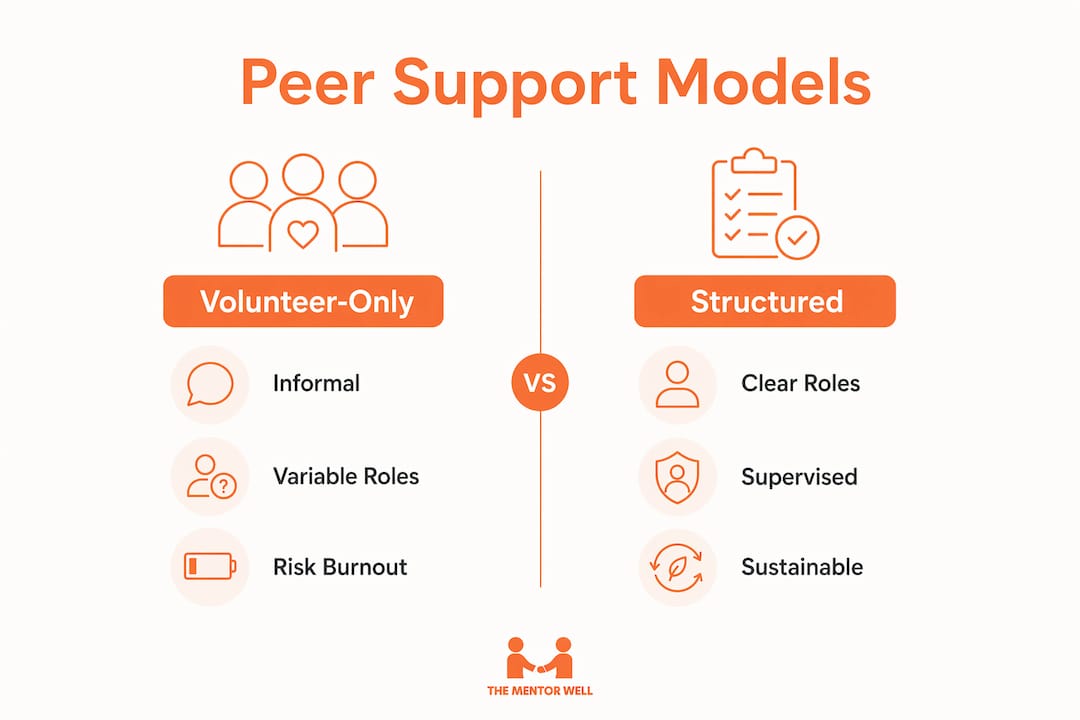
Effective programmes define roles clearly before recruiting anyone. A peer supporter is not a counsellor, a confidant to management, or an informal HR representative. The role boundaries protect both the supporter and the person seeking help. Training must cover active listening, communication skills, conflict resolution, and, critically, how to refer someone to professional help without making them feel dismissed.
The Plan-Do-Check-Act cycle, known as PDCA, gives organisations a practical framework for maturing psychological health and safety programs from initial awareness through to full integration. Most programmes stall at the awareness stage because they never build in a formal review process. PDCA prevents that.
Voluntary participation is non-negotiable. Coerced peer support is not peer support. It is surveillance with a friendlier name.
The table below compares two common programme models:
| Feature | Volunteer-only model | Structured peer support model |
|---|---|---|
| Recruitment | Informal, self-selected | Defined criteria and application process |
| Training | Minimal or inconsistent | Specialised communication and referral training |
| Compensation | None | Fair recognition or micro-credential |
| Supervision | Rare | Regular check-ins with programme lead |
| Burnout risk | High | Managed through structured support |
| Evaluation | Ad hoc | Formal PDCA review cycles |
The volunteer-only model is where most organisations start. It is also where most programmes quietly collapse. Peer supporters carry real emotional weight. Without supervision and recognition, that weight accumulates without relief.
Pro Tip: Involve senior leadership in the programme launch, not just the announcement. Leaders who visibly use mental health resources signal that doing so is safe. That signal travels further than any policy document.
What are the tangible benefits for employers and employees?
The business case for peer support is not complicated. Employees who feel psychologically safe show up more consistently, perform more reliably, and stay longer.
Pratt & Whitney Canada's Inspire programme launched in 2020 and now maintains a network of nearly 300 peer ambassadors. The programme uses employee surveys and focus groups for ongoing evaluation, which keeps it responsive rather than static. That scale did not happen by accident. It happened because leadership treated mental health as a core responsibility, not a wellness add-on.
Workplaces with peer support see reductions in accidents and enhanced overall mental and physical health safety. The mechanism is trust: when employees believe their wellbeing matters to the organisation, they communicate problems earlier, before those problems become crises.
The benefits for employees are direct and measurable:
- Lower rates of psychological distress and burnout
- Greater willingness to seek help through EFAPs and clinical services
- Stronger sense of belonging and connection at work
- Reduced absenteeism linked to mental health
- Improved psychological safety across teams
For employers, the return shows up in retention, productivity, and reduced costs associated with disability claims and turnover. Mental health strategies that include peer support also strengthen leadership accountability. When leaders are trained to model psychological safety, as Pratt & Whitney does, the culture shifts in ways that no policy alone can achieve.
How can employers implement and sustain peer support programs?
Implementation fails most often at two points: the launch, when enthusiasm outpaces planning, and the six-month mark, when the novelty fades and no one has built in a review process.

Securing leadership buy-in before recruiting peer supporters is not optional. If the programme lives only in HR, it will be seen as an HR initiative. That limits its reach and its credibility. Leaders need to understand why the programme exists, what it asks of them, and how they can model the behaviours that make it work.
Recruiting peer supporters requires care. The best candidates are not always the most enthusiastic volunteers. Look for employees who are trusted by their peers, who have navigated their own challenges with some degree of resolution, and who understand the difference between sharing experience and giving advice.
Training must be specialised and ongoing. A one-day workshop is a starting point, not a qualification. The Governor General's Mental Health Learning and Listening Tour found that participants across Canada consistently advocate for micro-credentialed training and fair pay for peer supporters. Volunteer-only models risk burnout. That is not a theoretical concern. It is what happens.
Key implementation considerations:
- Define the peer supporter role in writing before recruiting
- Provide structured training in communication, boundaries, and referral pathways
- Build in regular supervision and debrief sessions for supporters
- Use anonymous feedback channels to evaluate programme effectiveness
- Apply PDCA cycles to review and improve the programme annually
- Recognise peer supporters formally, through compensation, credentials, or both
Sustainability requires treating peer support as a core mental health strategy, not a pilot project. Programmes that survive are the ones where leadership sees the data, adjusts the approach, and keeps showing up.
Key takeaways
Peer support programmes work when they are structured, supervised, and treated as a leadership priority rather than a volunteer initiative.
| Point | Details |
|---|---|
| PSC shapes outcomes | High-risk psychosocial safety climates amplify stigma and distress; peer support directly reduces both. |
| Role clarity prevents harm | Peer supporters provide empathetic connection only; they are not therapists or informal HR representatives. |
| Structure prevents burnout | Volunteer-only models collapse without training, supervision, and fair recognition for supporters. |
| Leadership is the multiplier | Programmes led visibly by senior leaders, like Pratt & Whitney's Inspire, achieve sustainable scale. |
| PDCA drives improvement | Regular review cycles using Plan-Do-Check-Act keep programmes responsive and effective over time. |
What I have learned from watching people carry this alone
I did not build The MentorWell because I had the answers. I built it because I had already seen what happens when the answers come too late.
Peer support is not a programme. It is a decision to pay attention. And I have watched organisations get that decision exactly backwards. They build the structure first and assume the culture will follow. It does not work that way. Culture is what happens in the hallway, in the break room, in the moment someone decides whether or not to say something. The structure only matters if the culture already says it is safe to use it.
The peer supporters I have seen do this work well carry something heavy. They carry it quietly, often without recognition, often without anyone asking how they are doing. That is the part that keeps me up at night. We ask people to hold space for others without building space for them. That is not sustainable. It is not fair. And eventually, it costs someone something they cannot get back.
The most honest thing I can tell you is this: peer support is not a cure. It is a connection. It is the moment between silence and help where someone decides they are not alone. That moment is everything. But it only exists if the person on the other side of it has been trained, supported, and genuinely cared for by the organisation asking them to show up.
Leadership is not a title. It is what you model when no one is watching. If your leaders do not talk about mental health, your peer supporters will be swimming upstream every single day.
Build the programme. Train the people. Pay them fairly. And then ask yourself, honestly, whether your culture is one where someone would actually use it.
That question is harder than any implementation checklist. It is also the only one that matters.
— Chris Coulter
Workplace mental health resources from The MentorWell
The MentorWell was built for exactly this moment. When you know something needs to change but are not sure where to start, or when you have started and need to go deeper. The platform offers workshops, coaching, and educational tools designed for employers and HR professionals who are serious about workplace mental health support that goes beyond policy. Whether you are building your first peer support programme or strengthening one that already exists, The MentorWell provides practical guidance grounded in real experience. Visit The MentorWell to explore resources built for the people who are trying to get this right.
FAQ
What is the role of peer support programs in the workplace?
Peer support programs provide voluntary, non-clinical mental health connection between trained employees who share lived experience. Their role is to reduce stigma, promote early help-seeking, and strengthen psychological safety across the organisation.
How does peer support reduce workplace mental health stigma?
Peer supporters normalise mental health conversations by sharing their own experiences, which lowers the shame associated with seeking help. A 2026 Canadian study found that stigma-distress associations are significantly stronger in high-risk psychosocial safety climates, where peer support has the greatest impact.
What training do peer supporters need?
Peer supporters require specialised training in active listening, communication, boundary-setting, and referral pathways to clinical services. Ongoing supervision and regular debrief sessions are equally important to prevent burnout and maintain programme quality.
How do employers measure the impact of peer support programs?
Employers can use employee surveys, anonymous feedback channels, EFAP utilisation rates, and absenteeism data to evaluate programme effectiveness. Applying PDCA review cycles annually keeps programmes responsive to changing workforce needs.
Can peer support programs work in any size of organisation?
Peer support scales across organisation sizes, from small teams with one trained supporter to large networks like Pratt & Whitney Canada's Inspire programme with nearly 300 ambassadors. The key is matching the programme structure to the organisation's capacity and culture, not copying a model built for a different context.