
The most effective social impact initiatives for early detection of youth mental-health crises combine three things: structured observation tools, low-barrier provincial access points, and employer-funded community supports. Start here, today.
Three actions to take now:
- Use a named early-detection tool. The Teen Signal Check (The MentorWell, ages 8–25) or HEADS-ED (ages 6+) gives you a structured way to observe changes in intensity, frequency, and duration — not just a gut feeling.
- Connect to a low-barrier provincial service. In Ontario, One Stop Talk offers instant access to a therapist, no referral needed. Find your province's equivalent through a local youth wellness hub.
- If you are an employer, launch a small pilot. Three to six months, manager training plus a funded access pathway for employees' families. Measure uptake and time-to-first-appointment. That is your baseline.
Silence is not safety. The window to act is earlier than most parents and employers think.
Table of Contents
- Why do social impact initiatives for early detection actually reduce harm?
- Which detection frameworks can parents, teachers, and managers use right now?
- What do employer and community social impact initiatives look like in Canada?
- What should parents and schools do in the first 72 hours after noticing warning signs?
- How can employers design and measure social impact initiatives that genuinely help?
- Where can Canadian parents and employers find verified resources right now?
- Key takeaways
- What I keep coming back to
- The MentorWell can help you take that first step
- Useful sources
- FAQ
Why do social impact initiatives for early detection actually reduce harm?
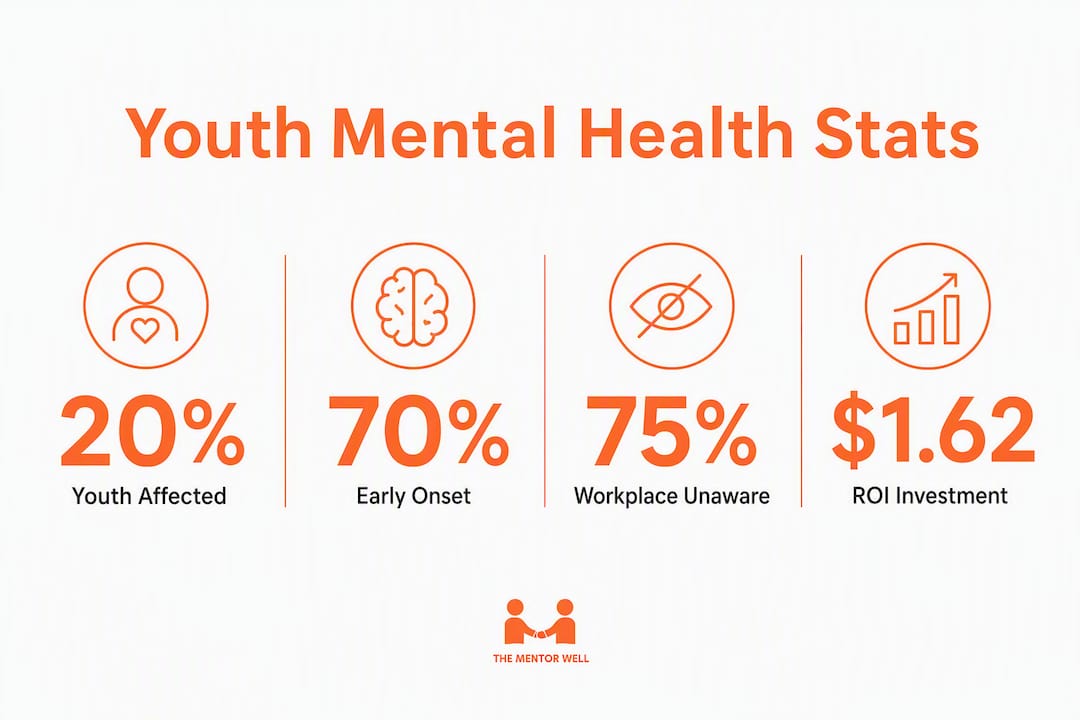
About 1 in 5 children and youth have a mental-health challenge, and roughly 70% of mental-health conditions begin during childhood or adolescence. Early identification and intervention can improve outcomes and reduce the need for more intensive services later. That is not a slogan. That is the mechanism.

On the employer side, the gap is just as stark. The Mental Health Commission of Canada found that 75% of employees are unaware of a workplace mental-health strategy, even when 66% of employers report offering some benefits. Awareness without strategy changes nothing. Employers that pair policy and manager training with a funded access pathway see higher uptake than those that offer benefits alone.
The business case is real too. Deloitte analysis cited by CBC found a median ROI of $1.62 per dollar invested in workplace mental-health programmes, rising to $2.18 for programmes in place three years or more. The absenteeism link to youth mental health is direct: when an employee's child is in crisis, that parent is not fully present at work.
Which detection frameworks can parents, teachers, and managers use right now?
These are screening tools, not diagnostic instruments. Their job is to signal timing and intensity — when to seek professional care, not whether a diagnosis applies.
Core frameworks:
- HEADS-ED (ages 6+): screens for mental-health and substance-use concerns across home, education, activities, drugs, suicidality, emotions, and discharge. An Under 6 version exists for younger children. Both support triage and referral across school, primary care, and community services.
- ONE-CALL (School Mental Health Ontario): a desk reference for school staff that documents behaviour changes and escalates earlier rather than waiting for definitive signs. The key instruction: record changes in intensity and duration, not just presence or absence of a symptom.
- Teen Signal Check (The MentorWell): a low-friction digital assessment for families and employers. Designed for ages 8–25, it flags concerning changes and prompts relational conversations before clinical referral is needed.
What to observe and record:
- Changes in sleep patterns, appetite, or energy lasting more than two weeks.
- Withdrawal from friends, activities, or conversations that used to matter.
- Declining school attendance or grades without a clear academic explanation.
- Increased irritability, tearfulness, or emotional flatness.
- Any mention of hopelessness, worthlessness, or not wanting to be here.
When to escalate immediately: any direct or indirect reference to self-harm or suicide, a sudden calm after a period of distress, or giving away valued possessions. Call a crisis line or use One Stop Talk without waiting.
Pro Tip: Make the first conversation relational, not clinical. "I've noticed you seem tired lately — how are you actually doing?" opens more doors than "I'm worried about your mental health." The goal is to keep talking, not to arrive at a diagnosis.
What do employer and community social impact initiatives look like in Canada?
Corporate funders in Canada are increasingly underwriting community-based supports outside the public system. A named example is Manulife's commitment to expand youth mental-health prevention across Quebec. BGIS and Zurich Canada have directed support toward similar prevention-focused programmes. These are not perks. Funders increasingly view them as necessary infrastructure.
Employer models in practice:
- A bridge funding arrangement with a community provider (such as Kin Wellness) that gives employees' family members rapid, confidential access to therapy outside the EAP.
- Manager training paired with a family care stipend, so employees can access support without disclosing to HR.
- Paid leave pilots tied to a child's mental-health appointment, reducing the hidden cost of presenteeism.
Community models:
The Government of Canada's Youth Mental Health Fund supports mobile outreach, hub expansion, and culturally responsive services for youth aged roughly 12–25 across provinces. School partnerships that embed HEADS-ED and ONE-CALL workflows are the most cost-effective early tier. Every school board in Ontario has funded positions for school mental-health professionals at secondary schools.
Employer checklist before launching a programme:
- Define scope: employees only, or employees' families too?
- Identify a community partner with rapid-access capacity and cultural competency.
- Establish confidentiality protocols independent of HR records.
- Set two or three simple KPIs before you start (uptake rate, time-to-first-appointment, manager confidence scores).
What should parents and schools do in the first 72 hours after noticing warning signs?
The first 24–72 hours matter more than most people realise. Not because the situation is always urgent, but because the conversation you have in that window shapes whether your child stays open or shuts down.
Step-by-step referral path:
- Have a calm, private conversation. Use open questions. Listen more than you speak. Validate before you problem-solve.
- Contact the school counsellor or designated mental-health professional. Ontario schools offer assessment and early intervention through social work and psychology staff — use them before going external.
- If school support is insufficient, use ONE-CALL or HEADS-ED to document what you are observing and request a structured triage.
- Access One Stop Talk (Ontario) or your province's equivalent for immediate, low-barrier therapy.
- If there is any safety concern, call a crisis line or go to the nearest emergency department.
Observation template — record these changes:
- Sleep: falling asleep, staying asleep, sleeping too much.
- Appetite: significant increase or decrease over two or more weeks.
- Mood: persistent sadness, irritability, or emotional numbness.
- School: attendance, grades, engagement with teachers and peers.
- Social: withdrawal from friends, family, or activities they used to enjoy.
A short script for parents: "I've been paying attention, and I've noticed some changes. I'm not here to lecture you. I just want to understand what's going on for you right now." That is enough to start.
On cultural sensitivity: some youth carry additional weight from racism, discrimination, or systemic barriers within school systems. Acknowledge that context directly. Work alongside the student and their family to address contributing factors, not just symptoms. School Mental Health Ontario is explicit on this point.
How can employers design and measure social impact initiatives that genuinely help?
Start small. A three-to-six month pilot that ties manager training to a funded access pathway for employees' families is enough to generate real data. Managers who understand the difference between stress, mental-health challenges, and mental illness are more confident to act and less likely to mishandle a disclosure.
Sample pilot timeline:
| Phase | Timeline | Key activities |
|---|---|---|
| Design | Weeks 1–4 | Select community partner, set KPIs, brief HR and managers |
| Launch | Weeks 5–8 | Manager training, communicate access pathway to staff |
| Monitor | — | Track uptake, time-to-first-appointment, absenteeism |
| Evaluate | Week 24 | Review KPIs, gather employee confidence scores, decide on scale |
KPIs that actually matter:
- Uptake rate: percentage of eligible employees or family members who access the pathway.
- Time-to-first-appointment: target under five business days for a bridge provider.
- Manager confidence score: pre/post training self-assessment.
- Absenteeism trend: compare the pilot cohort to the prior six-month baseline.
Privacy note: bridge programmes work best when they are structurally independent from HR. Confidentiality fears are the primary reason EAPs go unused. An independent community provider removes that barrier.
Where can Canadian parents and employers find verified resources right now?
For parents and educators:
- HEADS-ED documentation — Knowledge Institute on Child and Youth Mental Health and Addictions
- ONE-CALL desk reference — School Mental Health Ontario
- School Mental Health Ontario parent resources — noticing concerns and local referral guidance
- One Stop Talk — instant therapist access in Ontario, no referral required
- Youth Wellness Hubs Ontario — free, community-based services
- Family mental health support in Canada — overview of government and locally funded services
For employers:
- Mental Health Commission of Canada — workplace strategy reports and the National Standard of Canada for Psychological Health and Safety in the Workplace
- Youth Mental Health Fund — federal funding for community hubs and mobile outreach
- Mental health resources for young employees — benefit design and bridge programme examples
Three actions to take this week:
- Download the Teen Signal Check at The MentorWell and complete it for the young person you are concerned about.
- Call your local integrated youth service hub or One Stop Talk to understand wait times and intake requirements before you need them urgently.
- If you are an employer, set a 6-week pilot start date and identify one community partner to contact this week.
Key takeaways
Early detection through structured tools and low-barrier community access is the most effective way for Canadian parents and employers to prevent youth mental-health crises from escalating to emergency care.
| Point | Details |
|---|---|
| Start with structured tools | HEADS-ED, ONE-CALL, and Teen Signal Check give you a framework for observation before a crisis develops. |
| 70% of conditions begin in youth | Early identification reduces the need for intensive services later, according to School Mental Health Ontario. |
| Employer strategy gap is real | 75% of employees are unaware of a workplace mental-health strategy despite benefits being offered. |
| Bridge programmes outperform EAPs | Independent community access points overcome confidentiality fears that keep employees from using standard EAP benefits. |
| The MentorWell as a starting point | The Teen Signal Check and employer workshops give parents and HR teams a low-friction first step toward early detection. |
What I keep coming back to
Most parents I talk to did not miss the signs because they were not paying attention. They missed them because they did not have a framework for what they were seeing. A quiet kid. A dropped sport. A door that stayed closed a little longer each week. Those things look like adolescence until they don't.
I built The MentorWell because I know what the other side of that dismissal looks like. The Teen Signal Check is not a diagnostic tool. It is a prompt. It asks you to slow down and look at what has actually changed, not just what feels off. That distinction matters in practice.
The community development programmes and school-linked supports described in this guide are not abstract social change projects. They are the difference between a family that catches something early and one that ends up in an emergency room at 2 AM wondering how they got there.
If you are an employer reading this, your employees' children are part of your workforce's mental-health reality. A parent in crisis is not a productive employee. A bridge programme is not a perk. It is a practical response to a problem that is already costing you.
You do not need a perfect programme. You need a first step.
The MentorWell can help you take that first step
The MentorWell offers employer workshops on youth mental-health early detection, live and on-demand parent coaching, and the Teen Signal Check — a free digital assessment that helps families identify subtle warning signs in youth aged 8–25 before a crisis develops. Workshops are designed for HR teams and managers who want a practical, evidence-informed approach, not a one-hour awareness session that changes nothing.
Canadian employers working with Manulife, BGIS, and Zurich Canada have directed resources toward exactly this kind of prevention-focused programming. The MentorWell is built to support that work at the family and workplace level.
Start with the Teen Signal Check or reach out to book a workshop for your team.
Useful sources
- HEADS-ED — Knowledge Institute on Child and Youth Mental Health and Addictions
- ONE-CALL desk reference — School Mental Health Ontario
- Noticing mental health concerns for your child — School Mental Health Ontario
- Prevention and early intervention — School Mental Health Ontario
- Child and youth mental health — CMHA Ontario
- Mental Health Commission of Canada workplace mental health report
- Youth Mental Health Fund — Canada.ca
- Manulife youth mental-health prevention commitment
- Workplace mental health ROI — CBC News
- CSA Group: Navigating the Mental Health Crisis in Canada
Further reading for employers: The CSA Group public policy report on workplace mental health provides a detailed analysis of employer investment gaps and proposed national strategy frameworks relevant to Canadian HR leaders.
Further reading for parents: School Mental Health Ontario's parent-facing resources and the CMHA Ontario child and youth mental-health pages are the most practical starting points for understanding local referral pathways.
To find a local integrated youth service hub: search "Youth Wellness Hubs" plus your province, or contact your local Children's Mental Health Ontario member agency directly.
FAQ
What is the Teen Signal Check and who is it for?
The Teen Signal Check is a free digital assessment from The MentorWell for parents and caregivers of youth aged 8–25. It helps identify subtle behavioural and emotional changes that may signal early distress, prompting a relational conversation before clinical referral is needed.
How does HEADS-ED differ from a clinical diagnosis?
HEADS-ED is a screening and triage tool, not a diagnostic instrument. It signals when and how urgently to seek professional care, and helps coordinate referrals across school, primary care, and community services.
What is One Stop Talk and is it available outside Ontario?
One Stop Talk provides instant, low-barrier access to brief therapy for children, youth, and families in Ontario, with no referral required. Similar rapid-access models exist in other provinces; contact your local youth wellness hub to find the equivalent in your area.
Why do most workplace mental-health benefits go unused?
The Mental Health Commission of Canada found that 75% of employees are unaware of a workplace mental-health strategy even when benefits exist. Confidentiality fears and lack of clear communication are the primary barriers; independent community bridge providers address both.
How quickly can an employer launch a meaningful pilot programme?
A focused pilot can be designed and launched within four to eight weeks. The key elements are a community partner with rapid-access capacity, brief manager training, and two or three KPIs set before launch — uptake rate and time-to-first-appointment are the most telling early indicators.