
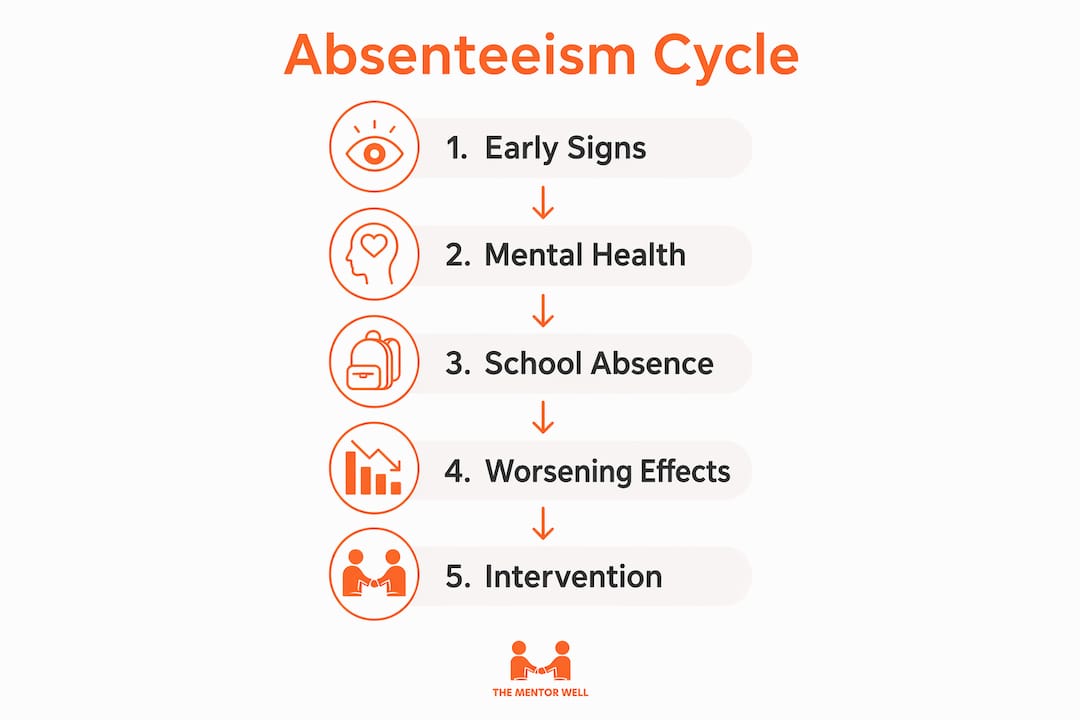
The relationship between school absence and youth mental health runs in both directions. Mental health challenges drive kids out of school. And missing school makes those challenges worse. That is the core of it. Not a theory. A cycle that plays out in classrooms and kitchens and car rides home across Canada every single day.
Absenteeism, in the clinical sense, refers to missing school days in patterns that disrupt learning and development. Chronic absenteeism typically means missing more than 10% of the school year. But the number matters less than what is underneath it. When a teenager stops going to school, something is usually already wrong.
Here is how the connection runs in both directions:
Mental health drives absence:
- Anxiety makes the school building feel genuinely unsafe, triggering school refusal
- Depression drains the energy and motivation needed to get out of bed, let alone attend class
- ADHD, especially when unmanaged, creates repeated failure experiences that make avoidance feel rational
- Trauma responses and mood dysregulation make predictable daily attendance nearly impossible
Absence worsens mental health:
- Social disconnection deepens loneliness and compounds depression
- Falling behind academically creates shame and hopelessness
- Avoidance patterns entrench themselves, making return harder with every passing week
- Loss of routine removes structure that many youth depend on for stability
I know what it looks like when a parent chalks up the absences to laziness or a phase. I did it too. I watched the signals and told myself it would pass. It did not pass for Maddie. That is why I am telling you this plainly, before you have to find out the hard way.
What school absenteeism actually looks like among youth
School absenteeism is not simply skipping class. It exists on a spectrum, from occasional missed days to complete withdrawal from school life, and the form it takes often tells you something about what is driving it.
The most commonly used threshold for chronic absenteeism is missing more than 10% of the school year, roughly 18 or more days. But research and educators increasingly recognise that even sporadic, patterned absences, particularly on Mondays, before tests, or after social conflicts, can signal something deeper. About 30% of Canadian 15-year-olds skipped at least one full day of school within a two-week period as of 2022, a rate that exceeded the OECD average of 20%.
The main forms of school absenteeism include:
- Sporadic absence: Irregular missed days without a clear pattern, often dismissed early on
- Chronic absenteeism: Missing more than 10% of the school year, with compounding academic and social consequences
- School refusal: Emotionally driven refusal to attend, often rooted in anxiety, depression, or trauma, distinct from truancy
- Truancy: Unexcused absence typically associated with conduct issues, though this distinction is frequently misapplied to youth with mental health challenges
- Medical absence: Legitimate physical illness, though mental health conditions are often not counted here even when they should be
The distinction between excused and unexcused absences matters less than schools often assume. A teenager with severe anxiety who stays home with a stomachache is technically absent for a "physical" reason. The stomachache is real. So is the anxiety causing it. Schools that track only unexcused absences miss a large portion of the picture.
Absenteeism is typically measured through attendance registers and reported at the school or board level, but Canada lacks a consistent national framework for collecting and publishing this data. That gap makes it harder to see the full scope of the problem.
Which mental health conditions are most linked to school absence?
The connection between specific mental health conditions and absenteeism is not vague. Certain profiles show up repeatedly in the research, and understanding them helps parents and educators respond to what they are actually seeing rather than what they assume.

Depression is one of the strongest predictors of chronic absence. Low energy, persistent sadness, and the inability to find meaning in daily activities make the act of attending school feel monumental. Youth with depression often describe school as a place where their struggles are visible and their failures are public.
Anxiety disorders, including generalised anxiety, social anxiety, and panic disorder, are closely tied to school refusal. The school environment, with its social demands, performance pressures, and unpredictability, can trigger genuine physiological distress. Absence often functions as a coping mechanism, a way to escape a distressing environment, and is frequently an early symptom of internal emotional dysregulation rather than defiance.
ADHD creates a different pathway. Repeated academic struggles, disciplinary incidents, and social friction accumulate into a pattern of avoidance. When ADHD co-occurs with depression, the effect compounds. Students with both conditions miss more school days over a two-week period than those with ADHD alone or neither condition.
Conduct disorders and externalising behaviours also drive absence, though through different mechanisms. Suspensions, conflicts with teachers, and peer relationship problems create a push away from school rather than a pull toward safety at home.
| Mental health profile | Primary absenteeism mechanism | Compounding risk |
|---|---|---|
| Depression | Low motivation, withdrawal | Social isolation deepens symptoms |
| Anxiety / school refusal | Avoidance of distressing environment | Avoidance patterns entrench quickly |
| ADHD alone | Academic frustration, disciplinary friction | Moderate |
| ADHD with depression | Combined withdrawal and frustration | Higher absence than either condition alone |
| Conduct / externalising | Suspensions, peer conflict | School pushes youth out |
| Trauma / PTSD | Hypervigilance, emotional dysregulation | Unpredictable triggers in school setting |
Parents often interpret these absences through a behavioural lens. "He just does not want to go." "She is being dramatic." That framing is understandable. It is also, in many cases, wrong. The behaviour is real. The cause is internal.
What does the research actually show about this connection?
The evidence is not ambiguous. Longitudinal Canadian research confirms that absenteeism predicts worsening internalising and externalising symptoms over time. A student who misses school early in the year is more likely to show increased mental health difficulties later in that same year. The absence is not just a symptom. It is also a cause.
A large-scale Canadian study found that poor attendance and low grades are closely associated with worse mental health outcomes, including depression and low psychosocial wellbeing. Critically, mental health's impact on academic success extends beyond attendance alone. Even when attendance is controlled for, mental health directly affects how students perform and engage.
Key findings from peer-reviewed research on this connection:
- Absenteeism at one point in the school year predicts increased mental health symptoms at a later point, confirming a bidirectional, not just correlational, relationship
- Internalising symptoms (depression, anxiety) and externalising symptoms (aggression, conduct problems) both independently predict higher rates of absence
- Youth with co-occurring conditions face compounding risks that single-diagnosis models underestimate
- The relationship between mental health and academic outcomes is not fully explained by attendance behaviour, meaning mental health affects learning directly, not only through absence
Youth Mental Health Canada advocates explicitly for shifting away from punitive responses to school absence. The organisation frames school attendance challenges through a disability lens, arguing that accommodation, not discipline, is the appropriate response. This is not a soft position. It is grounded in what the evidence shows about what actually works.
Pro Tip: When a student's absence pattern clusters around specific triggers, such as test days, social events, or transitions back from weekends, treat it as clinical information, not a behavioural problem. That pattern is telling you something about their internal experience.
What happens to youth when absence goes unaddressed?
Missing school is not a neutral event. The consequences accumulate, and they do not stay contained to academics.
Social isolation is one of the earliest and most damaging effects. School is where most teenagers build and maintain their peer relationships. When a young person stops attending, those connections fray quickly. Peers move on. Inside jokes, shared experiences, and the ordinary texture of adolescent social life continue without them. Returning becomes harder not just academically but socially, and the gap widens with every missed week.
Academic underachievement follows predictably. Missed instruction compounds. Assignments pile up. The sense of being permanently behind creates a kind of hopelessness that is hard to reverse without direct support. For many youth, this academic disconnection becomes a reason to stay away rather than a reason to return.
The consequences extend further:
- Increased dropout risk, with chronic absenteeism documented as a well-established pathway to leaving school before completion
- Worsening mental health symptoms as isolation, shame, and academic failure reinforce the original conditions driving absence
- Elevated suicide risk as longer durations of absence deepen psychological barriers and entrench avoidance patterns
- Ripple effects on family dynamics, as parents navigate guilt, conflict, and exhaustion trying to manage a child who will not or cannot attend school
- Reduced community engagement and social confidence that can persist well into adulthood
The window for intervention narrows the longer absence continues. That is not a metaphor. It is what the research shows. Each week of absence makes the return harder, the barriers higher, and the risk greater.
How COVID-19 changed the picture for Canadian youth
The pandemic did not create the connection between mental health and absenteeism. It accelerated it, and it did so unevenly.
One in five Canadian youth who reported good mental health before the pandemic felt their mental health had worsened by 2023. That shift correlated directly with school attendance challenges. The disruption of years of intermittent school closures, remote learning, and social isolation did not simply end when schools reopened. For many children, particularly those in elementary grades, the patterns of irregular attendance that formed during the pandemic persisted long after.
Research on COVID-19's impact on Canadian school absenteeism found that chronic absence rates increased significantly for elementary students from pre- to post-pandemic, with regions that experienced longer school closures showing higher post-pandemic absenteeism. Secondary students, whose absenteeism rates were already high before COVID-19, showed a less dramatic increase, but the baseline was already concerning.
The systemic response in Canada has been uneven. Some school boards have moved toward accommodation-based models. Others continue to rely on attendance policies built around compliance rather than support. The gap between what the evidence recommends and what most schools actually do remains wide. Social and economic factors compound this. Families with fewer resources, less flexible work arrangements, and limited access to mental health services face higher barriers to getting their children the support they need.
How early intervention actually works
The most effective responses to absenteeism tied to mental health share one characteristic: they treat the absence as a signal, not a problem to be punished.
Early identification is the starting point. Schools that track attendance patterns in real time, rather than waiting for chronic thresholds to be crossed, can flag concerns weeks earlier. A student missing one or two days a week for a month is showing a pattern that warrants a conversation, not a warning letter.
Tiered, school-wide support models work better than individual reactive responses. At the first tier, all students benefit from a positive school climate, mental health literacy programmes, and accessible counsellors. At the second tier, students showing early warning signs receive targeted check-ins, modified expectations, or flexible attendance arrangements. At the third tier, youth with identified mental health conditions receive individualised plans developed with families and health professionals.
Family involvement is not optional. Parents and caregivers are often the first to notice the change, the reluctance at the door, the stomachaches that appear every Monday, the withdrawal that happens gradually and then all at once. Family support strategies that build communication and reduce shame at home directly reduce the barriers to school re-engagement.
Mental health professionals, including school psychologists, community counsellors, and paediatricians, play a critical role in bridging the gap between a clinical diagnosis and a school accommodation plan. Early psychosis and mood disorder interventions, such as those offered through teen-focused mental health services, can interrupt the cycle before it becomes entrenched.
Pro Tip: Reframe "school attendance challenge" as a disability requiring accommodation, not a behaviour requiring correction. That single shift in language changes what gets offered and what gets withheld.
The MentorWell's Teen Signal Check gives parents and caregivers a structured way to identify subtle warning signs in youth aged 8 to 25 before those signs become crises. Recognising the pattern early, whether it is a shift in sleep, a change in how a teenager talks about school, or a quiet withdrawal from activities they used to love, is where the work begins. You can learn more about early warning signs and what they look like in practice.
What policy needs to change to actually help
The evidence points clearly toward what works. The gap is in implementation.
Canada lacks a national framework for tracking school absenteeism with consistent definitions and publicly available data. That absence of data makes it nearly impossible to measure the scale of the problem, allocate resources appropriately, or evaluate whether interventions are working. The first policy priority is straightforward: establish national reporting standards for school attendance that include chronic absenteeism rates, disaggregated by age, region, and demographic group.
Beyond data, the structural recommendations from researchers and organisations like Youth Mental Health Canada converge on several points:
- Reframe attendance policy from a compliance model to an accommodation model, recognising that school refusal and chronic absence are often disability-related and require individualised support plans rather than escalating consequences
- Fund school-based mental health services at a level that reflects actual need, including counsellors, psychologists, and social workers with manageable caseloads
- Train educators to recognise the early signs of mental health-driven absence and to respond with curiosity rather than discipline
- Integrate health and education systems so that a diagnosis from a paediatrician or psychiatrist translates automatically into a school accommodation, rather than requiring families to navigate two separate bureaucracies
- Address equity gaps by directing additional resources to schools serving lower-income communities, where the barriers to accessing mental health support are highest and the consequences of untreated absenteeism most severe
The shift from punitive to supportive approaches is not just ethically preferable. It is practically more effective. Suspensions and attendance warnings do not address the underlying mental health conditions driving absence. They add shame and further disconnection to an already fragile situation.
What happens when nothing changes
Untreated absenteeism tied to mental health does not resolve on its own. It compounds.
In the short term, youth fall behind academically and lose social footing. In the medium term, the avoidance patterns that began as coping mechanisms become habitual. The anxiety that once made school feel unsafe generalises to other environments. The depression that made getting out of bed hard in grade nine makes holding a job hard at twenty-two.
The long-term consequences documented in the research are stark. Chronic absenteeism is a well-established pathway to high school dropout. Dropout, in turn, is associated with higher rates of unemployment, lower lifetime earnings, increased risk of involvement with the justice system, and reduced life expectancy. These are not worst-case scenarios. They are documented population-level outcomes.
The mental health consequences are equally serious. Youth who experience prolonged absence without support are at elevated risk for entrenched anxiety and depressive disorders, social phobia, and, as the research confirms, increased suicide risk. The longer the absence continues without a compassionate, structured response, the harder the return becomes and the higher the stakes grow.
I think about this when I think about Maddie. Not the end. The middle. The months when the signals were there and the responses were not quite right. The absences that got explained away. The conversations that did not go deep enough. The window that was open and then, quietly, was not.
You are reading this because you are paying attention. That matters more than most people realise. Paying attention early, before the pattern becomes a crisis, is where the difference gets made. Not in the emergency room. Not in the principal's office. In the kitchen, on a Tuesday morning, when something feels off and you decide to ask instead of assume.
How The MentorWell can help you act early
The MentorWell was built for exactly this moment. Not the crisis. The before.

The Teen Signal Check is a structured assessment for parents and caregivers of youth aged 8 to 25. It helps you identify the subtle shifts in behaviour, mood, and engagement that often precede a mental health crisis, including the early patterns of withdrawal that show up before chronic absenteeism takes hold. It is not a diagnostic tool. It is a way of paying attention with more precision.
The MentorWell also offers workshops, coaching, and community connection for families navigating exactly what this article describes. You do not have to figure this out alone, and you do not have to wait until things get worse to start.
Visit The MentorWell to learn more and access the Teen Signal Check today.
Key takeaways
Youth mental health and school absenteeism are locked in a bidirectional cycle: mental health conditions drive absence, and absence deepens mental health challenges, making early identification and accommodation-based responses the most effective path forward.
| Point | Details |
|---|---|
| Bidirectional relationship | Mental health drives absence, and absence worsens mental health, creating a self-reinforcing cycle. |
| Canadian absenteeism rates | About 30% of Canadian 15-year-olds missed at least one full school day in a two-week period in 2022, surpassing the OECD average of 20%. |
| Co-occurring conditions | Students with both ADHD and depression miss more school than those with either condition alone, showing compounding risk. |
| Post-pandemic shift | A notable proportion of Canadian youth who reported good mental health before the pandemic reported that their mental health had worsened by 2023. |
| Accommodation over punishment | Youth Mental Health Canada recommends treating school attendance challenges as a disability requiring accommodation, not a behaviour requiring discipline. |
FAQ
What is the link between youth mental health and school absence?
Mental health conditions like anxiety, depression, and ADHD are among the leading drivers of school absenteeism in youth. The relationship runs both ways: poor mental health increases absence, and prolonged absence worsens mental health outcomes.
How does missing school affect a teenager's mental health?
Chronic absence deepens social isolation, increases academic shame, and entrenches avoidance patterns that make return harder over time. Research confirms that longer durations of absence are linked to elevated suicide risk and worsening psychological barriers.
How did COVID-19 affect absenteeism and youth mental health in Canada?
Post-pandemic data shows that chronic absenteeism increased significantly among Canadian elementary students, with regions experiencing longer school closures showing higher post-pandemic absence rates. One in five Canadian youth also reported worsened mental health by 2023 compared to before the pandemic.
Is school refusal the same as truancy?
No. School refusal is emotionally driven and rooted in mental health conditions like anxiety or depression. Truancy is typically associated with conduct issues. Treating school refusal as truancy, through punitive responses, misses the underlying cause and tends to make the situation worse.
What can parents do when a teenager starts missing school regularly?
Start with curiosity, not consequences. Ask what the school environment feels like, not just why they are not going. Use structured tools like The MentorWell's Teen Signal Check to identify early warning signs, and connect with a mental health check-in resource to guide the conversation before the pattern becomes entrenched.