
TL;DR:
- Early intervention in youth mental health involves addressing signs of emotional distress before they escalate into crises.
- Parents and schools can play a crucial role by recognizing early signs and maintaining ongoing support and engagement.
Early intervention in youth mental health is defined as identifying and responding to signs of emotional distress in young people before those signs become a crisis. 70% of mental health problems begin during childhood or adolescence. That number should stop you. It means the window to act is not in adulthood. It is right now, in the years you are already living with your teen. Between 18% and 22% of children and youth show mental health difficulties that warrant support. The Mental Health Commission of Canada and School Mental Health Ontario both recognise early identification as the most effective way to reduce long-term harm. This article explains what early intervention means in practice, what signs to watch for, and what you can do today.
What signs in teens indicate the need for early intervention?
The signs are rarely dramatic at first. That is what makes them easy to dismiss.

A teen who stops eating dinner with the family. A young adult who used to text you back within minutes and now goes silent for days. Grades that slip quietly, without any obvious reason. Anger that arrives faster than it used to, over things that would not have mattered before. These are the early signals. Not proof of a crisis. But worth paying attention to.
The difference between typical adolescent behaviour and a concerning pattern comes down to three things: frequency, intensity, and duration. Every teenager has bad weeks. What you are watching for is a shift that holds. A mood that does not lift. A withdrawal that deepens instead of passing.
Common signs that warrant closer attention include:
- Persistent sadness, irritability, or emotional flatness lasting more than two weeks
- Pulling away from friends, family, or activities they used to care about
- Changes in sleep, appetite, or energy that are not explained by illness
- Increased anxiety, worry, or physical complaints like headaches and stomach aches
- Anger outbursts that feel disproportionate or come with self-blame afterward
- Statements about feeling worthless, hopeless, or like a burden
School staff with mental health training are often the first to notice changes in behaviour, emotions, and thinking. That means the school is a partner in this, not just an academic institution.
Pro Tip: Listen more than you speak. When a teen goes quiet, the instinct is to fill the silence with questions or reassurance. Resist it. Sit with them. Let the quiet be safe. What they are not saying is often more important than what they are.
How does early intervention improve outcomes for young people?
Most mental health disorders emerge before age 25. Early support improves long-term health, employment, and psychosocial outcomes. That is not a small claim. It means the timing of support shapes the trajectory of a young person's entire adult life.
Early intervention reduces the need for intensive, long-term care. When distress is caught early, the level of support required is generally lower. The young person has not yet built years of avoidance patterns or lost significant ground in school, relationships, or self-worth.
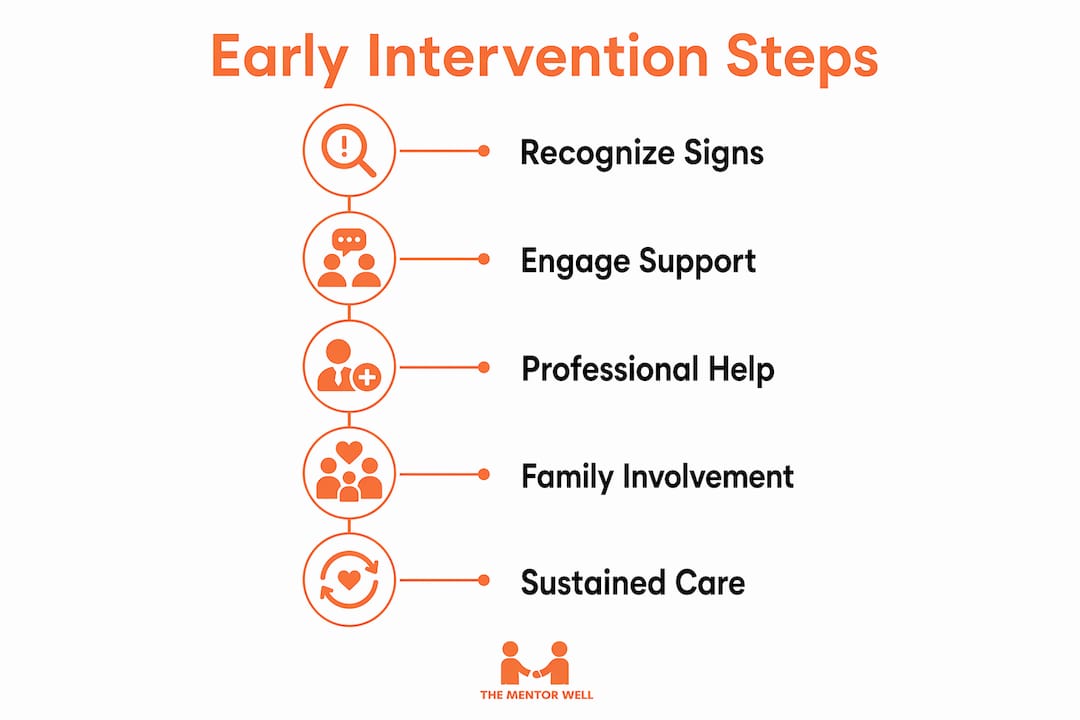
Early intervention is not a one-time fix. It is a sustained process of engagement between the young person, their family, and the people supporting them. Early improvement can be misleading. Many youth need ongoing support well beyond the point where things appear to be better.
The evidence is stronger for some conditions than others. Early psychosis interventions have particularly well-established outcomes, with coordinated care showing clear benefits in reducing relapse and improving functioning. For general distress and anxiety, the evidence is promising but less uniform. That does not mean early support is less valuable. It means the approach needs to match the young person's specific situation.
| Outcome area | What early intervention supports |
|---|---|
| Mental health | Reduced severity of symptoms over time |
| Physical health | Lower rates of stress-related illness |
| Education | Better school attendance and completion |
| Employment | Stronger long-term workforce participation |
| Relationships | Improved social connection and family functioning |
Sustained engagement among youth, family, and providers is what makes the difference. One appointment is not intervention. It is a starting point.
What can parents do to support early intervention at home?
Parents are not bystanders in this process. You are the first line of awareness, and often the reason a young person either reaches for help or pulls further away.
- Create a strengths-based environment. Strengths-based environments help youth feel supported and willing to engage. This means noticing what your teen does well, not just what is going wrong. It means conversations that do not always circle back to problems.
- Reduce stigma at home. Mental health stigma at home is one of the most significant barriers to a young person seeking help. If mental health is treated as something shameful or private, teens learn not to speak. Normalise the conversation before there is a crisis to discuss.
- Know your school's mental health supports. Most schools have referral pathways to counsellors, social workers, or community mental health services. Ask about them before you need them. Knowing the path in advance means you move faster when the moment comes.
- Involve the right people early. This includes teachers, school counsellors, family doctors, and community mental health workers. Early intervention works best as wraparound care involving schools, community supports, and culturally safe frameworks, not therapy alone.
- Stay in it for the long term. Parents often ease off support when their teen seems better. That is a natural response. It is also one of the most common ways early gains are lost. Recovery is not linear. Keep showing up.
Pro Tip: Call your teen's school and ask directly: "What mental health supports do you have, and how do I access them?" Most parents never ask. The ones who do are already ahead.
A family mental health checklist can help you track what supports are in place and where the gaps are. Having that clarity before a difficult moment makes it easier to act when it counts.
What barriers make early intervention harder to access?
Access is not equal. That is a fact worth sitting with.
Geography is one of the most significant barriers. Families in rural and northern communities often wait months for mental health services that urban families access in weeks. Virtual consultation models have shown real promise in supporting rural and Indigenous youth, reducing the distance between a family in crisis and a clinician who can help. Telehealth is not a compromise. For many families, it is the only option that works.
Stigma is the other wall. It operates quietly, inside families, inside communities, inside the teen themselves. A young person who has heard mental health treated as weakness will not ask for help easily. Reducing stigma requires consistent, low-stakes conversations over time, not a single talk after something goes wrong.
Other barriers that come up regularly:
- Long wait times for publicly funded mental health services
- Cost of private therapy for families without extended health coverage
- Cultural and linguistic barriers that make standard services feel unsafe or irrelevant
- Misconceptions that early intervention means something is seriously wrong, leading families to wait and watch instead of act
- Youth resistance, particularly in mid-adolescence, when independence and privacy feel most important
Culturally safe and community-driven approaches address barriers that standard clinical models miss. For Indigenous families and newcomer communities, this is not optional. It is the difference between a service that gets used and one that does not.
Knowing how to find mental health resources online is a practical first step when local services feel out of reach.
Key takeaways
Early intervention in youth mental health works best when it starts before crisis, involves the whole family, and continues well past the first signs of improvement.
| Point | Details |
|---|---|
| Act before crisis | 70% of mental health problems begin in childhood or adolescence, making early action the most effective approach. |
| Know the signs | Watch for persistent changes in mood, behaviour, sleep, or social connection lasting more than two weeks. |
| Reduce stigma at home | Normalising mental health conversations makes it safer for teens to speak before things get worse. |
| Expect ongoing support | Early improvement does not mean recovery is complete; sustained engagement produces better long-term outcomes. |
| Use wraparound care | Schools, community supports, and culturally safe services together produce stronger results than any single resource. |
What I wish I had known sooner
I remember the morning I noticed Maddie was different. Not dramatically different. Just quieter than usual at breakfast. A little slower to smile. I told myself it was a phase. Teenagers have phases. I had read that somewhere, or maybe I just needed to believe it.
The silence I chose in that moment was not safety. It was distance.
What I know now, after years of sitting with that and talking to hundreds of parents who carry the same weight, is that the early signs are almost always visible in hindsight. The question is not whether they were there. The question is whether we let ourselves see them.
Early intervention is not about panicking at every mood shift. It is about paying attention with intention. There is a difference between watching your teen and actually seeing them. One is passive. The other requires you to be present in a way that feels uncomfortable sometimes, because it means acknowledging that something might be wrong.
Parents often mistake early improvement for complete recovery. I have watched families pull back support the moment their teen seemed okay again. I understand the relief that drives that. But the window does not close just because things look better on the surface.
Keep the door open. Keep showing up. Not with alarm. Just with presence.
That is what I would tell the version of me sitting at that breakfast table. Stop waiting for certainty. Certainty comes too late.
— Chris Coulter
How The MentorWell supports families navigating early intervention
The MentorWell was built for exactly this moment. The one where you notice something is off but are not sure what to do next.

The MentorWell offers parents and caregivers practical tools, including the Teen Signal Check, an assessment designed to help you identify subtle warning signs in youth aged 8 to 25. Alongside that, the platform provides youth mental health guidance for families who want to act early and act well. Whether you are trying to understand what you are seeing in your teen or looking for the right words to start a conversation, The MentorWell connects you with resources grounded in real experience and backed by evidence. You do not have to figure this out alone.
FAQ
What is early intervention in youth mental health?
Early intervention is the process of identifying and responding to mental health difficulties in young people before they escalate into a crisis. It involves schools, families, and community supports working together to provide timely, sustained care.
What are the early signs of mental health issues in teens?
Common early signs include persistent mood changes, social withdrawal, disrupted sleep or appetite, increased anxiety, and anger outbursts that feel out of proportion. A pattern that lasts more than two weeks and does not lift warrants closer attention.
Why does early intervention matter for long-term outcomes?
Most mental health disorders emerge before age 25, and early support improves health, education, and employment outcomes over a lifetime. Acting early reduces the need for intensive care later.
How can parents access early mental health resources for their teen?
Start with your teen's school counsellor or family doctor, and ask directly about referral pathways. The MentorWell also offers quick mental health check-ins and family-focused tools to help you identify concerns and take the next step.
Does early intervention mean my teen has a serious mental illness?
No. Early intervention means you are responding to signs of distress before they become serious. Acting early is a sign of awareness, not alarm, and it significantly improves the likelihood of a positive outcome.