
TL;DR:
- A youth mental health crisis involves persistent, widespread symptoms lasting over two weeks that impair functioning. Recognizing early signs and using the 4 Ps framework can help identify when professional support is needed. Immediate action includes direct conversations, safety planning, and emergency helpline contact to prevent tragedy.
A mental health crisis in young people is defined by significant, persistent symptoms that impair their ability to function safely across essential areas of life. Clinically, a crisis involves changes lasting two or more weeks with marked social withdrawal, persistent mood disturbances, and functional decline across multiple settings. Youth self-injury rates in Canada increased 3.5% annually from 2000 to 2024, more than doubling over 25 years. That number tells you this is not a rare event. It is happening in ordinary families, in ordinary towns, and it often goes unrecognized until the window for early action has already closed.
What does a mental health crisis look like in young people?
The signs are rarely dramatic at first. A young person in crisis does not always fall apart visibly. More often, the changes are quiet and gradual, which is exactly what makes them so easy to miss.
The clearest indicators include:
- Persistent sadness or hopelessness that does not lift after a few days, often accompanied by a flat or empty emotional tone
- Anger outbursts or irritability that feel disproportionate to the situation and happen repeatedly
- Social withdrawal from friends, family, and activities the young person previously loved
- Drastic changes in sleep including insomnia, sleeping through the day, or waking repeatedly at night
- Loss of interest in school, sports, hobbies, or any activity that once brought pleasure
- Self-harm behaviours such as cutting, burning, or hitting, which signal that coping strategies have been overwhelmed
- Non-medical use of substances including cannabis, alcohol, or opioids to manage emotional pain
- Physical symptoms tied to anxiety, including nausea, chest tightness, or heart palpitations with no clear medical cause
Self-harm reflects overwhelmed coping strategies and a need for professional support. It is not defiance. It is a young person communicating that they have run out of other options.
Some young people shut down completely. Others act out. Some do both on the same day. The behaviour varies, but the underlying message is the same: something is wrong, and they do not know how to say it plainly.

Pro Tip: Watch for clusters of changes, not single symptoms. One bad week is not a crisis. A pattern of withdrawal, mood shifts, and declining self-care across several weeks is a different matter entirely.
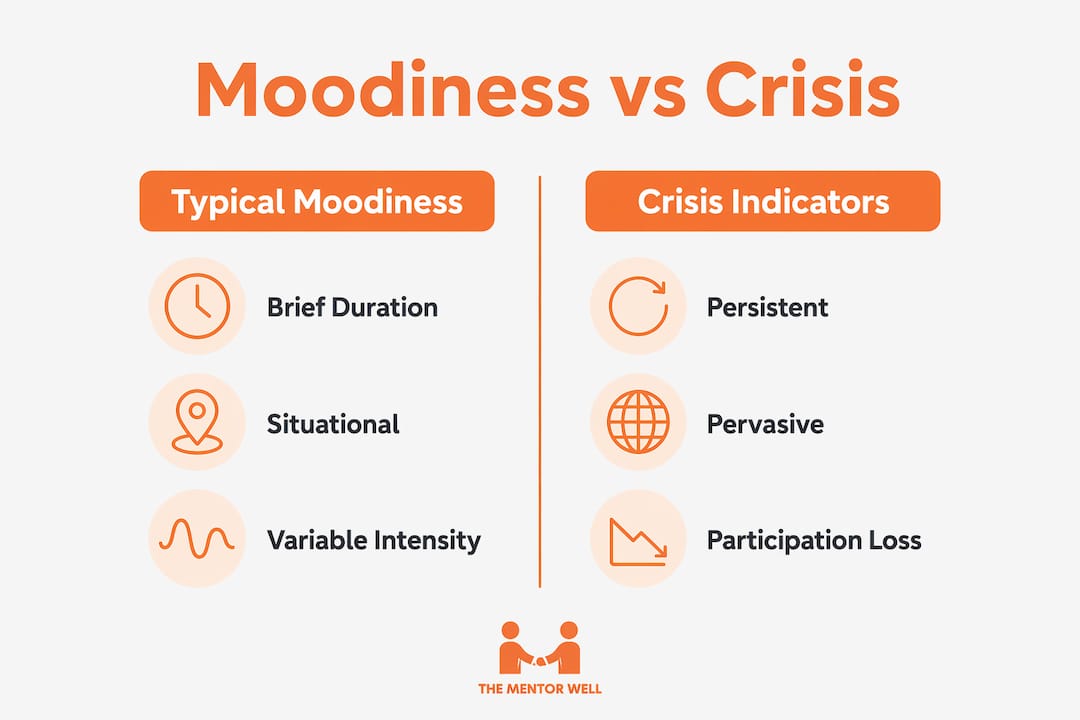
How do you tell the difference between moodiness and a real crisis?
This is the question most parents sit with. And it is a fair one. Adolescence is genuinely hard. Moods shift. Sleep suffers. Friendships collapse and rebuild. Not every dark week is a crisis.
The 4 Ps framework gives caregivers a practical way to tell the difference. Symptoms must be persistent, pervasive, involve participation decline, and show changes in personal care to meet the threshold of a crisis rather than ordinary adolescent stress.
| Typical adolescent behaviour | Crisis indicator |
|---|---|
| Moody for a few days after a conflict | Persistent low mood lasting two or more weeks |
| Sleeping in on weekends | Sleeping through school days or unable to sleep at all |
| Pulling back from one friend group | Withdrawing from all social contact |
| Skipping one activity they used to enjoy | Losing interest in everything they previously valued |
| Irritable after a stressful exam | Explosive anger with no clear trigger, repeatedly |
| Forgetting to shower occasionally | Consistent decline in hygiene and self-care |
One of the least obvious warning signs is sudden calmness. Sudden calmness after intense distress can indicate suicidal planning. A young person who has been in visible turmoil and then appears settled and peaceful may have made a decision. That shift deserves attention, not relief.
High-functioning young people are particularly difficult to read. They attend school, maintain grades, and appear composed. The distress is entirely internal. Parents and educators often describe these young people as "fine" right up until they are not.
Pro Tip: If you are unsure whether what you are seeing is normal development or something more serious, use the 4 Ps as a checklist. Duration and pervasiveness are your clearest guides.
What should you do when you notice signs of a mental health crisis?
Noticing is the first step. Acting on what you notice is the harder one.
-
Start a direct conversation. Ask plainly and without judgment. "I've noticed you seem really low lately. Are you having thoughts of hurting yourself?" Asking directly about suicidal thoughts reduces isolation and does not plant ideas. It opens a door.
-
Listen without fixing. Your job in that first conversation is not to solve the problem. It is to stay present. Resist the urge to reassure too quickly or redirect to solutions. Let them speak.
-
Build a simple safety plan. Identify one or two trusted adults the young person can contact when distress rises. Reduce access to means of harm where possible. Know the next step before you need it.
-
Use emergency resources for acute risk. For immediate crises involving suicide planning, active self-injury, or a break from reality, call 988 or go to emergency. Canada's 988 Suicide Crisis Helpline operates 24 hours a day, seven days a week. Do not wait to see if it passes.
-
Connect to community and cultural supports. Family connection, trusted community members, and cultural practices all reduce crisis risk. For Indigenous youth especially, connections with Elders and time on the land carry protective weight that clinical care alone cannot replicate.
For parents navigating these conversations for the first time, The MentorWell's teen crisis prevention guide offers step-by-step support grounded in real family experience.
Pro Tip: You do not need to have the right words. You need to show up and stay. A young person who knows one adult will not flinch is already in a safer position than one who feels entirely alone.
Understanding the broader context of youth mental health crises in Canada
The numbers are not abstract. 7.8% of grade 11 students reported non-medical opioid use in 2024. That is nearly one in twelve young people in a single grade, using substances to manage pain that has nowhere else to go.
Mental health and substance use do not sit in separate categories for young people. They are deeply intertwined. Treating mental health and substance use together produces better outcomes than requiring sobriety before mental health care begins. Separating them in treatment is a clinical error that costs young people time they do not have.
Social and academic pressure accelerates crisis onset. The pressure to perform, to belong, and to appear fine online creates a specific kind of exhaustion that is hard to name and harder to ask for help with. Stigma compounds this. Young people who fear being labelled or dismissed stay quiet longer than they should.
"Community protective factors, including cultural connections and relationships with Elders, significantly buffer youth crisis risk beyond what clinical care alone can provide." — Nisichawayasihk Cree Nation
Access to mental health resources remains uneven across Canada. Rural and remote communities, Indigenous communities, and low-income families face the longest waits and the fewest options. The gap between need and available support is not a minor inconvenience. For a young person in acute distress, it can be the difference between intervention and tragedy.
Families navigating these gaps can find practical guidance through The MentorWell's mental health support resources, which address both crisis response and longer-term family support strategies.
Key takeaways
A mental health crisis in youth is defined by persistent, pervasive changes across behaviour, mood, and functioning that last two or more weeks and require direct, informed action from the adults around them.
| Point | Details |
|---|---|
| Duration matters most | Symptoms lasting two or more weeks across multiple settings signal a crisis, not typical moodiness. |
| The 4 Ps framework guides recognition | Persistent, pervasive symptoms with participation decline and personal care changes distinguish crisis from normal development. |
| Sudden calmness is a warning sign | A young person who becomes calm after intense distress may have made a suicidal decision and needs immediate attention. |
| Ask directly about suicidal thoughts | Non-judgmental, direct questions reduce isolation and open the door to honest disclosure. |
| Community and culture protect | Cultural connections, family presence, and trusted community members reduce crisis risk alongside clinical care. |
What I wish I had known sooner
I used to think a crisis would announce itself. That there would be a moment, clear and unmistakable, where I would know something was wrong and know exactly what to do.
Maddie did not give me that moment. Or maybe she did, and I did not recognise it for what it was.
She seemed fine. That is the word that stays with me. Fine. She was going to school. She was laughing at dinner. She was doing the things a person does when they are managing. And underneath all of it, she was drowning in something I could not see because I was not looking in the right places.
I have sat with parents who describe the same thing. The child who was "fine" right up until they were not. The conversation they wish they had started earlier. The question they were afraid to ask because they did not want to plant an idea, not knowing that asking the question is the one thing that might have kept the door open.
What I know now is that silence is not safety. A young person who appears calm and composed is not necessarily okay. And the adults who matter most are not the ones with the right answers. They are the ones who stay in the room when it gets uncomfortable.
You do not need to fix it. You need to be there. That is where it starts.
— Chris Coulter
How The MentorWell supports families facing youth mental health crises
The MentorWell was built for exactly this moment. The one where you have noticed something, you are not sure what it means, and you do not know what to do next.

The platform offers workshops, coaching, and tools like the Teen Signal Check, an assessment designed to help parents and caregivers identify subtle warning signs in youth aged 8 to 25. The MentorWell also connects families globally through a community built on shared experience, not clinical distance. Whether you are a parent reading the signs for the first time or an educator looking for structured guidance, the resources at The MentorWell are grounded in real family experience and Canadian research. You do not have to figure this out alone.
FAQ
What is a mental health crisis in youth?
A mental health crisis in youth is defined by persistent, pervasive symptoms lasting two or more weeks that impair functioning across school, home, and social settings. Key signs include social withdrawal, drastic mood changes, self-harm behaviours, and significant changes in sleep or self-care.
How do I know if my child is in crisis or just being a teenager?
Use the 4 Ps framework: symptoms must be persistent, pervasive, involve participation decline, and show changes in personal care to indicate a crisis rather than typical adolescent stress. Duration and severity across multiple settings are the clearest guides.
Should I ask my child directly if they are thinking about suicide?
Asking directly about suicidal thoughts reduces isolation and does not increase risk. Non-judgmental, direct questions open the door to honest disclosure and can save a young person's life.
When should I call 988 or go to emergency?
Call 988 or go to the nearest emergency department immediately if a young person is actively planning suicide, engaging in serious self-injury, or experiencing a break from reality. Canada's 988 Suicide Crisis Helpline is available 24 hours a day, seven days a week.
What role does culture play in supporting youth mental health?
Cultural connections, relationships with Elders, and time spent on the land provide protective factors that reduce crisis risk in Indigenous youth beyond what clinical care alone can offer. Community belonging is a genuine buffer against crisis escalation.