
TL;DR:
- Persistent changes in teens' mood, behavior, or functioning across multiple life areas signal emotional distress.
- Parents should respond with calm, regulate themselves first, and validate their teens' feelings to foster trust and openness.
If you think your teen is struggling, the single most important thing you can do right now is sit with them, stay calm, and say: "I've noticed things feel hard lately. I'm here." That one sentence keeps the door open.
Emotional distress in teenagers means a persistent change in mood, behaviour, or functioning that affects more than one area of life — home, school, friendships — and lasts longer than a few days. The Canadian Mental Health Association describes it as a pattern of change, not a single bad moment.
If your teen is in immediate danger, call 911. For crisis support any time, contact Kids Help Phone at 1-800-668-6868 or text HELLO to 686868. Crisis Services Canada is available 24/7 at 1-833-456-4566.
Table of Contents
- How do you recognise early signs of emotional distress in teens?
- What do leadership and mentorship look like at home?
- What should you actually say? Scripts for tonight
- What are the red flags that mean you need help now?
- How can tools and workshops help you catch things earlier?
- A simple plan: what to do in the next 24 hours, week, and month
- Key takeaways
- What I would do differently
- How The MentorWell supports families through early intervention
- Trusted Canadian resources
- FAQ
How do you recognise early signs of emotional distress in teens?
The most telling signal is not one dramatic moment. It is persistent change across two or more areas of your teen's life — home, school, and friendships — lasting several weeks.
Watch for these specific signs:
- Mood shifts: Irritability, tearfulness, or a flat affect that is new and stays
- Social withdrawal: Pulling away from friends, skipping activities they used to love
- Academic decline: Missed assignments, skipping class, or a sudden drop in grades
- Sleep and appetite changes: Sleeping far more or far less, eating noticeably differently
- Loss of interest: Hobbies, sports, or music they once cared about go quiet
- Increased risk behaviours: Substance use, reckless choices, or self-harm
At home, this might look like a teen who used to talk at dinner and now eats in their room. At school, it might be a teacher's note about absences. Online, it can show up as a sudden shift in what they post, or a complete disappearance from platforms they were active on.
One more thing worth knowing: many teens present a "parent persona" — performing fine to protect you from worry, while hiding what is actually happening. Surface compliance is not the same as genuine wellbeing.
Cultural context matters here too. In many Canadian families, emotional distress may be expressed through physical complaints like headaches or fatigue rather than direct statements about feelings. Some teens from communities where mental health stigma is strong will go to great lengths to appear functional. Trust what you observe over time, not just what they say.
What do leadership and mentorship look like at home?
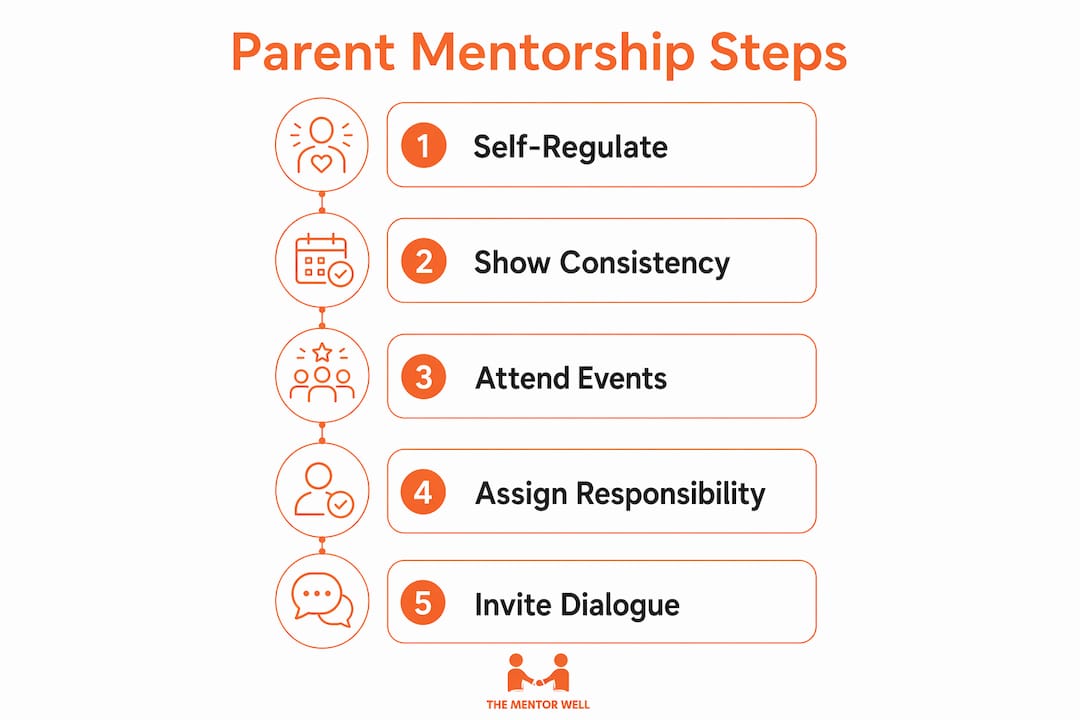
The single most effective thing you can do as a parent is regulate yourself first. A regulated parent is the primary safety signal a distressed teen receives. Your calm is not passivity. It is the condition that makes real conversation possible.
Authoritative parenting — warmth combined with clear expectations — consistently outperforms authoritarian control when it comes to keeping teens connected. High standards matter. So does psychological autonomy. The difference is whether your teen feels judged or held.
In practice, this means showing up consistently. Attending the things they care about, even briefly. Assigning responsibilities that signal you believe in their capability. Setting clear rules while adjusting expectations as they grow. Gentle monitoring — being present and curious — works better than surveillance. Heavy investigation tends to increase secrecy, not reduce it.

The shift from managing to mentoring older teens is real and necessary. Advice offered without invitation lands as criticism. Advice offered when asked lands as support. That distinction changes everything about whether your teen comes back to you.
Pro Tip: Before you start a hard conversation, take 60 seconds alone. Breathe slowly. Name what you are feeling to yourself. You cannot offer calm you do not have.
What should you actually say? Scripts for tonight
Validation comes before problem-solving. Always. A teen who feels heard is far more likely to return for advice. One who feels immediately fixed is more likely to stop sharing.
Do say:
- "I've noticed you seem tired lately. I'm not here to fix anything, just to listen."
- "That sounds really hard. Tell me more."
- "I'm not going anywhere."
Don't say:
- "You have nothing to be sad about."
- "When I was your age..."
- "You just need to push through."
- "Have you tried just not thinking about it?"
Three ready-to-use scripts for getting your teen to talk:
- Quiet check-in (any evening): "Hey. No agenda. Just wanted to sit with you for a bit. How's everything actually going?"
- Crisis pause (when things escalate): "I can see this is a lot right now. I'm not going anywhere. We don't have to solve it tonight."
- Post-argument repair (next morning): "I didn't handle that well last night. I'm sorry. Can we try again?"
When your teen opens up, ask permission before offering solutions: "Would it help if I shared what I'm thinking, or do you just need me to listen right now?" That one question changes the entire dynamic.
What are the red flags that mean you need help now?
Some signs require immediate action, not a wait-and-see approach. Seek help right away if your teen:
| Red flag | Why it is urgent | What to do |
|---|---|---|
| Talks about suicide or wanting to die | Direct risk of harm | Stay with them; call 911 or go to the nearest emergency room |
| Active self-harm with serious injury | Physical danger | Call 911; do not leave them alone |
| Sudden major functional collapse | Possible acute crisis | Call Kids Help Phone or Crisis Services Canada; book urgent care |
| Giving away possessions | Possible suicidal planning | Remove means if safe to do so; call crisis line immediately |
| Psychotic symptoms (hearing voices, paranoia) | Requires clinical assessment | Go to emergency; call your family doctor urgently |
For less acute but still serious concerns, structured pathways to care make a real difference. Start with your teen's school guidance counsellor. Book a visit with your family doctor or nurse practitioner and ask for a mental health referral. In most Canadian provinces, you can also access urgent mental health walk-in clinics without a referral.
A note on privacy: in Canada, teens aged 16 and older can generally consent to their own mental health treatment without parental involvement, though this varies by province. Your family doctor can clarify the rules for your specific situation.
How can tools and workshops help you catch things earlier?
Tools do not diagnose. They help you notice change before it becomes a crisis, and they help you feel less alone in the noticing.
The Teen Signal Check, offered through The MentorWell, is a structured assessment for parents and caregivers of youth aged 8–25. It walks you through observable behavioural and emotional indicators and helps you identify patterns you might otherwise explain away as "just a phase."
Using a checklist or attending a workshop is straightforward:
- Step 1: Complete the Teen Signal Check on your own, honestly, based on what you have observed over the past few weeks.
- Step 2: Note which areas show the most change. These become your conversation starting points, not your conclusions.
- Step 3: Bring your observations to a workshop, a coaching session, or your family doctor.
The MentorWell also offers parent coaching and group workshops that build the specific skills this article covers: regulated communication, early signal recognition, and how to access care in Canada.
Pro Tip: A checklist is most useful when you fill it out on a Tuesday, not during a crisis. Make it a monthly habit, not a panic response.
A simple plan: what to do in the next 24 hours, week, and month
The goal is to stabilise, connect, and organise access to care if needed — in that order.
In the next 24 hours:
- Check in using one of the scripts above. No agenda. Just presence.
- Assess immediate safety. If there is any risk of harm, call Kids Help Phone or 911.
- Write down two or three specific changes you have observed. Dates and details matter later.
In the next week:
- Have a second, quieter conversation. Follow up on what they shared.
- Contact the school guidance counsellor if academic or social changes are visible there too.
- Book an appointment with your family doctor. Mention mental health specifically.
- Consider involving your co-parent or another trusted adult using a shared approach.
Over the next month:
- Monitor mood and behaviour without interrogating. Presence, not surveillance.
- Attend a workshop or complete the Teen Signal Check if you have not already.
- Document changes to share with any clinician involved in your teen's care.
- Check in with yourself. Balancing your own wellbeing is not optional.
Key takeaways
Calm, consistent parental presence combined with early signal recognition and validated Canadian crisis resources is the most effective first response to teen emotional distress.
| Point | Details |
|---|---|
| Act on patterns, not moments | Concern is warranted when change persists across two or more life areas for several weeks. |
| Regulate yourself first | A calm parent is the primary safety signal; your regulated presence enables real conversation. |
| Validate before advising | Listening without fixing keeps teens talking; offer solutions only when invited. |
| Know the red flags | Suicidal talk, active self-harm, or sudden functional collapse require immediate professional help. |
| The MentorWell | Offers the Teen Signal Check, parent workshops, and coaching to support early detection and family skills. |
What I would do differently
I remember a drive home after a bad test. She was quiet in the passenger seat. I filled the silence with reassurance — grades don't define you, you'll do better next time, it's not the end of the world. I thought I was helping.
She nodded. She always nodded.
What I know now is that she wasn't asking me to fix the test. She was sitting in something heavier, and the reassurance told her, without either of us meaning it, that the heavier thing wasn't safe to name.
The blind spot most parents carry isn't indifference. It is the instinct to make things better too quickly. We reach for comfort before we have actually heard what the discomfort is. And teens, who are watching us constantly, learn from that reach. They learn to nod.
If I could go back to that car, I would turn off the radio and say nothing for a while. Then: "How are you actually doing?" And then I would wait. Not for the answer I wanted. For the one she had.
You don't have to get it perfect. You just have to stay in the car.
How The MentorWell supports families through early intervention
When you are trying to figure out whether what you are seeing is serious, and what to do about it, the hardest part is often not knowing where to start. The MentorWell was built for exactly that moment.

The MentorWell offers Canadian families three concrete entry points: the Teen Signal Check (a structured early-warning assessment for youth aged 8–25), parent workshops that build communication and early-detection skills, and one-on-one coaching for caregivers who want guided support. If you are not sure whether your teen needs professional help yet, the Teen Signal Check is the right first step. If you already know something is wrong and need help knowing how to respond, a coaching session gives you a direct, practical path forward.
Visit The MentorWell to complete the Teen Signal Check or book a workshop today.
Trusted Canadian resources
| Resource | Contact | When to use |
|---|---|---|
| Kids Help Phone | 1-800-668-6868 / text HELLO to 686868 | Any time your teen (or you) needs immediate support |
| Crisis Services Canada | 1-833-456-4566 / crisisservicescanada.ca | Adult crisis support, 24/7 |
| CMHA Ontario | ontario.cmha.ca | Signs, symptoms, and local service navigation |
| CAMH | camh.ca | Clinical guidance, parenting resources |
| HealthLink BC | healthlinkbc.ca | BC-based health navigation and parenting tips |
| The MentorWell | thementorwell.com | Teen Signal Check, workshops, coaching |
- CMHA Ontario: child and youth mental health signs and symptoms
- CAMH: tips for building healthy relationships with your teenager
- HealthLink BC: tips for parents of teens
Many Canadian schools and primary care offices can also connect you with culturally attuned local services. Ask your school guidance counsellor or family doctor specifically about culturally specific mental health supports in your community.
This article is general information, not professional medical or mental health advice. For your teen's specific situation, please consult a qualified health professional or contact one of the Canadian resources listed above.
FAQ
What are the first signs of emotional distress in a teenager?
Persistent changes across two or more areas of life — mood, school performance, sleep, appetite, or social withdrawal — lasting several weeks are the clearest early indicators, according to CMHA Ontario.
When should a parent call a crisis line instead of waiting?
Call Kids Help Phone (1-800-668-6868) or Crisis Services Canada (1-833-456-4566) immediately if your teen mentions suicide, is actively self-harming, or shows a sudden and severe decline in functioning.
How does leadership and mentorship help a struggling teen?
Parental leadership grounded in calm, authoritative warmth keeps teens connected and reduces withdrawal. Mentorship that offers advice only when invited, rather than imposing solutions, preserves trust and encourages teens to keep talking.
What is the Teen Signal Check?
The Teen Signal Check is a structured assessment offered by The MentorWell for parents and caregivers of youth aged 8–25, designed to help identify subtle early warning signs before a crisis develops.
Can a teen refuse mental health treatment in Canada?
In most Canadian provinces, teens aged 16 and older can generally consent to or decline their own mental health treatment. Rules vary by province, so confirm the specifics with your family doctor or a local mental health service.