
When one parent carries the weight of a teenager's mental health crisis alone, the whole family feels the strain. The most effective approach to supporting teen mental health is a united parental front, and learning how to involve your spouse in teen mental health support is one of the most impactful steps you can take. Family therapy is now a standard component of adolescent treatment precisely because teens recover better when their home environment is consistent, calm, and collaborative. This guide gives you the practical framework to make that happen.
What does it mean to involve your spouse in teen mental health?
Involving your spouse in teen mental health support is not simply telling them what the therapist said. The clinical term for structured parental participation is family systems involvement, and it covers a spectrum from attending formal family therapy sessions to learning psychoeducation at home.
There are two distinct models parents should understand:
- Family therapy brings the teen, both parents, and a clinician together to address relationship patterns and communication breakdowns within the family unit. Family therapy addresses systemic dynamics that fuel teen struggles, not just the teen's individual symptoms.
- Parent-involved individual therapy keeps the teen's one-on-one sessions private but includes structured caregiver check-ins. This targeted involvement educates parents on how to respond to their teen's reactions at home, producing better outcomes than uninformed involvement.
- Psychoeducation at home means both parents learn about their teen's diagnosis, triggers, and coping strategies so they can reinforce the same language and techniques the therapist uses.
The critical distinction is between support and surveillance. Your teen needs to feel that therapy is a safe, private space. Respecting teen confidentiality in therapy builds trust and keeps teens engaged. Asking your teen to report back on session content pushes them away.
Pro Tip: Frame your spouse's role as "protecting the support system," not "fixing the problem." That single shift in language reduces defensiveness and opens the door to genuine collaboration.
How do you prepare yourself and your spouse to help your teen?
The foundation of effective spouse support for teens is the state of the parental relationship itself. Parents who manage their own stress and communicate effectively create a safer space for teen healing. You cannot pour from an empty cup, and your teen is watching both of you closely.
Start with these preparation steps before you involve your partner in any clinical setting:
- Align privately first. Have an honest conversation with your spouse about your teen's struggles before approaching the teen together. Disagreements aired in front of a struggling teenager increase their distress.
- Manage your own emotional state. Teens rely on adult co-regulation; parental conflict directly worsens teen outcomes. If you and your spouse are in conflict, address that first, even if it means a few sessions of couples coaching.
- Agree on a shared language. Decide together which words you will use around mental health at home. Consistency reduces confusion and signals safety to your teen.
- Seek your own support. Parent coaching, caregiver support groups, and platforms like Thementorwell exist specifically to help parents build the skills they need before they can effectively help their child.
Pro Tip: Schedule a weekly 20-minute check-in with your spouse, separate from any family meetings, to discuss how you are both coping. Keeping your own communication healthy is the single most protective thing you can do for your teen.
Step-by-step guide to involving your spouse in your teen's care

Structured involvement produces far better results than ad hoc participation. The following steps reflect current best practices in family-centred adolescent mental health care.
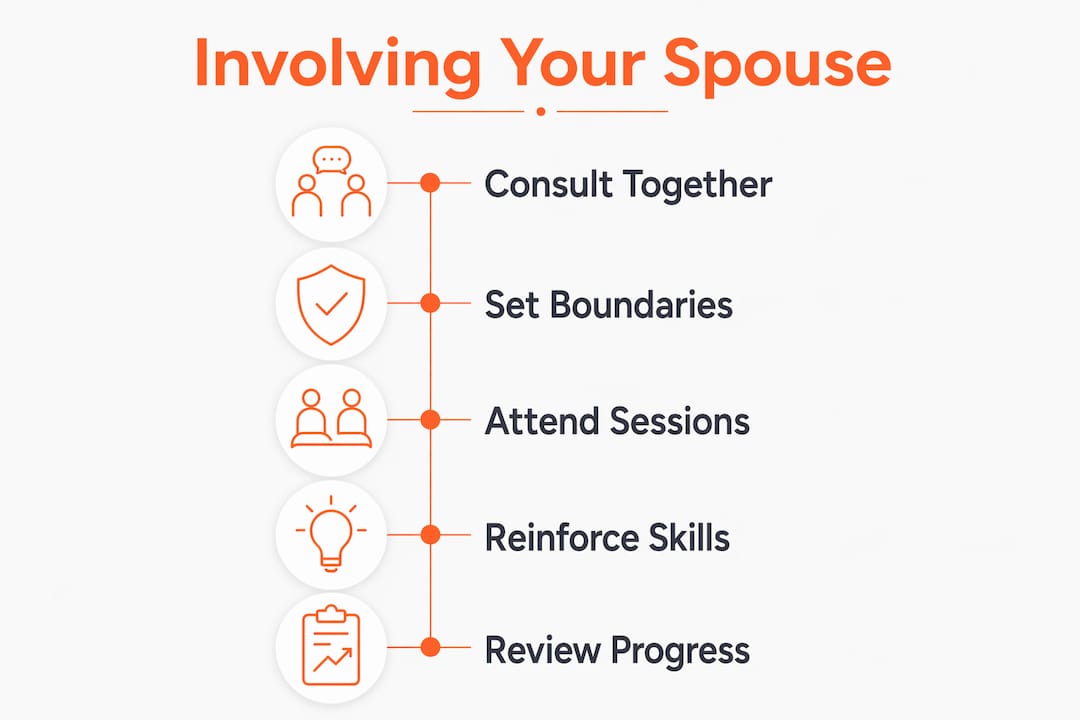
1. Consult a professional together, early
Avoid the "wait and see" approach when signs of distress appear, such as sleep changes, withdrawal, or mood shifts. Book an initial appointment with your teen's primary care provider or a mental health clinician as a couple. Arriving together signals to the clinician and your teen that you are a team.
2. Establish clear boundaries with the clinician
At the first caregiver session, ask the clinician to define what information will be shared with parents and what remains confidential. Clear therapist boundaries improve parent participation without undermining teen autonomy. Write these boundaries down so both you and your spouse refer to the same agreement.
3. Attend family sessions consistently
Inconsistent attendance sends a message to your teen that one parent is less invested. Virtual family sessions that include the teen, both parents, and the clinician are now widely available, removing scheduling barriers. Treat these sessions as non-negotiable appointments.
4. Reinforce skills at home
The table below outlines the four core home-support roles both parents can share:
| Role | What it looks like at home |
|---|---|
| Emotional validator | Acknowledging your teen's feelings without trying to fix them immediately |
| Skill reinforcer | Using the same coping language the therapist introduced, such as breathing techniques or grounding exercises |
| Routine anchor | Maintaining consistent meal times, sleep schedules, and low-conflict evenings |
| Safety monitor | Knowing the warning signs and having a clear plan if the teen's condition worsens |
5. Review progress together regularly
Set a monthly check-in with your spouse to assess what is working at home and what needs adjusting. Bring specific observations, not general concerns, to these conversations. Specificity helps clinicians and your partner respond usefully.
What are the common challenges when involving a spouse?
Even well-intentioned parents run into friction. Knowing the obstacles in advance makes them far easier to navigate.
When your spouse is hesitant or dismissive. Some partners minimize teen mental health struggles, especially if they grew up in households where emotions were not discussed. Framing involvement as protecting your child's support system rather than "going to therapy" reduces defensiveness significantly. Lead with the outcome your spouse cares about, whether that is your teen's grades, friendships, or future, not the clinical process.
When parental conflict spills into the home. Unresolved tension between spouses is one of the most common barriers to teen recovery. If your disagreements are frequent or heated, seek parent coaching or couples support before attending family sessions together. Arriving in conflict does more harm than arriving separately.
When boundaries get crossed. A parent who interrogates a teen after every therapy session, or who shares session details with extended family, erodes the trust that makes therapy work. Review the confidentiality agreement with your spouse regularly and hold each other accountable.
"The goal is not for both parents to become therapists. The goal is for both parents to become a safe place."
If you find that you and your spouse cannot align despite genuine effort, a family therapist or parent coach can mediate. Seeking that support is a sign of strength, not failure. Resources like Thementorwell's early warning sign guides can also help both parents get on the same page about what they are actually observing in their teen.
When your teen resists the process entirely, the article on what to do when your teen refuses therapy offers a practical starting point that most parents find genuinely useful.
Key takeaways
Involving both parents in teen mental health support, through family therapy, shared psychoeducation, and consistent home reinforcement, is the single most effective way to improve a teenager's recovery outcomes.
| Point | Details |
|---|---|
| United parental front | Both parents attending sessions and using consistent language accelerates teen recovery. |
| Know the two models | Family therapy and parent-involved individual therapy serve different purposes; use both where possible. |
| Prepare yourselves first | Parents who manage their own stress and conflict create a safer healing environment for their teen. |
| Respect confidentiality | Never interrogate your teen about therapy content; it destroys trust and disengages them from treatment. |
| Seek support when stuck | Parent coaching and platforms like Thementorwell exist to help parents collaborate more effectively. |
What I have learned about parental teamwork and teen wellness
I built Thementorwell after losing my daughter Maddie. One of the hardest truths I carry from that experience is this: the parents who struggled most were not the ones who lacked love. They were the ones who were not working together.
What I see consistently is that one parent often becomes the "identified worrier" while the other minimises or withdraws. That split is not a character flaw. It is a stress response. But left unaddressed, it leaves the teen caught in the middle, unsure which version of reality to trust.
The parents who make the most difference are the ones who do the uncomfortable work of aligning with each other first. That means hard conversations, admitting fear, and sometimes asking for help as a couple before asking for help as a family. Patience with your spouse is not weakness. It is the foundation your teen is standing on.
If you are reading this and feeling like you are carrying this alone, I want you to know that getting your partner on board is possible. It rarely happens in one conversation. Start small. Share one article. Attend one appointment together. The momentum builds.
— Chris
How Thementorwell supports families through this process
Parenting a teenager through a mental health struggle is hard enough. Doing it while also trying to get your spouse on the same page can feel like two full-time jobs at once.

Thementorwell was built for exactly this moment. The platform offers workshops, coaching, and tools like the Teen Signal Check to help both parents recognise early warning signs and respond as a team. Whether you are just starting to notice changes in your teen or you are already deep in the process, the Thementorwell family resources give you and your spouse a shared starting point. For parents who want tailored guidance, the MentorWell Info Guide connects you with mentors who specialise in family-centred teen wellness.
FAQ
What is the difference between family therapy and parent-involved individual therapy?
Family therapy brings the teen and both parents into sessions together to address relationship patterns. Parent-involved individual therapy keeps the teen's sessions private but includes structured caregiver check-ins to educate parents on supporting their teen at home.
How do I get a reluctant spouse to engage with my teen's mental health?
Frame involvement as protecting your child's support system rather than attending therapy. Positive framing reduces defensiveness and makes it easier for a hesitant partner to take the first step.
Should I ask my teen what happens in their therapy sessions?
No. Respecting your teen's confidentiality in therapy builds the trust that keeps them engaged in treatment. Listen and be available, but avoid asking your teen to report back on session content.
When should both parents consult a professional together?
Consult a professional as soon as you notice signs of distress, such as sleep changes, withdrawal, or mood shifts. Early consultation prevents crises and gives both parents a shared clinical foundation to work from.
What if my spouse and I are in conflict ourselves?
Address parental conflict before attending family sessions together. Parental conflict directly worsens teen outcomes, so seeking couples coaching or parent support first is the most protective step you can take for your teenager.
Recommended
- When Your Employee’s Teen Is in Crisis: A Leadership Test for HR and CEOs — THE MENTOR WELL
- How to Listen to Your Teen Without Pushing Them Away — THE MENTOR WELL
- We Don't Wait to Talk About Cancer. Why Wait for Mental Health? — THE MENTOR WELL
- 7 Subtle Signs Your Child Might Be Struggling (Even If They Say They're Fine) — THE MENTOR WELL