
TL;DR:
- Teen mental health coaching is a short-term, skill-focused process that teaches teens practical tools to manage stress and build resilience. It is non-diagnostic and differs from therapy, which treats clinical mental health conditions and involves diagnosis and treatment. Early coaching supports teens before crises develop and helps create space for honest communication and healthy habits.
Teen mental health coaching is a short-term, goal-focused process that teaches young people practical skills for managing stress, building routines, and strengthening emotional resilience. It is not therapy. It does not diagnose or treat clinical conditions. What it does is meet teenagers where they are, before a crisis, before the window closes, and help them build the internal tools they need to cope with what life throws at them. The MentorWell was built on exactly this premise: that early, skills-based support changes outcomes in ways that waiting never does.
What is teen mental health coaching and how does it work?
Teen mental health coaching is a structured, non-clinical support process designed for young people experiencing mild to moderate stress, anxiety, or emotional difficulty. The industry term used by practitioners is youth wellness coaching, and it sits in a distinct space between everyday parenting guidance and formal clinical therapy. A coach does not assess or diagnose. A coach teaches.

The process is short-term and goal-focused, typically built around weekly check-ins and small, achievable targets. A teenager might work on sleep hygiene one week, then practise a thought record the next. The goals are specific. The progress is visible. That visibility matters to teenagers who have spent months feeling like nothing is working.
Coaching draws on evidence-based frameworks, including cognitive behavioural coaching and wellness coaching, to help teens recognise their own stress signals before those signals become crises. Autonomy-supportive coaching improves adolescent psychological resilience, optimism, and reduces depressive symptoms. That is not a soft outcome. That is a measurable shift in how a young person moves through the world.
The core of the work is self-directed change aligned with a teenager's personal values. A coach does not tell a teen what to want. They help the teen figure out what they already want, and then build a path toward it. That distinction is what makes coaching feel different from being lectured, and it is why teenagers who resist adult advice often respond well to it.
Key benefits of youth coaching for emotional well-being
- Early signal recognition. Coaching teaches teens to notice appetite changes, social withdrawal, and irritability as early warning signs before stress escalates into crisis.
- Practical coping skills. Teens learn concrete tools: breathing techniques, sleep routines, mood tracking, and structured problem-solving.
- Resilience and optimism. Longitudinal research shows that supportive coaching produces lasting improvements in how teenagers handle adversity.
- Reduced isolation. Regular check-ins with a trusted adult who is not a parent or teacher create a space where teens feel heard without judgement.
- Habit formation. Coaches use micro-goals to build daily routines, shifting accountability gradually from external to internal over time.
Pro Tip: Ask any prospective coach to describe a typical session. If they cannot explain what a teenager would actually do during the hour, keep looking.
How does teen mental health coaching differ from therapy?
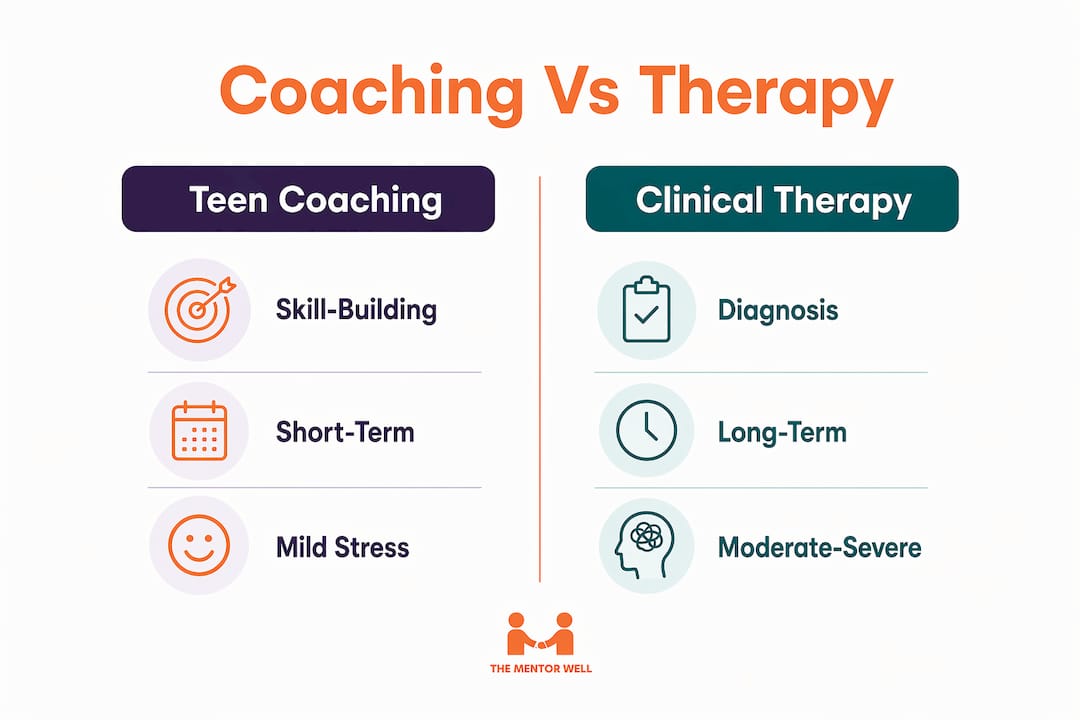
This is the question parents ask most often, and the answer matters. Coaching is non-diagnostic and skill-building. Therapy is clinical, diagnostic, and designed to treat recognised mental health conditions. Both have value. They serve different needs.
A coach works with a teenager who is struggling but functioning. Stress before exams. Friendship conflict. Low confidence. Difficulty sleeping. A therapist works with a teenager whose symptoms meet clinical criteria for a diagnosable condition, such as major depression, an anxiety disorder, or trauma. The scope is different. The credentials are different. The goals are different.
The coaching-therapy handoff is one of the most important protocols in this field. Trained coaches recognise red flags and refer to licensed clinical care when a teenager's needs exceed what coaching can address. That referral process is not a failure. It is the system working correctly.
| Feature | Teen mental health coaching | Clinical therapy |
|---|---|---|
| Scope | Mild to moderate stress and habit-building | Diagnosable mental health conditions |
| Approach | Skill-building, goal-setting, routine | Assessment, diagnosis, clinical treatment |
| Credentials | Wellness or youth coaching certification | Licensed psychologist, social worker, or therapist |
| Session focus | Micro-goals, accountability, self-awareness | Symptom reduction, trauma processing, clinical intervention |
| Referral | Refers to therapy when red flags appear | May refer to coaching as a complement to treatment |
The average delay in clinical intervention for young people is 8–10 years. Coaching exists precisely to fill that gap. It is not a replacement for therapy. It is what happens before the situation requires therapy, and sometimes, it is what prevents that situation from arriving at all.
Pro Tip: When evaluating a coaching programme, ask directly: "What is your protocol if my teenager shows signs of a clinical concern?" A good coach has a clear, practised answer.
What to expect in a teen mental health coaching programme
Parents often picture coaching as a version of therapy with a friendlier face. It is not. The structure is different from the ground up.
A typical coaching engagement looks like this:
- Initial goal-setting session. The coach and teenager identify one or two specific areas to work on. Not everything at once. One thing, done well.
- Micro-step planning. Large goals are broken into small, weekly actions. A teenager working on sleep might commit to putting their phone in another room by 10:00 PM, three nights a week.
- Weekly check-ins. Short, focused conversations review what worked, what did not, and what to adjust. The routine tracking of habits such as sleep, mood, and social behaviour is central to this process.
- Skill practice between sessions. Coaches assign simple tools: thought records, mood journals, or breathing exercises. The work happens in the teenager's real life, not just in the session.
- Progress review and adjustment. Every few weeks, the coach and teenager step back and assess whether the goals still fit. Coaching is flexible by design.
The coach's role is partner, not authority figure. That distinction is not semantic. Teenagers disengage quickly when they feel managed. They stay engaged when they feel respected. The most effective coaching relationships are built on connection, trust, and the understanding that the teenager is the expert on their own life.
Voluntary participation is not optional. Forced involvement undermines efficacy. A teenager who is dragged to coaching by a worried parent will not do the work. The motivation has to come from them, even if the initial nudge comes from you.
How can parents support their teen's mental health coaching?
Your role in your teenager's coaching is real, but it is not what you might expect. The most helpful thing you can do is stay out of the way, while staying present.
Here is what that looks like in practice:
- Respect the boundary. Coaching sessions are confidential. Do not ask your teenager to report back on what was discussed. That boundary is what makes the space safe.
- Ask open questions, not closed ones. "How are you feeling about the coaching?" lands differently than "Did you do your homework?" One invites. The other interrogates.
- Acknowledge effort, not just outcomes. If your teenager tried the sleep routine and it did not work perfectly, say so. Effort is the point at this stage.
- Model the behaviour you want to see. Teenagers notice when parents talk about stress management but never practise it. Your behaviour is louder than your encouragement.
- Know when to escalate. Family support strategies include recognising when coaching is no longer sufficient and clinical care is needed. Trust the coach's referral protocol, and act on it promptly.
The thriving zone for teenagers sits between parenting and clinical therapy. Coaching lives there. Your job is to hold the space around it without filling it.
Pro Tip: Tell your teenager you are proud of them for engaging with coaching before they have shown any results. The act of showing up is the hardest part.
Key takeaways
Teen mental health coaching is the most effective early intervention available to parents who want to support their teenager before a crisis requires clinical care.
| Point | Details |
|---|---|
| Coaching is not therapy | Coaching builds skills for mild to moderate stress; therapy treats diagnosable clinical conditions. |
| Early intervention changes outcomes | Coaching addresses warning signs before they escalate, filling the gap left by delayed clinical care. |
| Teen autonomy is non-negotiable | Voluntary participation drives coaching success; parents support best by respecting the process. |
| Structure matters | Micro-goals, weekly check-ins, and habit tracking are the practical tools that produce real change. |
| Referral protocols protect teens | Good coaches recognise red flags and refer to licensed clinical care when the situation requires it. |
What I have learned about showing up before it is too late
I did not know what teen mental health coaching was when Maddie was alive. I knew she was struggling. I could see it in the way she moved through the house, quieter than she used to be, slower to laugh. I told myself it was adolescence. I told myself she would come through it.
I have spent years since then sitting with that decision. Not to punish myself. But because I think about the parents reading this right now, recognising something in their own teenager, and telling themselves the same thing.
Coaching is not a guarantee. Nothing is. But it is a door that stays open longer than most people realise, and it closes quietly, without announcement.
What I have come to believe is this: the parents who engage early, who find a coach before the crisis, who learn to ask questions without demanding answers, they keep more doors open. Not all of them. But more.
The question I keep asking myself is not whether I could have saved Maddie. I cannot know that. The question is whether I was paying attention. Whether I created enough space for her to tell me what was happening inside her.
Coaching creates that space. It does not replace you as a parent. It gives your teenager somewhere to practise being honest, so that eventually, they might practise it with you too.
I do not have a tidy lesson here. I just know that before therapy, before crisis, there is a window. And it is worth using.
— Chris Coulter
Supporting your teenager with The MentorWell
The MentorWell was built for the moment before the crisis. It offers youth coaching programmes grounded in the same evidence-based principles covered here: early signal recognition, micro-goal skill-building, and autonomy-supportive partnerships that meet teenagers where they are.

The Teen Signal Check, a free assessment for parents and caregivers, helps you identify subtle warning signs in young people aged 8 to 25. It is a starting point, not a diagnosis. From there, The MentorWell's coaching and workshop programmes connect your family with the support that fits your teenager's needs right now, before the situation requires something more.
You do not have to wait until things get worse to act. The window is open. Use it.
FAQ
What is teen mental health coaching in simple terms?
Teen mental health coaching is a short-term, skills-based process that helps teenagers manage stress, build routines, and strengthen emotional resilience. It is non-clinical and non-diagnostic, designed for mild to moderate challenges rather than serious mental health conditions.
How is coaching different from therapy for teenagers?
Coaching builds practical skills and habits for teenagers who are struggling but functioning. Therapy diagnoses and treats clinical mental health conditions. Both have a role, and a good coach will refer to a therapist when the situation requires it.
Does my teenager have to want to do coaching for it to work?
Yes. Voluntary participation is central to coaching effectiveness. A teenager who is forced into coaching will not engage with the process. Parents can encourage and support, but the motivation must come from the teenager.
At what age can a teenager start mental health coaching?
Youth coaching programmes typically support young people from early adolescence through young adulthood. The MentorWell's tools and programmes are designed for youth aged 8 to 25, with approaches adapted to developmental stage.
What should I ask a coach before my teenager starts?
Ask about their protocol for recognising red flags and referring to clinical care. Ask what a typical session looks like. Ask how they handle confidentiality with parents. Clear answers to these questions indicate a coach who has thought carefully about safe coaching practice.