
TL;DR:
- Parenting with warmth and clear boundaries fosters open communication with teens.
- Using open-ended statements and side-by-side conversations encourages teens to share honestly.
Getting your teen to talk is less about finding the right question and more about becoming the kind of presence they trust enough to answer. Parent-teen communication, the term clinicians use for the ongoing dialogue between caregivers and adolescents, breaks down not because teens stop caring, but because they stop feeling safe. The authoritative parenting style, which combines genuine warmth with clear boundaries, is the approach most consistently linked to open dialogue and reduced conflict. If you have been standing in the kitchen asking "how was your day?" and getting a shrug, the problem is rarely your teen. It is the setup.
How does changing your communication style help your teen open up?
The shift from authoritarian to authoritative parenting is the single most effective change a parent can make. Authoritarian parenting relies on control and correction. Authoritative parenting leads with warmth first, then holds the boundary. That difference is everything when you are trying to get a teenager to speak freely.
Shifting to an authoritative style reduces conflict and improves teen cooperation. The reason is straightforward: teens disengage when they expect to be corrected. If every conversation ends with a lesson, they stop starting them.
Here is what that looks like in practice:
- Replace correction with curiosity. When your teen tells you something you disagree with, ask a question instead of offering a counter-point. "What made you think that?" keeps the door open. "That's not how it works" closes it.
- Protect low-pressure time together. Shared meals, a drive to practice, a walk after dinner. These moments are not wasted time. They are the foundation of trust that makes harder conversations possible later.
- Let some things go. Not every mood, messy room, or eye-roll needs a response. Teens connected to caring adults who do not over-react have measurably better mental health outcomes. Picking your moments is not weakness. It is strategy.
The goal is not a perfectly compliant teenager. The goal is a teenager who believes you are safe to talk to.
What communication techniques encourage teens to open up without pressure?
Rapid-fire questions are the fastest way to shut a teenager down. Interrogation-style questioning triggers withdrawal, not disclosure. Most parents do not realise they are doing it. You ask one question, get a short answer, ask a follow-up, get a shorter one, and within two minutes your teen has left the room.
Open-ended statements work better than questions. "I noticed you seemed quiet tonight" invites a response without demanding one. "Tell me more about that" signals interest without pressure. These are small shifts, but they change the emotional temperature of the conversation.

Pro Tip: Try the side-by-side approach. Teens often find direct eye contact confrontational. A conversation during a drive, while cooking, or on a walk removes that pressure entirely. The shared task gives both of you somewhere to look that is not each other, and that physical arrangement makes vulnerability easier.
A few techniques that consistently work:
- Pause when emotions run high. When either of you is flooded, logical processing shuts down. Naming the need for a break, "I want to keep talking about this, but I need ten minutes," protects the relationship and the conversation.
- Use statements, not questions. "It sounds like today was rough" lands differently than "Why are you upset?"
- Resist the urge to fill silence. Silence is not failure. Sometimes it means your teen is thinking. Wait it out.
The Three H's framework offers a useful check before you respond: ask yourself whether your teen needs to be Held, Helped, or Heard. Most of the time, the answer is Heard. Most of the time, parents jump straight to Help.
How can active listening and validation build trust with your teen?
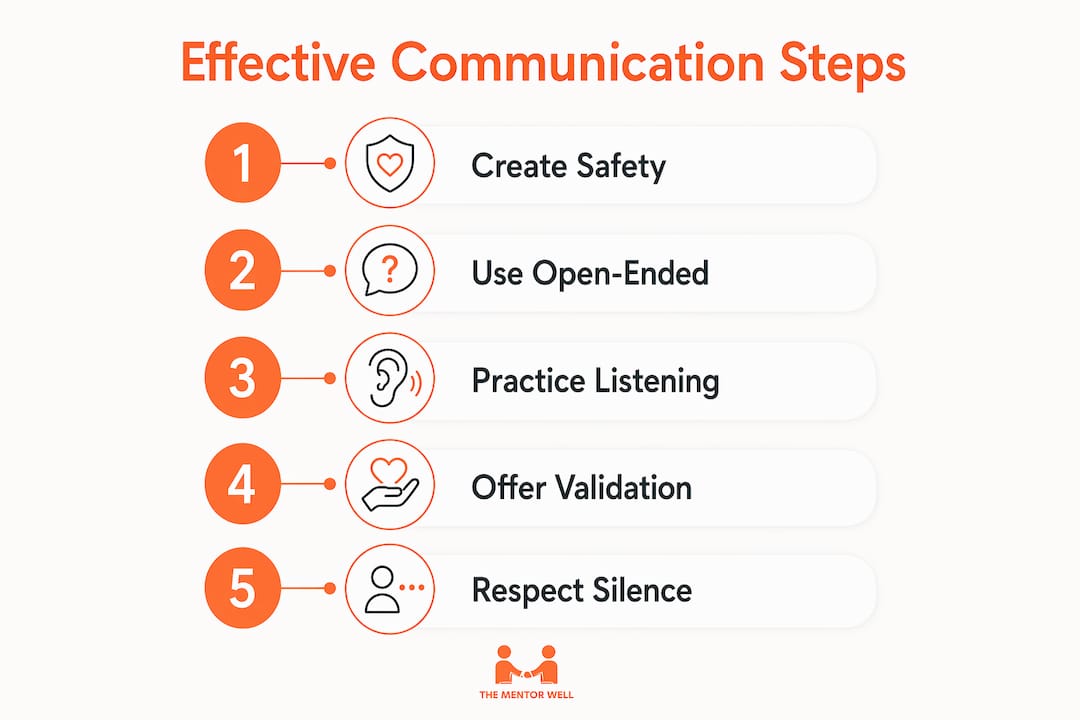
Most teens want to be heard before they want to be helped. Listening without interrupting and reflecting feelings back builds the kind of trust that makes future conversations more likely. This is not a technique. It is a posture.
Validation does not mean agreement. It means acknowledgment. "That sounds really frustrating" does not endorse whatever your teen did. It tells them their internal experience is real and worth naming. That distinction matters, because many parents hold back validation out of fear it signals approval.
Teens who feel heard by their parents are more likely to return to those parents when things get hard. The goal is not to solve the problem in front of you. The goal is to be the person they call when the next problem comes.
Pro Tip: Before you respond to something your teen shares, ask: "Do you want to vent, or are you looking for a solution?" This one question, drawn from Canadian youth support practice, prevents unsolicited advice and signals that you respect their autonomy.
The role of emotional validation in mental health is well established. When teens feel their emotions are acknowledged rather than dismissed or fixed, they are more willing to share those emotions. That willingness is the foundation of every meaningful conversation you will have with them.
What steps help parents navigate silence or emotional shutdown?
Silence from a teenager often signals overwhelm, not defiance. Forcing talk when a teen is shut down backfires consistently. The harder you push, the further they retreat. The better move is to make your availability known and then step back.
A simple, low-pressure statement works: "I'm here when you're ready. No rush." Then mean it. Do not hover. Do not check in every twenty minutes. Let the statement stand.
When a conversation does go sideways, repair matters more than perfection. Here is a practical sequence for getting back on track:
- Acknowledge what happened. "I came in too hard on that. I'm sorry." Teens notice when parents own their mistakes. It models the exact behaviour you are asking of them.
- Name what you want instead. "I want to understand what's going on for you. Can we try again?"
- Give it time. Repairing after conflict builds long-term trust more reliably than any single perfect conversation.
- Know when to bring in support. If communication has stalled for weeks, or if you are seeing signs of withdrawal, low mood, or changed behaviour, a counsellor or mental health professional can help. Seeking support is not a failure of parenting. It is parenting.
Teens connected to caring adults tend to have better mental health outcomes. That connection does not require perfect conversations. It requires consistent presence, and the willingness to show up again after things go wrong.
Key takeaways
Open parent-teen communication comes from consistent warmth, low-pressure presence, and the willingness to listen before you advise.
| Point | Details |
|---|---|
| Shift your parenting style | Authoritative parenting, warmth plus clear limits, reduces conflict and opens dialogue. |
| Avoid rapid-fire questions | Open-ended statements invite sharing; interrogation-style questions trigger withdrawal. |
| Use side-by-side conversations | Shared activities lower pressure and make it easier for teens to speak honestly. |
| Validate before you advise | Asking whether your teen wants to vent or wants solutions prevents unsolicited advice. |
| Repair after conflict | Acknowledging mistakes and apologising builds more trust than any single perfect exchange. |
What I learned about listening the hard way
I used to think I was a good listener. I was not. I was a good waiter. I would let Maddie finish a sentence, and then I would fix it. I had an answer ready before she was done talking. I thought that was help. I know now it was the opposite.
The anxiety to fix is real. Every parent feels it. Your kid is hurting, and you have spent their whole life being the person who makes things better. Sitting with their pain without reaching for a solution feels like failure. It is not. It is the hardest and most important thing you can do.
I learned this too late for Maddie. I am writing it down so you do not have to learn it the same way.
The conversations that mattered most were never the ones where I had the right answer. They were the ones where I stayed in the room. Where I did not check my phone. Where I let the silence sit without filling it. Where I said "that sounds really hard" and meant it, without immediately following it with "here's what you should do."
Adolescence takes patience that most of us were never taught to have. There are no quick fixes. There is just showing up, getting it wrong sometimes, apologising, and showing up again. The connection you build through that repetition is what keeps the door open. And an open door is everything.
If your teen is not talking to you right now, that is not the end of the story. It is a signal. Pay attention to it. And keep showing up.
— Chris Coulter
How The MentorWell supports parents and teens
Building real communication with your teenager takes more than good intentions. Sometimes you need a guide, a framework, or simply someone who has been through it.

The MentorWell was built for exactly this. Founded after the loss of Maddie Coulter, the platform offers parent-focused tools and workshops designed to help families recognise early signs of distress and build the kind of connection that keeps teens talking. The Teen Signal Check gives parents a structured way to identify what their teenager may not be saying out loud. Coaching, community, and educational resources are available without judgement and without pressure. You do not have to have it figured out to reach out. That is the point.
FAQ
How do I get my teen to open up when they refuse to talk?
Letting your teen know you are available without pressure is more effective than pushing for conversation. A simple "I'm here when you're ready" and then stepping back gives them the space to come to you.
What questions should I ask my teen to start a conversation?
Open-ended statements work better than direct questions. Try "It seemed like today was tough" instead of "What's wrong?" and wait for your teen to fill the space.
Why does my teen shut down when I try to talk to them?
Teens often shut down when they anticipate correction or unsolicited advice. Shifting to an authoritative style that leads with warmth rather than guidance reduces this pattern over time.
Does validation mean I have to agree with my teen?
Validation means acknowledging your teen's feelings, not endorsing their choices. Saying "that sounds really frustrating" confirms their experience without approving of the behaviour that caused it.
When should I seek professional help for my teen's communication?
If your teen has been withdrawn for several weeks, or if you notice changes in behaviour, mood, or social connection, a mental health professional can help. Teens connected to caring adults have better outcomes, and professional support is one more way to provide that connection.