
TL;DR:
- Online family mental health resources in Canada include publicly funded programs, crisis lines, private therapy, apps, and support groups. Choosing credible providers involves verifying credentials, assessing the therapeutic relationship, and checking privacy policies and insurance coverage. Virtual therapy is effective when the client-therapist relationship is strong, and early signs of issues should prompt timely action from parents.
Family mental health resources online are digital and virtual services designed to support the emotional and psychological well-being of youth and their families. For parents of teenagers and young adults, knowing where to look and how to evaluate what you find can mean the difference between early support and a crisis that could have been prevented. Canada's mental health system is fragmented, but the online options available in 2026 are real, accessible, and worth understanding. This guide walks you through the types of resources available, how to assess their quality, and how to navigate the system without getting lost in it.
What types of family mental health resources are available online?
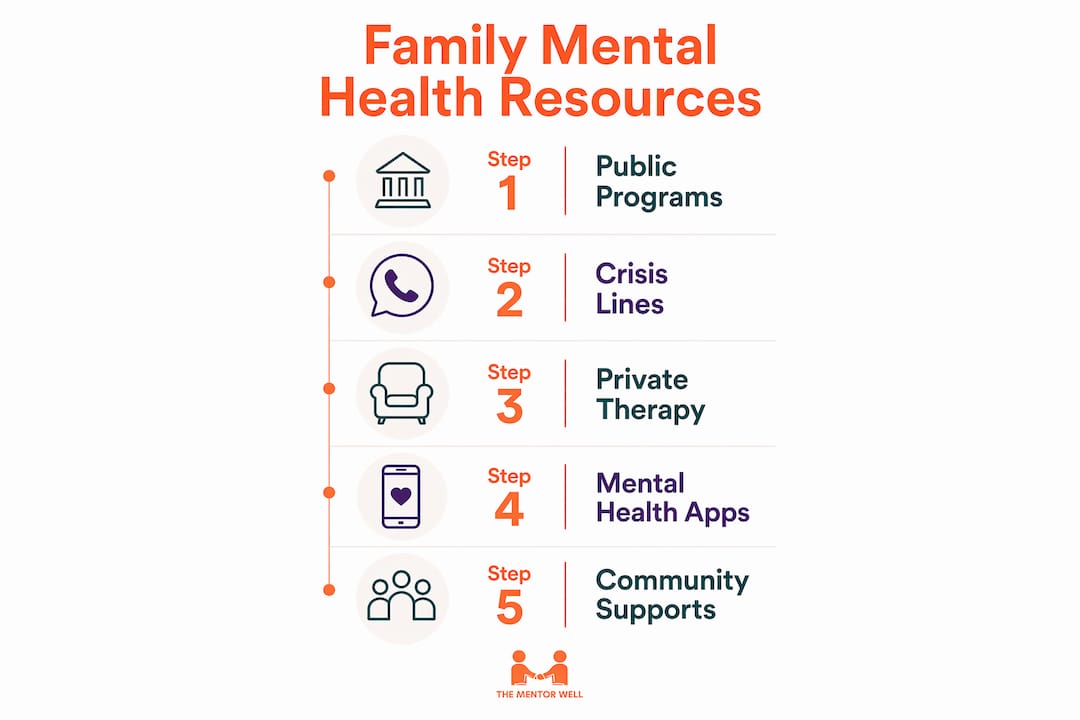
The range of online mental health support for Canadian families is wider than most parents realise. Resources fall into several distinct categories, and knowing which one fits your situation saves time and reduces frustration.
Publicly funded programmes are the starting point for many families. In British Columbia, Child and Youth Mental Health teams provide no-cost counselling and integrated support for children and youth aged 0–18. These services are delivered virtually in many regions, which removes the barrier of travel and wait times for in-person appointments. Other provinces have equivalent programmes, though the names and eligibility criteria vary.
Crisis lines are available around the clock and require no referral. The 9-8-8 Suicide Crisis Helpline and Kids Help Phone both offer 24/7 confidential support by phone and text for youth across Canada. These are not just for emergencies. Many teens use them to talk through stress, anxiety, or difficult family situations before things escalate.
Private online therapy and counselling services fill the gap between crisis support and publicly funded care. Most private therapists offering virtual sessions provide a free 15–20 minute consultation before any paid commitment. That initial call is where you assess whether the therapist has experience with adolescents and whether your teen might connect with them.
Mental health apps are widely downloaded but unevenly regulated. The Centre for Addiction and Mental Health (CAMH) notes that many apps lack peer-reviewed evidence and have inconsistent privacy standards. That matters when your teenager's data is involved. Use vetted app libraries and check developer credentials before recommending any app to your child.
Community and non-profit digital resources round out the picture. These include moderated online support groups, educational video series, and parent-focused webinars. They are not therapy, but they build awareness and reduce isolation for both parents and teens.
| Resource type | Access method | Cost |
|---|---|---|
| CYMH public counselling | Referral or self-referral | No cost (0–18 in BC) |
| 9-8-8 / Kids Help Phone | Phone or text, no referral | Free |
| Private virtual therapy | Direct booking | Varies; free consult common |
| Mental health apps | App store download | Free to paid; vet carefully |
| Non-profit digital groups | Online registration | Usually free |
How do you evaluate and choose credible online providers?
Choosing an online mental health provider is not the same as choosing a streaming service. The stakes are higher, and the wrong fit can set a teenager back rather than move them forward.

Start with credentials. Regulated mental health professionals in Canada include registered psychologists, registered social workers, and registered clinical counsellors. Each province has a regulatory body that maintains a public register. Checking that register takes five minutes and confirms that the person you are considering is licensed to practise.
The quality of the therapeutic relationship is the strongest predictor of successful outcomes in online therapy for youth. The platform matters far less than whether your teen feels genuinely heard. That is why the free initial consultation is not a formality. Use it to ask direct questions: How do you work with teenagers who are reluctant to talk? What does the first few sessions typically look like? How do you handle disclosures?
Privacy and data security deserve specific attention when the client is a minor. Ask any platform or app provider how session notes are stored, who can access them, and what their breach notification policy is. If the answer is vague, that is your answer.
Pro Tip: Before booking a paid session, ask the therapist directly whether they have experience with the specific issue your teen is facing, whether that is anxiety, depression, school refusal, or something else. Specialisation matters more than general credentials.
Canadian insurance plans often have narrow coverage definitions for mental health providers, which can result in unexpected out-of-pocket costs. Check whether your plan covers registered psychologists, social workers, or counsellors specifically. Some plans cover one designation but not another, and the difference can be significant.
- Verify the provider's registration with their provincial regulatory body.
- Use the free consultation to assess communication style and experience with teens.
- Ask specific questions about privacy policies and data storage.
- Confirm your insurance coverage before the first paid session.
- Trust your instinct. If something feels off in the consultation, keep looking.
How does online family counselling work for teenagers and young adults?
Virtual therapy for families typically runs through secure video platforms that meet Canadian privacy standards. Sessions are usually 50–60 minutes and happen weekly or biweekly, depending on the teen's needs and the therapist's recommendation.
Adolescent privacy is one of the most delicate parts of this process. Therapists working with teenagers must balance parental consent with teen confidentiality to keep the young person engaged. If a teen believes that everything they say will be reported back to their parents, they stop talking. That silence is not safety. It is a closed door.
Most therapists establish a clear agreement at the start: parents are informed of general progress, but the content of sessions remains private unless there is a safety concern. Understanding and respecting that boundary is one of the most useful things a parent can do.
The pacing of virtual therapy with teenagers is slower than many parents expect. Rapport builds gradually, often over several sessions, before any meaningful skill work begins. Rushing that process or asking your teen to report back after every session undermines the relationship the therapist is trying to build. Your role is to hold the space, not to manage the outcome.
Virtual therapy is often more approachable for teenagers than in-person sessions. There is no waiting room, no unfamiliar building, and no commute. Many teens find it easier to open up from their own bedroom, on their own terms. That accessibility is not a compromise. For some teens, it is the only reason they agree to try at all.
- Secure video platforms meeting Canadian privacy standards are standard for virtual sessions.
- Therapists establish privacy agreements with teens at the outset to maintain engagement.
- Session pacing is gradual; rapport comes before skill-building.
- Parents support best by staying available without demanding updates.
- Virtual format reduces barriers for teens who resist in-person appointments.
How do you navigate Canada's mental health system to access online resources?
Canada's mental health system is not one system. It is a patchwork of provincial programmes, private services, school-based supports, and crisis lines that do not always connect to each other. Knowing where to start makes the difference.
Your family doctor is the most reliable first step. Family doctors assess, diagnose, and refer within Canada's fragmented mental health system. They can rule out physical causes for emotional symptoms, provide a formal referral to publicly funded services, and advise on medication if needed. Many parents wait too long to involve their doctor because they feel they need a clear diagnosis first. You do not. Early help-seeking improves outcomes and clarifies next steps. Go before you are certain.
For finding qualified private providers, provincial psychological associations and social work colleges maintain searchable directories. Psychology Today's Canadian directory is widely used and filterable by location, specialisation, and insurance coverage. The therapy discovery process can feel slow, but a structured approach reduces the time spent on poor fits.
Pro Tip: Keep a brief written record of your teen's symptoms, changes in behaviour, and dates. When you speak to a doctor or therapist for the first time, that record gives them a clearer picture faster and reduces the chance that something important gets missed.
| Step | Action | Resource |
|---|---|---|
| 1. Start with your doctor | Book an appointment; describe what you are observing | Family physician or walk-in clinic |
| 2. Request a referral | Ask for CYMH or equivalent provincial programme | Provincial health authority |
| 3. Search private directories | Filter by teen specialisation and insurance | Provincial association directories |
| 4. Confirm coverage | Call your insurer before booking | Your benefits provider |
| 5. Crisis support | Use 9-8-8 or Kids Help Phone if immediate need arises | Phone or text, 24/7 |
Sustaining engagement in virtual therapy requires some practical planning. Consistent session times, a private space in the home, and a charged device with a stable connection are small things that matter. Teens who feel their therapy space is respected at home are more likely to continue attending. You can read more about family support strategies that complement professional care.
Key takeaways
The most effective way to find family mental health resources online is to start with your family doctor, verify provider credentials, and prioritise the therapeutic relationship over the platform or price.
| Point | Details |
|---|---|
| Start with your doctor | Family physicians provide referrals and early assessment before a formal diagnosis is needed. |
| Know your resource types | Public programmes, crisis lines, private therapy, and apps each serve different needs. |
| Vet apps carefully | CAMH confirms many mental health apps lack evidence or adequate privacy safeguards. |
| Protect teen privacy | Therapists balance parental consent with teen confidentiality to keep youth engaged. |
| Verify insurance coverage | Canadian plans vary widely; confirm provider type coverage before the first paid session. |
What I wish I had known before I started looking
I spent a long time looking in the wrong direction. Not because the resources were hidden. Because I was looking for certainty before I was willing to act.
I wanted a clear diagnosis. A name for what was happening. Something that would tell me I was right to be worried, or right to wait. That is not how it works. By the time you have the certainty you are waiting for, the window has often already closed.
What I know now is that the subtle signs your child is struggling show up long before a crisis does. The withdrawal. The shorter answers. The way they stop talking about the future. Those are not phases. They are signals. And they are worth acting on before you have proof.
The other thing I got wrong was thinking my involvement was helping. I asked too many questions after sessions. I wanted progress reports. I wanted to know it was working. What I was actually doing was making it harder for trust to build between my daughter and the people who might have helped her. Silence isn't safety, but neither is pressure. There is a version of caring that closes doors without meaning to.
If you are a parent reading this, you are already doing something right. You are paying attention. That matters more than you know. The gap between parenting and therapy is real, and it is uncomfortable to sit in. But sitting in it, staying present without demanding answers, is often the most useful thing you can do.
— Chris Coulter
The MentorWell: support for parents who are paying attention

The MentorWell was built for parents who are already watching closely and wondering if what they see is enough to act on. The platform offers the Teen Signal Check, an assessment designed to help parents and caregivers identify early warning signs in youth aged 8–25, along with workshops, coaching, and a community of families navigating the same uncertainty. You do not need a crisis to use it. You need a question you are not sure how to answer. Visit The MentorWell to access tools and connect with a community that understands what you are carrying.
FAQ
What are the main types of family mental health resources online?
Online family mental health resources include publicly funded youth counselling programmes, 24/7 crisis lines like 9-8-8 and Kids Help Phone, private virtual therapy, mental health apps, and non-profit digital support groups. Each serves a different level of need and urgency.
How do I know if an online therapist is qualified to work with my teenager?
Check that the therapist is registered with their provincial regulatory body, such as a college of psychologists or social workers. Ask during the free consultation whether they have specific experience working with adolescents and the issues your teen is facing.
Is virtual therapy as effective as in-person therapy for teenagers?
The quality of the therapeutic relationship predicts outcomes more than the format. Many teenagers find virtual sessions more accessible and less intimidating than in-person appointments, which can improve attendance and engagement.
Will my insurance cover online therapy in Canada?
Canadian insurance plans vary significantly in which provider designations they cover. Contact your benefits provider before booking to confirm whether your plan covers registered psychologists, social workers, or counsellors specifically.
When should I use a crisis line instead of booking a therapy appointment?
Use 9-8-8 or Kids Help Phone immediately if your teen expresses thoughts of self-harm or suicide, or if you are concerned about their immediate safety. These services are available 24/7 by phone and text and require no referral or prior registration.