
Executive mentoring, as used throughout this guide, means structured mentoring and coaching that trains parents, caregivers, and workplace managers to recognise early signs of emotional distress in young people and act before a crisis arrives. It is not corporate leadership coaching. If you are worried about a child or teen right now, start here: watch for three persistent changes — loss of interest in things they used to love, shifts in sleep or appetite, and pulling away from friends and family. If any of those changes have lasted more than a few weeks, or if you are seeing signs of immediate danger, call the 988 Suicide & Crisis Lifeline now.
Three trusted sources anchor the guidance in this article: The MentorWell, the National Institute of Mental Health (NIMH), and the 988 Suicide & Crisis Lifeline.
Key takeaways
Early detection through structured executive mentoring, paired with a digital screening tool and crisis protocol, gives parents and managers the specific skills to act before distress becomes a crisis.
| Point | Details |
|---|---|
| Definition | Executive mentoring here means coaching for parents and managers to spot youth emotional distress early. |
| Timeline rule | Persistent changes lasting weeks or months, or interfering with daily life, are the signal to act. |
| Crisis step | Call 988 or local emergency services immediately if there is any sign of imminent danger. |
| Programme quality | Look for a screening tool, written crisis protocol, manager scripts, and a follow-up component. |
| The MentorWell | Offers workshops, family programmes, and the free Teen Signal Check for youth aged 8–25. |
Table of Contents
- What executive mentoring means in this guide
- What warning signs actually look like by age
- How mentoring and manager training build real skills
- What a good programme includes
- How to choose a programme or partner
- What to do if you're worried right now
- Why The MentorWell exists
- Keeping the conversation going after training ends
- Integrating mentoring into schools and workplaces
- How to measure whether training is working
- A note from the dock
- The MentorWell: workshops, the Teen Signal Check, and next steps
- Sources
- FAQ
What executive mentoring means in this guide
Most searches for "executive mentoring" return results about C-suite leadership development. That is a different subject entirely. Here, executive mentoring refers to mentoring and coaching programmes designed for the adults who are closest to young people: parents, caregivers, school staff, and workplace managers. The goal is early detection of emotional distress in youth roughly aged 8–25, and the skills to respond.
The core outcomes readers should expect from this kind of training: greater confidence starting difficult conversations, clearer referral pathways, and a written safety plan before one is ever needed. These are not abstract goals. They are the difference between catching something early and finding out too late.
What warning signs actually look like by age
NIMH guidance on child and adolescent mental health emphasises that distress looks different depending on developmental stage, and that interference with daily functioning is the key indicator for when to seek an evaluation.
Younger children (roughly 0–7)
- Persistent clinginess or new separation anxiety
- Frequent unexplained stomach aches or headaches
- Regression to earlier behaviours (bedwetting, thumb-sucking)
- Nightmares or sleep disruption lasting more than two weeks
School-age children (8–12)
- Sudden drop in grades or refusal to attend school
- Withdrawal from friends or activities they previously enjoyed
- Irritability or anger that seems out of proportion
- Complaints of being "bored" with everything, persistently
Teenagers (13–17)
- Marked changes in sleep, appetite, or personal hygiene
- Giving up hobbies, sports, or social connections without explanation
- Increased secrecy, especially around devices or whereabouts
- Expressions of hopelessness, worthlessness, or being a burden
The timeline rule: NAMI's guidance is direct on this point. Persistent changes lasting weeks or months, or changes that interfere with school, sleep, eating, or social life, are red flags that warrant a conversation with a paediatrician or mental health clinician. A bad week is not the signal. A changed kid, sustained over time, is.
Crisis signs requiring immediate action: Giving away possessions, self-harm, direct statements about not wanting to be alive, or a drastic personality shift. Mental Health America is clear that these signs require crisis-level response. Call 988 or local emergency services without delay.
UNICEF's parenting guidance adds an important nuance: prolonged reactions to stress that persist well beyond the triggering event should prompt specialist support, not a wait-and-see approach.
How mentoring and manager training build real skills
The skills taught in quality executive mentoring programmes are specific and practisable. They are not soft skills in the vague sense. They are scripts, frameworks, and habits.
For parents and caregivers: conversation starters that reduce shame, how to listen without immediately problem-solving, emotional check-in routines, and how to document concerns clearly before a paediatrician appointment.

For managers and HR: brief screening language for one-on-one conversations, how to support employees whose teens are in crisis, boundary-setting and confidentiality protocols, accommodation conversation frameworks, and escalation pathways.
Training managers to alternate between a consulting role and a supportive coaching role is one of the most underused levers in workplace mental health programmes. Policy documents do not change behaviour. Practised conversations do.
Pro Tip: Short role-plays and scripted practice scenarios increase skill uptake significantly more than lecture-based training. Even a ten-minute scripted exchange between two participants embeds the language in a way that a slide deck cannot.
What a good programme includes
The MHFA Supporting Youth course trains adults who regularly interact with young people to recognise early decline, initiate supportive conversations, and assist in crises. It provides an action-focused participant guide participants can use immediately. Pairing that kind of structured curriculum with a digital screening tool like the Teen Signal Check increases practical uptake.
| Component | What to look for |
|---|---|
| Screening tool | A validated or structured digital assessment (e.g., Teen Signal Check) |
| Crisis protocol | Written steps for imminent danger, including 988 and emergency contacts |
| Manager scripts | Ready-to-use language for check-ins and referral conversations |
| Family follow-up | Scheduled coaching or check-in after the initial workshop |
| Peer mentoring option | Matched peer support based on shared experience, not just problem category |
| Evaluation plan | Metrics: screening uptake, referral rate, confidence scores, follow-up contacts |
Formats vary: live workshops, short one-on-one coaching sessions, on-demand modules, and digital screening tools each serve different schedules and budgets. A quality programme uses at least two of these in combination.
How to choose a programme or partner
Step-by-step checklist:
- Confirm the programme is designed for your audience (parents, managers, or both).
- Check that a screening tool is included or recommended alongside training.
- Review the crisis protocol: it should name 988, local emergency services, and a referral pathway.
- Ask for outcome data: referral rates, confidence scores, or follow-up contact rates.
- Confirm the time commitment upfront — most quality workshops run two to four hours, with optional follow-up coaching.
Questions to ask any provider:
- What is the cost structure: per workshop, per seat, or subscription?
- How do you measure whether participants actually use what they learned?
- What is your confidentiality policy for manager training?
- Do trainers have direct youth mental health experience?
Red flags:
- No written crisis protocol
- Vague or unmeasured outcomes
- Trainers without youth mental health backgrounds
- No follow-up component after the initial session
For HR teams building internal programmes, this step-by-step guide to manager mental health coaching covers the design decisions in practical detail.
What to do if you're worried right now
Three conversation openers that work, because they listen rather than diagnose:
For younger children: "You seem a little different lately. Is there anything heavy you're carrying around?"
For teens: "I'm not going to freak out. I just want to hear what's actually going on for you."
If a conversation reveals something serious, write down what was said, when, and any behaviours you have observed. That record matters when you speak to a paediatrician or school counsellor. HealthyChildren.org recommends making the home a judgement-free zone and listening more than speaking, using concrete observations rather than labels.
If there is any imminent safety concern, call 988 or local emergency services. Do not wait for certainty.
Why The MentorWell exists
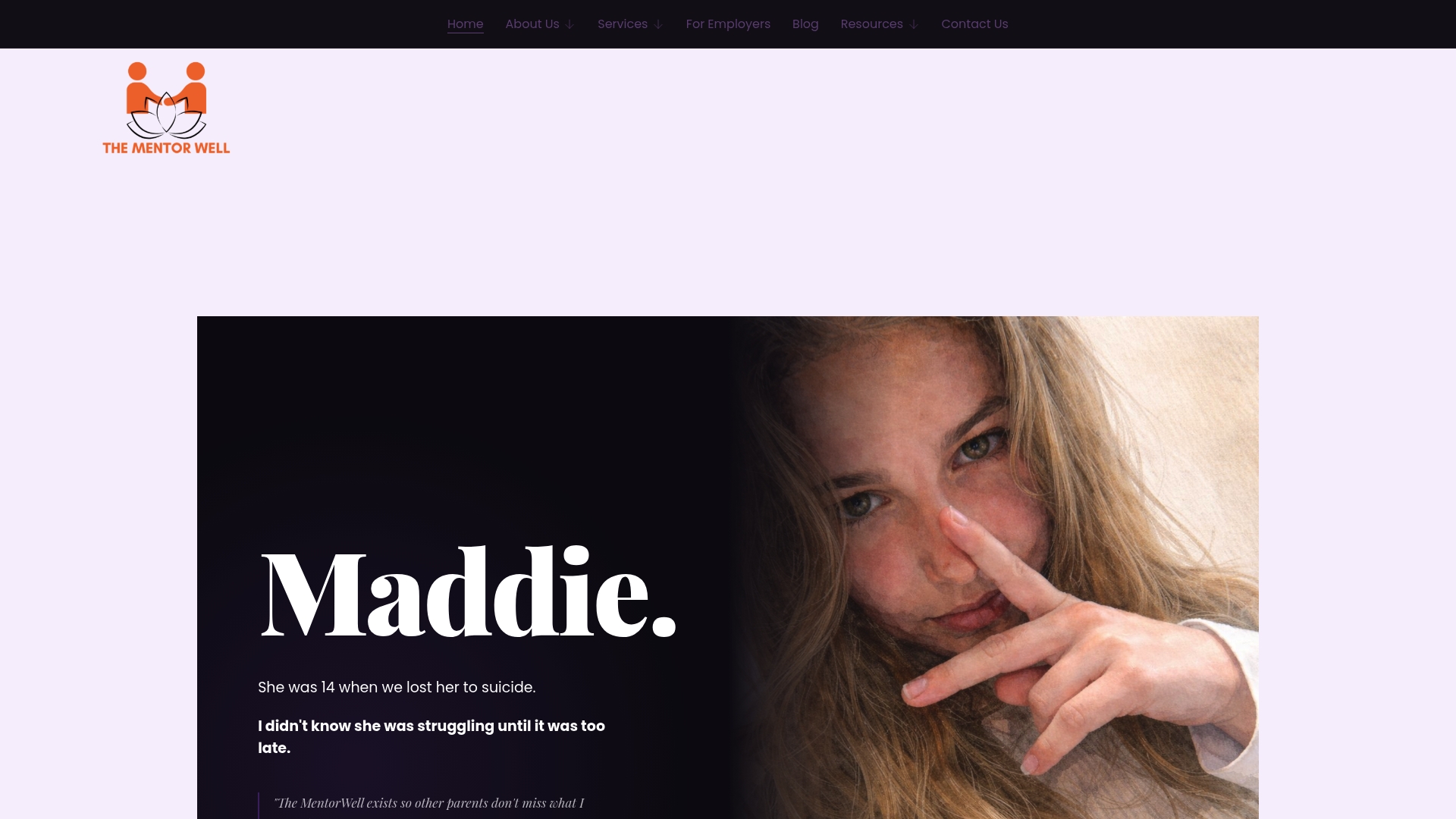
There was a morning I sat on the dock with my coffee, watching the water, and I kept thinking about all the signs I had seen and not named. Not because I didn't love Maddie. Because I didn't know what I was looking at.
The MentorWell was founded by Chris Coulter in memory of his daughter Maddie, with one purpose: give parents, caregivers, and managers the tools to act before the window closes.
Core offerings include live and on-demand workshops for parents and HR teams, one-on-one coaching, family mentorship programmes, and the Teen Signal Check, a free digital screening tool for youth aged 8–25. After a workshop, participants receive follow-up coaching and access to a peer community of families navigating the same terrain. Impact is tracked through screening uptake, referral rates, and participant confidence scores.
Keeping the conversation going after training ends
A single workshop changes awareness. Sustained practice changes behaviour. The strategies that keep mental health conversations alive after the initial training:
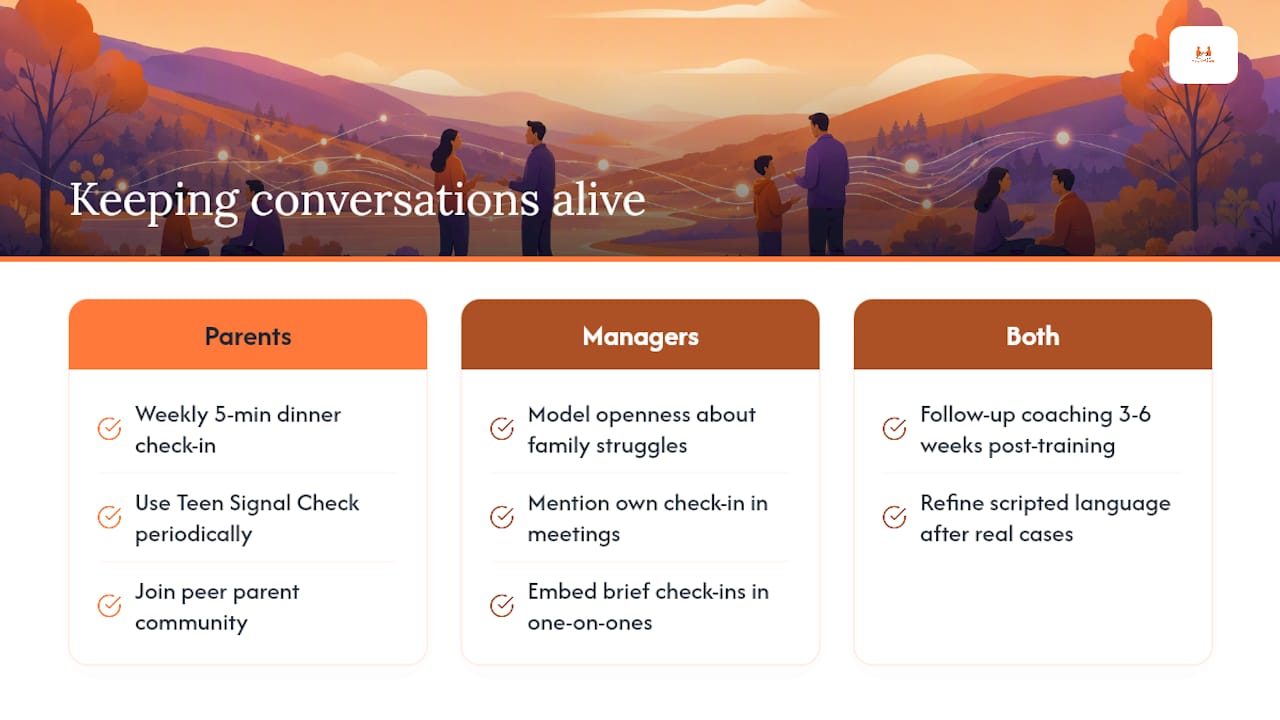
For parents: Schedule a brief weekly emotional check-in, even five minutes at dinner. Use the Teen Signal Check periodically, not just once. Connect with a peer community of other parents doing the same work.
For managers: Role-modelling openness around family struggles reduces isolation and lowers burnout risk for employees dealing with youth mental health challenges at home. A manager who mentions, once, that they checked in on their own kid this week gives every employee in the room permission to do the same. Build brief mental health check-ins into existing one-on-one meeting structures rather than creating separate, stigmatised conversations.
Both groups benefit from scheduled follow-up coaching, three to six weeks after initial training, when the first real-world situations have surfaced and the scripted language needs refining.
Integrating mentoring into schools and workplaces
The programmes that stick are the ones that attach to existing structures rather than running parallel to them.
In schools, that means embedding screening conversations into existing counsellor check-ins, training teachers alongside counsellors so the language is consistent, and creating a clear referral pathway that every staff member knows. A mental health first aid programme works best when it is not a one-off event but a recurring part of staff professional development.
In workplaces, building a teen mental health policy gives manager training a structural home. Without policy, training evaporates. With it, the skills have somewhere to live. Employee health services and occupational health teams can serve as natural referral partners when managers identify a concern.
How to measure whether training is working
Three metrics that actually tell you something:
Screening uptake: Are participants using the Teen Signal Check or another structured tool after training? A rise in uptake indicates the training landed.
Referral rate: Are more concerns being referred to paediatricians, school counsellors, or clinicians? An increase is the signal the training is working, not a sign something is wrong.
Confidence scores: Pre- and post-training self-assessment on three questions: "I know what signs to look for," "I know how to start a conversation," and "I know what to do in a crisis." A meaningful shift in all three indicates real skill transfer.
Schedule a formal review at 30 days and 90 days post-training. Collect brief written feedback. Adjust the follow-up coaching based on what participants report as the hardest moments.
A note from the dock
I remember the car ride home after a bad test. Maddie was quiet. I filled the silence with reassurance she didn't ask for.
I've thought about that ride a lot.
What would I do differently.
I'd ask one question and then stop talking. I'd let the quiet sit there instead of rushing to fill it. I'd pay attention to what she wasn't saying, not just what she was.
You don't need to be a clinician. You need to be present, and you need to know what you're looking at. That's what this work is about.
What's one thing you noticed this week that you haven't said out loud yet?
The MentorWell: workshops, the Teen Signal Check, and next steps
The MentorWell offers a direct path from awareness to action. HR teams and employers can book a live workshop for managers, covering screening language, check-in frameworks, and crisis protocols, with follow-up coaching included. Parents and caregivers can enrol in on-demand family programmes at their own pace.
The free Teen Signal Check takes minutes and gives you a structured starting point, whether you are a parent noticing something off or a manager unsure what you are seeing. Workshops are priced per session or per seat depending on group size; on-demand programmes are available for individual purchase. Visit The MentorWell to book a workshop, access the screener, or connect with the peer community.
Sources
- What to look for and when to act | NAMI
- Child and adolescent mental health | NIMH
- Know the signs: recognizing mental health concerns in kids and teens | Mental Health America
This article provides general information for educational purposes and is not a substitute for professional mental health advice. If you have concerns about a child's safety, contact a qualified clinician, paediatrician, or call 988.
FAQ
What does executive mentoring mean for parents and managers?
Here, executive mentoring means structured coaching and training that helps parents, caregivers, and workplace managers recognise early signs of emotional distress in young people and respond with confidence, not corporate leadership development.
How long do warning signs need to persist before I act?
NAMI guidance indicates that changes lasting weeks or months, or interfering with school, sleep, eating, or social life, are the threshold for seeking a professional evaluation.
What is the Teen Signal Check?
The Teen Signal Check is a free digital screening tool from The MentorWell, designed for parents and caregivers to identify subtle warning signs in youth aged 8–25; it takes minutes and provides a structured starting point for next steps.
When should I call 988?
Call or text 988 immediately if a young person is expressing suicidal thoughts, giving away possessions, self-harming, or showing a sudden drastic personality change; these are crisis-level signs that require immediate response.
How do I know if a mentoring programme is worth the investment?
Ask the provider for three things: a written crisis protocol, outcome data (referral rates or confidence scores), and a follow-up component after the initial session. Programmes without all three are unlikely to produce lasting behaviour change.