
If you are an HR leader in Canada, here is what to do now: stand up a manager mental health coaching programme that pairs short skills modules with ongoing coaching and structured evaluation. Do not wait for a perfect curriculum. Start with a pilot team, a clear objective, and a measurement plan.
Before you begin, three things need to be in place:
-
Define your objective. What do you want managers to do differently after training? Name it specifically: initiate a check-in, make a referral, complete an accommodation form.
-
Map your audience. Which manager tiers are in scope? Frontline supervisors carry different risks than senior leaders. Sequence them accordingly.
-
Secure leadership buy-in. Without visible executive support, participation rates drop and the programme stalls after the first cohort.
-
Pilot one team first. A small, measurable pilot produces evidence you can use to justify a full rollout.
The Mental Health Commission of Canada and the National Standard of Canada for Psychological Health and Safety in the Workplace (CSA Z1003) both provide the framework your programme should align to. The MentorWell offers workshops, live coaching, and measurement support to help you move from planning to pilot without building everything from scratch.
Key takeaways
A manager mental health coaching programme works when it combines clear objectives, behavioural practice, legal alignment to CSA Z1003, and a measurement plan that tracks behaviour change, not just attendance.
| Point | Details |
|---|---|
| Define the objective first | State what managers will do differently; observable behaviour, not awareness. |
| Pilot before full rollout | One small cohort of managers gives you real data and go/no-go evidence. |
| Align to CSA Z1003 | The National Standard is the framework Canadian organisations use; build to it from the start. |
| Measure behaviour change | Track manager-initiated check-ins and EAP referral rates, not just completion rates. |
| The MentorWell | Offers pilot-ready workshops, coaching, and measurement support for Canadian employers. |
Table of Contents
- Why does manager coaching matter in Canadian workplaces?
- What must every manager mental health coaching programme include?
- What delivery format and logistics work best?
- What does a sample programme look like module by module?
- How do you measure whether the programme is working?
- What are the legal, privacy, and safety risks in Canada?
- What does a realistic rollout timeline look like?
- How does The MentorWell design and deliver this for employers?
- What I know about silence and why this programme has to be practical
- The MentorWell can help you pilot this now
- Sources
- FAQ
Why does manager coaching matter in Canadian workplaces?
Canadian employers carry a legal obligation to train their managers. Federal guidance states clearly that employers must ensure supervisors and managers are adequately trained in health and safety and informed of their responsibilities when acting on the employer's behalf. Psychological health is not a carve-out from that duty. It sits inside it.
The National Standard (CSA Z1003) is the voluntary framework most Canadian organisations use to structure that obligation. It identifies 13 psychosocial factors — things like psychological protection, civility, and workload management — that managers directly influence every day. Training managers on those factors is not optional goodwill. It is how you operationalise the Standard.
The business case is plain. Mental health conditions are among the leading causes of short- and long-term disability claims in Canada, according to the Mental Health Commission of Canada. Untrained managers miss early signals, handle disclosures poorly, and inadvertently extend absences that a better conversation might have shortened.
When you communicate the intent of manager training to the whole workforce before it launches, something shifts. Employees become more willing to disclose early. Fear of stigma drops. That is a simple cultural lever, and it costs nothing to pull.
What must every manager mental health coaching programme include?
The structure matters as much as the content. A programme that covers the right topics but skips behavioural practice produces managers who know the theory and freeze in the actual conversation.
Programme foundation:
- A written objective tied to observable manager behaviour, not just awareness
- A defined audience: which tiers, which roles, what is mandatory versus optional
- Alignment to CSA Z1003 and your organisation's existing OH&S policies
Core curriculum pillars:
- Recognition of psychosocial risk and early distress signals (including WHO's occupational burnout framework as a reference for chronic stress)
- How to have the conversation: opening lines, active listening, what not to say
- Legal obligations, privacy limits, and documentation basics
- Accommodations and return-to-work toolboxes with concrete examples of modified duties and phased schedules
- Referral pathways: EAP contacts, occupational health, community resources, and when to escalate to emergency services
Support and credentialing elements:
- Coaching for managers' own wellbeing, not just their direct reports — programmes that ignore manager self-care produce emotional contagion and burnout
- Access to subject-matter experts (occupational health, legal, EAP) during and after training
- A follow-up coaching cadence: at least one check-in at 30 days post-training
- Certificate of completion or alignment with Mental Health First Aid (MHFA) credentialing where appropriate
Implementation requirements:
- Minimum competency expectations stated in writing before training begins
- Coach qualifications defined (see Section 7 for specifics)
- Privacy and confidentiality policy, escalation protocol, and documentation standards in place before launch
Employee Assistance Services can provide manager consultation, training facilitation, and return-to-work planning support — worth integrating into your referral pathway from day one.
Pro Tip: Skip the two-hour lecture on mental health theory. Run a 20-minute roleplay instead. Managers who practise a real opening line — "I noticed you seemed quieter this week; how are you doing?" — retain it. Managers who hear about it in a slide deck do not.
What delivery format and logistics work best?
The right format depends on your organisation's size, geography, and shift structure. No single model fits every Canadian workplace.
| Format | Best for | Typical duration | Limitations |
|---|---|---|---|
| In-person workshop | Cohorts of 10–15, relationship-building, roleplay | Half-day to full day | Travel cost, scheduling complexity |
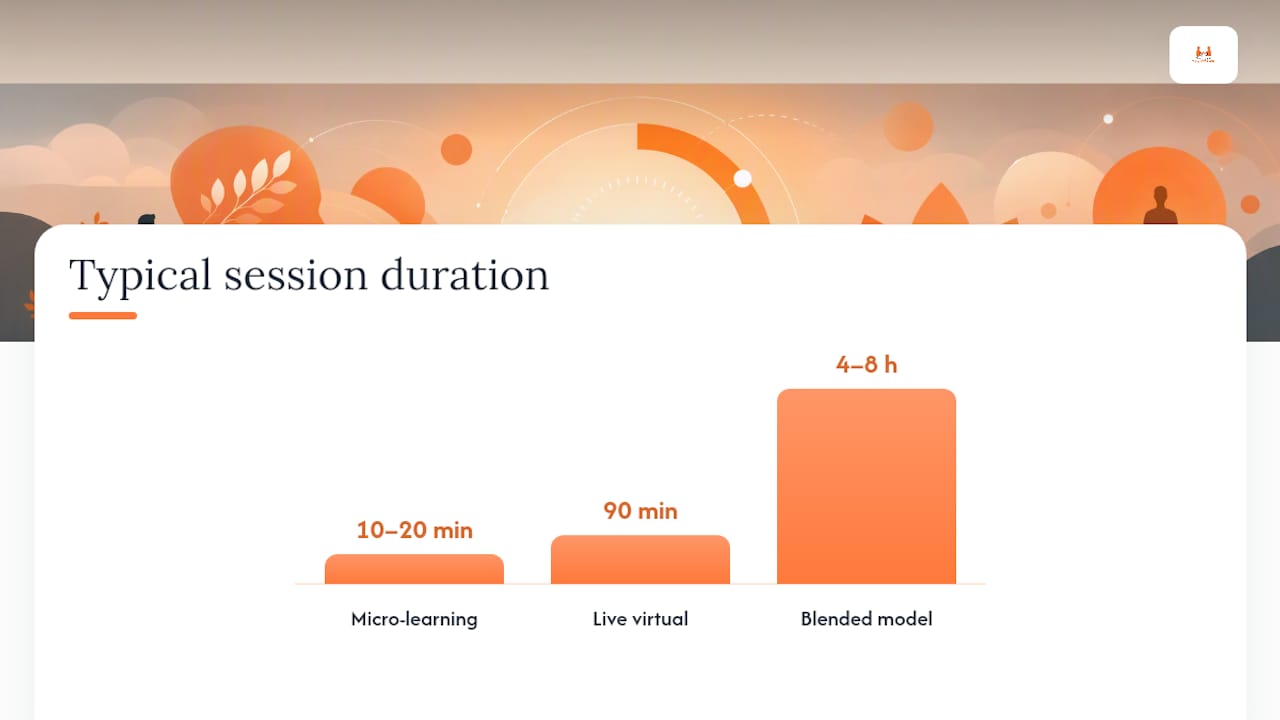
| Live virtual | Remote or distributed teams, multi-site orgs | 90 minutes per module | Requires strong facilitation to maintain engagement |
| Micro-learning modules | Reinforcement, shift workers, on-demand access | 10–20 minutes per module | Not sufficient as a standalone programme |
| Blended (workshop + coaching) | Most organisations; highest behaviour-change yield | 4–8 hours total over 4–6 weeks | Requires coordinator and follow-up infrastructure |
A blended model — one live session plus two or three shorter follow-up coaching touchpoints — produces the most durable behaviour change, particularly when structured coaching and follow-up are built into the design rather than added as an afterthought.
Attendance and logistics:
- Frontline supervisors: mandatory, prioritised in the first cohort
- People managers: mandatory
- Senior leaders: strongly recommended; their visible participation changes the culture signal
- Cohort size: 8–15 participants per session for meaningful roleplay practice
- Facilitator ratio: one facilitator per 12 participants for skills sessions; a co-facilitator helps with larger groups
- Shift workers and remote teams: schedule two identical sessions per cohort to cover coverage gaps
Procurement notes:
When requesting a quote or issuing an RFP, include success criteria in the brief. Require the vendor to state coach qualifications, data-handling practices, and IP ownership. Pilot before committing to a full rollout. A pilot with one team of 10–15 managers gives you real data before you spend the full budget.
What does a sample programme look like module by module?
This five-module sequence is designed for a blended delivery over four to six weeks. Adapt it to your organisation's size and existing training infrastructure.
-
Module 1 — Orientation and legal duties (60 minutes). Objectives: managers understand their OH&S responsibilities, the scope of the programme, and what it is not asking them to do. Activity: review of your organisation's psychological health policy; Q&A on confidentiality limits.
-
Module 2 — Spotting risk and early signals (90 minutes). Objectives: managers can name at least five early distress signals and distinguish between a bad week and a pattern. Activity: case vignettes drawn from the 13 Mental Health Job Aids for Managers published by the Canada School of Public Service; small group discussion.
-
Module 3 — Conversation skills (90 minutes). Objectives: managers can open a check-in conversation, listen without diagnosing, and close with a clear next step. Activity: paired roleplay using scripted prompts. Sample opening: "I've noticed you've seemed a bit off lately — I just wanted to check in. How are you doing?" Scripted escalation line for safety concerns: "What you're describing sounds serious. I want to make sure you're safe. Can we call the EAP together right now?"
-
Module 4 — Accommodations and return-to-work (60 minutes). Objectives: managers can draft a basic accommodation plan with modified duties, a phased schedule, and a follow-up date. CAMH's Mental Health Playbook for Business Leaders recommends return-to-work planning be concrete and ongoing, not a single event. Activity: complete a sample accommodation template.
-
Module 5 — Follow-up coaching session (45 minutes, 30 days post-training). Objectives: managers debrief a real conversation they have had since training; coach provides feedback and reinforcement. This session is where behavioural rehearsal consolidates into habit.
Credentialing: Issue a certificate of completion after Modules 1–4. For organisations wanting a recognised credential, align Module 3 with Mental Health First Aid (MHFA) competency standards and signpost managers to MHFA certification as a next step.
How do you measure whether the programme is working?
Measurement is where most programmes fail. They track completion rates and call it evaluation. That tells you who attended. It tells you nothing about whether anything changed.
Short-term (immediately post-training):
- Pre/post confidence self-assessment: a five-item scale asking managers to rate their readiness to initiate a mental health conversation
- Roleplay performance rubric scored by the facilitator
- Training satisfaction score (useful for logistics; not a proxy for learning)
Medium-term (3–6 months):
- Manager-initiated check-in frequency: tracked via a simple monthly self-report or calendar audit
- Referral rates to EAP: compare pre- and post-training referral volumes
- Absenteeism trends in trained versus untrained manager cohorts
- Time-to-return metrics for employees whose managers completed the programme
Long-term (6–12 months):
- Employee engagement scores in trained teams versus baseline
- Retention rates in trained cohorts
- Reduction in long-duration disability claims where measurable
A JMIR formative study suggests structured coaching and follow-up can improve manager confidence and short-term behaviour change. Treat that as promising, single-study evidence — not a guarantee — and build your own measurement baseline so you have your own data to stand on.
Reporting cadence: Run a 3-month pulse, a 6-month review, and a 12-month outcomes report. Share results with your executive sponsor in a one-page dashboard that links behaviour-change indicators to absenteeism cost estimates.
What are the legal, privacy, and safety risks in Canada?
The legal foundation is clear. Federal guidance places the duty to train supervisors squarely on the employer. Provincial OH&S legislation adds parallel obligations in most jurisdictions. Psychological harm is not excluded from those frameworks.
Privacy and confidentiality:
Managers are not clinicians. They do not hold clinical privilege. When a manager learns personal health information during a check-in, that information must be handled under your organisation's privacy policy and applicable provincial privacy legislation (PIPEDA federally; provincial equivalents where applicable). Coaching records should be kept separate from HR performance files. Involve legal counsel before designing your documentation system.
Crisis and harm-reduction protocol:
Every programme needs a written escalation flow before the first session runs. The flow should include:
- Step 1: Manager identifies a safety concern during a conversation
- Step 2: Manager uses the scripted escalation line and stays with the employee
- Step 3: Manager contacts EAP or occupational health immediately
- Step 4: If imminent risk, manager calls 9-1-1 and notifies HR
Managers need to practise this flow, not just read it. Include it in Module 3 roleplay.
Scope boundaries:
Managers are coaches and signposters. They are not therapists, diagnosticians, or case managers. The programme must state that boundary explicitly, in writing, in the participant materials. Training does not replace clinical care. Accommodation decisions require documented rationale and, in complex cases, occupational health or legal input.
What does a realistic rollout timeline look like?
Move through these steps in order. Skipping the needs assessment or the pilot is the most common reason programmes fail to scale.
- Define objectives and stakeholder map (Week 1–2): identify HR lead, OHS/occupational health contact, legal, EAP vendor, union reps if applicable, and executive sponsor.
- Conduct a needs assessment (Week 2–3): survey a sample of managers and employees; review existing absence and EAP data; identify gaps in current manager capability.
- Select and customise curriculum (Week 3–6): choose or build the five-module sequence; align to CSA Z1003 and your OH&S policy; confirm coach qualifications.
- Design the pilot (Week 6–7): select one team of 10–15 managers; set go/no-go criteria; establish your measurement baseline.
- Procure and contract (Week 6–8): issue RFP or direct quote request; require coach credentials, data-handling clauses, and IP terms; confirm pricing model.
- Launch pilot (Week 8–10): run Modules 1–4; collect pre/post data; schedule 30-day follow-up coaching.
- Evaluate and decide (Week 14–16): review pilot data against go/no-go criteria; present findings to executive sponsor; confirm rollout plan and budget.
- Scale rollout (Month 4 onward): sequence remaining cohorts by priority tier; sustain with quarterly follow-up coaching and annual refreshers.
Timeline by organisation size:
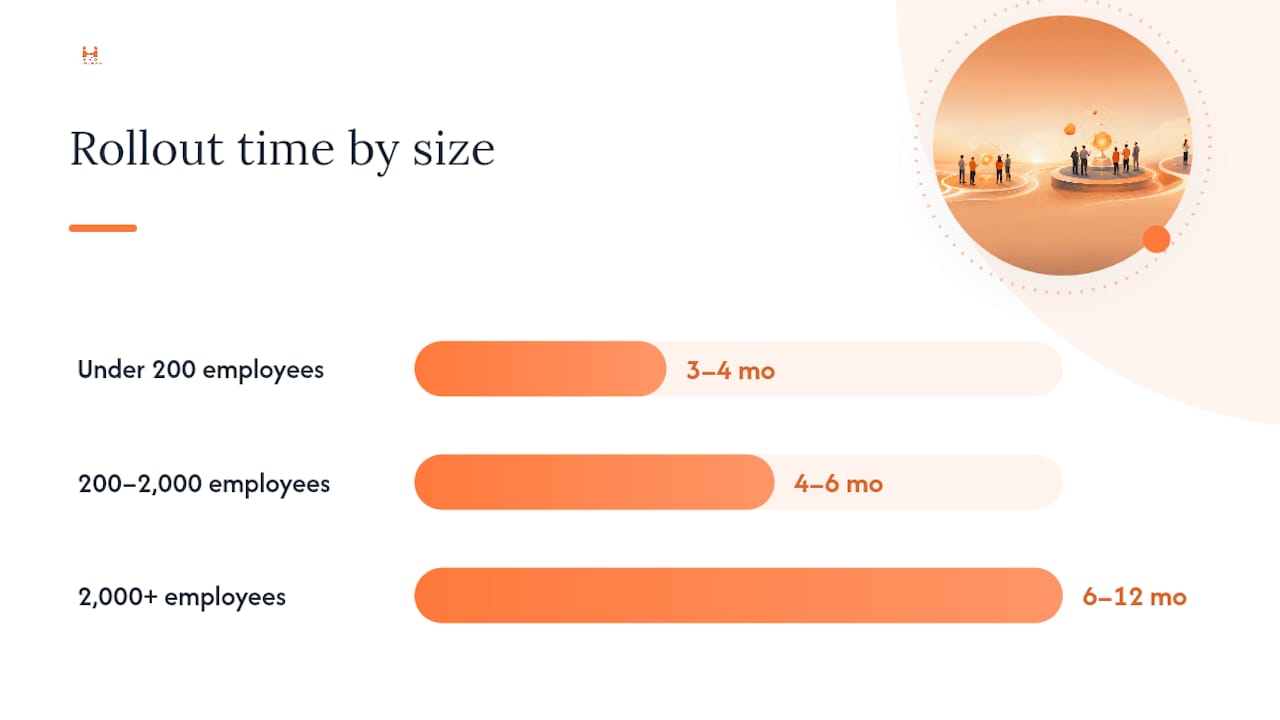
- Under 200 employees: pilot to full rollout in 3–4 months. Smaller organisations can start immediately with high-quality, low-cost resources; a bespoke programme is not a prerequisite.
- 200–2,000 employees: 4–6 months from needs assessment to full rollout.
- 2,000+ employees: 6–12 months; phase by business unit or geography.
Budget guidance: Pilot costs are typically lower than full rollout per-head costs. Build success criteria into your RFP so vendors know what outcome they are being held to, not just what content they are delivering.
How does The MentorWell design and deliver this for employers?
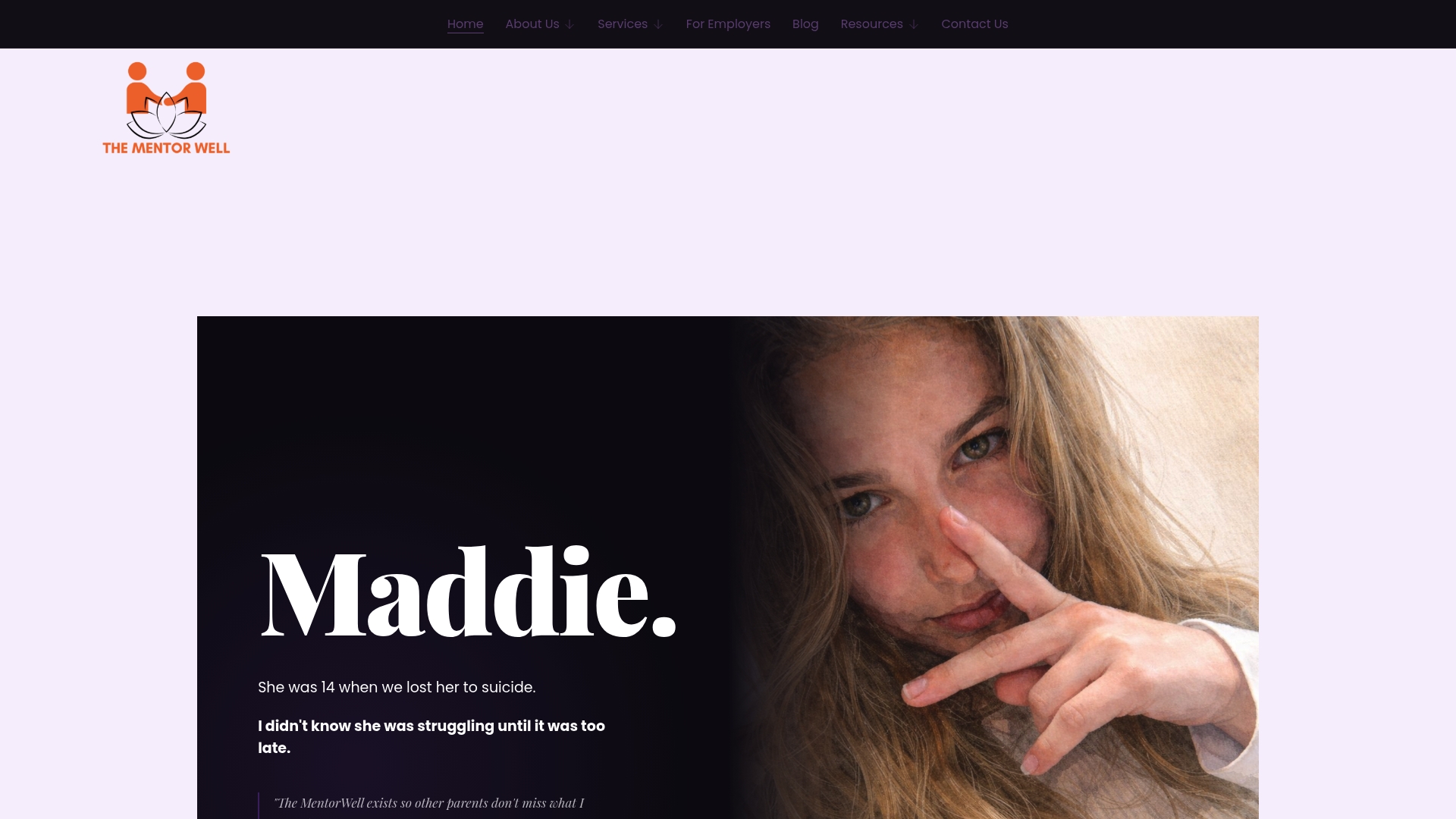
The MentorWell was founded by Chris Coulter after the loss of his daughter Maddie. The platform was built on one conviction: that early signals, seen and acted on, keep more doors open. That conviction shapes how The MentorWell approaches manager training.
For employer clients, The MentorWell delivers a blended programme that includes live workshops, on-demand modules, follow-up coaching sessions, and measurement templates your HR team can use immediately. The curriculum covers recognition, conversation skills, accommodations, and referral pathways. Roleplay practice is built into every live session. The International Coaching Federation notes growing integration of mental wellbeing into coaching practice as a leadership development pathway — that integration is central to how The MentorWell structures its manager coaching work.
The MentorWell's experience spans both family and workplace contexts, including supporting young employees and helping managers recognise distress signals in employees who are also caregivers. That dual lens matters when your workforce includes parents under pressure and young workers navigating their first mental health challenges at work.
Pricing is quote-based and pilot-first. HR teams can request a quote or book a discovery call directly through The MentorWell.
What I know about silence and why this programme has to be practical
I have sat with the weight of a signal I did not act on. That is not a metaphor. It is the thing I carry every morning on the dock with my coffee, watching the sun come up and asking the same question.
What would I have done differently if I had known what to look for.
That question is why I believe manager training has to be practical above everything else. Not theoretical. Not a compliance checkbox. A manager who can say, plainly and without flinching, "I noticed something. How are you?" keeps a door open that silence closes.
But I want to be honest about the limits. A trained manager is not a clinician. A good check-in conversation is not therapy. The programme described in this guide equips managers to notice, to ask, and to connect people to real support. It does not replace that support. The moment a manager tries to become the support, the boundary breaks and both people are worse off.
Keep the scope modest. Keep the practice real. That is where the value lives.
The MentorWell can help you pilot this now
Most HR teams know they need a manager mental health programme. The gap is between knowing and having something running. The MentorWell closes that gap with a pilot-ready package: live workshops, follow-up coaching, and measurement templates included from day one. No year-long implementation project required.
Pricing is quote-based. The MentorWell works with employers of all sizes across Canada, starting with a single pilot cohort so you have real data before committing to a full rollout. If you are ready to move from planning to action, request a quote or book a discovery call through The MentorWell's landing page today.
Sources
These are the primary references HR teams in Canada should consult when designing and aligning a manager mental health coaching programme.
- Canada
- CAMH’s Mental Health Playbook for Business Leaders
- Canada
- Standards for psychologically healthy and safe workplaces - CSA Group
- Burn-out an occupational phenomenon - WHO
- Formative (JMIR) study 2025
- ICF research on mental wellbeing in coaching - International Coaching Federation
This article is general information, not a substitute for advice from a qualified doctor. Consult a qualified healthcare professional about your own circumstances before acting on anything here.
FAQ
What is the National Standard CSA Z1003 and does it apply to my organisation?
CSA Z1003 is a voluntary national standard that provides a framework for promoting psychological health and preventing psychological harm in Canadian workplaces. Any Canadian organisation can adopt it regardless of size or sector, and many use it to structure their manager training obligations.
How long should a manager mental health coaching programme take?
A blended programme typically runs 4–8 hours of total contact time spread over four to six weeks, plus a 45-minute follow-up coaching session at 30 days. Shorter formats exist but are best used as reinforcement, not as a standalone programme.
Do managers need a formal certification to complete this training?
Formal certification is not legally required, but issuing a certificate of completion and aligning conversation-skills modules to Mental Health First Aid (MHFA) competency standards adds credibility and gives managers a recognised credential to point to.
How do we measure whether manager behaviour actually changed?
Track manager-initiated check-in frequency, EAP referral rates, and absenteeism trends in trained cohorts compared to a baseline. A JMIR formative study suggests structured coaching and follow-up can improve manager confidence and short-term behaviour change, though that finding should be treated as promising rather than definitive.
Can a small organisation run this programme without a large budget?
Yes. Smaller organisations can start with the free 13 Mental Health Job Aids for Managers and a single pilot cohort. A bespoke programme is not a prerequisite for impact, and The MentorWell's pilot-first model is designed specifically for organisations that want to test before committing to a full rollout.