
The strongest mentor training programs for youth mental health share three non-negotiable features: competency-based instruction, documented clinical supervision, and youth-led facilitation. If a programme cannot show you all three in writing, keep looking.
For parents and employers in Canada who need structured training quickly, here is where to start:
- The MentorWell offers workshops, mentor training modules, and digital tools including the Teen Signal Check, with supervised debriefing and evaluation built in.
- MHFA Canada's Supporting Youth course delivers 10 hours of blended training covering recognition, response, and first-aid level crisis support.
- Jack.org's Be There framework gives mentors and allies a structured, youth-informed approach to showing up safely for young people.
Pro Tip: Ask any provider for their supervision policy before you register. If they cannot produce a written document within 24 hours, that tells you something.
Table of Contents
- Why trained mentors matter for early youth mental-health support
- What every high-quality mentor training programme must include
- How to choose the right mentor training programme in Canada
- A practical implementation checklist for parents and employers
- Canada-available programmes and when to use them
- Safety, privacy, and legal checks before you enrol in Canada
- Key takeaways
- What I know now that I didn't know then
- The MentorWell can help you get started
- Useful sources and further reading
- FAQ
Why trained mentors matter for early youth mental-health support
A trained mentor is not a therapist. That distinction matters more than most people realise. What a mentor offers is something clinical services rarely can: a consistent, non-familial relationship where a young person can set their own goals and build trust at their own pace. Research on the Agenda Gap programme describes this as a "Third Space" mechanism, a counterspace outside family and school where youth develop adaptive responses and a sense of collective agency.

That space only stays safe when the mentor is trained. CADTH's health technology assessment on peer support for youth mental health found that formal programmes with trained workers who have access to ongoing debriefing may mitigate safety risks such as boundary breaches and confidentiality concerns. Without that structure, the same relationship that could help can quietly cause harm.
The evidence base is still developing. CADTH notes that overall, only a small amount of low-quality evidence is currently available, and calls for strengthened programme evaluation. That is not a reason to wait. It is a reason to measure what you do.
What every high-quality mentor training programme must include
Quality is not about length. A 10-hour MHFA course and structured therapeutic mentoring models with approximately 20 hours of pre-match training serve different purposes. What matters is whether the curriculum covers the right ground for the role.
| Training element | Why it matters | Minimum time anchor |
|---|---|---|
| Trauma-informed practice and active listening | Mentors working with youth who have experienced trauma need self-awareness and regulated responses | Embedded across all models |
| Boundary-setting and confidentiality | Prevents the most common safety failures in peer and mentor relationships | Covered in short-form (MHFA, 10 hrs) |
| Risk recognition and referral pathways | Mentors must know when and how to escalate, not manage alone | Required in all models |
| Cultural responsiveness | Inclusive programmes require mentors who reflect and respect the youth they serve | Embedded; explicit in CADTH guidance |
| Closure and exit procedures | Ending a match poorly causes real emotional harm to youth | Often omitted; literature flags this as a critical gap |
| Clinical supervision and debriefing | The primary safety mechanism for mentors and mentees alike | Ongoing; not a one-time event |
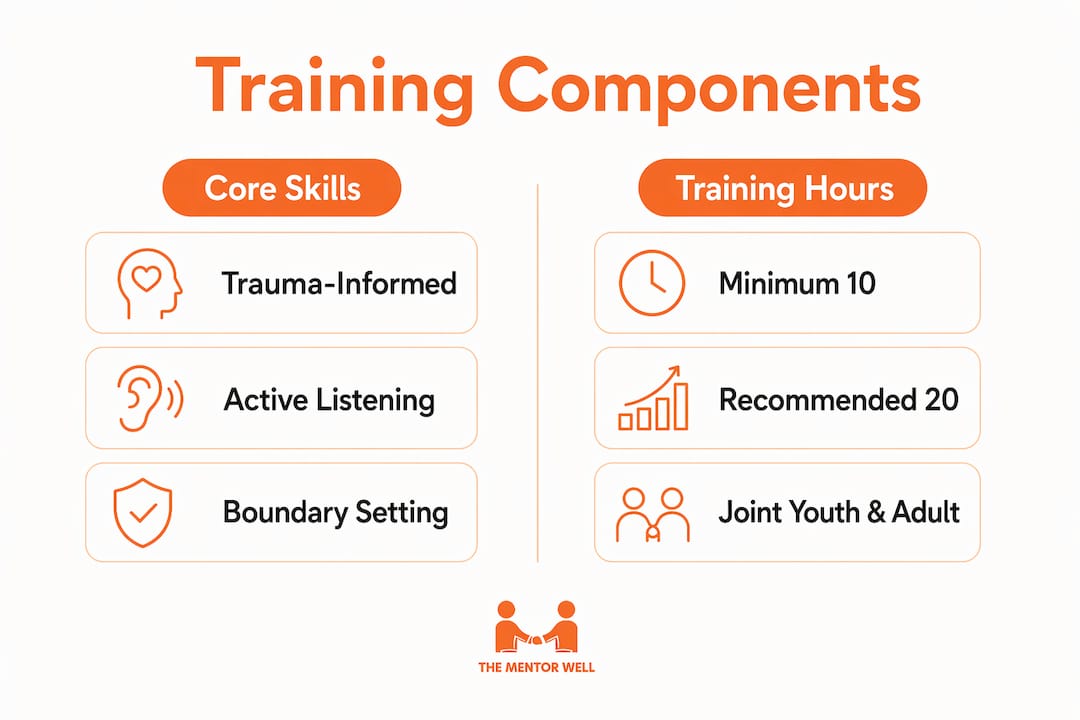
The RNAO recommends training youth and adult allies together at programme start. Joint training builds shared norms and positions mentors as facilitators and partners rather than problem-solvers. That shift in framing changes everything about how the relationship unfolds.
For structured therapeutic mentoring, Campus Connections used approximately 20 hours of pre-match training integrated with clinical supervision. Some high-intensity models may report more, but 20 hours is a common benchmark in the literature for structured approaches. Pro Tip: Pre-match training should include mentor self-care and trigger awareness. Vicarious trauma is a real risk when mentors work alongside youth who have experienced significant adversity.
How to choose the right mentor training programme in Canada
The decision comes down to fit, safety, and measurability. Here are the questions to ask any provider before you commit:
- What are the qualifications of your trainers, and do they have clinical backgrounds?
- What does your supervision model look like after training ends?
- Were youth involved in designing the curriculum?
- What evaluation metrics do you collect, and how often?
- What are your mandatory reporting and escalation procedures?
- What is your cost structure, and what is your refund or cancellation policy?
Walk away if you encounter any of these:
- No documented supervision model or a vague promise of "check-ins"
- Confidentiality rules that are not explained in plain language
- Claims that mentoring replaces or reduces the need for clinical care
- No evaluation data or outcome reporting from past cohorts
Your decision checklist before signing anything:
- Does the programme match the specific needs and age range of your youth population?
- Is delivery in-person, virtual, or hybrid, and does that fit your context?
- What is the realistic timeline from enrolment to a trained, supervised mentor?
- How will you measure outcomes, and who receives the reports?
A practical implementation checklist for parents and employers
Starting small is not a compromise. It is the right call.
Phase 1: Pilot (weeks 1–12)
- Define two or three measurable goals before recruiting anyone (e.g., mentor engagement rate, youth wellbeing check-in scores at baseline and week 12).
- Recruit a single cohort of mentors using a written role description, background checks, and scenario-based interviews.
- Complete training before any match is made.
- Assign a clinical supervisor or debrief facilitator from day one.
Phase 2: Ongoing supports
- Set a regular supervision schedule (bi-weekly minimum for new mentors).
- Use peer debrief groups so mentors can process difficult sessions together.
- Keep documentation templates simple but consistent: date, session summary, any concerns flagged.
- Build closure procedures into the programme from the start, not as an afterthought.
Pro Tip: Review your mental health support checklist for families alongside your pilot plan. Parallel family supports reduce pressure on the mentor relationship.
Canada-available programmes and when to use them
| Programme | Format | Training hours | Best for | Key verification |
|---|---|---|---|---|
| The MentorWell | Workshops, digital tools, supervised debriefing | Varies by module | Parents, employers, workplace pilots | Ask for evaluation templates and supervision model |
| MHFA Supporting Youth (MHFA Canada) | Blended (10 hours total) | 10 hours | Quick staff upskilling, parent awareness | Confirm facilitator certification |
| Jack.org Be There | Online, self-paced | Not publicly listed | Youth allies, peer supporters | Review youth-involvement in curriculum |
| Therapeutic mentoring models (university/agency) | In-person, clinical supervision required | ~20 hrs pre-match | Complex needs, clinical settings | Verify licensed clinician oversight |
| High-intensity models (e.g., youth-in-care programmes) | In-person, structured | Benchmarks range from 20 to 40 hrs pre-match | Youth with significant trauma histories | Confirm supervision ratio and documentation |
How to pick by need: if you need staff upskilled quickly, MHFA Canada's 10-hour Supporting Youth course is the most accessible starting point in Canada. For structured therapeutic mentoring with clinical oversight, look to university-affiliated or agency-based models. For community peer support, formalised programmes with paid peer workers and documented debriefing are the safer route.
Availability checklist before you enrol:
- Is the programme available in your province, or does it offer a verified virtual option?
- Is the cost structure transparent, and are there subsidies or employer funding options?
- Can it scale if your pilot succeeds?
Safety, privacy, and legal checks before you enrol in Canada
These are not optional steps. They are the difference between a programme that helps and one that creates liability.
- Request written supervision policies and mandatory reporting procedures before signing any agreement.
- Ask where participant data is stored and whether consent processes for minors meet provincial requirements. PIPEDA applies to many private-sector programmes; provincial health privacy legislation may also apply depending on your context.
- Confirm the provider carries adequate insurance and that the duty of care is clearly assigned in writing.
- Verify that the programme has documented closure protocols. A paraprofessional mentoring framework recommends explicit role delineation and professional supervision as baseline requirements, not add-ons.
CADTH's assessment notes that the safety of peer support programmes is currently unknown from a research-evidence standpoint. That makes your own governance checks more important, not less.
Pro Tip: Ask the provider directly: "What happens when a match ends badly?" If they do not have a clear answer, that is a gap in their programme design.
This article provides general information only. Confirm current provincial regulations and programme requirements with the relevant authorities or a qualified professional for your specific situation.
Key takeaways
Mentor training programmes for youth mental health are only as safe and effective as the supervision, evaluation, and youth involvement built into them from the start.
| Point | Details |
|---|---|
| Supervision is non-negotiable | Walk away from any programme that cannot show a written, ongoing clinical supervision model. |
| Start with a pilot | A 6–12 week pilot with measurable goals protects youth and gives you real data before you scale. |
| Train youth and adults together | Joint training, as recommended by RNAO, builds shared norms and keeps youth in the lead. |
| Closure procedures prevent harm | Programmes that skip exit training risk serious emotional harm when matches end. |
| The MentorWell | Offers workshops, the Teen Signal Check, and supervised debriefing for parents and employers running pilots. |
What I know now that I didn't know then
I missed things. Not because I wasn't paying attention. Because I didn't know what to look for, and no one had ever told me plainly what a trained mentor could have meant for Maddie.
That is the whole reason The MentorWell exists. Not to lecture. Not to alarm. Just to say: there are people who can be trained to hold that space for your kid or your employee's kid, and the training matters enormously. A mentor without structure is just a well-meaning adult. A mentor with competency training, supervision, and clear protocols is something your young person might actually lean on.
Try a pilot. Measure it. See what it does.
That is all I am asking.
The MentorWell can help you get started
Every parent and employer who has read this far already knows something is at stake. The MentorWell was built for exactly that moment: before the crisis, when there is still time to put something real in place.

The MentorWell's mentor training and workshop programmes give parents and employers a structured path from awareness to action. The Teen Signal Check helps you identify what you are actually seeing in a young person. The mentor training modules cover the core competencies this article describes. Supervised debriefing and evaluation templates are built into the programme, not bolted on later.
Getting started takes three steps: assess your need using the Teen Signal Check, run a single pilot cohort with defined goals, then measure and decide whether to scale. Employers can request a workplace demo. Parents can start with a workshop.
Visit thementorwell.com to book a pilot or request an employer demo. The window for early intervention is real, and it does not stay open indefinitely.
Useful sources and further reading
These are the primary sources behind the claims in this article. Each one is worth reading directly if you are building or evaluating a programme.
| Source | What it offers |
|---|---|
| CADTH HTA: Peer Support for Youth Mental Health | Evidence review and safety caveats for formal peer support programmes in Canada; essential for governance decisions |
| Therapeutic Mentoring Scoping Review (PMC) | Programme design, supervision requirements, and training hour benchmarks for therapeutic mentoring models |
| RNAO | Youth engagement and joint youth-adult training guidance; foundational for curriculum design |
| Alberta Mentoring Review: Mentoring Youth in Care | Training topics that predict positive outcomes; closure protocol evidence |
| MHFA Supporting Youth Course Outline | Full breakdown of the 10-hour blended course for adults working with young people |
| Agenda Gap Realist Evaluation (PLOS Mental Health) | Evidence for the Third Space mechanism and youth-adult facilitation in Canadian mental health promotion |
| McQuillin et al. Paraprofessional Mentoring Framework | Role delineation, supervision requirements, and task-shifting limits for paraprofessional mentors |
FAQ
What are mentor training programs for youth mental health?
Mentor training programmes teach adults or peers the skills to support young people's mental wellbeing through structured, supervised relationships. Quality programmes cover trauma-informed practice, boundary-setting, risk recognition, and referral pathways.
How many training hours does a mentor need before working with youth?
It depends on the model. Short-form certification such as MHFA Supporting Youth takes 10 hours and covers first-aid level response. Structured therapeutic mentoring models typically require around 20 hours pre-match, with some high-intensity programmes reporting more depending on the setting.
Is clinical supervision required for mentor programmes in Canada?
Clinical supervision is not universally mandated by law, but it is the primary safety mechanism identified by CADTH and the therapeutic mentoring literature. Any programme working with youth who have mental health concerns should have a documented supervision model with a qualified clinician.
How do I verify a mentor training programme is safe for my workplace or family?
Request written supervision policies, mandatory reporting procedures, and confidentiality protocols before enrolling. Confirm data storage practices meet provincial privacy requirements, and ask specifically what the programme does when a match ends.
Where does The MentorWell fit among mentor training options in Canada?
The MentorWell provides workshops, mentor training modules, the Teen Signal Check, and supervised debriefing for parents and employers. It is designed for early intervention pilots in family and workplace settings, with evaluation templates built into the programme from the start.
Recommended
- Youth mental health training benefits: a guide for parents
- Mentorship Matters: This Wisdom Will Help Fast Track Your Career — THE MENTOR WELL
- MentorWell Info Guide Landing Page | Find Your Ideal Mentor Today — THE MENTOR WELL
- The Thriving Zone: The Gap Between Parenting and Therapy Teens Need — THE MENTOR WELL