
TL;DR:
- A mental health first aid program teaches people to recognize signs of a crisis and connect individuals to support early. Proper implementation requires organizational readiness, leadership commitment, and documented protocols beyond training. Without a referral network and clear procedures, MHFA training alone cannot effectively improve mental health support.
A mental health first aid program is a structured training system that teaches people to recognise the early signs of a mental health crisis and connect individuals to appropriate support before the situation worsens. The industry standard for this training in Canada is Mental Health First Aid (MHFA), a certification developed and governed by the Mental Health Commission of Canada. 1 in 5 Canadians experiences a mental health challenge annually. That number tells you how many people in any given school, workplace, or community are already struggling while the people around them wait for something obvious to happen. For community leaders, educators, and HR professionals working with youth and young adults, building this kind of programme is not a policy checkbox. It is the difference between catching something early and finding out too late.
What do you need before you create a mental health first aid program?
Organisational readiness comes before any training date is booked. You need a clear picture of who will be trained, who will lead the programme, and what happens after someone completes the course.
MHFA certification courses cost $125–$250 per participant and run in both in-person and virtual formats. Group sessions typically require a minimum of eight participants. That minimum matters because the learning model is built around peer discussion and scenario practice, not passive instruction.
| Format | Typical cost per person | Minimum group size | Duration |
|---|---|---|---|
| In-person | $175–$250 | 8 participants | 2 days |
| Virtual (live) | $125–$175 | 8 participants | 2 days |
| Blended | $150–$200 | 8 participants | 2 days |
Before you schedule anything, confirm these prerequisites are in place:
- A designated programme coordinator who owns logistics and follow-up
- HR or leadership sign-off on the programme's scope and purpose
- A written policy that defines what trained staff are and are not expected to do
- A list of internal and external referral contacts ready before the first session runs
- Clarity on confidentiality obligations under applicable provincial privacy legislation
Pro Tip: Do not wait until training is complete to build your referral list. Participants will ask "What do I do after I notice something?" on day one. Have the answer ready.
The certification lasts three years. Build renewal cycles into your planning calendar from the start so the programme does not quietly expire.
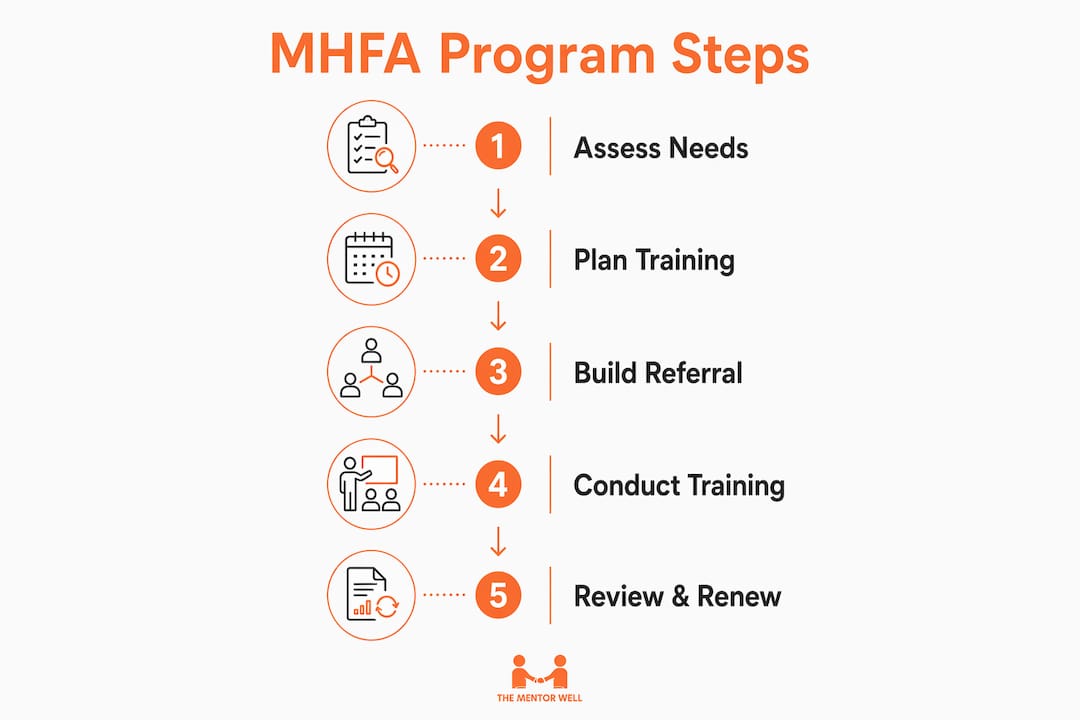
How to implement a mental health first aid training programme step by step
Implementation fails most often at the edges, not the centre. The training itself is well-designed. What collapses is everything around it.
- Secure leadership commitment. Visible support from school principals, HR directors, or community board chairs signals that this is not optional. Without it, participation stays low and follow-through disappears.
- Select a certified MHFA instructor or training partner. Instructors must be accredited through the Mental Health Commission of Canada. Verify credentials before signing any agreement.
- Define your participant group. For youth-focused programmes, prioritise teachers, coaches, youth workers, HR staff, and anyone in a supervisory or mentorship role. These are the people most likely to notice a change before it becomes a crisis.
- Schedule sessions and manage enrolment. Two-day formats work best when scheduled on consecutive days. Splitting sessions across weeks reduces retention and disrupts the emotional continuity of the learning.
- Assign pre-work. Most MHFA courses include pre-reading or short online modules. Participants who complete pre-work engage more deeply with scenario-based exercises during the live training. Those exercises are where practical confidence actually builds.
- Run the training with full participation expectations. Attendance policies matter here. A participant who misses half a day cannot be certified and cannot reliably apply what they have learned.
- Issue certification and document completion. MHFA certification is valid for three years. Keep records centrally so you know exactly when renewals are due.
Pro Tip: Schedule a 30-minute debrief session within one week of training completion. Ask participants what they would do if they noticed a warning sign tomorrow. The answers will tell you exactly where your protocol still has gaps.
The goal of implementation is not a certificate on a wall. It is a person in a hallway who knows what to say, and what to do next.

How to integrate MHFA training with workplace and community protocols
Training alone does not protect anyone. MHFA programmes need documented HR protocols that define escalation triggers and confidentiality standards to function as intended. Without that infrastructure, trained staff are left improvising in moments that require clarity.
Escalation triggers include any disclosure of disability, risk of harm, substance use affecting safety, repeated unexplained absences, or reports of harassment. Each of these requires a defined response pathway, not a judgment call made in the moment.
Key elements of an effective supporting protocol:
- Documented escalation pathways that specify who is contacted, in what order, and within what timeframe
- Confidentiality guidelines that protect the individual while allowing necessary disclosures for safety
- Accommodation and return-to-work procedures that connect MHFA observations to formal HR processes
- A referral network that goes beyond a single Employee Assistance Programme. EAPs are valuable but insufficient as the only option. Programmes need multiple community and clinical resource pathways, including mental health resources across Canada that are accessible to youth and families
- Regular protocol reviews at least annually, or after any significant incident
Pro Tip: Map your referral network before training begins. A trained staff member who cannot name a single next step outside the EAP is not equipped to help.
Confidentiality and respectful documentation are not just legal requirements. They are the foundation of trust. If young people or employees believe that speaking up will follow them in a file, they will not speak up. The protocol has to make safety feel safer than silence.
What are the most common pitfalls when building a mental health first aid programme?
The most common failure is treating MHFA training as a standalone event. Training without documented response processes and referral networks limits impact to the classroom and leaves people without direction when a real situation unfolds.
These are the pitfalls that consistently undermine programmes:
- Unclear escalation triggers. When staff do not know what qualifies as a situation requiring action, they either overreact or do nothing. Both outcomes cause harm.
- Managers acting as clinicians. MHFA training does not make someone a therapist. The role is to notice, respond with care, and connect. Crossing into clinical territory damages trust and creates liability.
- Confidentiality breaches. Sharing information beyond what is necessary for safety erodes the entire programme. One breach can silence a community for years.
- Over-reliance on the EAP. An EAP is one door. Programmes that treat it as the only door leave people stranded when it does not fit their situation or has a wait time of weeks.
- No follow-through after training. Momentum dies without reinforcement. Monthly check-ins, refresher discussions, and visible leadership engagement keep the culture alive between certification cycles.
"MHFA success depends on infrastructure: communication, role clarity, and escalation pathways are vital. The training is the beginning, not the solution."
The peer support integration piece is often the most underused. Trained peers who check in informally, without pressure or documentation, are sometimes the first real contact a struggling young person accepts.
Key takeaways
A mental health first aid programme only works when MHFA certification is backed by documented escalation protocols, a real referral network, and sustained organisational commitment.
| Point | Details |
|---|---|
| Certification is the starting point | MHFA certification costs $125–$250 per person and is valid for three years; plan renewals from day one. |
| Protocols must exist before training | Escalation triggers, confidentiality rules, and referral contacts must be documented before the first session runs. |
| Referral networks need depth | EAPs alone are insufficient; programmes require multiple community and clinical pathways for youth and adults. |
| Managers are not clinicians | Trained staff notice, respond, and connect. They do not diagnose, counsel, or manage clinical care. |
| Culture outlasts the course | One training event changes nothing; ongoing reinforcement, peer support, and leadership visibility sustain impact. |
What I have learned about the window that closes
I have sat with a lot of parents who said they saw something but were not sure what to do with it. I was one of them.
The thing about mental health first aid training is that it does not give you certainty. It gives you permission to act before you are certain. That is the part nobody tells you. Most people wait for proof. They wait for the obvious sign, the clear statement, the undeniable moment. And sometimes that moment never comes in a form you recognise until it is already over.
I built The MentorWell because I know what it feels like to have the information arrive too late. The early warning signs in youth are quiet. A shift in sleep. A withdrawal from something they used to love. A flatness in the voice that you almost miss because you are busy, because life keeps moving, because you tell yourself it is probably just a phase.
MHFA training does not fix that. But it changes the question you ask yourself. Instead of "Is this serious enough to say something?" you start asking "What do I do now that I have noticed?" That shift is not small. It is the whole thing.
What I would tell any educator, HR professional, or community leader reading this: build the programme, yes. But also build the habit of paying attention before the programme is even in place. The protocol matters. The paperwork matters. The certification matters. And none of it matters as much as the moment someone decides to say something instead of waiting.
— Chris Coulter
How The MentorWell supports your mental health programme
The MentorWell was built for exactly this work. Whether you are an HR professional putting together a workplace mental health programme or a community leader trying to reach youth before a crisis takes hold, the resources here are grounded in real experience, not theory.

The MentorWell offers workshops, coaching, and tools like the Teen Signal Check, an assessment designed to help parents, educators, and caregivers identify subtle warning signs in young people aged 8 to 25. The platform also connects you to a broader community of families and professionals who are doing this work alongside you. If you are ready to take the next step in building a programme that actually holds, start with The MentorWell and find the support that fits your context.
FAQ
What is mental health first aid (MHFA)?
Mental health first aid is a structured training programme that teaches people to recognise and respond to mental health crises and connect individuals to appropriate support. In Canada, MHFA certification is governed by the Mental Health Commission of Canada and is valid for three years.
How much does MHFA certification cost in Canada?
MHFA certification courses cost $125–$250 per participant, depending on format. Both in-person and virtual options are available, and most sessions require a minimum of eight participants.
What HR protocols should support an MHFA programme?
Effective programmes require documented escalation triggers, confidentiality guidelines, accommodation procedures, and a referral network that extends beyond a single EAP. Without these, trained staff lack the direction to act consistently.
How do I know when to escalate a mental health concern at work or school?
Escalation is required when someone discloses a disability, expresses risk of harm, shows substance use affecting safety, has repeated unexplained absences, or reports harassment. These triggers should be written into your protocol before training begins.
Can MHFA training work for youth-focused programmes?
MHFA training is effective in youth settings when it is delivered to the adults around young people: teachers, coaches, youth workers, and HR staff. Pairing certification with referral pathways in Canada that are accessible to youth and families significantly increases programme impact.