
Youth mentorship programs, as used here, are family- and parent-focused coaching, peer support, and structured guidance designed to help caregivers identify early signs of emotional distress in young people aged roughly 8–25. The goal is prevention, not crisis response. For Canadian families and HR teams looking for a place to start, The MentorWell is a Canada-ready option built specifically for this purpose.
- Primary goal: early identification and prevention of youth mental-health crises before they escalate, using structured tools, coaching, and peer support for caregivers.
- Who benefits: youth (earlier support, better outcomes), parents and caregivers (confidence, reduced isolation), and employers (lower absenteeism, stronger retention, clearer legal footing under the Canadian Human Rights Commission caregiver guidance).
Book an employer briefing or explore the free Teen Signal Check assessment at The MentorWell.
Key takeaways
Early-detection youth mentorship programmes work best when parents and employers act before signs become a crisis, using structured tools, qualified facilitators, and peer support grounded in lived experience.
| Point | Details |
|---|---|
| Start with a screening tool | The Teen Signal Check gives parents a structured way to identify warning signs in youth aged 8–25 before distress escalates. |
| Know your legal footing | Canadian employers have accommodation obligations under CHRC caregiver guidance; manager training reduces both legal risk and absenteeism. |
| 70% rule applies here | Many serious mental-health challenges begin in youth or early adulthood, making early-detection programmes a prevention investment, not a reactive one. |
| Cultural fit is non-negotiable | Programmes like Nurturing the Seed show that culturally adapted, relationship-based models produce better engagement, especially for Indigenous families. |
| The MentorWell | Offers workshops, coaching, the Teen Signal Check, and a parent peer community; employers can book a briefing, parents can start free. |
Table of Contents
- What do youth mentorship programs actually look like?
- How these programs help youth, parents, and employers
- Who are these programs designed for?
- How do you choose the right programme?
- How to implement a programme at home or in your organisation
- Why The MentorWell is a recommended Canadian option
- What I wish I had known sooner
- The MentorWell is ready when you are
- Useful Canadian resources
- Sources
- FAQ
What do youth mentorship programs actually look like?
These programmes are not tutoring. They are not therapy. They sit in the space between a worried parent and a clinical referral, and they work by building the caregiver's ability to notice, name, and respond to what they are seeing in their child.
Four core formats exist across the Canadian market:
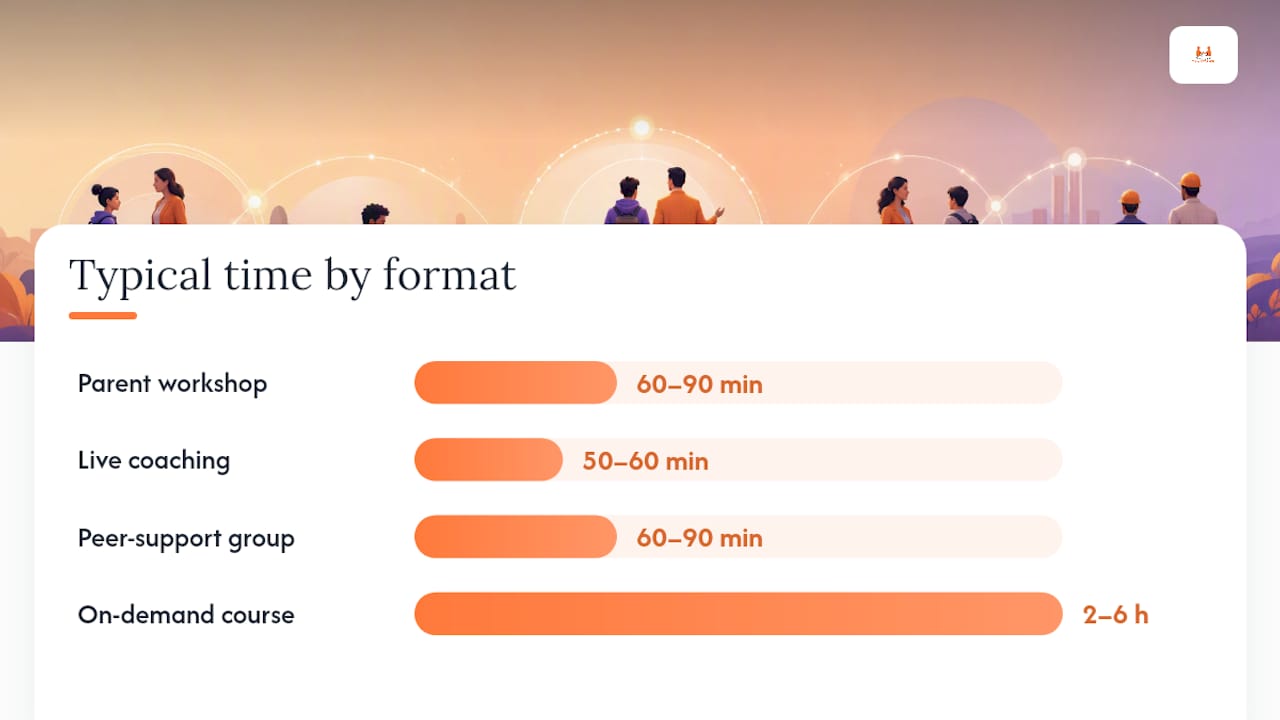
| Format | Screening included | Facilitator type | Typical session length | Commitment |
|---|---|---|---|---|
| Parent workshop | Yes (intake tool) | Trained facilitator | 60–90 minutes | Single session or series |
| Live coaching (caregiver/manager) | Yes (check-in tool) | Certified coach or counsellor | 50–60 minutes | 4–8 week sequence |
| Parent peer-support group | Informal | Peer worker with lived experience | 60–90 minutes | Ongoing, drop-in or weekly |
| On-demand digital course | Self-directed (e.g., Teen Signal Check) | Pre-recorded, facilitator-reviewed | Self-paced | 2–6 hours total |
Kelty Mental Health describes trained Family Peer Support workers who offer compassionate, lived-experience support and system navigation for parents. That peer model sits alongside more structured coaching and is often the entry point families use first.
Picture this: a parent notices their 14-year-old has stopped eating dinner with the family. They complete a Teen Signal Check-style intake tool online, identify three moderate warning signs, and book a 60-minute coaching session. The coach reviews the results, recommends two specific conversation approaches, and schedules a four-week follow-up. No waitlist. No referral required. The window stays open.

Understanding what teen mental health coaching actually involves helps parents decide whether coaching, a workshop, or peer support is the right first step.
How these programs help youth, parents, and employers
Many serious mental-health challenges begin in youth or early adulthood, which means most crises that reach emergency rooms or school counsellors were preceded by years of quieter signals. Early-detection programmes exist to catch those signals while the window is still open.
For youth: earlier support reduces the likelihood of crisis escalation and builds de-escalation skills the young person carries forward.
For parents and caregivers: structured guidance reduces isolation, builds confidence in navigating the mental-health system, and shortens the gap between noticing something and doing something about it.
For employers: working parents who feel supported are less likely to miss work, more likely to stay, and more productive when present. Employer benefits designed for working parents — including modern EFAPs and flexible mental-health spending — can improve retention outcomes.
The legal dimension matters here. The Canadian Human Rights Commission frames family status as a protected ground. Federally regulated employers who ignore caregiver burdens risk both legal and operational consequences. Manager training and flexible arrangements are not optional extras; they are part of the accommodation obligation. Measurable outcomes to track include referral rates to clinical services, employee engagement scores, and reduction in unplanned absences tied to family mental-health events.
Who are these programs designed for?
The age range of 8–25 is intentional. Pre-teens (8–12) show distress differently than teenagers, and young adults in post-secondary settings face a distinct set of pressures. A good programme distinguishes between these bands rather than treating them as one audience.
Specific audiences who benefit most:
- Parents of pre-teens noticing early behavioural shifts (withdrawal, sleep changes, school avoidance)
- Caregivers of teenagers navigating anxiety, mood instability, or social isolation
- HR teams and managers supporting employees with caregiving responsibilities
- Indigenous families and communities where culturally adapted models are not just preferred but necessary
On that last point: Nurturing the Seed uses Developmental Support Plans, culturally relevant tools, and a web app to support early-childhood mental health with a relationship-based, caregiver-led approach. Similarly, community-driven programmes like Listening to One Another to Grow Strong (LTOA) at McGill University adapt wellness activities for Indigenous communities without positioning them as clinical treatment. These models matter because a programme that does not reflect a family's cultural context will not be used.
For rural and remote families, virtual delivery is not a compromise; it is often the only realistic option. Look for programmes that offer live video coaching, asynchronous course content, and community forums that do not require travel.
How do you choose the right programme?
Must-have features: clinical oversight or partnership, qualified facilitators, lived-experience peer support, a clear privacy and data policy, a defined age range, and measurable outcomes.
Nice-to-have features: employer reporting dashboards, bilingual delivery, sliding-scale fees, and integration with existing EFAPs.
Questions for parents:
- What screening or assessment tool do you use at intake?
- Who reviews the results, and what are their qualifications?
- How is my child's information stored and who can access it?
- What is the difference between your coaching and clinical therapy?
- How do you handle a disclosure of immediate risk?
- What does follow-up look like after the first session?
- Is there a parent peer-support component?
Questions for HR teams:
- Can you provide aggregate (de-identified) outcome data from previous employer pilots?
- How does your programme align with our accommodation obligations under the CHRC guidance?
- What training do facilitators hold?
- How do you handle employee confidentiality within a workplace contract?
- What does a standard manager training module cover, and how long does it run?
- Do you offer a pilot cohort option before full rollout?
- Can the programme integrate with our existing EFAP or benefits platform?
- What metrics do you report back to HR?
Red flags to avoid:
- Vague outcome claims with no supporting data or pilot notes
- No published privacy or data-handling policy
- Sole reliance on unvalidated screening tools
- Pressure to purchase add-ons before completing a trial session
Pro Tip: Ask any provider for a short outcome report or pilot summary. Even a one-page summary of a small cohort tells you whether the programme tracks anything beyond attendance. A provider who cannot produce one has not been measuring what matters.
Reading what to look for in mentor training programmes helps you evaluate facilitator qualifications before you commit.
How to implement a programme at home or in your organisation
For families (1–4 weeks): Start with a free digital assessment tool like the Teen Signal Check. Review results, identify one or two priority areas, and book a single coaching session to discuss next steps. Most on-demand courses can be completed in under six hours across two weeks.
For employers (6–12 weeks): Week 1–2: needs assessment and stakeholder alignment. Week 3–4: select a provider and define the pilot cohort (typically 10–20 managers). Week 5–8: deliver the pilot workshop series. Week 9–12: collect feedback, review aggregate outcome data, and decide on full rollout.
Cost drivers include per-workshop fees, per-family course access, facilitator travel for in-person delivery, and customisation for your industry or workforce. On-demand digital programmes carry the lowest per-user cost; bespoke employer workshops sit at the higher end.
HR procurement checklist:
- Conduct a needs assessment with at least one HR and one operations stakeholder
- Define pilot cohort size and success metrics before signing
- Confirm facilitator qualifications and clinical oversight arrangements
- Complete an employee privacy review and confirm alignment with CHRC accommodation guidance
- Schedule a debrief at week 12 to review referral rates and engagement data
Family privacy and consent checklist:
- Ask how screening results are stored and for how long
- Clarify the difference between parental consent and youth assent for participants aged 14 and older
- Confirm whether results are shared with schools, employers, or third parties
- Ask what happens to your data if you cancel
A mental health support checklist for families can help you triage next steps before your first provider conversation.
Why The MentorWell is a recommended Canadian option
The MentorWell was built around one question: what would have changed the outcome if a parent had known earlier? Its offerings map directly to the must-have criteria above.
- Teen Signal Check: a digital assessment tool for parents and caregivers to identify subtle warning signs in youth aged 8–25; free to use and clinically informed
- Parent workshops: structured sessions covering early detection, conversation frameworks, and escalation pathways
- Live and on-demand coaching: for parents and managers, delivered in 50–60 minute sessions across a 4–8 week sequence
- Parent peer community: a supported space connecting caregivers who are navigating similar situations
- Employer workshops: manager training modules covering recognition, accommodation, and referral, aligned with CHRC caregiver guidance
A sample workshop runs across three modules: (1) recognising early warning signs and what they mean, (2) having the conversation without closing the door, and (3) navigating next steps and knowing when to refer. Each module runs approximately 60–90 minutes.
The MentorWell was founded by Chris Coulter in memory of his daughter Maddie. The platform's clinical oversight and facilitator training reflect a commitment to evidence-informed practice, not just good intentions. Privacy commitments are built into the platform's design: screening data is not shared with schools, employers, or third parties without explicit consent.
Parents can start with the free Teen Signal Check. HR teams can book an employer briefing directly through The MentorWell.
What I wish I had known sooner
There was a morning I sat at the kitchen table with a coffee going cold, and I knew something was wrong. Not crisis-wrong. Just quiet-wrong. The kind of quiet that a busy parent explains away because explaining it away is easier than sitting with what it might mean.
I know now that the window does not stay open forever. Not because of anything dramatic. Just because kids get older, and the distance grows, and the moments where they might have said something pass without anyone noticing they were moments at all.
The parents I talk to are not negligent. They are tired. They are working. They are doing what most of us do, which is waiting for something obvious before we act. What I want to tell them, plainly, is that obvious usually comes too late.
You do not need to have all the answers. You need to be paying attention a little earlier than you think you need to be.
The MentorWell is ready when you are
Early detection does not require a crisis. The MentorWell gives parents and employers three low-friction ways to start: the free Teen Signal Check assessment, a pilot employer workshop for manager teams, and a parent starter course available on demand.
Every programme is built on evidence-informed practice, with clinical oversight and a clear privacy commitment. Screening results stay with you. No data is shared without your explicit consent.
Parents can start with the free assessment today. HR teams looking to pilot a manager workshop can reach out through the same page to book an employer briefing. The conversation is worth having before you need to have it.
Useful Canadian resources
FamilySmart offers free, parent-led peer support, online events, and a resource library for families navigating child and youth mental-health challenges. No referral needed.
Kelty Mental Health Resource Centre connects families with trained Family Peer Support workers who provide non-judgemental navigation and lived-experience mentorship across BC.
Help Starts Here (BC) lists intake routes, free clinics, virtual services, and peer supports for families supporting youth. Other provinces have equivalent portals; search "[province] youth mental health help" for your regional hub.
PLEO (Parent Lifeline of Eastern Ontario) provides helplines, parent support groups, and mobile support that work alongside clinical and paid programme pathways.
Nurturing the Seed supports early-childhood mental health with culturally relevant, caregiver-led tools and Developmental Support Plans.
Free services are a legitimate starting point. Paid programmes like The MentorWell add structure, clinical oversight, and measurable outcomes that free peer support alone does not provide. Most families use both.
This article is general information, not a substitute for advice from a qualified doctor. Consult a qualified healthcare professional about your own circumstances before acting on anything here.
Sources
- Creating a caregiver-friendly workplace - A guide for federally regulated employers | Canadian Human Rights Commission
- Seeking help for families supporting youth | Help Starts Here (BC)
- Nurturing the Seed | Infant and Early Mental Health Promotion
- Peer support for families | Kelty Mental Health Resource Centre
FAQ
What age range do these programmes cover?
Most family-focused youth mentorship and early-detection programmes serve youth aged 8–25, with distinct approaches for pre-teens, teenagers, and young adults in post-secondary settings.
How is a youth mentorship programme different from therapy?
These programmes focus on caregiver coaching, early detection, and peer support rather than clinical treatment. When a screening tool identifies elevated risk, the programme's role is to support the family in accessing the right clinical care, not to replace it. The difference between therapy and coaching is worth understanding before you choose a provider.
Do Canadian employers have legal obligations related to caregiver mental health?
Yes. The Canadian Human Rights Commission identifies family status as a protected ground, and its caregiver workplace guide outlines accommodation obligations including flexible arrangements and manager training for federally regulated employers.
How do I know if a programme is evidence-informed?
Ask for a pilot summary or outcome report. Look for clinical oversight, qualified facilitators, a published privacy policy, and a validated screening tool. A programme that tracks referral rates, engagement, and follow-up completion is measuring what matters.
Where can a Canadian family start for free?
FamilySmart and Kelty Mental Health both offer free, peer-led support with no referral required. The MentorWell's Teen Signal Check is also free and gives parents a structured first look at what they may be seeing in their child.