
Community outreach programs bring services directly to people who face barriers accessing them — and in Canada, the fastest place to start is Service Canada's Community Outreach and Liaison Service (COLS), the 211 helpline, your municipal portal, or the nearest public library or community health centre. These programs benefit newcomers, seniors, youth, people experiencing homelessness, and anyone for whom a fixed office is simply out of reach.
Key takeaways
Community outreach programs are most effective when they go to people rather than waiting for people to come to them, and when they are part of a coordinated system with warm handoffs and consistent measurement.
| Point | Details |
|---|---|
| Start with COLS and 211 | Use Service Canada's activity finder and the 211 helpline as your first search steps for local outreach. |
| Equity requires removing barriers | Covering transport and financial costs directly increases uptake, as Canadian social prescribing pilots have shown. |
| Warm handoffs prevent drop-off | Escorting a client into the next service, physically or virtually, is the single action most likely to prevent them from falling through the gap. |
| Measure a short basket of metrics | Track attendance, referral acceptance, benefit uptake, and one wellbeing question — consistently — rather than many indicators poorly. |
| The MentorWell for mental health outreach | Organisations adding early-detection or youth mental health components to outreach can access specialist workshops and tools through The MentorWell. |
Table of Contents
- What community outreach programs actually do
- Types of outreach services, with Canadian examples
- Who runs outreach in Canada, and what Service Canada COLS does
- How to find outreach activities near you
- How organisations can host or request outreach
- Research-backed best practices for equity-first outreach
- How outreach programs measure impact
- Short Canadian case examples worth borrowing
- Legal and regulatory considerations for running outreach in Canada
- Funding sources and grant opportunities for outreach in Canada
- Community engagement strategies that build trust and fit local needs
- Challenges outreach programs face, and how to address them
- Why outreach is the part we cannot afford to skip
- When a specialist mental health workshop fits your outreach plan
- Sources
- FAQ
What community outreach programs actually do
Outreach programs are not just a friendlier version of a government office. They are a deliberate shift in who carries the burden of access. Instead of asking a person in crisis to navigate transit, childcare, and paperwork to reach a service, the service comes to them.
Typical goals include:
- Removing physical, linguistic, and digital barriers to benefits and services
- Connecting people to income support, housing, health care, and employment resources
- Building social ties and reducing isolation, particularly for seniors and newcomers
- Providing early intervention before a situation becomes a crisis
The difference from fixed-site services is practical. A drop-in clinic at a library on a Tuesday afternoon reaches people who would never book an appointment downtown. Mobile and pop-up delivery is not a compromise — for many people, it is the only model that works.
Types of outreach services, with Canadian examples
Four broad categories cover most of what you will encounter.
Social support includes food bank outreach, housing navigation, and seniors' visiting programmes. The ITMAV project in Lachine, Québec, sends outreach workers directly into apartment buildings to reduce isolation among vulnerable older adults, connecting them to services they would otherwise never use.

Education outreach shows up in school-based programmes, literacy workshops, and post-secondary institutions like SAIT running youth outreach and skills-building sessions for young people who have disengaged from formal learning.
Health outreach covers mobile mental health clinics, immunisation drives, and community psychosocial rehabilitation. Community health centres across Canada run drop-in counselling and referral services that meet people at neighbourhood level.
Employment outreach includes job-readiness workshops, résumé clinics, and settlement services for newcomers. Service Canada COLS runs application clinics for Employment Insurance, Old Age Security, and the Canada Pension Plan at community venues.
Delivery mode matters. In-person kiosks work well for form completion and one-on-one help. Mobile clinics reach rural and remote populations. Virtual outreach expanded significantly after 2020 and now serves people with mobility limitations or those in areas with no local provider. The right format depends on who you are trying to reach, not on what is easiest to organise.
Who runs outreach in Canada, and what Service Canada COLS does
Outreach in Canada is delivered by federal, provincial and territorial governments, municipalities, community health centres, nonprofits, post-secondary institutions, and schools. Each level plays a different role.
Federal programs like COLS focus on benefits access. Provincial and territorial bodies fund community health and social services. Municipalities often coordinate local networks and fund neighbourhood-level nonprofits. Community health centres are frequently the most agile local actors, running multilingual drop-ins and warm referral pathways. Post-secondary institutions and schools reach youth directly, often partnering with mental health and employment services.
Service Canada's COLS deserves specific attention. Its mandate is to travel to communities — including remote and on-reserve Indigenous communities — to deliver information and help residents access federal programs and benefits. COLS staff conducted numerous visits to many Indigenous communities in 2019–2020. Activities include SIN clinics, pension clinics, and application intake sessions, all designed to reduce the digital and travel barriers that prevent people from claiming what they are entitled to.
How to find outreach activities near you
Start with Service Canada's searchable outreach activity listing, which you can filter by location, activity type, audience, language, and delivery mode.
- Search the COLS activity finder for your province or territory and filter by the service type you need (SIN clinic, pensions, EI, etc.).
- Call 211, Canada's social services helpline, and ask specifically for outreach programmes in your area — not just fixed-site services.
- Check your municipal website's community services or social services section; many cities post calendars of outreach events.
- Contact your nearest public library. Libraries frequently host outreach clinics and can refer you to the right organiser.
- Call your local community health centre and ask what drop-in or mobile services they run or know about.
- If you are looking for a specific audience (newcomers, seniors, youth), contact a settlement agency, seniors' centre, or youth hub directly and ask what outreach they offer or can connect you to.
When you call or email, say plainly: "I am looking for outreach services that come to [neighbourhood or community]. Do you run any, or can you refer me to someone who does?" That framing gets a faster, more useful answer than a general inquiry.
How organisations can host or request outreach
Most organisations can request an outreach visit or host a clinic. The process is more straightforward than many assume.
Hosting checklist:
- Confirm the venue is physically accessible (step-free entry, accessible washrooms, adequate seating)
- Identify your target audience and estimate realistic attendance
- Arrange interpretation or translation if your community includes non-English or non-French speakers
- Designate a staff contact responsible for logistics and privacy compliance
- Prepare a simple sign-in sheet that collects only what you need (name, contact, consent to follow-up)
- Brief volunteers or staff on their role and on referral pathways for people who need more than the clinic offers
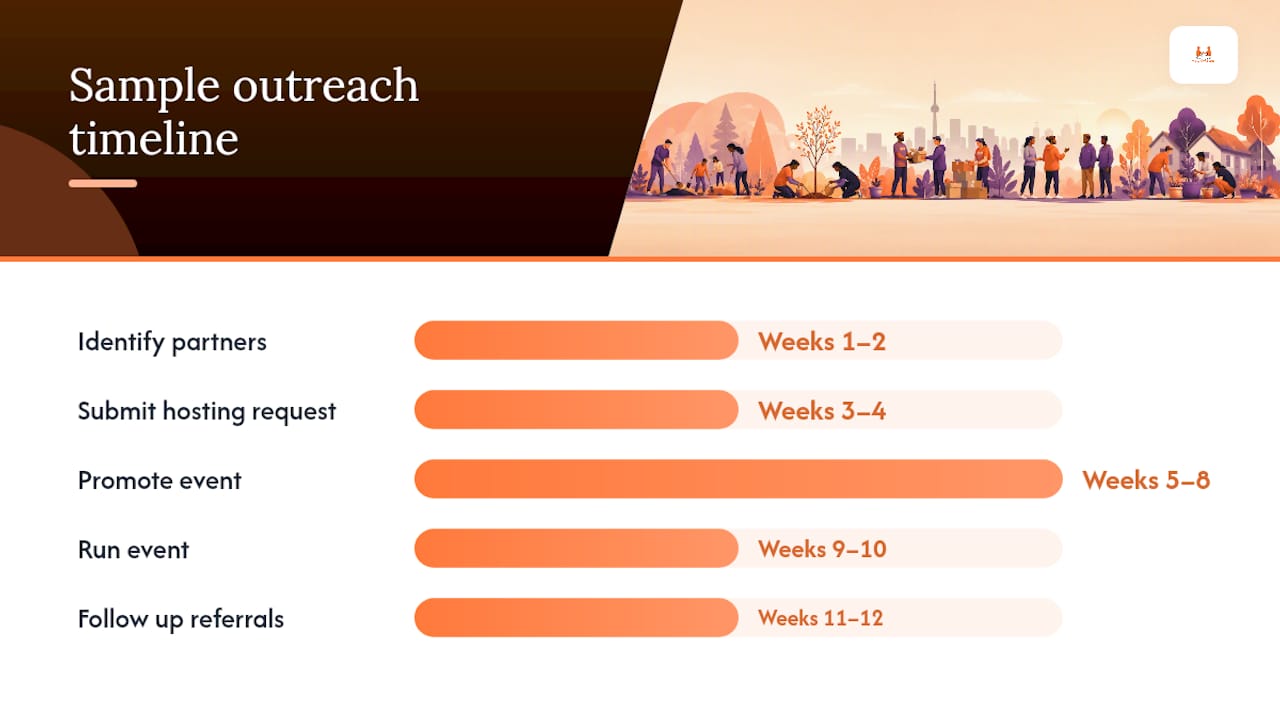
Sample timeline for a small outreach series:
Weeks 1–2: identify partners and confirm venue. Weeks 3–4: submit a hosting request to COLS or your provincial partner and confirm the programme. Weeks 5–8: promote the event through community channels, libraries, and social media. Week 9–10: run the event and collect sign-in data. Weeks 11–12: follow up on referrals and document outcomes.
Cost considerations include venue (often donated or low-cost at libraries and community centres), staff or volunteer time, printed materials, interpretation, and travel reimbursement for outreach workers coming from outside the neighbourhood.
| Delivery mode | Strengths | Limitations | Best fit |
|---|---|---|---|
| In-person kiosk | Face-to-face help, form completion, trust-building | Requires accessible venue and staff | Urban neighbourhoods, seniors, newcomers |
| Mobile clinic | Reaches rural and remote populations | Higher travel cost, weather-dependent | Remote communities, on-reserve outreach |
| Virtual session | Low cost, no travel, scalable | Requires device and internet access | Digitally connected clients, follow-up sessions |
Research-backed best practices for equity-first outreach
Equity-first outreach consistently outperforms generic delivery because it removes the specific barriers that keep the most vulnerable people away. The evidence from Canadian programmes is clear on this.
A social prescribing pilot for children and youth in Canada found that mitigating financial and transport costs directly increased uptake and made participation feel meaningful to families. When those costs were not covered, participation dropped — not because people did not want help, but because the barrier was simply too high.
The Alliance for Healthier Communities' Social Prescribing for Better Mental Health project scaled this model at Ontario pilot sites and reported high provider satisfaction and positive client wellbeing outcomes. It also flagged sustainability and funding as the central ongoing risks — strong short-term results that fade without continued investment.
Practical principles that hold across programmes:
- Meet people where they are, physically and emotionally
- Use warm handoffs: a worker who physically or virtually escorts a client into the next appointment prevents drop-off at transitions
- Reduce every cost and transport barrier you can control
- Provide language access from the start, not as an afterthought
- For Indigenous communities, engage community leadership early and follow community protocols
Pro Tip: Build your by-name list from day one. Lambton County's outreach team used by-name data and coordinated system meetings to track individuals across services — that discipline is what turned outreach contacts into housing exits for 117 people. Without named tracking, you are counting events, not outcomes.
A Canadian social prescribing pilot reported that mitigating costs and transport barriers was the single most important factor in increasing uptake and equity of access among children and youth.
How outreach programs measure impact
The most useful measurement approach is a short basket of metrics tracked consistently, rather than a long list of indicators collected inconsistently.
Key metrics programmes typically use:
- Attendance (headcount and repeat visits)
- Referral acceptance rate (how many people agreed to a referral and followed through)
- Benefit uptake (applications submitted, benefits received)
- Wellbeing (one validated question, such as a single-item wellbeing scale)
- Housing moves or stability (for homelessness-focused programmes)
Collect data through simple sign-in sheets, referral tracking logs, and brief follow-up calls at 30 and 90 days. Consent must be obtained before collecting personal information — one clear sentence on the sign-in sheet is sufficient for most community events, but programmes handling health data must comply with applicable provincial privacy legislation and PIPEDA where it applies.
| Metric | Why it matters | Simple collection method |
|---|---|---|
| Attendance | Shows reach and demand | Sign-in sheet at each event |
| Referral acceptance | Measures trust and relevance | Referral log with outcome column |
| Benefit uptake | Demonstrates tangible impact | Follow-up call at 30 days |
| Wellbeing score | Tracks client-level change | Single validated question at intake and follow-up |
| Housing stability | Captures housing-focused outcomes | By-name list updated at coordination meetings |
Short Canadian case examples worth borrowing
- Lambton County homelessness outreach (Ontario): A three-person team combined street outreach with housing-focused systems and by-name data tracking, helping 117 people exit homelessness locally. The model is replicable anywhere a small team can commit to coordinated access meetings.
- Service Canada COLS mobile kiosks: COLS staff bring SIN clinics, pension clinics, and EI application support directly to community venues, with 1,287 visits to 646 Indigenous communities in 2019–2020 alone.
- Youth social prescribing hub, Ottawa region: A paediatric integrated hub ran a social prescribing pilot from May 2023 to February 2024, connecting children and youth to community activities with supported referrals and cost mitigation, reporting improved feelings of connection.
- ITMAV seniors outreach, Lachine, Québec: Outreach workers visit apartment buildings and accompany isolated seniors to community activities, reaching people who would never self-refer to a fixed-site service.
- Nova Scotia community psychosocial rehabilitation: A community programme for people with severe and persistent mental illness was associated with statistically significant reductions in inpatient admissions and inpatient days for the studied cohort, with substantial cost savings.
Any of these models can be adapted locally. The common thread is going to the person, not waiting for them to come to you.
Legal and regulatory considerations for running outreach in Canada
Privacy is the most immediate legal obligation. Under the Personal Information Protection and Electronic Documents Act (PIPEDA) and applicable provincial privacy legislation, you must collect only the personal information you need, obtain informed consent before collecting it, and store it securely. For health-related outreach, provincial health privacy laws (such as Ontario's Personal Health Information Protection Act) apply and are stricter.
Liability is managed through your organisation's general liability insurance, which should cover off-site events. Confirm with your insurer before hosting a clinic at a venue you do not own. If volunteers are involved, ensure they are covered under your policy or a separate volunteer insurance arrangement.
For outreach involving minors, obtain parental or guardian consent unless the programme operates under a statutory exception (such as school-board authority). Indigenous community outreach requires adherence to community protocols and, where data is collected, alignment with First Nations data sovereignty principles (OCAP®).
Register your programme with your municipal or provincial social services registry where one exists — this improves discoverability and can open funding pathways.
Funding sources and grant opportunities for outreach in Canada
Federal funding for community outreach flows through several streams. Employment and Social Development Canada (ESDC) funds community-based projects through the Social Development Partnerships Program and the Enabling Accessibility Fund. The Public Health Agency of Canada funds health promotion and disease prevention outreach through its community-based programming grants.
At the provincial level, most provinces have a community services or social development grant stream administered through their ministry of social services or health. Ontario's Trillium Foundation, the BC Gaming Grants program, and similar bodies in other provinces fund nonprofit outreach directly.
Municipal governments often provide small grants or in-kind support (venue, printing, promotion) for local outreach events. Contact your city's grants office or community development department.
Foundations such as the United Way, the McConnell Foundation, and local community foundations fund outreach with a social equity focus. Many require a demonstrated community need, a clear theory of change, and a measurement plan — the metrics framework described earlier in this article maps directly onto those requirements.
For organisations focused on community dispute resolution and facilitation as part of their outreach model, partner resources can strengthen grant applications by demonstrating a coordinated community approach.
Community engagement strategies that build trust and fit local needs
Generic outreach fails because it assumes the community is waiting for you. It usually is not. Trust is built before the event, not during it.
Start with a community needs assessment: talk to local leaders, service providers, and residents before designing anything. Ask what is missing, what has been tried before, and what made past efforts fall short. That conversation is the programme design.
Co-design with community members wherever possible. A seniors' outreach programme designed without seniors' input will miss the times, locations, and formats that actually work. A youth programme designed without youth will feel like a lecture.
Peer outreach workers — people with lived experience of the barriers your programme addresses — are among the most effective trust-builders available. They reach people that a professional worker in a polo shirt simply cannot.
Sustain the relationship between events. A single clinic builds awareness. A series of visits builds trust. The family mental health support resources that families access through outreach are most useful when the outreach worker can follow up and check in, not just hand over a pamphlet.
Challenges outreach programs face, and how to address them
Funding instability is the most common reason strong programmes end. The Alliance for Healthier Communities' social prescribing report found that pilots with strong short-term results rarely survived without continued investment. The practical response is to diversify funding sources from the start and document outcomes in funder-ready language from day one.
Staff and volunteer burnout affects outreach teams disproportionately because the work is emotionally demanding and often under-resourced. Build supervision, peer support, and clear caseload limits into programme design, not as an afterthought.
Reaching the hardest-to-reach requires going further than a kiosk in a community centre. People experiencing homelessness, those with untreated mental illness, and people in abusive situations often cannot come to even a mobile service. Street-level outreach, peer workers, and partnerships with shelters and food banks extend reach to these groups.
Data and privacy tensions arise when funders want detailed outcome data and clients want anonymity. Aggregate reporting, consent-based opt-ins, and minimum necessary data collection resolve most of this tension without sacrificing programme credibility.
Language and cultural barriers persist even in well-resourced programmes. Budget for interpretation from the start, not as a line item to cut when funding is tight. For Indigenous communities, cultural safety training for all outreach staff is not optional.
Why outreach is the part we cannot afford to skip
I have spent years watching parents miss what I missed. Not because they did not care. Because no one came to them.
That is what outreach does. It closes the distance between a family in trouble and the person who can help. It does not wait for someone to find the right phone number on the right day when they have enough energy left to dial it. It shows up. And showing up — at the right moment, in the right place, without judgment — is often the difference between a family that gets support early and one that does not get it at all.
Early intervention is not a clinical term to me. It is the thing I wish someone had done. It is the conversation that keeps a window open before it closes.
If you are running outreach, or thinking about it, or wondering whether it is worth the effort: it is. Not because the data says so, though it does. Because the person on the other side of that door is waiting for someone to knock.
When a specialist mental health workshop fits your outreach plan
If your organisation is planning outreach that touches mental health, emotional distress in youth, or workplace wellbeing, a general outreach model may not be enough. Specialist workshops and early-detection tools are the right fit when your staff need to recognise warning signs, not just hand out pamphlets.

The MentorWell offers workshops for employers and parent groups focused on identifying early signs of emotional distress in young people aged 8 to 25. These sessions are designed for managers, HR professionals, and parents who want practical skills, not theory. The Teen Signal Check and supporting coaching programmes give outreach teams and families a structured way to act before a situation becomes a crisis. If you are building a mental health outreach series or want to add an early-detection component to an existing programme, connect with The MentorWell to discuss a tailored workshop or referral pathway that fits your community.
Sources
These are the primary Canadian sources to consult when planning, finding, or evaluating outreach programmes.
- Canada
- Understanding the successes and challenges of a social prescribing program for children and youth in Canada: a qualitative evaluation
- Housing-first in action: How Lambton County’s community outreach team moves people from the streets and into homes
- Clinical Outcomes and Cost Implications of a Community Psychosocial Rehabilitation Service for Severe and Persistent Mental Illness in Nova Scotia, Canada
- Social prescribing for better mental health — Alliance for Healthier Communities (final report)
FAQ
What is community outreach?
Community outreach is the practice of bringing services, information, or support directly to people in their own communities, rather than requiring them to travel to a fixed office or clinic. It is designed to reach people who face barriers to access, including distance, language, disability, or lack of information.
What are examples of community outreach programs in Canada?
Examples include Service Canada COLS clinics for EI and pension applications, mobile mental health services run by community health centres, seniors' visiting programmes like ITMAV in Lachine, youth social prescribing hubs, and housing-focused street outreach teams like Lambton County's three-person team that helped 117 people exit homelessness.
What are local outreach programs and how do I find them?
Local outreach programs are community-level services that come to neighbourhoods through kiosks, mobile clinics, drop-ins, or home visits. Find them by searching the Service Canada outreach activity finder, calling 211, checking your municipal website, or contacting your nearest public library or community health centre.
Who benefits most from community engagement programs?
People who face the greatest access barriers benefit most: newcomers navigating settlement services, seniors with mobility limitations, youth who have disengaged from formal systems, people experiencing homelessness, and residents of remote or rural communities with limited local services.
How can an organisation start running outreach programs?
Start by identifying a clear community need and a partner who already has trust in that community. Secure a venue, confirm accessibility, obtain consent forms, and submit a hosting request to Service Canada COLS or a provincial partner. Budget for interpretation, staff time, and follow-up, and track at least one outcome metric from the first event.