
TL;DR:
- Corporate social responsibility programs are structured, business-led efforts to reduce harm and generate measurable social value across environmental, social, and governance areas. The eight most consistent program types include sustainability, employee well-being, philanthropy, ethical supply chain, diversity, impact investing, pro-bono work, and responsible marketing. Implementing a CSR program starts with selecting one type, assigning an owner, and setting a measurable pilot metric within a quarter.
Corporate social responsibility (CSR) programs are structured, business-led efforts to reduce harm and create measurable social value across environmental, social, and governance dimensions. The eight program types that deliver the most consistent organisational value are:
- Environmental sustainability — reducing emissions, waste, and resource use
- Employee well-being and mental health — supporting psychological safety and early intervention
- Community philanthropy and volunteering — grants, matched giving, and staff time
- Ethical supply chain — supplier audits, fair labour standards, and traceability
- Diversity, equity and inclusion (DEI) — hiring practices, pay equity, and belonging programmes
- Social impact investing — directing capital toward community benefit
- Pro-bono and skills-based volunteering — lending professional expertise to nonprofits
- Product stewardship and ethical marketing — responsible product design and honest communications
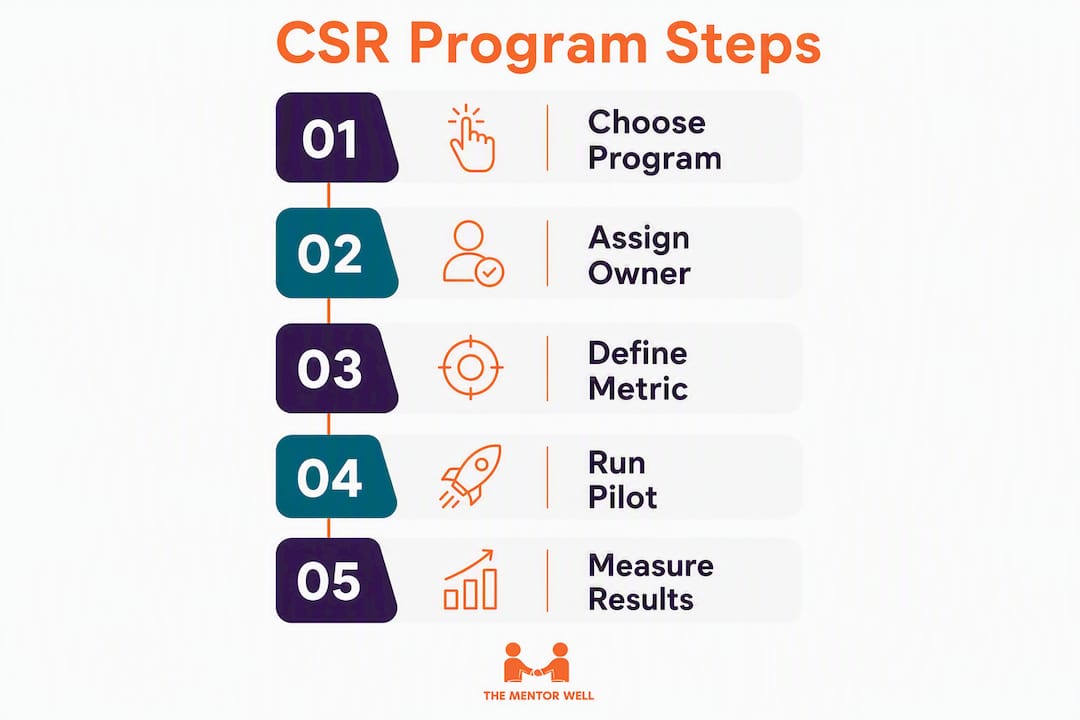
The single most practical first step: pick one programme type, assign a named owner, and define one measurable pilot metric before the end of this quarter.
Table of Contents
- What do social responsibility programs actually look like in practice?
- How do you implement a CSR programme in a Canadian organisation?
- How do you measure CSR outcomes and meet Canadian reporting expectations?
- Mini case studies you can adapt for a 90-day pilot
- What commonly goes wrong with CSR programmes?
- What does Canada's policy environment mean for your CSR strategy?
- How does CSR integrate with Canadian corporate social governance standards?
- How do you communicate CSR efforts effectively in Canadian media and public relations?
- Key takeaways
- The question I keep asking
- What The MentorWell offers for workplace mental health CSR
- Useful sources
- FAQ
What do social responsibility programs actually look like in practice?
Each programme type carries a different scope, a different business rationale, and a different demand on your team. The table below maps all eight to a named example and an honest effort level.
| Programme type | Scope | Business rationale | Named example | Effort |
|---|---|---|---|---|
| Environmental sustainability | Emissions, packaging, energy, water | Reduces regulatory risk and operating costs | Lego committed to replacing all plastic packaging with paper-based alternatives by 2025 | High |
| Employee well-being and mental health | Psychological safety, EAP, early detection | Reduces absenteeism and turnover; builds retention | Starbucks extended mental health benefits and counselling sessions to all North American employees | Medium |
| Community philanthropy and volunteering | Grants, matched giving, paid volunteer days | Builds brand trust and community licence to operate | RBC directs over $100 million annually through RBC Foundation to community organisations across Canada | Medium |
| Ethical supply chain | Supplier audits, fair labour, traceability | Manages reputational and legal risk | Levi Strauss publishes a supplier list and enforces its Worker Well-being programme across its global supply base | High |
| Diversity, equity and inclusion | Hiring, pay equity, belonging | Expands talent pool; reduces legal exposure | Salesforce conducts annual pay equity audits and has committed to equal pay globally | Medium |
| Social impact investing | Community bonds, mission-aligned capital | Aligns capital with long-term social licence | Shopify has invested in carbon removal and climate tech through its Sustainability Fund | High |
| Pro-bono and skills-based volunteering | Legal, marketing, finance expertise for nonprofits | Deepens employee engagement; low cash cost | Ben & Jerry's staff contribute skills to social justice organisations aligned with the brand's advocacy work | Low |
| Product stewardship and ethical marketing | Responsible design, honest claims, end-of-life | Reduces liability; builds consumer confidence | Ben & Jerry's labels GMO ingredients and publishes sourcing standards publicly | Low–Medium |
Quick wins for SMEs: pro-bono volunteering and matched giving require almost no infrastructure. A 20-hour annual volunteer commitment per employee, tracked in a simple spreadsheet, is a legitimate pilot. Pair it with one community partner and you have a programme.

Pro Tip: Before you build anything, run a one-page stakeholder survey. Ask employees, customers, and one community partner what issue they most want your organisation to address. The answer almost always narrows your shortlist from eight programme types to two.
How do you implement a CSR programme in a Canadian organisation?
The ISED Implementation Guide for Canadian Business recommends a six-stage plan→do→check→improve framework. Here is how that maps to a practical 90-day pilot.
Phase 1: Plan (weeks 1–4)
- Define the problem your programme will solve and the measurable outcome you expect. "We will reduce employee mental health leave by 15% over 12 months" is a plan. "We care about our people" is not.
- Map your stakeholders: employees, board, investors, community partners, Indigenous rights holders if your operations touch their lands, suppliers, and regulators.
- Conduct a materiality assessment. Which social and environmental issues are most significant to your business and your stakeholders? Prioritise two or three.
- Assign a programme owner with a budget line, even a small one. Ownership without budget is theatre.
- Bring the board in early. ISED's governance guidance recommends boards treat CSR as part of enterprise risk, either by embedding it across existing committees or creating a focused CSR committee.
Phase 2: Do (weeks 5–10)
- Launch the pilot with one programme type, one community partner or internal cohort, and one data collection method.
- Train the managers who will deliver or champion the programme. A workshop, a briefing deck, and a clear escalation path are the minimum.
- Communicate internally before you communicate externally. Employees who hear about your CSR programme from a press release before their manager tells them will not trust it.
Phase 3: Check (weeks 11–12)
- Collect your pilot metrics. Compare against your baseline.
- Run a short debrief with participants and the programme owner. What worked? What did not?
- Document findings in a one-page summary for the board or executive sponsor.
Phase 4: Improve (ongoing)
- Adjust scope, budget, or delivery based on pilot data.
- Set a 12-month target and a reporting cadence.
- Decide whether to scale, pause, or pivot.
Budgeting for a Canadian pilot
High-level cost categories to plan for: staff time (the largest hidden cost), external facilitation or training, community partner grants or donations, data tools, and communications. A modest workplace mental health pilot, including a facilitated workshop and a digital assessment tool, can run between $5,000 and $25,000 depending on organisation size. Social impact investing and supply chain audits often require greater investment.
Engaging Indigenous communities
If your programme touches Indigenous lands, resources, or communities, consultation is not optional. The duty to consult is a constitutional obligation in Canada, and meaningful engagement goes well beyond a single meeting. Start by identifying the relevant First Nation, Métis Nation, or Inuit community early in your planning phase. Engage through their established governance structures, not through individual contacts. Budget time: genuine consultation takes months, not weeks. The First Nations Information Governance Centre and the National Collaborating Centre for Indigenous Health both publish practical guidance on respectful engagement protocols.

How do you measure CSR outcomes and meet Canadian reporting expectations?
Choose two to four core KPIs per programme type and measure them well before you widen scope. Breadth without depth produces data you cannot trust.
| Programme type | Suggested KPIs | Data source | Frequency |
|---|---|---|---|
| Environmental sustainability | GHG emissions (Scope 1 and 2), energy intensity, waste diversion rate | Utility bills, fleet data, waste hauler reports | Quarterly |
| Employee well-being and mental health | Mental health leave rate, EAP utilisation, employee engagement score | HR system, benefits provider, annual survey | Quarterly/Annual |
| Community philanthropy | Total giving ($), volunteer hours, community partner satisfaction | Finance system, volunteer tracking tool | Annual |
| Ethical supply chain | % suppliers audited, audit pass rate, remediation completion rate | Supplier audit platform | Annual |
| DEI | Representation by level and gender, pay equity gap, promotion rate by group | HR system | Annual |
| Social impact investing | Capital deployed ($), community outcomes achieved | Finance system, partner reports | Annual |
| Pro-bono volunteering | Hours contributed, estimated value, nonprofit satisfaction | Volunteer log | Annual |
| Product stewardship | % products with sustainability certification, customer complaint rate | Product database, CRM | Annual |
Mapping KPIs to reporting frameworks
The three frameworks most relevant to Canadian organisations right now are GRI (Global Reporting Initiative), CSDS (Canadian Sustainability Disclosure Standards), and TCFD/ISSB.
GRI is the most widely used voluntary framework globally and covers social, environmental, and governance topics in granular detail. It is a practical starting point for any organisation publishing a sustainability report.
CSDS is the framework that matters most for Canadian regulatory readiness. The Canadian Sustainability Standards Board (CSSB) finalised CSDS 1 and CSDS 2 in December 2024. CSDS 1 covers general sustainability-related disclosures; CSDS 2 covers climate. Both model the ISSB standards. They are currently voluntary for reporting periods beginning January 1, 2025, with phased relief allowing entities to publish sustainability disclosures within nine months of year-end in the first year, and deferrals on Scope 3 and scenario analysis for initial reporting periods.
PwC Canada notes that the reporting environment is shifting from voluntary frameworks toward regulatory-driven transparency. Organisations that have already aligned with TCFD will face labour-intensive requirements to meet detailed CSDS obligations. Starting now reduces that future cost.
KPMG Canada confirms that CSDS 1 underpins all reporting and requires disclosure of material sustainability-related risks. Governance and data readiness are the two areas where most organisations have the largest gaps.
The Scope 3 problem: most organisations do not yet have reliable Scope 3 data (indirect emissions from your supply chain and product use). The phased CSDS relief exists precisely because of this gap. Do not let the absence of Scope 3 data paralyse your programme. Start with Scope 1 and 2, map your data gaps honestly, and build toward Scope 3 incrementally.
Pro Tip: Audit your existing data before you commit to any KPI. If you cannot pull the baseline figure from a system you already own, you will spend more time chasing data than running the programme. Start with what you can measure today.
Mini case studies you can adapt for a 90-day pilot
These five cases show how organisations set an objective, ran a pilot, measured impact, and scaled. Each ends with a concrete adaptation for Canadian mid-sized organisations.
-
RBC — community investment at scale. RBC directs philanthropic capital through RBC Foundation to education, environment, and community development across Canada. The mechanism is straightforward: a dedicated foundation with a grant committee, published criteria, and annual reporting. What to copy: even without a foundation structure, a small internal grants committee with a defined annual budget and published criteria creates accountability and community trust.
-
Starbucks — employee mental health benefits. Starbucks extended mental health benefits and added counselling sessions for all North American employees, including part-time workers. The business case was retention and absenteeism reduction. What to copy: survey your employees on their top mental health barriers, then negotiate with your benefits provider for one targeted improvement. Measure EAP utilisation before and after.
-
Levi Strauss — ethical supply chain transparency. Levi Strauss publishes its full supplier list and enforces its Worker Well-being programme, which includes health education and financial literacy for factory workers. The programme has reached hundreds of thousands of workers globally. What to copy: start with your top 10 suppliers. Send a one-page self-assessment questionnaire on labour practices. The data you collect becomes your baseline.
-
Shopify — social impact investing. Shopify commits a portion of revenue to its Sustainability Fund, directing capital toward carbon removal technologies. The programme is tied to a public commitment and reported annually. What to copy: identify one community bond or impact investment vehicle in your region. Even a modest allocation signals intent and builds relationships with impact investors.
-
Salesforce — DEI with accountability. Salesforce conducts annual pay equity audits and publishes the results. The audit is run by an external firm, which removes internal bias from the process. What to copy: commission a pay equity analysis from your HR software provider or an external consultant. Publish the gap, even if it is uncomfortable. Transparency builds trust faster than silence.
What commonly goes wrong with CSR programmes?
Most programmes do not fail because the idea was bad. They fail because the execution was underfunded, unowned, or unmeasured.
-
CSR as PR only. Red flag: the programme is announced before it is designed. Remedy: require a measurable outcome and a named owner before any external communication.
-
No measurement baseline. Red flag: you cannot answer "compared to what?" Remedy: collect baseline data in the planning phase, before the pilot launches.
-
Lack of governance. Red flag: CSR sits in communications or marketing with no board visibility. Remedy: embed CSR reporting into at least one board committee agenda item per year.
-
Unclear ownership. Red flag: multiple people think someone else is responsible. Remedy: one named owner, one budget line, one reporting line to the executive team.
-
Ignoring Indigenous consultation. Red flag: the programme touches Indigenous lands or communities and no consultation has occurred. Remedy: engage the relevant Indigenous governance body at the planning stage, not after the programme is designed.
-
Over-ambitious Scope 3 goals without data. Red flag: your sustainability report commits to Scope 3 targets but your data collection does not yet exist. Remedy: use the phased CSDS relief period to build your data systems before committing to public targets.
Resetting a stalled programme: if a programme has lost momentum, run a one-hour debrief with the owner and one or two participants. Identify the single biggest barrier. Usually it is one of three things: the owner changed, the budget was cut, or the measurement was too complex. Fix the one thing and relaunch with a smaller scope.
What does Canada's policy environment mean for your CSR strategy?
The policy environment is shifting, and planning now is practical risk management, not early adoption.
The ISED Implementation Guide frames CSR as a strategic tool for managing risk and unlocking opportunity, not a prescriptive checklist. The business case must be clear to secure board buy-in. ISED's six-stage plan → do → check → improve framework is the most practical backbone available for Canadian organisations of any size.
ISED's governance toolkit recommends boards evaluate whether to embed CSR across existing committees or create a focused CSR committee, include CSR in director education, and incorporate social and environmental risk into major decisions and director recruitment. Effective CSR governance is rarely a standalone function. The most durable models place oversight at board level so that social and environmental risk sits within fiduciary duty.
PwC Canada's analysis is direct: organisations aligned with voluntary frameworks like TCFD will face labour-intensive requirements to meet detailed CSDS obligations. The operational strain is real. Cross-functional teams and data systems built now reduce future compliance costs.
Near-term CSDS readiness checklist:
- Conduct a gap assessment against CSDS 1 and CSDS 2 requirements
- Map your existing data against required disclosures, with particular attention to Scope 3 gaps
- Assemble a cross-functional team: finance, legal, operations, HR, and sustainability
- Set a timeline with milestones tied to your fiscal year-end
- Use the phased relief period to build data quality controls before attempting full quantitative climate scenario analysis
The federal CSR publication from publications.gc.ca reinforces that CSR must be tailored to firm size. A 50-person manufacturer and a 5,000-person financial institution face different disclosure burdens. The phased approach is not a workaround. It is the intended path.
How does CSR integrate with Canadian corporate social governance standards?
Corporate social governance (CSG) in Canada is not a separate standard from CSR. It is the governance layer that makes CSR credible. Without it, programmes are activities. With it, they are accountable commitments.
The practical integration point is the board. When CSR objectives appear in board mandates, when directors ask management about social and environmental performance, and when CSR metrics appear in executive compensation frameworks, the programme moves from discretionary to structural. That shift matters to investors, to regulators, and to employees who are watching to see whether the commitment is real.
For Canadian public companies, the Canadian Securities Administrators (CSA) have signalled increasing expectations around climate-related disclosure, aligned with TCFD and now CSDS. For private companies and Crown corporations, the pressure comes from procurement requirements, lender covenants, and employee expectations. The governance integration question is the same regardless of ownership structure: does the board see this, and does someone's performance review depend on it?
Practically, integration looks like this: CSR objectives are included in the annual strategic plan, reported to the board at least annually, and tied to at least one executive KPI. The programme owner has a direct line to the CFO or CEO, not just to communications. The audit or risk committee reviews material social and environmental risks alongside financial risks.
Community engagement programmes that operate without this governance layer tend to drift. The community partner changes, the internal champion leaves, and the programme quietly disappears. Governance is what keeps it alive when the enthusiasm fades.
How do you communicate CSR efforts effectively in Canadian media and public relations?
The most common mistake in CSR communications is announcing the intention rather than the outcome. Canadian media and the public have become skilled at identifying the gap between a press release and a result.
A few principles that hold up in practice. Report outcomes, not activities. "We planted 10,000 trees" is an activity. "Our reforestation programme sequestered an estimated 500 tonnes of CO2 and employed 12 Indigenous land stewards in northern Ontario" is an outcome. The second version earns coverage. The first earns scepticism.
Timing matters. Publish your CSR report or programme update at a consistent time each year. Consistency signals that the programme is real, not reactive. Many Canadian organisations tie their report to their annual general meeting or fiscal year-end, which also aligns with investor expectations under CSDS.
Earned media in Canada responds to local specificity. A national programme with a local story, a named community partner, a real person whose situation changed, gets picked up. A generic sustainability commitment does not. Work with your communications team to identify the one or two stories from each programme cycle that have a human face and a measurable result.
Social media amplification works best when employees share it. Internal communications before external launch, a simple sharing toolkit for staff, and recognition for employees who champion the programme publicly all increase reach without paid media spend.
On the question of greenwashing: the Competition Bureau of Canada has enforcement authority over misleading environmental claims. Any public claim about your programme's environmental impact must be substantiated. "Carbon neutral" and "net zero" claims require methodology disclosure. The bar is higher than it was five years ago, and it is rising.
For community case management programmes that involve health or social services partnerships, transparent reporting on outcomes builds credibility with both community partners and funders. Publish what you measured, including what did not work.
Key takeaways
Effective social responsibility programs in Canada require a named owner, a measurable pilot metric, and board-level governance before any external communication.
| Point | Details |
|---|---|
| Start with one programme type | Assign an owner and define one measurable pilot metric before launching anything publicly. |
| Use the plan→do→check→improve model | ISED's six-stage framework is the most practical implementation backbone for Canadian organisations of any size. |
| CSDS readiness starts now | CSDS 1 and CSDS 2 are voluntary from January 2025 with phased relief, but building data systems now reduces future compliance costs. |
| Governance makes programmes durable | CSR objectives embedded in board mandates and executive KPIs outlast individual champions and budget cycles. |
| The MentorWell for workplace mental health | The MentorWell's workshops, coaching, and digital tools give employers a structured, measurable pilot for employee well-being CSR programmes. |
The question I keep asking
I think about the moment before things go wrong. Not the crisis. The quiet before it.
I have sat with enough parents, and enough HR leaders, to know that the signs were usually there. A change in behaviour. A withdrawal. A comment that landed oddly and then got filed away. We all have a version of that moment where we noticed something and then talked ourselves out of it.
Workplace mental health programmes, when they are designed well, are not about crisis response. They are about the moment before. A manager who knows what to look for. A team culture where someone can say they are not okay without it becoming a performance issue. A digital check-in that catches what a busy leader misses.
That is what I built The MentorWell around. Not the aftermath. The window before it closes.
When I see organisations treat employee well-being as a line item in a CSR report, I understand the impulse. It is easier to count EAP utilisation than to ask whether your managers actually know how to hold a hard conversation. But the count is not the point. The conversation is.
If your CSR programme includes employee mental health and you want it to do more than look good on paper, the question worth sitting with is this: do your managers know what to do when someone on their team is struggling? Not the policy. The actual conversation.
What The MentorWell offers for workplace mental health CSR
Most organisations have the intention. What they lack is a structured, measurable way to turn that intention into a programme their board can report on and their employees can feel.

The MentorWell offers workshops for managers and HR teams on recognising early signs of emotional distress, live and on-demand coaching for people leaders, and digital tools including the Teen Signal Check for organisations with programmes that extend to employees' families. The workplace wellness resources are designed for employers who need a pilot they can measure, not a one-day event they cannot track.
When to consider an external partner: when internal capacity is limited, when you need rapid pilot measurement for a board report, or when stakeholder buy-in is stalled and an external voice would help move it.
Visit The MentorWell to book a pilot support conversation and find out what a 90-day workplace mental health programme looks like in practice.
Useful sources
-
ISED Implementation Guide for Canadian Business — the federal government's practical guide for building a CSR strategy; use it for your plan→do→check→improve roadmap and SME checklists. Essential for implementation.
-
ISED Governance for Sustainability toolkit — covers board-level CSR governance, committee design, and director education. Essential for board buy-in.
-
Publications.gc.ca — federal CSR guide — an earlier federal publication with practical checklists tailored to SMEs and phased implementation guidance.
-
Persefoni — CSDS explainer — the clearest plain-language explanation of CSDS 1 and CSDS 2, phased relief timelines, and what voluntary adoption means in practice. Essential for CSDS readiness.
-
KPMG Canada — CSSB sustainability reporting — summarises what CSDS 1 requires, governance and data readiness priorities, and the link to investor expectations.
-
PwC Canada — ESG reporting insights — analysis of the shift from voluntary to regulatory-driven reporting and the operational demands of CSDS compliance.
-
Harvard Business School Online — CSR examples — a well-curated set of global corporate social responsibility examples useful for benchmarking programme design.
-
WellCheck — community case management strategies — practical strategies for community health partnerships; useful when designing community engagement programmes or public health collaborations.
FAQ
What are social responsibility programs?
Social responsibility programs are structured business-led initiatives designed to reduce harm and create measurable social, environmental, or governance value. They span eight core types, from environmental sustainability and employee well-being to ethical supply chains and community philanthropy.
What are the four types of social responsibility?
The four commonly cited categories are environmental responsibility (reducing ecological impact), ethical responsibility (fair labour and honest practices), philanthropic responsibility (giving back to communities), and economic responsibility (operating profitably in a way that supports broader social good).
What is an example of a social responsibility programme in Canada?
RBC directs over $100 million annually through RBC Foundation to education, environment, and community development across Canada, with published criteria and annual reporting. Shopify's Sustainability Fund is another Canadian-headquartered example, directing capital toward carbon removal technologies.
What are some examples of CSR programmes companies run?
Common examples include Starbucks extending mental health counselling benefits to all North American employees, Levi Strauss publishing its full supplier list and enforcing its Worker Well-being programme, Salesforce conducting annual pay equity audits, and Lego committing to paper-based packaging. Each programme is tied to a measurable outcome and reported publicly.
When should a Canadian organisation bring in an external partner for CSR?
Consider an external partner when internal capacity is limited, when you need rapid pilot measurement for a board report, or when stakeholder buy-in is stalled. The MentorWell offers structured 90-day workplace mental health pilots with built-in measurement for organisations at exactly that stage.