
TL;DR:
- Most Canadian organizations find the best return from executive, mid-career, and employer workshops tailored by leadership level. Effective programs link curriculum to on-the-job application, incorporate stretch assignments, and measure behavioural change over time. Choosing the right program involves matching level, asking about outcomes, and evaluating post-program support and alumni networks.
For most Canadian organisations, three programme types deliver the clearest return: cohorted executive programmes for senior leaders, modular mid-career tracks for managers, and bespoke employer workshops for teams with specific skill or culture gaps. If you are deciding where to start, the shortlist below will get you to the right conversation faster.
- Identify your leadership level first. Emerging leaders, mid-career managers, senior executives, and public-sector professionals each need a different structure. Matching level to programme type is the single most important decision you will make.
- Ask your HR or L&D lead one question before contacting any provider: "What business outcome are we trying to move?" If no one can answer that, the programme will not stick.
- Quick decision rule: tight budget and urgent need points to a bespoke employer workshop; longer runway and succession planning points to a university executive cohort or a national public-sector stream.
- For mental-health-informed leadership workshops that build manager coaching skills and early-intervention awareness, The MentorWell offers employer-facing programmes grounded in real-world experience with emotional distress in teams.
- Reference standard: the 70-20-10 learning ratio is the most widely used framework for designing experience-driven development. Any programme worth your investment should reflect it.
Table of Contents
- What level of leadership programme do you actually need?
- What do quality leadership programmes actually teach?
- How are leadership programmes delivered, and how much time do they take?
- What does a leadership programme cost in Canada?
- Which Canadian programmes and providers are worth your time?
- How do you choose the right programme? Questions to ask and red flags to watch for
- How do you measure whether a leadership programme actually worked?
- What does research say about what actually works?
- What do alumni networks actually give you after the programme ends?
- What does programme impact look like in practice?
- Does accreditation matter, and what should you look for?
- Can leadership programmes be customised for your industry or team?
- Key takeaways
- What leadership development taught me about paying attention
- Useful sources
- FAQ
What level of leadership programme do you actually need?
The most common mistake organisations make is buying the wrong level. A programme built for a VP will frustrate a first-time manager. A workshop designed for frontline supervisors will bore a senior director. Getting the level right is not a nice-to-have; it is the whole game.
Emerging leader programmes target individual contributors moving into their first supervisory role. Typical eligibility is several years of experience with demonstrated potential. Learning goals centre on self-awareness, giving feedback, and managing small teams. Time commitment is usually light: a few half-days or a short modular series over a couple of months.
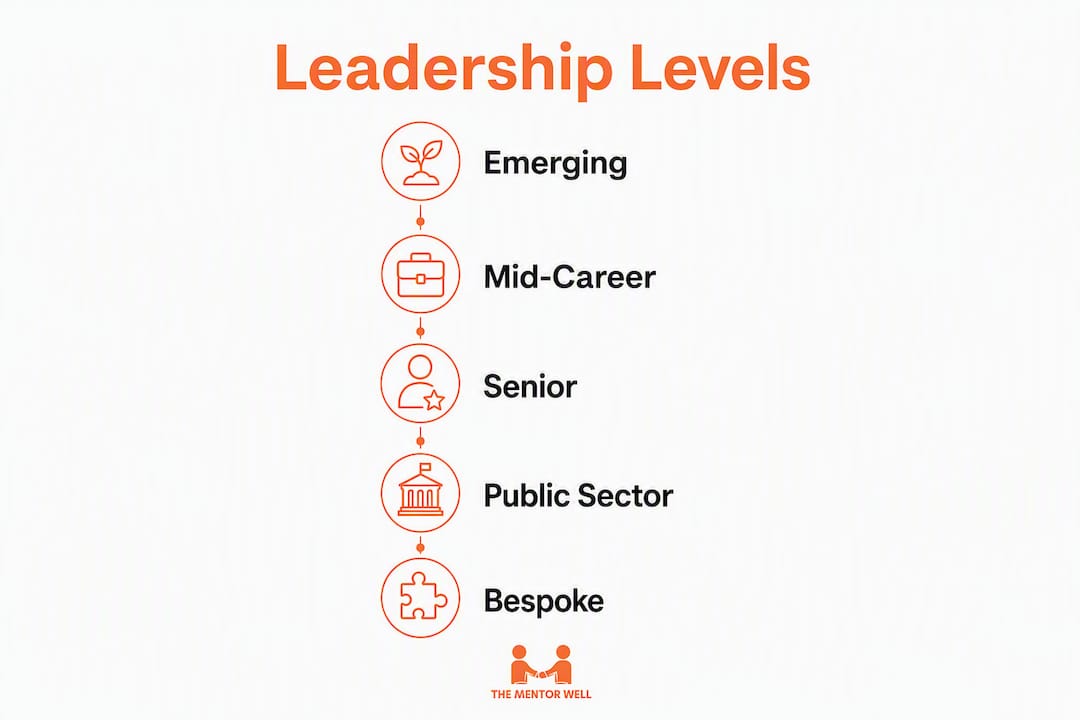
Manager and mid-career development serves people already leading teams who need to grow their strategic thinking, coaching capability, and cross-functional influence. These programmes often run several weeks, blending online modules with in-person workshops. The Canada School of Public Service offers structured tracks at this level for federal employees, and university continuing education units across the country run open-enrolment equivalents.
Senior and executive cohort programmes are built for directors, VPs, and C-suite leaders. The Rotman School of Management at the University of Toronto and the Ivey Business School at Western University both offer executive education at this level, typically delivered in residential or blended formats lasting days to weeks. The Haskayne School of Business at the University of Calgary runs a Strategic Leadership Development Programme with a similar profile. These programmes are expensive and deliberately so: the peer cohort and the alumni network are as valuable as the curriculum.
Public-sector executive streams serve a distinct audience. The Canada School of Public Service's Executive Leadership Development Program targets EX-01 to EX-03 federal executives and is specifically designed around the competencies and governance realities of the Canadian public service. The Treasury Board Secretariat also administers the ELDP for senior federal leaders.
Bespoke employer workshops sit outside the standard academic ladder. They are scoped to a specific team, culture challenge, or skill gap and can be deployed quickly. The MentorWell's employer workshops fall into this category, with a focus on mental-health literacy, manager coaching, and early-intervention skills.
| Leadership level | Best fit | Typical time commitment |
|---|---|---|
| Emerging leader | First-time supervisors, high-potential ICs | several weeks, part-time |
| Mid-career manager | Team leads, senior managers | several weeks, blended |
| Senior/executive | Directors, VPs, C-suite | days to weeks, intensive |
| Public-sector executive | Federal EX-01 to EX-03 | Programme-specific, cohorted |
| Bespoke employer workshop | Any level, team-specific | variable duration, custom |
What do quality leadership programmes actually teach?
The curriculum of a well-designed programme is not a list of topics. It is a sequence that builds on itself. Self-awareness comes first, because leaders who do not understand their own triggers and blind spots cannot reliably develop anyone else. The best programmes invest heavily in this before layering strategy.
Common modules across quality programmes include:
- Self-awareness and 360-degree feedback: structured input from peers, direct reports, and managers, processed with a coach or facilitator
- Strategic thinking and business acumen: reading organisational context, setting direction, and making decisions under uncertainty
- Change leadership: leading teams through ambiguity, communicating during transitions, and managing resistance
- Coaching and feedback skills: giving developmental feedback, holding performance conversations, and building psychological safety
- Inclusive leadership: understanding bias, building belonging, and leading across difference
- Mental-health literacy: recognising early signs of distress in teams, knowing when and how to intervene, and creating climates where people ask for help
The 70-20-10 model describes how leaders actually learn: 70% from on-the-job experience, 20% from developmental relationships, and 10% from formal coursework. Coursework is the amplifier, not the engine. A programme that delivers only classroom content without linking modules to stretch assignments and mentorship will fade within weeks of completion.
Pro Tip: When evaluating a programme's curriculum, ask the provider to show you one specific stretch assignment participants complete between modules. If they cannot name one, the programme is classroom-only and the learning will not transfer.

How are leadership programmes delivered, and how much time do they take?
Delivery format shapes the learning experience as much as curriculum does. The right format depends on what you are trying to build and how much time participants can realistically give.
- Cohorted residential programmes bring a fixed group together in person for several days, sometimes in a retreat setting. The intensity accelerates trust and candour. Participants test new behaviours in a safe environment before taking them back to work. The trade-off is cost and time away from the office.
- Short in-person modules spread over weeks or months reduce the time-away burden while preserving face-to-face connection. Many Canadian university executive education programmes use this format.
- Fully virtual multi-week programmes offer the most scheduling flexibility and are well-suited to geographically distributed teams. The risk is lower cohort cohesion if the design does not actively build peer relationships through breakout work and asynchronous discussion.
- Microlearning plus coaching pairs short digital lessons (15–30 minutes) with regular one-on-one coaching sessions. This format works well for busy managers who cannot block large chunks of time but need sustained development over three to six months.
Cohort size matters more than most buyers realise. Small groups create enough diversity for rich peer learning while staying small enough for genuine vulnerability and trust. Larger open-enrolment cohorts can feel anonymous, which limits the candour that makes executive programmes valuable.
Typical weekly time commitments vary by programme level, with emerging-leader programmes requiring a few hours weekly, mid-career programmes more, and executive cohorts sometimes requiring full days during intensives. Build that reality into your planning before you enrol anyone.
What does a leadership programme cost in Canada?
Price varies widely by level, format, and provider. Here is a realistic picture of what Canadian organisations and professionals are budgeting.
Funding options worth exploring:
- Government grants and subsidies: — federal and provincial workforce development programmes periodically fund leadership training for small and medium-sized businesses. The Canada Job Grant is one mechanism worth checking with your provincial authority.
The return on a well-designed programme is not always easy to quantify in the first quarter. Organisations that connect programme goals to business metrics before enrolment are far better positioned to demonstrate value to senior leadership afterward.
Which Canadian programmes and providers are worth your time?
The Canadian market organises into five provider categories. Each serves a different need.

| Provider category | Best for | Delivery | Duration | Price model | Outcomes emphasised | Follow-up support |
|---|---|---|---|---|---|---|
| University executive education | Senior/executive leaders | Blended or residential | Days to weeks | Per seat or corporate contract | Strategic thinking, peer network, alumni access | Alumni network, some coaching |
| National public-service executive tracks | Federal EX-01 to EX-03 | Cohorted, blended | Programme-specific | Government-funded | Public-sector competencies, succession readiness | Cohort alumni, structured follow-up |
| Global research-based leadership centres | Mid to senior, any sector | Blended or virtual | Days to weeks | Per seat | Evidence-based competencies, 360 feedback | Post-programme coaching options |
| Accredited corporate training vendors | Emerging to mid-career | In-person or virtual | Hours to weeks | Per seat or cohort | Skill-specific, applied | Varies by vendor |
| Mental-health-informed workshop providers | Any level, employer teams | In-person or blended | variable duration | Engagement-based | Mental-health literacy, manager coaching, and early intervention | Coaching, digital tools, community |
University executive education in Canada is anchored by programmes at Rotman (University of Toronto), Ivey (Western University), and Haskayne (University of Calgary). These programmes are built for senior leaders who need both rigour and a strong peer network. The Centre for Creative Leadership (CCL), a global research-based organisation, makes its programmes available to Canadian organisations and brings an evidence base that few domestic vendors can match.
National public-service executive tracks are the right choice for federal leaders. The Canada School of Public Service's Executive Leadership Development Program is the primary pathway for EX-level executives, designed specifically around Canadian governance competencies and succession planning.
The MentorWell sits in the mental-health-informed workshop category and is the right choice when your organisation needs leadership training that goes beyond strategy and into the human realities managers face every day. Programmes include mental-health literacy and manager coaching, early-intervention tools, and peer support design. If your managers are struggling to recognise distress in their teams, or if your organisation has experienced a mental-health crisis and wants to build a safer culture, this is where to start. Reach out directly at thementorwell.com to discuss a scoped workshop.
How do you choose the right programme? Questions to ask and red flags to watch for
The procurement conversation is where most organisations go wrong. They evaluate brochures instead of asking the questions that reveal whether a programme will actually work for their people.
Questions to ask every provider:
- What specific business outcomes have your alumni achieved, and can we speak to two or three of them?
- How does the curriculum connect to on-the-job application? What stretch assignments do participants complete?
- Who are the facilitators, and what is their practitioner experience outside academia?
- What is the cohort profile, and how do you ensure diversity of sector and seniority?
- What measurement plan do you recommend, and at what intervals do you assess behavioural change?
- What post-programme support is included: coaching, alumni access, follow-up check-ins?
- What is the full cost, including any materials, travel, or coaching fees not in the base price?
Red flags:
- No alumni references available or offered
- Curriculum described only in topic headings with no mention of application or assessment
- No measurement plan or ROI framework
- One-size-fits-all content with no customisation discussion
- Opaque or evasive pricing
- Facilitators with only academic backgrounds and no leadership practice experience
Pro Tip: Before committing to a full programme, ask the provider to run a half-day pilot session with a small group of your leaders. Define two success metrics in advance (e.g., participant feedback score and one observable behaviour change). A provider confident in their work will say yes.
How do you measure whether a leadership programme actually worked?
Measurement is the part most organisations skip, and it is the reason so many programmes feel like they disappeared six months after completion. A minimal viable evaluation does not require a research team. It requires intention and timing.
| Metric | Measurement method | Cadence |
|---|---|---|
| Participant satisfaction | Post-programme survey (NPS or rating scale) | Immediately after |
| Behavioural change indicators | Manager observation checklist, self-report | several months post |
| 360-degree feedback delta | Repeat 360 assessment vs. baseline | several months post |
| Retention of promoted participants | HR tracking of cohort career progression | 12 months post |
| Business KPIs tied to programme goals | Dashboard review against pre-set targets | several months post |
The most common failure is measuring only at the end of the programme, when participants are still energised and the real test has not yet happened. Behavioural change shows up at three to six months, when the novelty has worn off and the old environment is pulling people back to old habits. Set those check-in dates before the programme begins, not after.
Connecting programme goals to organisational strategy and succession planning before enrolment is the single most reliable predictor of measurable impact. Organisations that skip this step often find themselves unable to demonstrate value when leadership asks for a programme review.
What does research say about what actually works?
The evidence on leadership development is clearer than most providers admit. The 70-20-10 model is descriptive, not a marketing claim: it reflects how leaders actually report learning. Formal coursework accounts for roughly 10% of development; the other 90% comes from experience and relationships. A programme that does not actively design for those other 90% is selling you the smaller slice.
Key findings worth knowing before you buy:
- Behaviour change is far more likely when learning happens in the context of a stretch assignment supported by a mentor and immediate feedback. The classroom is only the start.
- The most durable lessons often come from poor management experiences: learning what not to do. Programmes must include candid reflection and mentor processing for failures, not just successes.
- Programmes that ignore organisational alignment risk participants returning to a culture that prevents use of new skills. Set explicit expectations with line managers before the programme begins.
- Mentorship plus post-programme coaching increases the chance that new behaviours stick back at work.
- Including mental-health literacy and manager coaching in leadership programmes improves early detection of distress and builds team resilience.
"Leadership development starts with self-awareness; the best programmes invest heavily in helping participants discover their drivers, triggers and blind spots before layering strategy." — Ivey Executive Education
What do alumni networks actually give you after the programme ends?
The programme ends. The cohort does not have to.
Alumni networks are one of the most undervalued elements of executive education. A well-maintained alumni community gives participants access to peer counsel when they face a hard decision, a warm introduction when they are hiring or job-seeking, and a sounding board when they are navigating something they cannot discuss inside their own organisation.
The strongest alumni networks are structured, not passive. They include annual gatherings, online forums with active moderation, and mentorship matching between recent graduates and senior alumni. When evaluating a programme, ask specifically how the alumni community is maintained and what participation looks like two years after graduation. A provider who cannot answer that question has not invested in the network.
Post-programme coaching is a related but distinct offering. Some executive programmes include two to four coaching sessions in the months after completion. This is where mentorship and follow-up coaching close the loop: the coach helps the participant process what is actually happening at work against what they learned in the programme. Without that bridge, the gap between classroom insight and workplace reality stays wide.
What does programme impact look like in practice?
The clearest evidence of programme impact is not a certificate. It is a manager who handles a difficult conversation differently. A director who builds a succession plan for the first time. A team that stays together through a reorganisation because the leader knew how to hold the room.
Organisations that track cohort outcomes over 12 months consistently find that the most meaningful changes are behavioural, not credential-based. A federal executive who completes a public-sector leadership stream and then leads a policy transformation. A mid-career manager who applies coaching skills learned in a workshop and reduces team turnover. A team leader who recognises early signs of burnout in a direct report and intervenes before a crisis.
These outcomes are real, but they require measurement to become visible. The organisations that can point to them are the ones that set goals before the programme started, not after. Peer support networks built during programmes often become the infrastructure for ongoing learning long after the formal curriculum ends.
Does accreditation matter, and what should you look for?
Accreditation signals that a programme has been reviewed against an external standard. For university executive education, the relevant markers are institutional accreditation (AACSB for business schools, for example) and the credentials of the faculty delivering the programme. A programme run by a fully accredited business school carries a different weight than one offered by an unaffiliated training vendor.
For corporate and employer-facing programmes, accreditation is less standardised. What matters more is whether the provider can demonstrate a track record: published learning outcomes, named facilitators with verifiable practitioner experience, and alumni references you can actually contact.
Certificates from university executive education programmes are generally recognised by Canadian employers as signals of serious investment. They carry weight in succession planning conversations and performance reviews. Certificates from unaccredited vendors carry less inherent recognition, though a well-designed programme from a boutique provider can still deliver strong outcomes.
One practical check: ask whether the programme's certificate is tied to assessed learning outcomes or simply to attendance. Attendance-only certificates tell you someone showed up. Assessed certificates tell you something about what they can do.
Can leadership programmes be customised for your industry or team?
Yes, and for most organisations, some degree of customisation is worth the investment.
Off-the-shelf programmes are designed for the broadest possible audience. They cover the fundamentals well, but they cannot address your organisation's specific culture, strategic priorities, or the particular challenges your managers are navigating right now. A healthcare organisation dealing with clinician burnout needs different content than a technology company managing rapid growth.
Customisation options typically include:
- Industry-specific case studies and scenarios replacing generic examples with situations your leaders will actually recognise
- Curriculum sequencing adjusted to match your organisation's strategic calendar or a specific change initiative
- Facilitator briefing on your culture, recent history, and the specific behaviours you are trying to build or shift
- Integration with your existing HR and performance frameworks so programme competencies map directly to your review criteria
The MentorWell's employer workshops are built this way from the start. Every engagement begins with a scoping conversation about the team, the context, and the specific outcomes the organisation needs. Mental-health literacy, early intervention skills, and manager coaching are woven into the design rather than bolted on as an afterthought.
For healthcare organisations specifically, linking leadership training to clinical and organisational outcomes is a distinct discipline. Resources like WellCheck's impact framework offer one model for connecting training investment to measurable operational results in healthcare settings.
Key takeaways
The most effective leadership development programmes match level to learner, connect curriculum to on-the-job application, and measure behavioural change at three, six, and twelve months after completion.
| Point | Details |
|---|---|
| Match level to programme type | Emerging, mid-career, executive, and public-sector leaders each need a different structure; mismatching level is the most common procurement error. |
| Apply the 70-20-10 frame | Formal coursework is 10% of development; choose programmes that actively design for stretch assignments and mentorship to drive the other 90%. |
| Measure before and after | Set behavioural baselines and business KPIs before enrolment; check in periodically after programme completion, not only at programme end. |
| Ask for alumni references | Any provider unwilling to connect you with two or three alumni is signalling a gap in their track record. |
| Include mental-health literacy | Programmes that add manager coaching and early-intervention skills build safer teams and better retention; The MentorWell offers employer workshops built specifically around this need. |
What leadership development taught me about paying attention
I remember sitting across from a manager once, a good one, someone who genuinely cared about his team. He was telling me about a direct report who had gone quiet. Stopped contributing in meetings. Started leaving early. He had noticed. He just did not know what to do with what he noticed, so he waited.
He was not indifferent. He was untrained.
That is the gap most leadership programmes do not touch. They teach strategy and communication and change management. They do not teach managers how to sit with someone who is struggling and say the right thing, or how to recognise that the quiet is not just introversion. They do not teach the difference between a person who needs space and a person who needs someone to open the door.
I know what happens when that door stays closed too long. I have lived on the other side of it.
The programmes worth your time are the ones that treat leadership as a human practice, not just a professional one. The ones that ask managers to look at the people in front of them, not just the metrics behind them. That is not soft. That is the hardest thing most leaders will ever be asked to do.
And it is the thing that matters most.
Useful sources
These are the starting points worth bookmarking as you evaluate your options.
- The 70-20-10 Rule for Leadership Development — Centre for Creative Leadership: the foundational research framework for experience-driven development; use it to evaluate any programme's design logic.
- Executive Leadership Development Program — Canada School of Public Service: the primary pathway for federal EX-level leaders in Canada; programme details, eligibility, and enrolment information.
- Executive Leadership Development Programs — Treasury Board Secretariat: the government's own overview of the ELDP, including succession planning context.
- Leadership Development Basics — TD (sample chapter): practical guidance on aligning programmes with organisational strategy and succession systems.
- The MentorWell — employer workshops and mental-health-informed leadership training: the primary next step for Canadian organisations seeking workshops that combine leadership development with mental-health literacy and manager coaching.
FAQ
What is a leadership development programme?
A leadership development programme is a structured learning experience designed to build the skills, self-awareness, and behaviours leaders need to perform effectively at their current level and grow into greater responsibility. Programmes range from short employer workshops to multi-week university executive cohorts.
What is the 70-20-10 rule for leadership development?
The 70-20-10 model describes how leaders learn: 70% from on-the-job experience, 20% from developmental relationships like mentorship, and 10% from formal coursework. It is a design framework, not a rigid prescription, used to ensure programmes build in stretch assignments and coaching rather than relying on classroom content alone.
What makes a good leadership development programme?
A good programme matches the participant's leadership level, connects curriculum to real work through stretch assignments and mentorship, includes a clear measurement plan, and offers post-programme support such as coaching or alumni access. Published learning outcomes, named facilitators with practitioner experience, and accessible alumni references are the trust signals worth checking.
Are there leadership programmes specifically for Canadian public-sector leaders?
Yes. The Canada School of Public Service administers the Executive Leadership Development Program for federal EX-01 to EX-03 executives, designed around Canadian governance competencies and succession planning. The Treasury Board Secretariat oversees the broader ELDP framework for senior federal leaders.
How do you measure the impact of a leadership programme?
Measure at multiple points: participant satisfaction immediately after, behavioural change indicators at three and six months, 360-degree feedback delta at six to twelve months, and business KPIs tied to pre-set programme goals at twelve months. Setting those baselines and targets before the programme begins is what makes the measurement meaningful.