
TL;DR:
- Children and adolescents often show emotional distress through physical symptoms and behavioral changes.
- Sustained distress that interferes with daily life requires prompt attention from caregivers and professionals.
Emotional distress in children and adolescents is a state of psychological struggle that sits on a continuum, from the normal moodiness of growing up to sustained suffering that interferes with school, home life, and friendships. If you are seeing something that feels different in your child right now, contact your family doctor, your child's school health staff, or call Kids Help Phone at 1-800-668-6868. The Canadian Mental Health Association (CMHA) and The MentorWell are also there for families who need guidance before a crisis takes hold.
Table of Contents
- What does emotional distress in youth actually mean?
- How emotional distress shows up: signs across ages and settings
- Why youth become emotionally distressed: causes and risk factors
- How common is emotional distress in young Canadians?
- When should you actually worry? Red flags and a timeline for action
- Practical first steps for parents and caregivers
- What professional help looks like in Canada
- How to reduce risk and build resilience before distress becomes severe
- Canadian resources for families and educators
- Key takeaways
- What I would do differently
- The MentorWell: early recognition for families and workplaces
- Useful sources and further reading
- FAQ
What does emotional distress in youth actually mean?
Emotional distress is not a diagnosis. It is a description of where a child sits on a spectrum of psychological wellbeing. At one end: the ordinary sadness after a fight with a friend, the anxiety before a big test, the irritability of a tired teenager. At the other end: a sustained state of suffering that disrupts daily functioning across weeks or months and may signal an emerging mental health condition.
The distinction that matters most is not intensity alone. It is the combination of intensity, duration, and interference. A child who is sad for a day is having a hard day. A child who has stopped going to school, stopped eating normally, and stopped talking to anyone they love for three weeks is in distress that needs attention.
- Intensity: the feeling is stronger than the situation seems to call for
- Duration: it persists beyond a few days without lifting
- Interference: it disrupts school performance, friendships, sleep, or family relationships
"Mental health exists on a spectrum. Intervention is most effective when caregivers act on sustained functional change rather than waiting for a formal diagnosis or a crisis to arrive." — School Mental Health Ontario
A concrete example: a 14-year-old who used to play hockey three nights a week quietly quits the team, stops texting her friends, and starts complaining of stomachaches every morning before school. No single sign is alarming on its own. Together, over three weeks, they are a pattern worth taking seriously.
How emotional distress shows up: signs across ages and settings
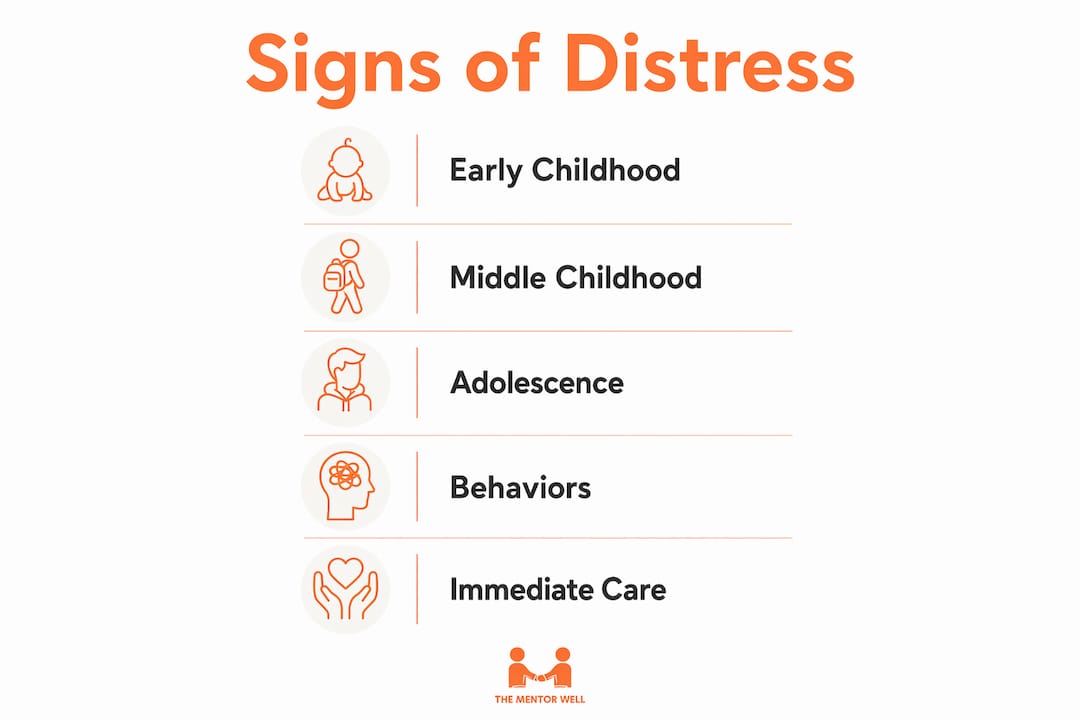
Children rarely say "I am struggling emotionally." They show it. The signs look different depending on age, and they often look like something else entirely.

Emotional and behavioural signs
| Age group | Common signs |
|---|---|
| Early childhood (4–7) | Clinginess, regression (bed-wetting, thumb-sucking), nightmares, separation anxiety, frequent tantrums |
| Middle childhood (8–10) | Withdrawal from activities, drop in school performance, frequent stomachaches or headaches, irritability, avoiding friends |
| Adolescence (12–17) | Persistent sadness or emptiness, anger and defiance, social withdrawal, changes in sleep or eating, loss of interest in things they loved |
Physical symptoms are not faking. Headaches, stomachaches, and trouble sleeping are among the most common ways emotional distress surfaces in young bodies. Dismissing them as excuses reinforces a child's sense that no one sees what they are carrying.
Distress in boys and older teens often looks like irritability, defiance, or aggression rather than sadness. Responding first with discipline when the underlying feeling is fear or grief can escalate conflict and close the door on the conversation you need to have.
Statistic: Canadian HBSC data shows that girls report higher rates of emotional problems than boys, and that emotional health tends to worsen from Grades 6 to 10, with the sharpest decline for girls between Grades 6 and 7.
Red flags requiring immediate attention
These signs call for same-day action, not a wait-and-see approach:
- Talking about death, dying, or not wanting to be here
- Giving away valued possessions
- Sudden calm after a period of severe distress (can signal a decision has been made)
- Self-harm marks or statements about self-harm
- Severe withdrawal from all people and activities within a short period
If you are seeing any of these, call Kids Help Phone (1-800-668-6868) or go to your nearest emergency department. A mental health crisis in youth can escalate quickly.
Why youth become emotionally distressed: causes and risk factors
No single cause explains emotional distress in a child. It is almost always a combination of factors, and understanding them helps caregivers respond with compassion rather than blame.
Individual factors
- Temperament: children who are naturally more sensitive or anxious are more vulnerable
- Neurodevelopmental differences (ADHD, autism spectrum) that make emotional regulation harder
- Previous trauma or adverse childhood experiences
- Difficulty identifying or naming emotions
Family factors
- Parental mental health struggles
- Family conflict, instability, or loss
- Low trust and communication between parent and child (Canadian data shows this matters more than family structure or income)
- Caregiving stress that limits a parent's emotional availability
Social and contextual factors
- Bullying, peer rejection, or social exclusion
- Social disconnection and exposure to risky peer behaviours associate with worse mental health outcomes
- Poverty and neighbourhood stress
- School environments that feel unsafe or disconnecting
- Online harassment and social media pressure
Protective factors
- At least one stable, trusting adult relationship
- A school environment where the child feels known and valued
- Mentoring and community connection
- Predictable home routines and open emotional communication
Consider a 13-year-old boy whose parents are separating, who has recently changed schools, and who has been excluded from his friend group online. Each factor alone might be manageable. Together, they create a level of cumulative stress that can tip into sustained distress quickly.
How common is emotional distress in young Canadians?
A significant proportion of Canadian students fall into the group reporting high levels of emotional problems, according to Public Health Agency of Canada data from the Health Behaviour in School-aged Children (HBSC) study, with approximately 33.8% of students in the highest emotional-problems group. This represents about one in three students in any given classroom.
The impact is not abstract. Emotional distress disrupts:
- School: concentration, attendance, and academic performance all decline. School absenteeism is often one of the earliest visible signals.
- Friendships: withdrawal and irritability erode peer relationships at exactly the age when those relationships matter most for development.
- Family life: distressed youth often pull away from parents, and the resulting tension can make home feel like another source of stress rather than a refuge.
- Long-term risk: emotional distress left unaddressed in adolescence increases the likelihood of anxiety disorders, depression, and substance use in adulthood.
The WHO notes that half of all mental health conditions have their onset before age 14, and most go undetected and untreated. Early recognition is not a luxury. It is the intervention.
When should you actually worry? Red flags and a timeline for action
Most parents ask the wrong question. They ask: "Is this serious enough?" The better question is: "Has something changed, and has it stayed changed?"
Watch for baseline change. A child acting differently from their usual self across days is having a rough patch. A child who has been different for weeks, across multiple settings, is showing you something that needs a response.
A practical timeline
- Days (1–5): Monitor. Note what you are seeing. Do not catastrophise, but do not dismiss.
- One to two weeks: Have a direct, calm conversation. Contact the school counsellor or your family doctor if the change is significant.
- Two to four weeks of persistent or worsening signs: Book a formal assessment. Do not wait for the child to ask for help.
- Any time: If you see red-flag signs (self-harm, talk of death, severe withdrawal), treat it as urgent. Same day.
Numbered red-flag checklist
- Statements about not wanting to be alive or about death
- Self-harm (cuts, burns, or other marks)
- Giving away meaningful possessions
- Sudden, unexplained calm after a period of visible distress
- Refusing to eat or sleeping more than 12 hours a day for more than a few days
- Complete withdrawal from all people, including close family
- Severe decline in functioning (not attending school, not leaving the room)
Crisis contacts: Kids Help Phone: 1-800-668-6868 (24/7, call or text). Canada Suicide Prevention Service: 1-833-456-4566. In immediate danger, call 911 or go to your nearest emergency department.
Practical first steps for parents and caregivers
You do not need a script. You need to show up and stay.
That said, how you open the conversation matters. Avoid "What's wrong with you?" or "You have nothing to be sad about." Both close the door. Try instead:
- "I've noticed you seem different lately. I'm not here to fix anything. I just want to understand."
- "You don't have to talk right now. But I'm here when you're ready, and I'm not going anywhere."
- For younger children: "Your body seems to be hurting a lot lately. Can you show me where it hurts the most?"
Practical steps to take now
- Document the baseline change: write down what you are noticing and when it started. This is invaluable when you speak to a clinician.
- Keep routines: predictability is stabilising for a distressed child, even when they resist it.
- Remove access to means: if there is any concern about self-harm or suicide, secure medications, sharp objects, and anything else that could be used.
- Contact the school: ask the counsellor what they are observing. Schools often see things parents do not, and vice versa.
Pro Tip: Create a brief safety plan together with your child: name two people they can call when things feel unbearable, one place they feel safe, and one thing that has helped before. Write it down and keep a copy. This is not alarmist. It is practical.
"Children often communicate distress through behaviour or physical symptoms rather than by naming emotion. Regression, clinginess, or quitting favourite activities are common but under-recognised signs." — School Mental Health Ontario
Family support strategies for teen mental health can help you build the kind of home environment where a child is more likely to speak up before things get critical.

What professional help looks like in Canada
Getting professional support does not mean you failed. It means you paid attention.
Evidence-based treatments
- Cognitive Behavioural Therapy (CBT): the most well-researched approach for youth anxiety and depression. Helps children identify and shift unhelpful thought patterns.
- Family therapy: addresses the relational dynamics that often maintain or worsen distress.
- Trauma-informed care: for children with adverse childhood experiences, standard CBT alone is often insufficient.
- Medication: sometimes discussed alongside therapy for moderate to severe anxiety or depression. Always initiated and monitored by a physician or psychiatrist.
Who does the assessment?
- Your family doctor or paediatrician is the first stop. They can rule out physical causes and provide referrals.
- School-based clinicians (social workers, psychologists) can assess and support within the school setting.
- Community mental health centres offer sliding-scale or publicly funded services.
- Private psychologists and therapists offer faster access but at out-of-pocket cost.
Waitlists for publicly funded services in Canada are real. Early recognition and triage matter precisely because getting on a waitlist early shortens the gap between distress and support.
"Intervention is most effective when caregivers act on sustained functional change rather than waiting for a formal diagnosis." — School Mental Health Ontario
What to bring to the first appointment
- A written summary of what you have observed and when it started
- Any relevant school reports or teacher notes
- A list of questions (see below)
- Your child, if they are willing, and a clear message to them that this is not punishment
Questions to ask a clinician:
- What is your assessment process, and how long does it take?
- What approach do you use, and is there evidence it works for this age group?
- How do you involve parents in the treatment?
- What do we do if things get worse before the next appointment?
Finding family mental health resources online can help you navigate the system before your first appointment.
How to reduce risk and build resilience before distress becomes severe
Prevention is not about protecting children from all difficulty. It is about making sure they have the internal and relational resources to move through difficulty without being overwhelmed by it.
What schools can do
Schools that check in regularly, notice attendance changes early, and create environments where students feel known produce measurably better mental health outcomes. Canadian data shows that a student's attitude toward school is more predictive of psychosomatic symptoms than their academic achievement. Connection matters more than grades.
Educators who notice a quiet student getting quieter, or an engaged student going absent, and who say something simple like "I've noticed you seem tired lately, how are you doing?" can open a door that a parent cannot.
What families can do
- Maintain predictable daily routines, especially around meals and sleep
- Practise emotion coaching: name feelings out loud yourself so children learn the vocabulary
- Hold regular, low-stakes check-ins (car rides are often better than face-to-face conversations for teenagers)
- Limit the conditions under which a child feels they must perform happiness
The role of mentoring
A trusted adult outside the immediate family, a coach, a mentor, an older peer, can be a significant buffer against distress. Children who have at least one such relationship outside the home are more likely to seek help when they need it.
Pro Tip: The sign most caregivers miss is not dramatic. It is a child who stops talking about the future. No plans, no excitement, no "I can't wait for..." If that changes in your child, ask about it directly.
Canadian resources for families and educators
You do not have to figure this out alone. These are the places to start.
Kids Help Phone (1-800-668-6868, text HELLO to 686868): Canada's only 24/7 national support service for young people. Free, confidential, available in English and French. For youth in crisis and for parents who need guidance on what to say.
Canadian Mental Health Association (CMHA): provincial chapters across Canada offer community mental health services, education, and referrals. Find your local chapter at cmha.ca.
Centre for Addiction and Mental Health (CAMH): Canada's largest mental health teaching hospital, with publicly available resources for families, clinicians, and educators.
School Mental Health Ontario (SMHO): provides guidance and resources specifically for Ontario educators and school-based mental health professionals.
AboutKidsHealth (The Hospital for Sick Children): evidence-based health information for Canadian families, including guidance on suicide and self-harm.
Provincial crisis lines: each province maintains its own crisis line. Search "[your province] mental health crisis line" for the current number.
The MentorWell's Teen Signal Check is a structured assessment tool for parents and caregivers of youth aged 8 to 25. It is designed to help you identify subtle warning signs before they become a crisis, and to give you language for what you are seeing. It is not a clinical diagnosis. It is a starting point for the conversation.
Key takeaways
Early recognition of sustained emotional distress in youth is the single most effective intervention available to parents, caregivers, and educators in Canada.
| Point | Details |
|---|---|
| Distress is a continuum | Normal moodiness becomes a concern when it persists across weeks and disrupts school, friendships, or home life. |
| One in three Canadian students | HBSC data shows approximately 33.8% of students fall into the highest emotional-problems group. |
| Physical symptoms are real signals | Headaches, stomachaches, and sleep changes are legitimate indicators of distress, not excuses. |
| Act on baseline change | If your child has been noticeably different for two or more weeks across multiple settings, consult a professional. |
| The MentorWell Teen Signal Check | Use it as an early-recognition tool to identify warning signs and find language for what you are observing. |
What I would do differently
There is a morning I keep coming back to. Coffee going cold on the counter. Maddie upstairs, quiet in a way that had become normal. I told myself she was a teenager. I told myself this was just how it goes.
I was wrong about what "normal" meant.
What I know now is that the silence was not safety. It was a signal I did not have the language to read. Not because I did not love her. Because I did not know what to look for, and no one had told me plainly enough that the absence of drama is not the same as the presence of okay.
If I could go back, I would have asked one question differently. Not "Are you okay?" She would have said yes. I would have asked: "What's the hardest part of your day right now?" That question leaves a door open. "Are you okay?" closes it.
The parents reading this are not failing. They are paying attention. That is already more than most. The next step is knowing what to do with what you are seeing, before the window closes.
The MentorWell: early recognition for families and workplaces
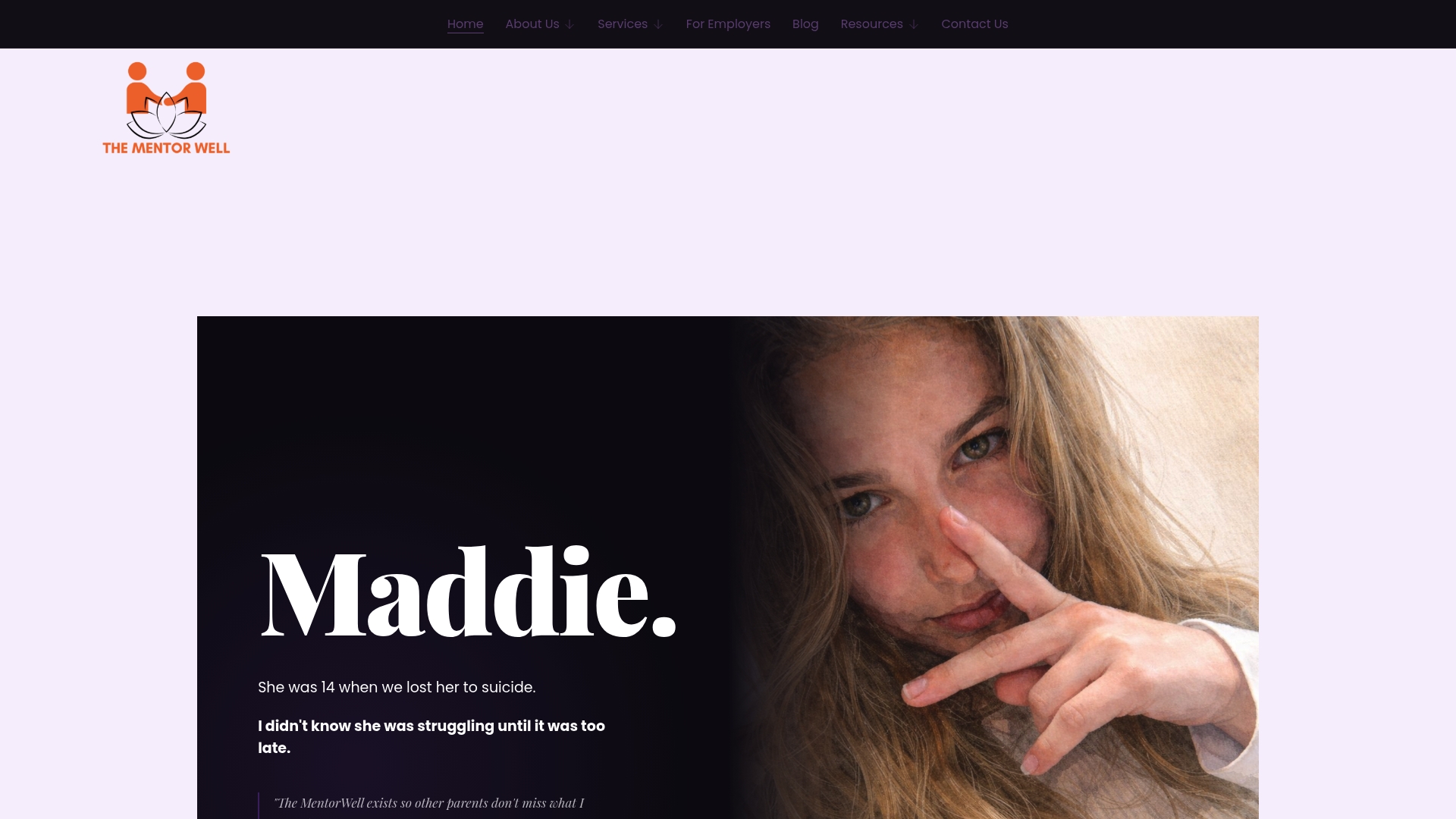
The MentorWell was built for the moment before the crisis. Not the emergency room. Not the call to 911. The moment when something feels off and you do not yet have words for it.
The Teen Signal Check is a structured assessment for parents and caregivers of youth aged 8 to 25. It helps you identify subtle warning signs, document baseline changes, and find language for what you are observing, so you can walk into a doctor's office or a school meeting with something concrete to say. The MentorWell also offers workshops and coaching for families and workplaces navigating early signs of youth emotional distress.
This is not a substitute for clinical care. If your child is in crisis, call Kids Help Phone or go to your nearest emergency department. The MentorWell is the step before that, and the support alongside it. Visit thementorwell.com to take the Teen Signal Check or learn about upcoming workshops.
This article is general information, not professional medical or mental health advice. For your child's specific situation, consult a qualified health professional or contact a crisis line.
Useful sources and further reading
The following are high-quality, Canada-relevant sources for families, educators, and clinicians seeking deeper reading on youth emotional distress.
Canadian sources:
- Public Health Agency of Canada: Health of Canada's young people: a mental health focus (HBSC findings on prevalence, gender, and grade trends)
- Public Health Agency of Canada: Healthy settings for young people in Canada (contextual factors including home, school, and peers)
- Kids Help Phone: 1-800-668-6868 / kidshelpphone.ca
- CMHA: cmha.ca
- CAMH: Youth mental health resources
- School Mental Health Ontario: smho-smso.ca
- Let's Talk Science: Recognising signs of child and youth mental distress
- AboutKidsHealth (SickKids): Suicide and self-harm guidance for parents
Practice guides and international references:
- World Health Organization: Adolescent mental health fact sheet
- American Academy of Child and Adolescent Psychiatry: Physical symptoms of emotional distress
- CDC: Anxiety and depression in children
- PMC: Bodily expression of psychological distress in adolescents
FAQ
What is emotional distress in youth?
Emotional distress in youth is a state of psychological struggle that ranges from normal developmental moodiness to sustained suffering that interferes with school, friendships, and home life. It is not a diagnosis, but a signal that a child may need support.
What are the five signs of emotional distress in young people?
The most consistent signs are: persistent sadness or irritability, withdrawal from people and activities they used to enjoy, physical complaints like headaches or stomachaches without a clear medical cause, significant changes in sleep or eating, and a noticeable drop in school performance or attendance.
What is an example of emotional distress in a teenager?
A teenager who quits a sport they loved, stops responding to friends, begins complaining of daily stomachaches, and seems flat or unreachable over three or more weeks is showing a pattern of emotional distress, even if they say they are fine.
How do I cope with emotional distress in my child?
Start by naming what you are seeing without judgment, keeping routines stable, and contacting your family doctor or school counsellor if the change persists beyond two weeks. For immediate support, Kids Help Phone (1-800-668-6868) is available around the clock for both youth and parents.
What are common emotional problems in teenagers?
Anxiety and depression are the most prevalent, often appearing together. Canadian HBSC data shows emotional health tends to worsen from Grades 6 to 10, with girls showing a sharper decline. Irritability, social withdrawal, and somatic complaints are among the most common presentations across genders.