
Responsible business practices are the steps a company takes to manage its environmental, social, and governance impacts in line with internationally recognised frameworks, principally the UN Guiding Principles on Business and Human Rights (UNGPs) and the OECD Guidelines for Multinational Enterprises. The single most important first action is to conduct a focused, risk-based due-diligence scan of your operations and supply chain. Everything else follows from knowing where your real exposures lie.
If you have a few weeks and a small cross-functional team, start here:
- Week 1–2: Assign an internal owner (a senior manager with cross-functional authority) and define the scope of your first due-diligence review.
- Month 1: Map your existing HR, procurement, safety, and environmental policies against the OECD Guidelines to reveal your hidden baseline.
- Month 2–3: Conduct a stakeholder mapping exercise to identify who is affected by your operations and where the highest-risk relationships sit.
Key takeaways
Responsible business practices in Canada require a risk-based due-diligence process anchored in the UNGPs and OECD Guidelines, supported by Canada-specific institutions including CORE, the NCP, and the Trade Commissioner Service.
| Point | Details |
|---|---|
| Start with due diligence | Conduct a risk-based scan of operations and supply chains before building any new policy or programme. |
| Map your existing baseline | Most organisations already have HR, procurement, and safety policies that partially meet OECD Guidelines standards. |
| Know your legal obligations | Canada's forced-labour reporting deadline is May 31 annually; non-compliance carries fines up to $250,000. |
| Use Canadian institutional supports | CORE, the NCP, Global Affairs Canada, TCS, and EDC all offer guidance, mediation, and funding for RBC implementation. |
| The MentorWell | Provides workplace mental-health workshops and manager coaching as a concrete, measurable responsible-business practice for Canadian employers. |
Table of Contents
- What are responsible business practices and what principles should guide them?
- Which international and Canadian frameworks should you actually use?
- Why do responsible business practices matter for Canadian organisations?
- What concrete practices should your organisation put in place?
- How do you implement responsible business practices step by step?
- How do you measure impact and report credibly?
- What Canadian laws and institutions do you need to know?
- What mistakes should you avoid, and how do you spot greenwashing?
- Sector-specific starting points for mining, garments, finance, and technology
- Workplace mental health as a responsible business practice
- A 12-month checklist for first-time implementers
- Why this work is about more than compliance
- The MentorWell's workplace mental-health workshops for Canadian employers
- Sources
- FAQ
What are responsible business practices and what principles should guide them?
Responsible business conduct (the term used by Global Affairs Canada and the OECD) integrates the management of risks to the environment, people, and society into a company's core activities. It is not a separate programme bolted onto the side of operations. It is how a company decides to source, hire, build, and communicate, every day.
The two anchoring frameworks are the UNGPs and the OECD Guidelines. The UNGPs establish that companies have a responsibility to respect human rights regardless of whether governments enforce that responsibility. The OECD Guidelines extend that logic to cover labour, environment, anti-corruption, consumer interests, and science and technology. Together, they define the floor.
The core principles that should guide your organisation:
- Human rights: Respect the rights of workers, communities, and affected people across your value chain, not just your direct employees.
- Environment: Identify, prevent, and mitigate environmental harm, including climate-related risks and biodiversity impacts.
- Anti-corruption: Maintain zero-tolerance policies for bribery and facilitation payments, with clear reporting channels.
- Stakeholder engagement: Consult meaningfully with affected communities, including Indigenous peoples, before decisions are made, not after.
- Transparency: Disclose your material risks, your progress, and your shortcomings honestly and on a regular basis.
- Remediation: When harm occurs, provide or cooperate in genuine remedy, not just an apology.
The Government of Canada expects all Canadian companies, regardless of size or sector, to adopt these practices domestically and abroad. That expectation is not aspirational. It is the foundation of Canada's RBC Strategy 2022–27.
Pro Tip: Treat responsible business conduct as a change-management exercise, not a compliance checklist. Export Development Canada advises embedding your CSR strategy into daily operations before a crisis forces your hand. The companies that do this well start with governance, not a policy document.
Which international and Canadian frameworks should you actually use?
There are more frameworks than any team can absorb at once. The practical question is which ones apply to your situation and in what order.
The OECD Guidelines for Multinational Enterprises recommend risk-based due diligence as the central mechanism for identifying, preventing, mitigating, and accounting for adverse impacts. The OECD Due Diligence Guidance translates that into sector-specific steps for mining, garments, agriculture, and finance. ISO 26000 offers a broader organisational guidance standard covering seven core subjects, useful for companies building their first governance structure. The UN Sustainable Development Goals (SDGs) provide a shared language for communicating your social and environmental contributions to external audiences.
On the reporting side, GRI (Global Reporting Initiative) is the most widely used standard for sustainability disclosure and works for companies of most sizes. SASB (now integrated into the ISSB framework) provides industry-specific metrics that investors find comparable. TCFD (Task Force on Climate-related Financial Disclosures) focuses specifically on climate risk and is increasingly expected by lenders and institutional investors.
Canada is also developing its own RBC due-diligence standard through the Canadian General Standards Board, which will complement these international frameworks and provide consistent indicators for how companies account for their impacts.
| Framework | Primary focus | Typical audience | One-line use case |
|---|---|---|---|
| UNGPs | Human rights due diligence | All companies | Identify and address human-rights risks in operations and supply chains |
| OECD Guidelines | Broad RBC (human rights, labour, environment, anti-corruption) | Multinationals and exporters | Comprehensive conduct standard for companies operating internationally |
| OECD Due Diligence Guidance | Sector-specific due diligence | Mining, garments, agriculture, finance | Step-by-step risk assessment for high-risk sectors |
| ISO 26000 | Organisational social responsibility | All organisations | Build a governance structure around seven core social-responsibility subjects |
| UN SDGs | Sustainable development goals | All organisations | Frame and communicate social and environmental contributions |
| GRI | Sustainability reporting | All companies | Disclose material ESG impacts to stakeholders |
| SASB/ISSB | Industry-specific ESG metrics | Publicly listed and investor-facing companies | Produce comparable metrics for capital markets |
| TCFD | Climate-related financial risk | Companies with material climate exposure | Disclose climate risks and opportunities to investors and lenders |
| Canadian RBC Strategy 2022–27 | Canada-specific RBC expectations | Canadian companies operating abroad | Align with government expectations and access TCS/EDC supports |
Why do responsible business practices matter for Canadian organisations?
The business case is not abstract. Responsible business conduct helps firms de-risk operations, build resilience, and maintain the social licence to operate in communities where they work. The benefits are concrete:
- De-risking: Identifying human-rights and environmental exposures before they become supply-chain disruptions or regulatory penalties.
- Reputation and brand: Transparent, credible conduct builds trust with customers, communities, and media.
- Access to capital: Institutional investors and lenders increasingly screen for ESG performance; poor disclosure can raise your cost of capital.
- Talent: Employees, particularly younger professionals, choose employers whose stated values match their conduct.
- Market access: Export markets, particularly in the EU, are tightening supply-chain due-diligence requirements. Canadian exporters who are not ready will lose contracts.
The risks of inaction are equally specific. Canada's Fighting Against Forced Labour and Child Labour in Supply Chains Act creates mandatory reporting obligations for entities meeting the thresholds, with an annual reporting deadline and potential fines for non-compliance. That is not a CSR risk. That is a legal one.
For Canadian extractive companies operating in conflict-affected regions, the reputational and operational exposure is acute. A single credible allegation of community harm can trigger a CORE review, freeze a project, and generate years of negative coverage. The window to prevent that is before the project begins, not after the allegation lands.
What concrete practices should your organisation put in place?
Knowing the principles is one thing. Knowing what to actually do on Monday morning is another.
Due diligence and risk assessment
Conduct a risk-based due-diligence review of your operations and supply chain at least annually. Prioritise by severity and likelihood of harm, not by proximity to headquarters. Mapping your existing HR, procurement, and safety policies against the OECD Guidelines often reveals a baseline of responsible conduct you already have, which lowers the cost of formalising it.
Supplier and procurement practices
Require suppliers to meet minimum conduct standards through a supplier code of conduct. Embed contractual clauses that allow for audits, corrective action plans, and termination for serious violations. Audit high-risk suppliers, and when audits reveal problems, remediate rather than simply exit. Exiting without remediation transfers harm; it does not eliminate it.
Environmental management
Set measurable targets for energy use, emissions, water, and waste. Track them quarterly. Align your climate disclosures with TCFD and your broader environmental reporting with GRI or ISSB standards.
Anti-corruption
Maintain a written anti-bribery policy, train all staff who interact with government officials or procurement decisions, and establish a confidential reporting channel. Review your facilitation-payment practices specifically; many Canadian companies carry exposure here without realising it.
Indigenous engagement
Meaningful engagement with Indigenous communities requires early consultation, respect for cultural protocols, and a genuine willingness to adjust plans based on what you hear. This is not a legal checkbox. It is a relationship. For resource-sector companies, the social-impact work required to build that relationship begins long before a project application is filed.
Workplace wellbeing
Responsible employers track more than safety incidents. Absenteeism, turnover, and manager-reported team stress are leading indicators of a workplace that is not well. Build referral pathways for employees experiencing mental-health challenges, and train managers to recognise early signs of distress.
Pro Tip: Before you build anything new, map what you already have. Most organisations have an existing baseline of responsible conduct embedded in HR policies, procurement checklists, and safety programmes. Surfacing that baseline first reduces implementation burden and builds internal credibility for the work.
How do you implement responsible business practices step by step?
Implementation is not a project with an end date. It is a cycle. The OECD due-diligence framework describes six steps, and the Canadian RBC Strategy maps closely to them.
Phase 1: Prepare (months 1–3) — Low to medium effort
- Secure leadership buy-in and assign a senior internal owner with cross-functional authority.
- Define the scope: which operations, geographies, and supply-chain tiers will you assess first?
- Establish a cross-functional working group (legal, HR, procurement, operations, communications).
- Map existing policies against the OECD Guidelines to identify gaps and existing strengths.
- Set a governance structure: who reports to whom, and how often does the board receive updates?
Phase 2: Assess (months 3–6) — Medium effort
- Conduct a risk mapping exercise across your value chain, prioritising by severity and likelihood of harm.
- Engage affected stakeholders, including workers, communities, and civil-society organisations, to understand impacts from their perspective.
- Document findings in a risk register with assigned owners and target remediation dates.
Phase 3: Act and embed (months 6–12) — Medium to high effort
- Implement mitigation measures: update contracts, revise procurement criteria, launch training, and adjust operational practices.
- Embed responsible conduct into performance reviews, supplier scorecards, and capital-allocation decisions.
- Establish a grievance mechanism that is accessible, safe, and genuinely responsive.
- Begin tracking KPIs and prepare your first public disclosure.
Phase 4: Track, communicate, and remedy (ongoing)
- Report annually against your chosen framework (GRI, ISSB, TCFD).
- When harm occurs, activate your remediation process promptly and document the outcome.
- Review and update your risk assessment annually or when material changes occur.
Board oversight is not optional for mature programmes. The board should receive at least an annual briefing on material RBC risks and the company's progress against commitments. For leadership development that embeds this kind of governance thinking, building manager capability is as important as writing the policy.
How do you measure impact and report credibly?
Measurement is where most organisations stall. The frameworks exist. The harder question is which KPIs actually tell you whether your conduct is improving.
Choosing a reporting standard
GRI is the right starting point for most Canadian companies. It is flexible, widely recognised, and covers the full range of material topics. ISSB (which absorbed SASB) is the standard investors are moving toward, particularly for publicly listed companies. TCFD is now effectively mandatory for large financial institutions in Canada and is expected by most institutional investors regardless of sector.
| Standard | Primary audience | Best used when |
|---|---|---|
| GRI | Customers, communities, NGOs, regulators | You want a comprehensive, stakeholder-facing sustainability report |
| ISSB/SASB | Investors, analysts, lenders | You need comparable, industry-specific ESG metrics for capital markets |
| TCFD | Investors, boards, regulators | You have material climate-related risks or opportunities to disclose |
Suggested core KPIs by theme
- Human rights: Number of due-diligence assessments completed; number of grievances received and resolved; percentage of high-risk suppliers audited.
- Labour: Lost-time injury rate; employee turnover; gender pay gap; percentage of workforce covered by collective agreements.
- Environment: Scope 1 and 2 greenhouse gas emissions (tonnes CO2e); energy intensity; water withdrawal in water-stressed areas; waste diverted from landfill.
- Governance: Percentage of board members with ESG oversight responsibility; number of confirmed anti-corruption violations; whistleblower reports received and resolved.
- Supply-chain due diligence: Percentage of suppliers who have signed your code of conduct; number of corrective action plans issued and closed.
Avoiding greenwashing
Greenwashing is not always deliberate. It often starts with a communications team that gets ahead of the evidence. The corrective is simple: only claim what you can measure, only measure what you track, and only track what you are willing to disclose when the numbers disappoint you.
Pro Tip: Balanced reporting builds more trust than polished reporting. Disclose a setback alongside your progress. Readers, investors, and regulators notice when every report shows improvement in every metric. A credible report acknowledges where targets were missed and explains what changed.
What Canadian laws and institutions do you need to know?
Canada has a specific institutional architecture for responsible business conduct. Knowing who does what saves time and reduces the risk of missing a compliance obligation.
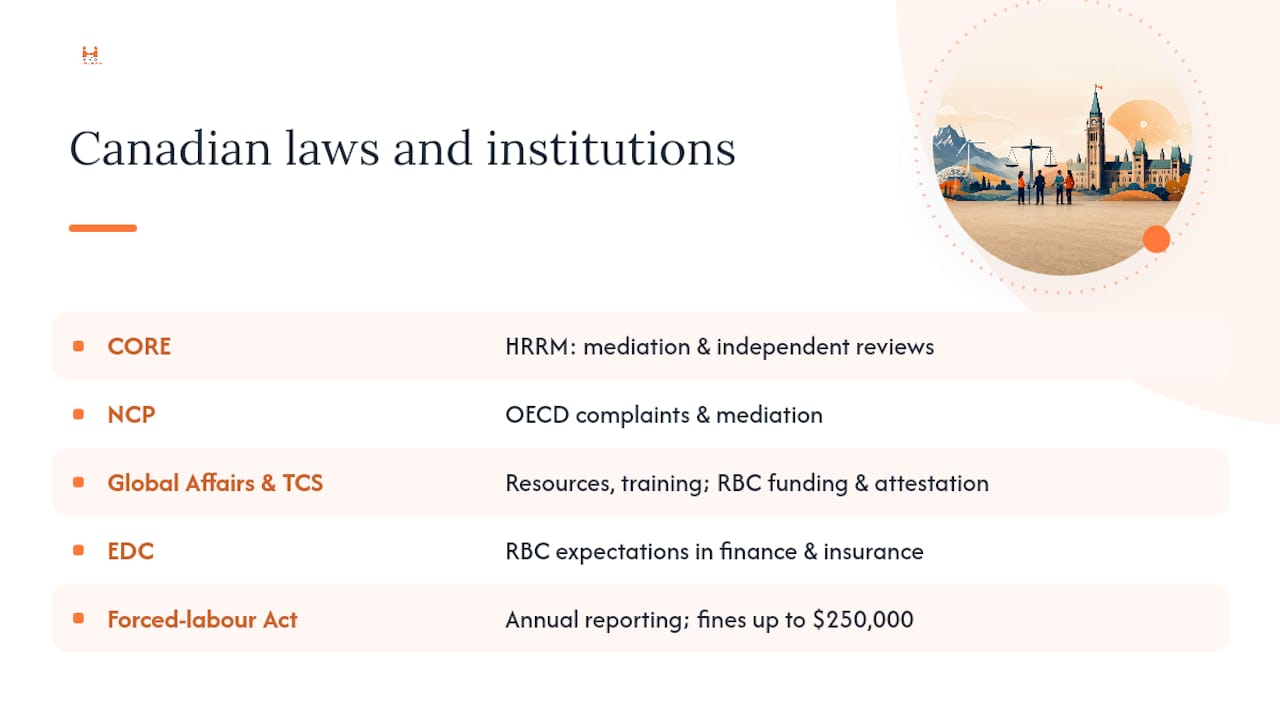
Canadian Ombudsperson for Responsible Enterprise (CORE)
The CORE operates a Human Rights Responsibility Mechanism (HRRM) that offers mediation, joint fact-finding, and independent reviews for alleged human-rights abuses tied to Canadian companies operating abroad. The HRRM can be initiated by complaint or by the Ombudsperson's own review. It is designed to encourage accountability and genuine remediation, not simply to punish. If your company operates in a high-risk sector or geography, understanding the HRRM process before a complaint arrives is prudent.
Canada's National Contact Point (NCP) for Responsible Business Conduct
The NCP, housed within Global Affairs Canada, handles complaints under the OECD Guidelines and facilitates mediation between companies and affected parties. It is a parallel mechanism to the CORE, focused on the full scope of the OECD Guidelines rather than human rights alone.
Global Affairs Canada and the Trade Commissioner Service (TCS)
Global Affairs Canada and the TCS provide resources, training, and funding, including a Responsible Business Fund, to help Canadian companies adopt and implement RBC practices abroad. The TCS is also moving toward requiring a Digital RBC Attestation for clients to access some services, signalling that proactive due diligence is becoming a condition of government support, not just a best practice.
Export Development Canada (EDC)
EDC integrates RBC expectations into its financing and insurance products. Companies seeking EDC support are expected to demonstrate responsible conduct, particularly in high-risk sectors and geographies.
Forced-labour legislation
Canada's Fighting Against Forced Labour and Child Labour in Supply Chains Act requires entities meeting the thresholds to report annually by May 31. Non-compliance can result in fines up to $250,000. Treat this as a mandatory legal obligation, not a voluntary CSR commitment. If your company imports goods or has supply-chain exposure in high-risk countries, legal counsel should review your reporting obligations now.
Global Compact Network Canada (GCNC)
The GCNC is the Canadian chapter of the UN Global Compact and provides peer learning, tools, and a community of practice for companies committed to the ten principles covering human rights, labour, environment, and anti-corruption.
What mistakes should you avoid, and how do you spot greenwashing?
The most common implementation mistake is treating responsible business conduct as a communications exercise. A policy document published on a website, a sustainability report with no third-party verification, and a supplier code of conduct that no one audits are not responsible practices. They are the appearance of responsible practices, and sophisticated stakeholders know the difference.
Common pitfalls
- Publishing commitments without assigning owners, budgets, or deadlines.
- Conducting supplier audits that are announced in advance and reviewed only at the tier-one level.
- Exiting a supplier relationship when an audit reveals a problem, rather than engaging in remediation.
- Treating certification (Fairtrade, B Corp, ISO 14001) as a substitute for ongoing due diligence.
- Disclosing only positive outcomes in annual reports.
Red flags for greenwashing
- Vague language ("we are committed to sustainability") with no measurable targets.
- Claims that cannot be independently verified.
- Selective disclosure that highlights wins and omits material risks.
- Carbon-offset claims that substitute for emissions reductions.
- Supply-chain claims based on self-reported supplier data with no audit trail.
Corrective actions
Tie every public commitment to a specific, measurable, time-bound target. Disclose the methodology behind your metrics. Engage a third party to verify material claims. When you miss a target, say so and explain why.
Pro Tip: Before your communications team publishes any environmental or social claim, ask one question: can we show the data that supports this, including the years when we fell short? If the answer is no, the claim is not ready to publish.
Sector-specific starting points for mining, garments, finance, and technology
Responsible business practices look different depending on where your material risks sit. Here are starting points for four sectors with significant Canadian exposure.
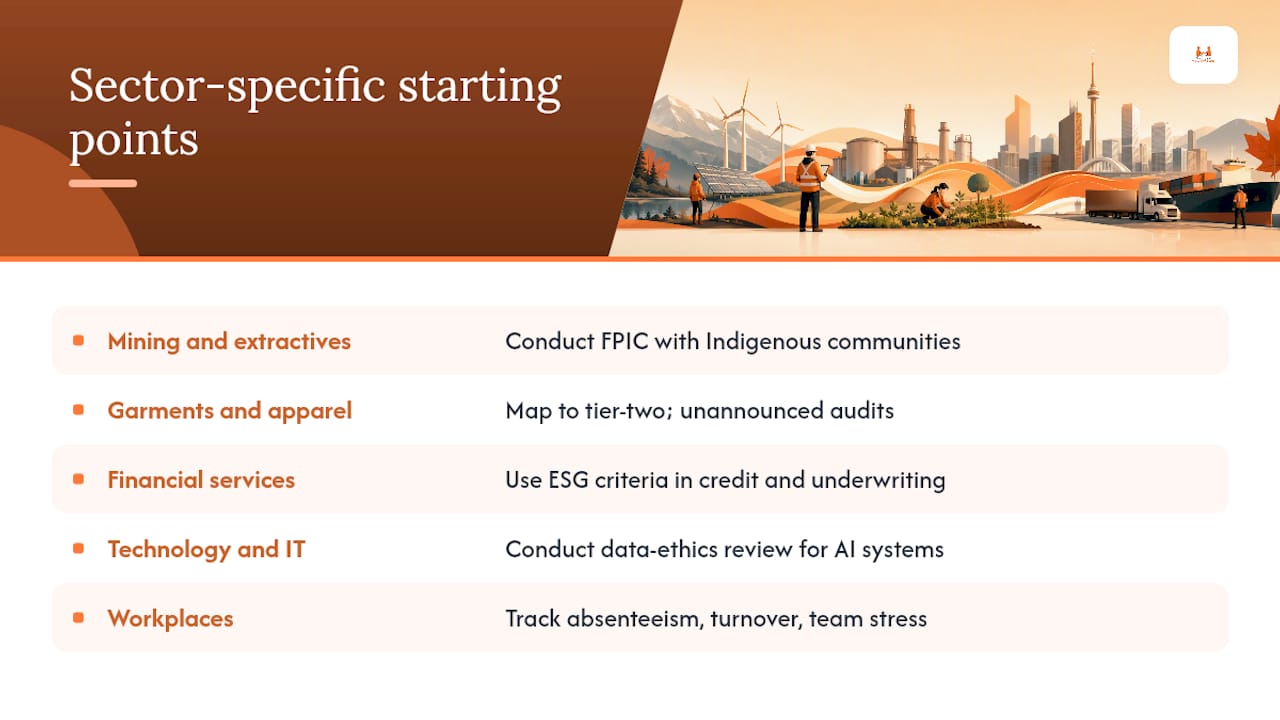
Mining and extractives
The primary risks are community displacement, environmental harm, and Indigenous rights. The OECD Due Diligence Guidance for Responsible Mineral Supply Chains is the sector-specific standard. Priority practice: conduct a free, prior, and informed consent (FPIC) process with affected Indigenous communities before any exploration or development activity begins. Quick template: a community-engagement log that records who was consulted, what was discussed, what concerns were raised, and how the company responded.
Garments and apparel
Supply chains in this sector routinely span multiple countries and dozens of sub-contractors, many in jurisdictions with weak labour enforcement. The OECD Due Diligence Guidance for Responsible Supply Chains in the Garment and Footwear Sector is the reference document. Priority practice: map your supply chain to at least tier two and conduct unannounced audits of high-risk facilities. Quick template: a supplier risk-rating matrix that scores suppliers on country risk, commodity risk, and audit history.
Financial services
Banks, insurers, and asset managers carry indirect exposure through the companies they finance and insure. The TCFD framework is the primary disclosure standard. Priority practice: integrate ESG risk criteria into credit and underwriting decisions for high-risk sectors. For healthcare and human-services organisations navigating safety and standards implementation, the same change-management discipline applies to embedding new conduct standards into existing workflows.
Technology and IT
The primary risks are data privacy, algorithmic bias, and supply-chain exposure in hardware manufacturing (conflict minerals in electronics). Priority practice: conduct a data-ethics review of any AI or automated decision-making system that affects employees or customers. Quick template: an algorithmic-impact assessment checklist covering data sources, decision criteria, affected populations, and appeal mechanisms.
Workplaces (all sectors)
Every employer carries responsibility for the psychological safety of its workforce. Responsible employers track absenteeism, turnover, and manager-reported team stress as leading indicators. They build referral pathways, train managers, and create conditions where people can say they are not well without fear of consequence.
Workplace mental health as a responsible business practice
Workplace mental health is not a soft benefit. It is a concrete responsible-business practice with measurable outcomes and real risk implications for employers who ignore it.
The practical steps are not complicated, but they require consistency. Train managers to recognise early signs of emotional distress, not just acute crisis. Build safe referral pathways so employees know where to go and trust that going there will not cost them their job. Adapt your approach for workplaces with significant youth exposure, including co-op students, apprentices, and young workers, where the signals of distress can look different from those in an adult workforce.
Suggested KPIs for a workplace mental-health programme:
- Participation rate in manager mental-health training (target: 80% of people managers within 12 months).
- Referral uptake: percentage of employees who access the Employee Assistance Programme or internal referral pathway.
- Short-term wellbeing indicators: absenteeism rate, presenteeism self-report, and voluntary turnover.
- Post-training confidence scores: manager self-reported confidence in recognising and responding to distress.
A basic programme, covering policy, manager training, and referral pathways, can be operational within three to six months. The workplace wellness resources available through The MentorWell include practical frameworks for building that foundation without starting from scratch.
Pro Tip: The most common failure in workplace mental-health programmes is the gap between policy and practice. A policy that says "we support mental health" means nothing if managers have never been trained to have the conversation. Start with the managers. The policy can follow.
A 12-month checklist for first-time implementers
Quarter 1: Set up (months 1–3)
- Appoint an internal RBC owner with cross-functional authority and a small working group.
- Map existing policies (HR, procurement, safety, environment) against the OECD Guidelines.
- Conduct a stakeholder mapping exercise to identify who is affected by your operations.
- Review your forced-labour reporting obligations under the Fighting Against Forced Labour and Child Labour in Supply Chains Act.
- Register with the Global Compact Network Canada for peer learning and tools.
- Set a governance structure and schedule the first board briefing on RBC risks.
Quarter 2: Assess and act (months 4–6)
- Complete a risk-based due-diligence scan of your top-priority operations and supply-chain tiers.
- Identify your three highest-priority risks and assign owners and target dates.
- Draft or update your supplier code of conduct and embed contractual audit rights.
- Launch manager training on workplace wellbeing and early-distress recognition.
- Establish or review your grievance mechanism for workers and affected communities.
- Contact the Trade Commissioner Service to understand available RBC supports and the Digital RBC Attestation process.
Quarter 3: Embed (months 7–9)
- Integrate RBC criteria into procurement scorecards and capital-allocation decisions.
- Conduct your first supplier audit of at least one high-risk relationship.
- Begin tracking your core KPIs across human rights, labour, environment, and governance themes.
- Review your anti-corruption policy and confirm training coverage for relevant staff.
Quarter 4: Report (months 10–12)
- Prepare your first public disclosure, even if it is a brief, honest progress report rather than a full GRI report.
- Conduct a lessons-learned review with your working group and update your risk register.
- Brief the board on progress, gaps, and the plan for year two.
- Set your year-two targets and assign owners before the fiscal year closes.
Low-cost starting actions for constrained budgets: the ISED implementation guide, the Global Affairs Canada RBC toolkit, and the GCNC's resources are all free. The biggest cost in year one is internal time, not external spend.
Why this work is about more than compliance
I have spent a lot of time thinking about what it means to pay attention. Not the performative kind, where you put a policy on a website and move on. The kind where you actually look at what is happening around you and decide to do something about it before the moment passes.
That is what responsible business practice is, at its core. It is paying attention to the people your decisions affect, the communities your operations touch, the workers in your supply chain you will never meet. And then doing something about what you see.
The companies that do this well are not the ones with the longest sustainability reports. They are the ones where a manager notices something is wrong with a team member and knows what to do next. Where a procurement officer flags a supplier risk before it becomes a headline. Where leadership hears a community concern and actually changes the plan.
The window to act is always earlier than you think. That is the one thing I know for certain.
What would you do differently if you started today?
The MentorWell's workplace mental-health workshops for Canadian employers

Responsible business conduct includes the psychological safety of your workforce. That is not a soft commitment. It is a measurable, manageable practice, and it starts with giving your managers the tools to recognise distress before it becomes crisis.
The MentorWell offers workplace workshops, live and on-demand manager coaching, and the Teen Signal Check assessment, a practical tool for identifying early warning signs of emotional distress in youth aged 8–25. For employers with young workers, co-op students, or family-facing employee populations, these tools address a gap that most EAP programmes do not.
Employers who complete The MentorWell's workplace mental-health programme can expect trained managers who know how to have the conversation, referral pathways that employees actually use, and a measurable baseline for tracking wellbeing over time.
Book a workplace workshop or explore the programme options at The MentorWell.
Sources
- 7 tips to build your own CSR strategy | EDC
- An implementation guide for Canadian business
- Operating procedures for the Human Rights Responsibility Mechanism of the Canadian Ombudsperson for Responsible Enterprise (CORE)
- Responsible business conduct — Global Affairs Canada
- OECD Guidelines for Multinational Enterprises on Responsible Business Conduct
- Fighting Against Forced Labour and Child Labour in Supply Chains Act (Canada)
FAQ
What is a responsible business practice?
A responsible business practice is any action a company takes to identify, prevent, and mitigate its negative impacts on people, the environment, and society, in line with frameworks such as the UN Guiding Principles on Business and Human Rights and the OECD Guidelines for Multinational Enterprises.
What are the four types of corporate social responsibility?
CSR is commonly organised into four categories: environmental responsibility (reducing ecological harm), ethical responsibility (fair and honest conduct), philanthropic responsibility (contributing to community wellbeing), and economic responsibility (operating profitably in ways that support long-term social value). In practice, the OECD Guidelines and UNGPs integrate all four into a single due-diligence process.
What are examples of responsible business practices?
Concrete examples include conducting risk-based supply-chain due diligence, publishing a supplier code of conduct with audit rights, setting measurable emissions targets, training managers to recognise workplace mental-health distress, engaging Indigenous communities before project decisions are made, and reporting annually against GRI or ISSB standards.
What is another term for responsible business practices?
The most widely used equivalent term in Canadian and international policy is "responsible business conduct" (RBC), which is the language used by Global Affairs Canada, the OECD, and the UN. "Corporate social responsibility" (CSR) is also common, though it tends to carry a broader and sometimes more philanthropic connotation than the due-diligence-focused RBC framing.
How does The MentorWell support responsible business practices?
The MentorWell provides workplace mental-health workshops, manager coaching, and early-detection tools that help Canadian employers meet their duty of care to employees, a concrete and measurable component of responsible business conduct. Employers can book a workshop or explore programme options at The MentorWell.