
A corporate mentorship programme connects a less experienced employee with a more seasoned colleague to transfer knowledge, accelerate development, and improve retention. For Canadian employers, the business case is urgent: only about one-third of Canadian companies offer mentorship programmes, while 75% reported retirements in the prior two years. That gap is where institutional knowledge quietly walks out the door.
If you are an HR leader reading this on a Monday morning, here are three things you can do before Friday:
- Secure a sponsor. Identify one senior leader willing to publicly champion the pilot. Without executive visibility, programmes stall before the first match is made.
- Define your cohort. Pick a single department or role level for the pilot, 10–20 participants maximum. Trying to run company-wide from day one is the fastest route to a programme that fizzles.
- Choose a simple matching approach. A short profile questionnaire and manual matching by the programme coordinator is enough for a first cohort. You can add algorithmic tools later.
Canadian survey data confirm that employees with workplace mentors report higher job satisfaction, and that access to mentorship varies significantly by age and occupation. Formal programmes close that gap. The rest of this guide gives you the playbook to build one.
Key takeaways
Effective corporate mentorship programmes require a named sponsor, a defined cohort, a clear matching process, and a coordinator who tracks participation from day one.
| Point | Details |
|---|---|
| Start with a pilot cohort | Limit the first cohort to 10–20 participants in one department to keep matching and coordination manageable. |
| Secure a sponsor before launch | A senior leader who publicly endorses the programme is the single most reliable predictor of first-cohort completion. |
| Track KPIs from the start | Collect baseline data on satisfaction, retention, and promotion before the programme opens, or you will have nothing credible to show leadership. |
| Separate mentorship from sponsorship | Mentors build capability; sponsors advocate for promotion. Both are needed, and both require formal structure to produce equitable outcomes. |
| The MentorWell supports your team | The MentorWell's pilot workshops and manager training give Canadian HR teams the psychological safety tools and escalation pathways their mentors need. |
Table of Contents
- What corporate mentorship programme models should you choose?
- How do you design a programme that actually holds together?
- How should you match mentors and mentees?
- What do mentors, mentees, and coordinators actually do?
- How do you launch and run the programme operationally?
- How do you measure whether the programme is working?
- How do you make your programme genuinely inclusive?
- Mentorship versus sponsorship: why you need both
- Templates and tools every Canadian HR team needs
- How do you keep mentorship psychologically safe?
- Why mentorship is not just a programme
- How The MentorWell supports Canadian employers building these programmes
- Sources
- FAQ
What corporate mentorship programme models should you choose?
Not every mentorship model fits every objective. Choosing the wrong structure is one of the most common design mistakes, and it usually shows up six weeks in when participation drops and no one can explain why.
| Model | Best for | Coordination effort | Scale | Measurement complexity |
|---|---|---|---|---|
| 1:1 traditional | Knowledge transfer, leadership development | Low | Limited by mentor supply | Low |
| Group mentoring | Skill-building, community, cohort learning | Medium | High | Medium |
| Peer mentoring | Onboarding, lateral skill-sharing | Low–medium | High | Medium |
| Reverse mentoring | Digital fluency, generational exchange | Low | Moderate | Low |
| Newcomer / cross-cultural | Immigrant integration, belonging | Medium–high | Moderate | High |
Gallup research finds that formal mentoring relationships produce stronger career development signals and better perceptions of equitable advancement than informal ones. That finding holds across models, but the delivery structure shapes what outcomes you can realistically measure.
1:1 mentoring remains the most widely used format because it is the easiest to administer at a small scale and the easiest to evaluate. One mentor, one mentee, a defined cadence. The constraint is mentor supply: you can only run as many pairs as you have qualified, willing mentors.
Group mentoring places one mentor with three to six mentees. It stretches mentor capacity and builds peer community inside the cohort, which is why it works well for new-hire cohorts or early-career development tracks. The trade-off is that individual attention is diluted, and quieter participants can disappear into the group dynamic without anyone noticing.
Peer mentoring pairs employees at similar levels. It is particularly effective for onboarding, lateral skill transfer, and peer support in the workplace where the goal is belonging rather than hierarchical knowledge transfer. Coordination is lighter because the power dynamic is flat, but you still need structure or the relationship drifts.
Reverse mentoring inverts the traditional direction: a junior employee mentors a senior one, typically on digital tools, emerging culture, or generational perspectives. It works best when senior leaders are genuinely curious and not just performing openness.
Newcomer and cross-cultural mentoring pairs recent immigrants or internationally trained professionals with established employees who can help them navigate workplace norms, credential recognition, and professional networks. This model carries the highest coordination overhead because it often involves language supports, cultural brokering, and connections to external settlement services.
How do you design a programme that actually holds together?
The programmes that survive past the first cohort share one thing: they started with outcomes, not activities, often supported by custom practice management software for healthcare clinics to embed mentorship into operational workflows. Before you build anything, write down two or three measurable objectives and map each one to a KPI your leadership team already cares about.
Step 1: Define your objectives and KPIs
Typical objectives for a pilot include reducing voluntary turnover in a target population, increasing the promotion rate for a specific group, or improving engagement scores in a department. Each objective needs a baseline measurement before the programme launches, or you will have nothing credible to show leadership at the end.
Step 2: Scope and eligibility
Decide who qualifies as a mentee, who qualifies as a mentor, and how large the cohort will be. A few decisions to make explicitly:
- Minimum tenure for mentors (commonly one to two years in role)
- Whether participation is opt-in or whether managers can nominate employees
- Whether mentors and mentees must be in different departments (recommended for most models)
- Cohort duration (six months is a practical pilot length; twelve months for leadership development tracks)
Step 3: Governance
Every programme needs a named sponsor, a programme lead, and a steering group that meets at least quarterly. ERG partnerships are worth building early: ERGs often have existing relationships with the populations you most want to reach, and they can help source mentors and flag matching concerns before they become problems.
Step 4: Budget and resources
A realistic budget checklist for a 20-person pilot:
- Programme coordinator time: 4–6 hours per week during active phases
- Mentor training: half-day workshop or equivalent asynchronous modules
- Platform or spreadsheet tools: free to low-cost for a pilot
- Mid-point and closing surveys: free with most HR survey tools
- Recognition and closing event: modest, but worth budgeting
Programmes that lack a dedicated coordinator and minimum meeting-frequency rules consistently show higher early drop-off rates. Budget the coordinator role before you budget anything else.
Pro Tip: Nominate a single programme champion, one person whose name every participant knows and can contact. Not a committee. One person. This is the single highest-leverage structural decision you will make.
How should you match mentors and mentees?
Matching is where most pilots either earn trust or lose it. A bad match in the first cohort becomes the story that circulates for years.
Matching approaches
Four methods are in common use, each with real trade-offs:
Manual manager-led matching relies on a coordinator or manager who knows both parties and makes a judgment call. It is fast and relationship-aware, but it tends to replicate existing networks and can introduce unconscious bias. Best for very small pilots where the coordinator genuinely knows the participants.
Questionnaire-based self-matching gives participants a profile form and lets them browse and select. It increases participant agency and buy-in, but it can reproduce homophily: people tend to select people who look like them.
Algorithmic or points-based matching uses a scoring system to rank compatibility across skills, goals, and logistics. It reduces coordinator workload at scale and can be designed to counteract network bias. The limitation is that it requires a platform or a well-built spreadsheet, and participants sometimes feel the match is impersonal.
Self-selection with guardrails allows open browsing within defined parameters (department exclusions, seniority bands). It preserves agency while preventing the most obvious mismatches.
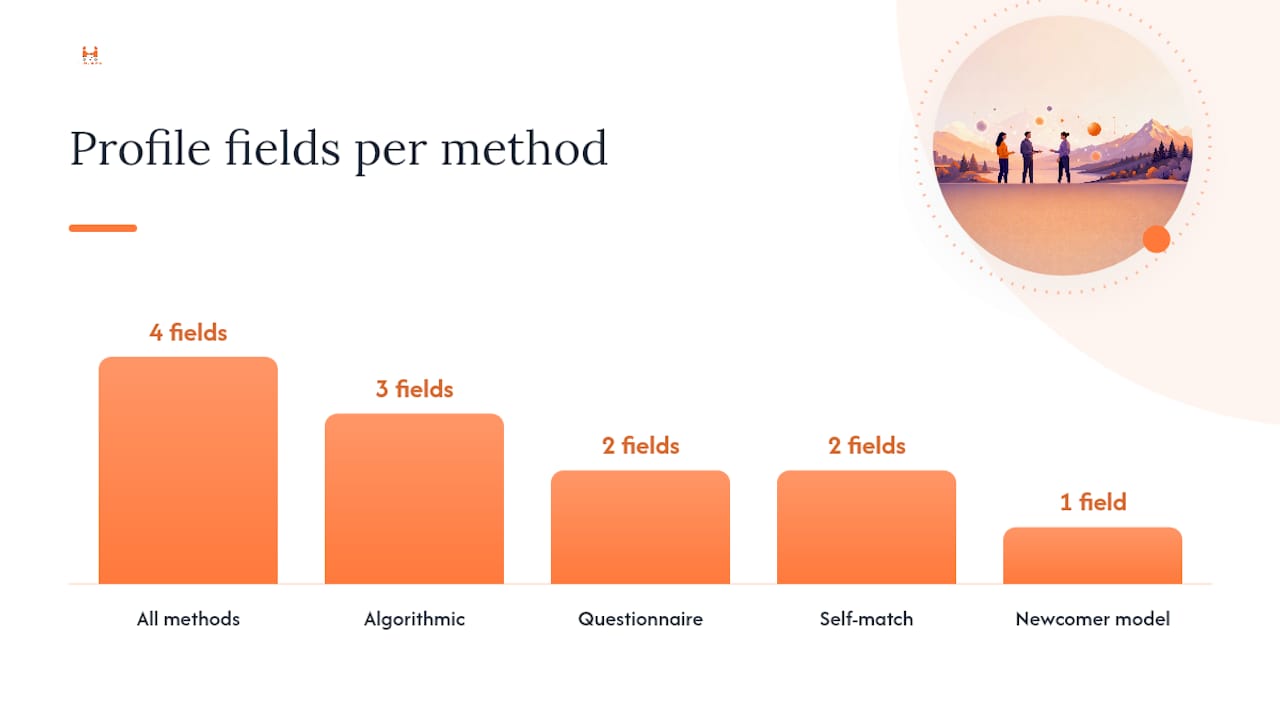
Sample profile questionnaire fields
| Field | Purpose | Feeds which method |
|---|---|---|
| Current role and department | Prevent same-team matches | All methods |
| Career goals (3–5 year horizon) | Align mentor expertise to mentee direction | Questionnaire, algorithmic |
| Skills I want to develop | Specific learning objectives | Algorithmic, self-match |
| Skills I can offer as a mentor | Mentor capability mapping | Algorithmic, self-match |
| Preferred meeting format (in-person, virtual, hybrid) | Logistics compatibility | All methods |
| Availability (days/times) | Scheduling | All methods |
| Languages spoken | Accessibility and cross-cultural matching | Newcomer model |
| Comfort with sharing personal challenges | Psychological safety signal | Manual, questionnaire |
| One thing I want my mentor/mentee to know about me | Relationship-building seed | All methods |
Canadian survey analysis shows that remote and hybrid work did not significantly reduce reported mentorship access, which means virtual matching is a legitimate option for distributed teams. Design the profile form to capture logistics preferences so you are not forcing in-person pairs who are three time zones apart.
Onboarding the pair or group
Once matches are confirmed, send a welcome package within 48 hours. It should include:
- A one-page overview of programme goals and timeline
- The participant agreement (see the next section)
- A suggested first-meeting agenda
- Contact information for the programme coordinator
Sample first-meeting agenda (60 minutes):
- Introductions and personal backgrounds (15 minutes)
- Review the participant agreement together and confirm expectations (10 minutes)
- Mentee shares two or three development goals (15 minutes)
- Mentor shares relevant experience and asks clarifying questions (10 minutes)
- Agree on meeting cadence, format, and next session date (10 minutes)
SHRM practitioners recommend making small, specific asks and following through on commitments as the foundation of a productive mentoring relationship. Build that expectation into the first meeting, not the third.
What do mentors, mentees, and coordinators actually do?
Unclear roles are the second most common reason programmes drift. Write the roles down. Share them before anyone signs up.
Role definitions
Mentor: Provides guidance, shares experience, asks questions, and holds the mentee accountable to their stated goals. Does not manage the mentee's career or make decisions on their behalf. Commits to the agreed meeting cadence and responds to messages within a reasonable timeframe (typically 48–72 hours).
Mentee: Drives the relationship. Sets the agenda for most meetings, follows through on agreed actions, and communicates proactively when circumstances change. The mentee is responsible for the relationship's momentum.
Programme sponsor: A senior leader who publicly endorses the programme, participates in the opening session, and reviews aggregate outcomes at the end of each cohort. Not involved in individual matches.
Programme coordinator: Manages administration, tracks participation, sends check-in communications, escalates concerns, and produces the impact report. This is the role that keeps everything moving.
Manager: Aware that their direct report is participating. Supports the time commitment. Not privy to the content of mentoring conversations.
Time commitments
A realistic monthly time budget for a 1:1 model:
- Mentor: 2–3 hours (one 60-minute meeting plus preparation and follow-up)
- Mentee: 3–4 hours (meeting, preparation, reflection, and any agreed actions)
- Coordinator: 4–6 hours during active phases, 8–10 hours during launch and wrap-up
Participant agreement template
The participant agreement does not need to be a legal document. It needs to be clear. Include these clauses:
- Confidentiality: Conversations between mentor and mentee remain private unless either party discloses a safety concern.
- Meeting frequency: Pairs agree to meet at least once per month for the duration of the programme.
- Goal-setting: The mentee will bring at least two written development goals to the first meeting.
- Duration: The programme runs for [X months]. Either party may exit early by notifying the programme coordinator.
- Exit criteria: If a pair is not working, the coordinator will facilitate a respectful reassignment without penalty to either participant.
- Respect and inclusion: Both parties commit to respectful, inclusive conduct consistent with the organisation's code of conduct.
How do you launch and run the programme operationally?
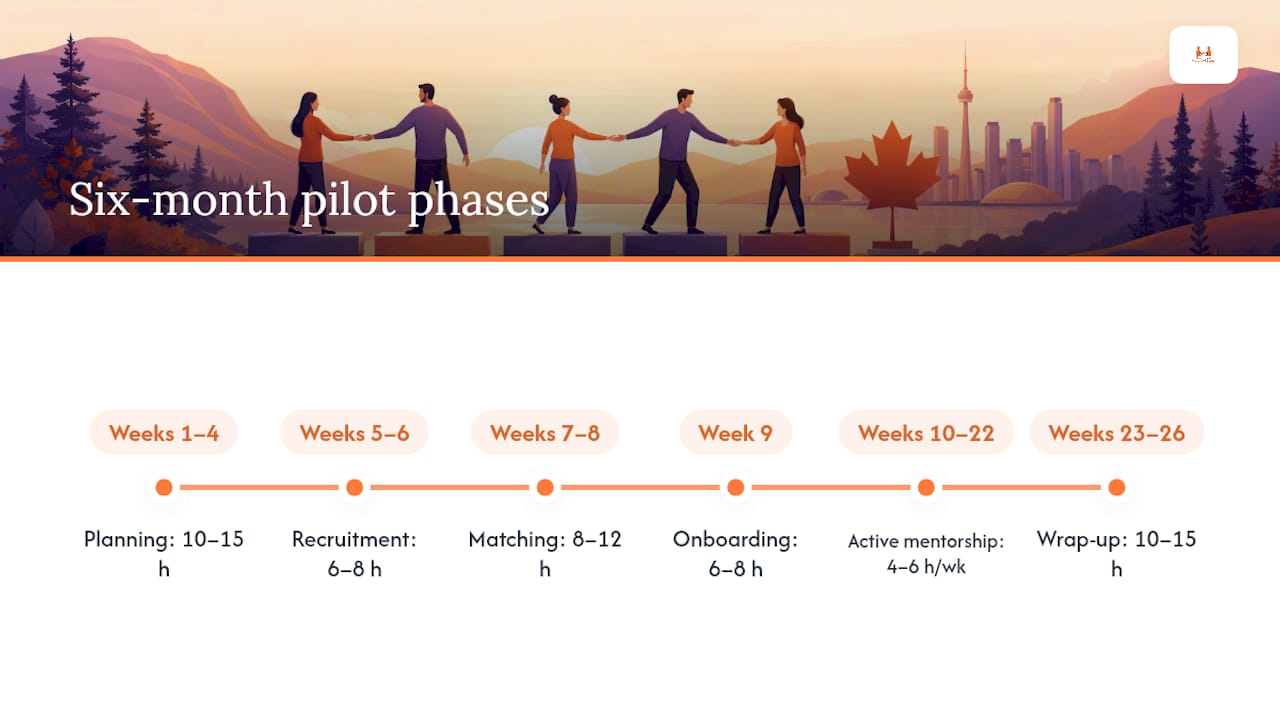
A six-month pilot has six phases. Each one has a clear owner and a clear deliverable.
Phase 1: Planning (Weeks 1–4). The programme lead finalises objectives, eligibility criteria, the profile questionnaire, and the participant agreement. The sponsor records a short video or writes a brief message to accompany the launch announcement. The coordinator builds the tracking spreadsheet and communication templates. Estimated coordinator hours: 10–15.
Phase 2: Recruitment (Weeks 5–6). Applications open. The announcement goes out through internal channels: email, intranet, team meetings. ERG partners share the opportunity with their networks. The application form collects the profile questionnaire fields plus a short statement of intent. Estimated coordinator hours: 6–8.
Phase 3: Matching (Weeks 7–8). The coordinator reviews applications, runs the matching process, and sends proposed matches to participants for confirmation. A brief opt-out window (48–72 hours) allows participants to flag concerns before matches are finalised. Estimated coordinator hours: 8–12.
Phase 4: Onboarding (Week 9). Welcome packages go out. The programme opens with a one-hour virtual or in-person kickoff session where the sponsor speaks, the coordinator explains logistics, and pairs have time to meet briefly. Estimated coordinator hours: 6–8.
Phase 5: Active mentorship (Weeks 10–22). Pairs meet on their agreed cadence. The coordinator sends a brief check-in email at the one-month and three-month marks. A mid-point survey goes out at Week 14. The coordinator reviews responses and follows up with any pairs showing low engagement. Estimated coordinator hours: 4–6 per week.
Phase 6: Wrap-up (Weeks 23–26). A closing survey goes out two weeks before the programme ends. The coordinator compiles the impact report. A closing session celebrates completions and collects qualitative stories. The sponsor reviews the report and confirms whether to continue. Estimated coordinator hours: 10–15.
Best-practice guides for establishing mentorship programmes consistently recommend defining minimum meeting frequency at the outset and assigning a single point of contact. Both decisions reduce the coordinator's reactive workload during the active phase.
Communication cadence
- Week 1: Launch announcement with application link
- Week 9: Welcome email with participant agreement and first-meeting agenda
- Week 14: Mid-point check-in survey (5–7 questions)
- Week 20: Reminder of programme close and closing survey preview
- Week 24: Closing survey and invitation to the wrap-up session
- Week 26: Thank-you email with aggregate outcomes summary for participants
How do you measure whether the programme is working?
Measurement is not an afterthought. It is what earns the next cohort.
Core KPIs for a pilot
- Participation rate: percentage of enrolled participants who complete the programme (target: 80% or higher)
- Meeting adherence: average number of meetings held versus meetings planned
- Mentee satisfaction score: post-programme survey rating (scale of 1–5 or 1–10)
- Mentor satisfaction score: same scale, tracked separately
- Promotion rate: percentage of mentee participants promoted within 12 months of programme completion, compared to a matched control group
- Retention rate: voluntary turnover among participants versus non-participants over the same period
- Internal mobility: lateral moves or stretch assignments taken up by participants
- Qualitative case studies: two or three short narratives from participants describing a specific outcome
Some programme evaluations report promotion and retention boosts for underrepresented groups, with increases in the range of 15–38% in specific studies, though effects vary significantly by context and programme design. Use those figures as a benchmark for what is possible, not a guarantee.
Sample survey questions
Baseline (before programme launch):
- How clear are you on your career development goals? (1–5)
- How connected do you feel to senior leaders in this organisation? (1–5)
- How satisfied are you with your current professional growth opportunities? (1–5)
Mid-point (Week 14):
- How often have you met with your mentor/mentee? (frequency)
- How useful have your conversations been so far? (1–5)
- Is there anything the programme coordinator could do to support you better? (open text)
Post-programme:
- Did you achieve the goals you set at the start of the programme? (yes/partially/no)
- Would you participate again? (yes/no)
- What was the single most valuable thing you gained? (open text)
One-page executive report structure
- Programme overview: cohort size, duration, model used
- Participation and completion: rates with brief commentary
- Satisfaction scores: mentor and mentee, with comparison to baseline
- Career outcomes: promotion and retention data with control group comparison where available
- Qualitative evidence: two or three participant quotes or case summaries
- Recommended next steps: continue, expand, or adjust with specific rationale
How do you make your programme genuinely inclusive?
Inclusive design is not a checkbox. It is a set of decisions made before the programme launches that determine who actually participates.
The Indigenous Workways Mentorship Framework recommends scheduling mentoring interactions during designated paid work hours and assigning a central point of contact, specifically to prevent employees with caregiving responsibilities from being excluded by programmes that treat mentoring as an after-hours activity.
Practical steps for inclusive scheduling and access:
- Schedule mentoring time as protected paid work time, not an add-on to the workday
- Offer asynchronous options (recorded updates, shared documents, messaging) for pairs who cannot align calendars easily
- Provide language supports for newcomer mentoring pairs, including translated materials and bilingual coordinators where possible
- Make the application form screen-reader accessible and available in multiple formats
Reducing bias in matching
- Use anonymised skills-matching fields in the profile questionnaire before revealing names and photos
- Exclude department and reporting-line information from the initial match to prevent same-network pairings
- Make participation opt-in rather than manager-nominated to preserve employee agency
- Review match demographics after each cohort and adjust the process if patterns of exclusion emerge
ERG and newcomer support partnerships
- Invite ERG leaders to co-design the programme, not just to recruit participants
- Ask ERG partners to identify potential mentors from underrepresented groups who might not self-nominate
- Connect newcomer mentoring pairs to external settlement and credential-recognition resources (Immigration, Refugees and Citizenship Canada maintains a directory of settlement services)
- Build a feedback loop: ask ERG partners to review the mid-point survey results and flag systemic concerns
Mentorship versus sponsorship: why you need both
Mentorship and sponsorship are not the same thing. Treating them as interchangeable is one of the most common structural mistakes in talent development.
SHRM describes the distinction clearly: mentoring offers guidance and skill-building, while sponsorship is explicit advocacy that helps protégés access promotions and high-visibility opportunities. A mentor talks to you. A sponsor talks about you, in rooms you are not in.
| Dimension | Mentor | Sponsor |
|---|---|---|
| Primary activity | Advice, reflection, skill-building | Public advocacy, opportunity access |
| Relationship direction | Mentee-driven | Sponsor-initiated |
| Typical outcome | Capability growth, confidence | Promotion, stretch assignment, visibility |
| Accountability | Informal | Formal pledge recommended |
Gallup analysis confirms that formal mentoring and sponsorship relationships are associated with stronger career development signals and better perceptions of equity than informal relationships. The equity dimension matters: without formal sponsorship pathways, the employees who benefit most from informal advocacy tend to be those who already have access to senior networks.
Why formal sponsorship pathways matter
Sponsorship without structure defaults to who the senior leader already knows. That is not a talent strategy. It is a replication of existing advantage. Formalising sponsorship means making the advocacy visible, accountable, and tied to specific actions.
Operational checklist for a sponsorship pathway
- Define the sponsor role in writing: what a sponsor commits to do (advocate in succession discussions, nominate for stretch projects, provide a reference)
- Ask sponsors to sign a brief pledge at the start of the programme cycle
- Set two or three measurable advocacy actions per sponsor per cohort (e.g., one nomination for a high-visibility project, one introduction to a senior leader outside the sponsor's direct team)
- Review sponsorship outcomes at the same time as mentorship outcomes in the executive report
- Separate sponsorship from line management: a sponsor should not be the protégé's direct manager
Templates and tools every Canadian HR team needs
The profile questionnaire, participant agreement, and tracking tools are the three documents that keep a programme running. Everything else is optional.
Profile questionnaire
Use the fields from the matching section above as your starting point. The fields that matter most are career goals, skills to develop, skills to offer, logistics preferences, and the open-ended "one thing I want you to know" prompt. That last field consistently produces the most useful matching signal and the most honest first conversations.
Participant agreement checklist
Your participant agreement should cover:
- Confidentiality clause (what stays private, what does not)
- Meeting frequency commitment (minimum once per month)
- Goal-setting requirement (written goals by the first meeting)
- Programme duration and exit process
- Code of conduct reference
- Data use statement (how participant information is stored and who can access it)
Tool categories and Canadian privacy considerations
- Tracking spreadsheets: Google Sheets or Microsoft Excel work for pilots of up to 30 pairs. Store them on your organisation's own cloud environment, not a personal account, to comply with provincial privacy legislation.
- Mentoring platforms: Dedicated platforms (available from multiple vendors) automate matching, track meeting logs, and generate reports. Before selecting one, ask the vendor where data is stored (Canadian servers are preferable under PIPEDA and provincial equivalents), what data is collected, and how it is deleted at programme end.
- Calendar coordination tools: Calendly or Microsoft Bookings reduce the scheduling friction that kills meeting adherence. Both are available to Canadian employers.
- Survey tools: Microsoft Forms, Google Forms, or SurveyMonkey (with Canadian data residency settings enabled) work for baseline, mid-point, and post-programme surveys.
Pro Tip: Before signing any mentoring platform contract, ask the vendor three questions: Where is participant data stored? Who has access to individual meeting notes? What is the data deletion process at programme end? Canadian employers have obligations under PIPEDA and, in some provinces, under PIPA or Quebec's Law 25. A vendor who cannot answer those three questions clearly is not ready for your organisation.
The MentorWell's info guide includes downloadable resources and templates that Canadian HR teams can adapt for their own programme design.
How do you keep mentorship psychologically safe?
Mentoring relationships open doors that do not usually open at work. That is the point. But it also means mentors sometimes hear things they are not trained to handle.
This is not a clinical problem. It is a design problem. Build the response pathway before the programme launches.
Non-clinical red flags mentors should watch for
Mentors are not therapists and should never be positioned as one. But they can be trained to notice:
- A mentee who has stopped engaging or cancels meetings repeatedly without explanation
- Expressions of hopelessness about their career or future that feel disproportionate to the situation
- Mentions of significant stress, isolation, or difficulty coping outside of work
- A noticeable change in energy, affect, or communication style over several meetings
None of these signals require a diagnosis. They require a conversation and a referral.
Escalation and referral pathway
Build this into the programme documentation before launch:
- Mentor notices a concern. Mentor acknowledges what they heard, expresses care, and asks directly whether the mentee is okay.
- Mentor contacts the programme coordinator. Within 24 hours, without sharing confidential details, the mentor flags that a mentee may need additional support.
- Coordinator connects the mentee to the Employee Assistance Programme (EAP) or HR. The referral is warm, not bureaucratic: a direct introduction, not a phone number on a flyer.
- Manager is involved only if there is a safety concern. Confidentiality is preserved unless the situation meets the threshold for mandatory disclosure.
The MentorWell's emotional resilience resources offer non-clinical guidance for mentors navigating these conversations, and The MentorWell's manager training workshops give leaders the language to respond without overstepping.
Manager training and a central point of contact
Every programme needs one named person a mentor can call when they are not sure what to do. Not a committee. Not a policy document. One person, available, who knows the escalation pathway and can make a warm referral within the same business day.
Mentor training programmes that include psychological safety modules consistently produce mentors who are more confident holding difficult conversations and more likely to flag concerns early, before a situation becomes a crisis.
Why mentorship is not just a programme
There is something I keep coming back to, years after losing Maddie.
The people who showed up for her were not the ones with the right credentials. They were the ones who paid attention. Who noticed when something shifted. Who asked the question a second time when the first answer felt too easy.
Mentorship, at its best, is that. It is structured attention. It is an organisation saying: this person matters enough that we are going to build a system around making sure someone is watching out for them.
I have sat with enough HR leaders to know that the programmes that work are not the ones with the most sophisticated platforms or the most detailed agreements. They are the ones where someone, usually one person, decided that the relationship mattered more than the paperwork. And then built the paperwork to protect the relationship.
The window for that kind of connection is not always open. You design the programme so it is open when it needs to be.
How The MentorWell supports Canadian employers building these programmes
Running a mentorship programme well requires more than a template. It requires managers who know how to hold a difficult conversation, mentors who can recognise when someone needs more than career advice, and a coordinator who knows when to call for backup.

The MentorWell offers pilot workshops and manager training designed specifically for Canadian employers who want to build psychologically safe mentorship programmes. The workshops cover mentor readiness, non-clinical red-flag recognition, and escalation pathways, all grounded in the same early-intervention principles that drive everything The MentorWell does. Whether you are launching a first cohort or rebuilding a programme that lost momentum, the training meets your team where they are.
Two ways to take the next step: request a pilot workshop for your HR team or leadership group, or download sample templates and book a short discovery call to talk through your programme design. Visit The MentorWell to connect with the team and find the right starting point for your organisation.
Sources
The sources below are directly applicable to Canadian employers designing or evaluating formal mentorship programmes.
- Mentorship and Sponsorship: Core Tools for Talent Growth
- Mentors and Sponsors Make the Difference
- Mentorship in the Workplace: Employee Participation and Perspectives
- Most Canadian Businesses Lack Mentorship Programs, Losing Institutional Knowledge of Retiring Workers
- Why mentoring programs fail and how to make them worthwhile
FAQ
What is the difference between mentorship and sponsorship?
A mentor provides guidance, advice, and skill-building in a relationship the mentee drives. A sponsor advocates publicly for a protégé in promotion and opportunity discussions, often in rooms the protégé is not in. SHRM describes sponsorship as explicit advocacy that directly accelerates career advancement, which is distinct from the developmental support a mentor offers.
How long should a corporate mentorship programme run?
Six months is a practical length for a first pilot: long enough to produce measurable outcomes, short enough to maintain momentum and keep coordinator workload manageable. Leadership development tracks often run twelve months.
How many Canadian companies currently offer mentorship programmes?
Survey data reported by the Financial Post show that approximately 34% of Canadian companies offer mentorship programmes, while 75% experienced retirements in the prior two years, creating a significant institutional knowledge risk.
What is the most common reason mentorship programmes fail?
Harvard Business Review research identifies lack of ongoing support as the primary failure mode: programmes without a dedicated coordinator, minimum meeting rules, or mentor training tend to lose momentum after the initial launch enthusiasm fades.
How does The MentorWell support corporate mentorship programmes?
The MentorWell offers pilot workshops and manager training for Canadian employers that cover mentor readiness, psychological safety, and escalation pathways. These are designed to complement the operational structure described in this guide, giving mentors the confidence to hold difficult conversations and refer participants to appropriate support when needed.