
Yes. Anxiety can qualify a child for a 504 plan when it substantially limits how they function at school, things like concentrating, learning, or even walking into a classroom without shutting down. The first move is simple: write a dated request for a 504 evaluation and send it to the school's 504 coordinator or principal. Keep a copy.
Two facts worth knowing before you walk into that first meeting:
- The U.S. Department of Education's Office for Civil Rights protects students with anxiety disorders under Section 504, and schools are required to evaluate any student they have reason to suspect has a disability.
- A formal diagnosis helps your case but is not always required. Schools are supposed to look at functional impact, not just a letter from a clinician.
I've sat across from enough parents who waited too long, hoping the anxiety would just pass, to tell you: it rarely does on its own. Ask for the evaluation now.
Key Takeaways
Anxiety qualifies for a 504 plan when it substantially limits school functioning, and a written evaluation request with dated, specific documentation moves the process faster than informal conversation.
| Point | Details |
|---|---|
| Anxiety can qualify | Section 504 covers anxiety when it substantially limits concentrating, learning, or participating at school. |
| Start with a written request | Send a dated evaluation request to the 504 coordinator or principal and keep a copy. |
| Document functional impact | Teacher notes, attendance logs, and a one-page timeline often matter more than diagnosis alone. |
| Demand measurable language | Accommodations need a named person, a frequency, and a clear implementation method. |
| Use MentorWell tools to track patterns | The Teen Signal Check helps parents build a documented trend to bring to 504 meetings. |
This article is general information, not a substitute for advice from a qualified doctor. Consult a qualified healthcare professional about your own circumstances before acting on anything here.
Table of Contents
- What is a 504 plan for anxiety, and how does anxiety qualify?
- How do I request a 504 evaluation for my child?
- What accommodations help students with anxiety?
- What documentation strengthens a 504 request?
- How do I make sure the 504 plan actually gets followed?
- What if the school denies or ignores the 504 plan?
- How MentorWell resources help you prepare and follow through
- An editorial take on the parent-first playbook
- How The MentorWell supports you through this process
- Sources
- FAQ
What is a 504 plan for anxiety, and how does anxiety qualify?
Section 504 of the Rehabilitation Act is a federal civil rights law. It requires any school that receives federal funding to provide a free, appropriate public education to students with disabilities, and anxiety disorders count when they substantially limit a major life activity.
"Substantially limits" is the phrase that trips parents up, because it sounds clinical and vague. In practice, schools look at real classroom behaviour. A student who cannot concentrate during tests, who visits the nurse three times a week with stomach aches that have no medical cause, who skips gym class or group projects to avoid a panic attack, these are the signals a 504 team is trained to weigh.
Here's what most parents don't expect: a diagnosis from a psychologist or pediatrician strengthens a request, but it isn't the whole case. Schools can, and often do, rely on what teachers and counsellors observe directly. The OCR factsheet on anxiety disorders makes this explicit: eligibility rests on impact at school, not paperwork alone.
How do I request a 504 evaluation for my child?
Once you suspect your child's anxiety is affecting school, the process has a clear sequence. Skipping steps usually costs you weeks.
- Submit a written request. Email or hand-deliver a short letter to the 504 coordinator or principal asking for a Section 504 evaluation, and state plainly that you believe your child's anxiety substantially limits their access to education. Date it. Keep a copy.
- Wait for the school's response. Once a school has reason to suspect a disability, it must act. There's no single federal deadline for 504 evaluations the way there is for IEPs, so ask your coordinator directly what your district's usual timeline looks like. Understood notes that districts vary, and knowing your district's pattern avoids surprise delays.
- Prepare for the 504 Team meeting. Bring a one-page summary of how anxiety shows up at school, teacher notes, attendance and nurse-visit logs, and specific accommodation language you want considered.
Pro Tip: Don't walk into that meeting with a general complaint like "school is hard for her." Walk in with three dated examples: the math test she couldn't finish, the two mornings she refused to get out of the car, the group presentation she missed. Specifics move meetings forward. Vague worry stalls them.
What accommodations help students with anxiety?
A 504 plan is only as good as its wording. "Extra time when needed" gets ignored. "Time and a half on all quizzes and tests, administered by the classroom teacher" gets followed.
Some accommodations worth proposing:
- Extended time on tests and quizzes, clearly specified to ensure proper implementation.
- A separate, quieter testing location for students whose anxiety spikes during timed assessments.
- Preferential seating near an exit or away from high-traffic areas.
- Recorded lectures or note-taking support for days anxiety makes focus difficult.
- A permanent hall pass so a student can step out without asking permission mid-panic.
- Scheduled check-ins with a counsellor, at a set frequency, to provide ongoing support.
- Excused absences for treatment, coupled with a plan to make up missed work.
According to Children's Health, plans should be reviewed regularly, and every accommodation should clearly identify who is responsible for delivering it. A plan that says "teacher will provide breaks as needed" without naming which teacher or how often is a plan that quietly falls apart by November.
What documentation strengthens a 504 request?
Clinical records matter, but school-based evidence often carries more weight in the room. A 504 Team wants to see the pattern at school, not just the diagnosis in a file.
- Gather clinical notes if you have them, a therapist's letter, a pediatrician's note, anything naming the anxiety diagnosis.
- Build a simple timeline. List dates, what happened (missed test, nurse visit, meltdown before a presentation), and how it affected schoolwork. A single page covering the last two or three months is often more persuasive than a thick folder.
- Collect teacher observations and attendance records. Ask teachers directly, in writing, what they've noticed. Their words carry weight precisely because they're not yours.
- Redact anything unrelated before sharing records, and send them through the school's secure channel rather than a personal email thread.
How do I make sure the 504 plan actually gets followed?
The meeting is the easy part. Getting the plan implemented by six different teachers across a school year is where things fall apart.
Push for measurable language every time: who delivers the accommodation, how often, and under what circumstances. "Counsellor check-in" should read "check-in with Ms. Reyes every Monday morning." Ask directly how new teachers will be notified of the plan each semester, because that handoff is where accommodations quietly vanish.
- Keep a simple log of conversations, emails, and any moment the plan wasn't followed.
- Ask for meeting minutes in writing, and request the annual review date before you leave the room.
- If a teacher isn't following the plan, document the specific incident before raising it. Vague frustration doesn't move a school; three dated examples do.
Pro Tip: Save every email. Not because you're building a case against anyone, but because six months from now you won't remember which Tuesday your daughter missed her math test. The record does that for you.
Children's Health puts it plainly: documenting conversations protects you later, even when things are going fine.
What if the school denies or ignores the 504 plan?
Start with the district's own grievance process. Most districts have one, and it's faster than anything federal. If that stalls, the Department of Education's guidance on Section 504 FAPE notes that OCR generally won't second-guess a school's placement decision as long as procedural steps were followed. But if the school skipped those steps, you have real standing.
Remedies families have secured include retroactive excused absences, regrading of unfairly penalized assignments, staff retraining, and formal corrective action plans. Mediation and due process hearings remain available if informal routes fail.
- File a written complaint with the district first.
- Escalate to your state education agency if the district doesn't respond.
- Contact OCR directly if you believe procedural rights were violated.
An organized record, the same log you started at the first meeting, is what makes any of these paths move quickly instead of dragging into another school year.
How MentorWell resources help you prepare and follow through
You don't need to build your evidence file from scratch. The Teen Signal Check gives you a simple way to log patterns over time, so instead of walking into a meeting with one bad week fresh in your mind, you bring a documented trend. That distinction changes how a 504 Team hears you.
Pair it with practical guides like balancing work and teen mental health for structuring your own notes, and the broader student support collection for language you can borrow in meetings.
Advocacy isn't a single dramatic meeting. It's showing up calm, with the same log, the same questions, the same follow up, week after week, until the school treats it as normal too.
- Use the Teen Signal Check to build your one-page summary before the first meeting.
- Bring MentorWell checklists as structured, written evidence rather than relying on memory in the room.
- Treat follow up as ordinary maintenance, not confrontation.
An editorial take on the parent-first playbook
Most advice on 504 plans treats the legal process as the hard part. It isn't. The hard part is staying steady enough, for months, to keep the paperwork moving while your kid is struggling in front of you every morning.
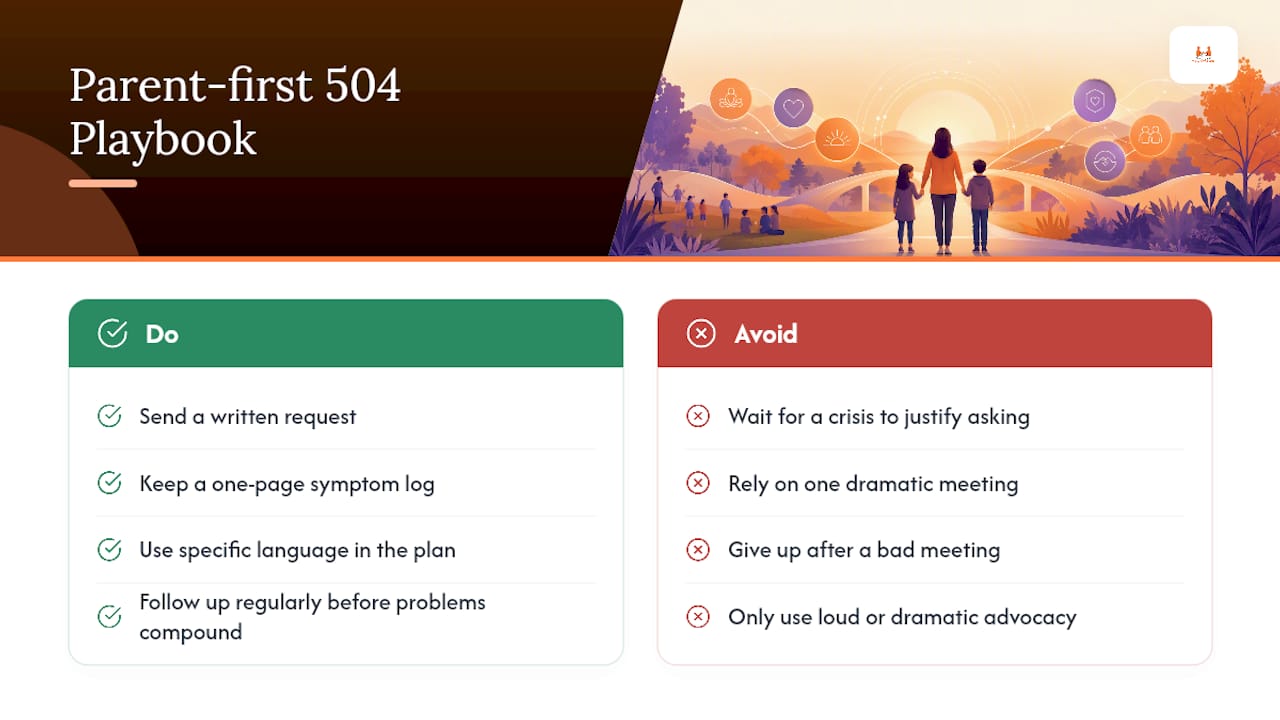
The conventional wisdom tells parents to "advocate strongly." Fine advice, but it skips the part where you're exhausted, where the school's timeline doesn't match your kid's crisis timeline, and where one bad meeting can make you want to give up on the whole process. What actually works is smaller and less dramatic: a written request, a one-page log, specific language in the plan, and a habit of following up before problems compound.
I'd tell any parent reading this to stop waiting for a "bad enough" moment to justify asking. You don't need a crisis to request an evaluation. You need a pattern. Missed tests, nurse visits, avoidance, that's enough. Ask now, document as you go, and treat the annual review as routine rather than something to dread. The families who get this right aren't the ones with the strongest arguments. They're the ones who never stopped showing up with the same calm, specific ask.
— Chris Coulter
How The MentorWell supports you through this process
Requesting a 504 plan is paperwork and patience in equal measure, and most parents are doing it exhausted, at night, after a hard day. The MentorWell exists for exactly that stretch: a place to document what you're seeing before you forget the details, and a way to prepare for a school meeting without walking in with nothing but a gut feeling.

The Teen Signal Check helps you track patterns in your child's behaviour over weeks, not just the one bad afternoon that pushed you to act. If you'd rather talk it through with someone before your next school meeting, The MentorWell's coaching sessions and workshops walk parents through exactly what to bring, what to say, and how to keep a plan on track once it's signed. Visit The MentorWell to start the Teen Signal Check or ask about coaching support before your next 504 meeting.
Sources
- Section 504 protections for students with anxiety disorders — U.S. Department of Education / OCR
- Can you get a 504 plan for anxiety? — Understood
- School accommodations for anxiety or depression — Children’s Health
FAQ
Can I get a 504 plan if my child has anxiety?
Yes. Anxiety qualifies under Section 504 when it substantially limits a major life activity like concentrating or learning, according to OCR guidance. Schools must evaluate when they have reason to suspect a disability, whether or not you already have a formal diagnosis.
How do I get a 504 plan for anxiety?
Submit a dated, written request for a 504 evaluation to your school's 504 coordinator or principal, then bring a one-page summary of school impact, teacher notes, and attendance or nurse-visit logs to the eligibility meeting.
Is a 504 plan or an IEP better for anxiety?
A 504 plan provides accommodations within general education and typically moves faster; an IEP includes specialized instruction and is appropriate when anxiety also affects academic progress enough to require direct services. Many families start with a 504 plan and revisit an IEP if functioning worsens.
What can I do to help my child with back-to-school anxiety?
Keep routines predictable, talk through what to expect before the first day, and document any patterns of avoidance or physical symptoms so you have evidence if a 504 evaluation becomes necessary. Practical coping strategies, like those in Alvarado Therapy's guide on anxiety, can help at home alongside school accommodations.
What accommodations are common for anxiety at school?
Extended test time, a quiet testing location, preferential seating, a permanent hall pass, scheduled counsellor check-ins, and excused absences with a plan to make up missed work are among the most common, according to Children's Health.