
TL;DR:
- Proactive parenting involves noticing early emotional signs in children and acting before a crisis arises.
- it emphasizes regular check-ins, early observation, and low-pressure conversations to support mental wellness.
Proactive parenting in mental health means watching for early signs of emotional distress in your child and acting before a crisis forms. It treats mental wellness the way a good family doctor treats physical health: regular check-ins, early observation, and low-stakes conversations long before anything becomes urgent.
Start here, within the next 72 hours:
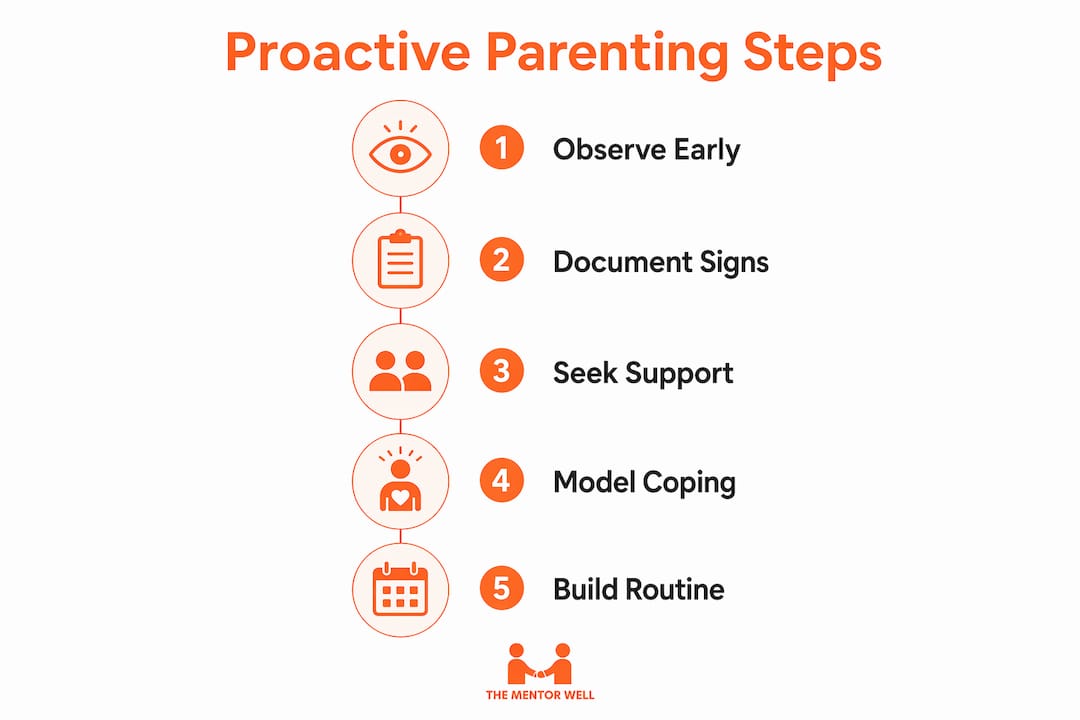
- Observe your child's mood, sleep, and appetite today and write down what you notice.
- Note any changes from their usual baseline, even small ones.
- Schedule a short, relaxed conversation. A car ride works. So does a walk.
- If something feels off, call your family doctor, speak with the school counsellor, or contact Kids Help Phone at 1-800-668-6868.
- Try the Teen Signal Check from The MentorWell, a free parent-facing assessment designed to identify subtle warning signs in youth aged 8–25.
Pro Tip: You do not need certainty to act. Concern is enough to start a conversation.
Table of Contents
- What does proactive parenting in mental health actually look like?
- Why does early detection change outcomes?
- What are the early warning signs to watch for?
- How do you practise proactive parenting day to day?
- When should you seek professional help?
- How do you build a simple family mental health plan this week?
- What Canadian resources can you reach right now?
- Why trust this guide?
- Key takeaways
- What I would do differently
- The MentorWell is here when you are ready to act
- Useful sources
- FAQ
What does proactive parenting in mental health actually look like?
It looks like paying attention before you have a reason to panic. Not hovering. Not interrogating. Just staying close enough to notice when something shifts.
The Canadian Paediatric Society identifies a strong, supportive parent-child relationship as the single most important protective factor for youth mental health. That is not a technique. It is a presence.
The core principles behind this approach:
- Early observation: Track mood, sleep, appetite, and social behaviour as a baseline, not just when something goes wrong.
- Timely intervention: Act when you notice a change, not after it has persisted for months.
- Resilience-building: Help your child name feelings, face manageable stress, and recover from setbacks with your support.
- Modelling: Let them see you manage your own stress calmly. That is preventative mental wellness in practice.
Think of it like a dental check-up. You do not wait for a toothache to see the dentist. The same logic applies here. The MentorWell's Teen Signal Check is one tool built for exactly this kind of routine monitoring.
Why does early detection change outcomes?
It does. Consistently. Across academic performance, long-term health, and the likelihood of crisis.
The Canadian Mental Health Association (CMHA) is direct: delaying help because of fear of "labelling" a child risks worse outcomes. Early identification improves school achievement and long-term wellbeing. Waiting does not protect your child. It narrows the window.
School Mental Health Ontario recommends documenting observable changes across settings, home and school, and contacting school support teams early. Their guidance frames this as a preventive step, not a crisis response.
Pro Tip: Seeking help is not labelling your child. It is giving them access to support before the weight becomes too heavy to carry.
What are the early warning signs to watch for?
A warning sign is not a bad day. It is a pattern. The threshold, according to CMHA Ontario, is behaviours that last more than a few weeks or interfere with daily life at home, school, or with friends.
Compare your child now to when they were well. Larger deviations across more than one area of life suggest elevated concern.
Young children (ages 4–8):
- Frequent unexplained stomach aches or headaches
- Regression (bedwetting, clinging, baby talk)
- Persistent nightmares or refusal to go to school
- Explosive tantrums beyond what is typical for their age
School-age children (ages 9–12):
- Withdrawal from friends or activities they used to enjoy
- Declining grades or refusal to complete schoolwork
- Persistent sadness or irritability lasting more than two weeks
- Complaints of feeling "different" or worthless
Teenagers (ages 13–25):
- Significant changes in sleep (too much or too little)
- Loss of interest in things they cared about
- Increased secrecy, isolation, or hostility
- Risky behaviour, substance use, or self-harm
Red flags that warrant contacting a professional sooner:
- Any mention of self-harm or not wanting to be alive.
- Sudden, severe withdrawal from all relationships.
- Inability to function at school or home for more than two weeks.
- Significant weight loss or gain in a short period.
How do you practise proactive parenting day to day?
Start with short, regular check-ins and let your child see you handle stress without falling apart. That is the foundation. Everything else builds from there.
Conversation starters that actually work:
- "What was the best part of your day? What was the hardest?"
- "I noticed you seemed quieter than usual. Is there anything on your mind?"
- "I'm not here to fix anything. I just want to listen."
Give them three uninterrupted minutes. No phone. No advice unless they ask. Just listening.
Daily routines that protect mental health:
- Consistent sleep and wake times, even on weekends.
- Shared meals without screens, even a few times a week.
- One-on-one time that is not about performance or problems.
- Physical activity built into the day, not treated as optional.
The Canadian Paediatric Society links predictable routines, including sleep, meals, and device boundaries, directly to reduced anxiety and stronger emotional regulation in children and teens.
Using the Teen Signal Check: The MentorWell's assessment takes roughly ten minutes. It asks parents to rate observable behaviours across mood, sleep, social connection, and school functioning. Use it when something feels off but you cannot name it. The results give you a starting point for a conversation with your child or a professional.

Pro Tip: Modelling healthy coping means letting your child see you say "I'm stressed today, so I'm going for a walk." That one sentence teaches more than a lecture on feelings.
When should you seek professional help?
Use a three-tiered approach. Most situations do not start at crisis level.
| Tier | Signs | Action | Timeline |
|---|---|---|---|
| Monitor at home | Mild mood changes, one area of life affected | Daily check-ins, document observations | 1–2 weeks |
| Consult school or primary care | Changes lasting 2+ weeks, two or more areas affected | Contact family doctor or school counsellor | Within the week |
| Urgent or crisis care | Self-harm, talk of suicide, severe withdrawal | Kids Help Phone, emergency services, crisis line | Immediately |
Canadian contacts:
- Kids Help Phone: 1-800-668-6868 (24/7, free, confidential)
- Crisis Text Line Canada: Text HOME to 686868
- CMHA local branch: Find yours at cmha.ca
- School mental health team: Ask the front office for the school counsellor or social worker
- Family physician: First call for non-urgent concerns
What to bring to an appointment:
- Written observations: dates, specific behaviours, what triggered them
- Sleep and appetite notes from the past two to four weeks
- School reports or teacher feedback
- Any Teen Signal Check results from The MentorWell
School Mental Health Ontario is clear that documented daily logs materially improve how clinicians assess what they are seeing.
How do you build a simple family mental health plan this week?
Three steps. That is all you need to start.
- Observe and document for seven days. Note mood, sleep, appetite, and social behaviour each evening. Two sentences is enough.
- Have one short conversation mid-week. Use a low-pressure moment. Ask one open question and listen.
- Review on day seven. If the pattern concerns you, contact your family doctor or school counsellor. If things seem stable, keep the routine going.
Daily rituals to add this week:
- A two-minute check-in at dinner: one good thing, one hard thing.
- Device-free time before bed, starting 30 minutes earlier than usual.
- One activity your child chooses, done together, no agenda.
Use The MentorWell's family mental health checklist to track your observations and know when to escalate.
What Canadian resources can you reach right now?
Free help exists. You do not need a referral to access most of it.
- Kids Help Phone: Free, 24/7 counselling by phone and text for young people up to age 29. Parents can also call for guidance.
- CMHA local branches: Offer crisis support, brief counselling, and pathways to longer-term care. Building a relationship with your local branch before a crisis shortens wait times when urgency rises.
- School Mental Health Ontario: Free parent resources, including guides on noticing concerns and starting conversations, at smho-smso.ca.
- Provincial youth wellness hubs: Most provinces now operate walk-in mental health clinics for youth. Search "[your province] youth wellness hub" to find the nearest one.
- The MentorWell: Workshops, coaching, and the Teen Signal Check, available across Canada. Designed for parents who want to act before a crisis, not after.
Pro Tip: Contact your CMHA branch before you need them urgently. A five-minute call now means a faster response later.
Why trust this guide?
This guide draws on guidance from the Canadian Paediatric Society, CMHA Ontario, School Mental Health Ontario, Kids Help Phone, and Let's Talk Science. Each source is linked where cited.
Chris Coulter founded The MentorWell in memory of his daughter Maddie. He spent years watching parents miss what he missed, not because they did not care, but because no one handed them a practical tool and said: start here. The Teen Signal Check and the resources on this site exist because of that gap.
Primary sources used:
- Canadian Paediatric Society (Caring for Kids)
- CMHA Ontario: Child and Youth Mental Health Signs and Symptoms
- School Mental Health Ontario: Noticing Mental Health Concerns
- Kids Help Phone
- Let's Talk Science: Recognising Signs of Child and Youth Mental Distress
Key takeaways
Proactive parenting in mental health means observing early, acting before crisis, and staying connected to your child through consistent presence and low-barrier conversations.
| Point | Details |
|---|---|
| Define the approach | Proactive parenting treats mental wellness like preventive care: observe, document, and act early. |
| Know the threshold | Behaviours lasting more than a few weeks or affecting two or more areas of life warrant professional input. |
| Use Canadian resources | Kids Help Phone (1-800-668-6868) and your local CMHA branch are accessible before a crisis forms. |
| Start a family plan | Observe for seven days, have one open conversation, and review at the week's end. |
| The MentorWell | The Teen Signal Check gives parents a structured starting point for early detection, available across Canada. |
What I would do differently
There is a morning I keep coming back to. Coffee going cold on the counter. Maddie heading out the door. I thought she seemed quiet. I told myself it was a phase.
I know what the other side of that dismissal looks like.
What I would do now is simpler than I thought it needed to be. I would sit down that evening and write two sentences about what I noticed. I would find a low-pressure moment, a drive somewhere, a walk, and ask one question without an agenda. I would not wait until I was certain something was wrong.
You do not need certainty. You need to pay attention a little earlier than feels necessary. Pick one thing from the one-week plan above and do it today. That is where it starts.
The MentorWell is here when you are ready to act

The MentorWell offers parents a concrete first step: the Teen Signal Check, a ten-minute assessment that identifies subtle warning signs in youth aged 8–25. No referral needed. No waiting room. You get a structured picture of what you are observing, and guidance on what to do next.
Beyond the assessment, The MentorWell provides workshops and coaching for families across Canada who want to build mental health awareness before a crisis arrives. Chris Coulter built these tools because he knows what it costs to wait.
Visit thementorwell.com to access the Teen Signal Check or book a workshop. Start with what you have, today.
Useful sources
- Kids Help Phone: kidshelpphone.ca | 1-800-668-6868 (24/7)
- Crisis Text Line Canada: Text HOME to 686868
- CMHA Ontario: ontario.cmha.ca | Local branch finder at cmha.ca
- School Mental Health Ontario: smho-smso.ca
- Canadian Paediatric Society (Caring for Kids): caringforkids.cps.ca
- Let's Talk Science: letstalkscience.ca
To find provincial services, search "[your province] youth mental health services" or ask your family doctor for a local referral directory. Bookmark the CMHA branch finder and Kids Help Phone now, before you need them urgently.
FAQ
What is proactive parenting in mental health?
Proactive parenting in mental health means observing your child's emotional wellbeing regularly and acting on early warning signs before a crisis develops, treating mental health with the same preventive care as physical health.
How do I know when to seek professional help for my child?
Contact a family doctor or school counsellor when concerning behaviours last more than a few weeks or affect more than one area of your child's life, such as school, sleep, and friendships simultaneously.
What is the Teen Signal Check from The MentorWell?
The Teen Signal Check is a parent-facing assessment from The MentorWell that helps caregivers identify subtle warning signs in youth aged 8–25, available online across Canada without a referral.
What should I bring to a mental health appointment for my child?
Bring written observations with dates, sleep and appetite notes from the past two to four weeks, any school feedback, and Teen Signal Check results if you have completed one.
Is Kids Help Phone available for parents, not just kids?
Yes. Parents and caregivers can call Kids Help Phone at 1-800-668-6868 for guidance on supporting a young person, in addition to the service being available directly to youth up to age 29.