
Co-parenting mental health support is a specialised, goal-oriented therapy focused exclusively on children's needs and reducing parental conflict after separation or divorce. Unlike couples counselling, it does not attempt to repair the romantic relationship. Its sole purpose is to help two parents build a functional, cooperative partnership centred on their children's well-being. In Canada, this support is delivered by licensed clinical professionals, including registered psychologists and certified family therapists, working within established family therapy frameworks. The result is a structured approach to communication, conflict reduction, and shared decision-making that protects children from the emotional fallout of parental tension.
What is co-parenting mental health support and why does it matter?
Co-parenting mental health support is the recognized clinical term for therapy that treats the parenting relationship, not the personal one. Therapists in this field focus on operational frameworks: how parents communicate, how they make decisions together, and how they manage disagreements without involving their children. Sessions typically begin with individual screening for each parent, followed by joint sessions that address logistics and conflict management rather than emotional history.
The stakes are real. Effective co-parenting not only stabilizes a child's home environment but also significantly improves parental mental health and reduces ongoing conflict. That means better outcomes on both sides of the parenting equation. When parents reduce their conflict, children gain the stable, nurturing environment they need to develop emotionally and academically.

Mental wellness in co-parenting is not a luxury. It is the foundation that determines whether children experience separation as a manageable life change or a prolonged source of anxiety and distress.
What evidence supports the benefits of co-parenting therapy?
The research on co-parenting therapy is direct and consistent. A study of 174 co-parent pairs found that positive evaluations of the co-parenting relationship correlated with measurable reductions in overall parental stress. That finding matters because parental stress does not stay with the parent. Children absorb it, often without either party realising it.
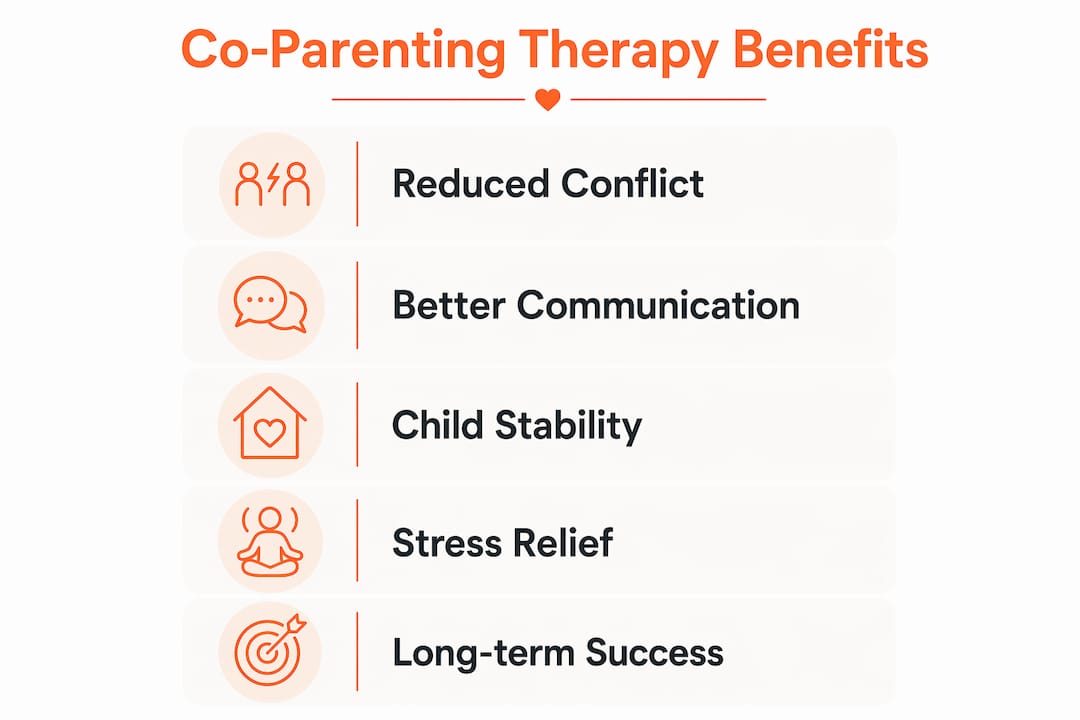
The benefits of co-parenting therapy extend beyond stress reduction. Parents who engage in structured support report clearer communication, fewer disputes over scheduling and decisions, and a stronger ability to keep children out of adult conflict. These are not soft outcomes. They translate directly into more stable home environments and better emotional regulation in children.
The connection between parental mental health and child well-being is well established. Research consistently shows that stress your kids carry often originates from the adults around them. Reducing parental conflict through structured therapy is one of the most direct ways to protect a child's emotional health.
Key benefits documented in research:
- Reduced overall parenting stress in both mothers and fathers
- Improved cooperative decision-making on schooling, health, and routines
- Lower rates of children being drawn into parental disputes
- More consistent and predictable home environments across two households
- Better emotional regulation in children when parents model calm communication
How does co-parenting therapy differ from mediation or couples counselling?
Co-parenting therapy occupies a distinct space that parents often confuse with other services. Therapists do not address past relationship grievances or emotional wounds from the marriage. They focus entirely on communication protocols and conflict reduction strategies going forward. This is a critical distinction.
Legal mediation handles custody arrangements and legal agreements. Couples counselling addresses emotional intimacy and relationship repair. Co-parenting therapy does neither. It treats the parenting partnership as a professional relationship, similar to two business partners who must collaborate effectively regardless of personal feelings toward each other.
The session structure reflects this focus. Individual screening sessions allow each parent to share concerns privately. Joint sessions then address specific logistics: holiday schedules, school decisions, medical choices, and communication boundaries. Emotional venting is redirected. The business-like partnership model keeps sessions productive and child-centred.
What co-parenting therapy is not:
- A forum to litigate the relationship or assign blame
- A substitute for legal advice or custody mediation
- Couples counselling with a different name
- A service only for high-conflict situations
Pro Tip: When searching for a co-parenting therapist, ask directly whether they specialise in post-separation parenting partnerships. A general family therapist may not use the structured, child-centred framework that co-parenting therapy requires.
What practical strategies and resources are available for co-parents?
Co-parenting support resources span a wide range, from professional therapy to digital tools and community programmed. Parents do not need to start with intensive therapy. Many begin with self-guided online courses, such as those offered through Coram Family Lives, which provide structured education on communication and conflict management. From there, parents can move into professional counselling as needed.
Professional support options
Licensed co-parenting therapists and registered family counsellors are the most effective starting point for parents dealing with significant conflict. These professionals use structured frameworks to guide joint sessions and provide individual coaching between appointments. Many offer virtual sessions, which removes geographic barriers for parents in rural or remote areas of Canada.
Support groups for co-parents offer a different kind of value. Peer groups provide shared experience, practical advice, and the reassurance that the challenges you face are not unique. Many community health centres and family resource centres across Canada facilitate these groups at low or no cost.
Digital tools and communication platforms
Court-approved communication platforms like OurFamilyWizard and TalkingParents create documented, neutral records of all co-parenting exchanges. These platforms reduce the risk of misinterpretation and provide a clear record if disputes escalate to legal proceedings. They also keep communication strictly child-focused by design.
The BIFF method is one of the most practical communication frameworks available to co-parents. BIFF stands for Brief, Informative, Friendly, and Firm. Applying it to digital messages keeps exchanges child-centred and emotionally neutral, which reduces the chance of conflict spiralling from a single poorly worded text.
Pro Tip: Before sending any co-parenting message, apply the BIFF test. If the message is longer than three sentences, contains emotional language, or addresses anything unrelated to the children, revise it before sending.
Regional helplines also provide immediate support. The Texas Parent Helpline (1-833-680-0611) is one example of a 24/7 helpline offering guidance for co-parenting challenges. Canadian parents can access similar services through provincial family resource lines and crisis support networks. For a broader overview of what is available, the family support guide from Care Managers outlines categories of caregiver resources that apply across different family structures.
What co-parenting models exist and which fits your family?
Two primary models define how separated parents structure their relationship: cooperative co-parenting and parallel parenting. Choosing the right model is not about preference. It is about matching the approach to the actual level of conflict in the relationship.
Cooperative co-parenting
Cooperative co-parenting is the collaborative model most people picture. Both parents communicate directly, attend school events together when possible, and make joint decisions in real time. This model works well when conflict is low and both parents can interact without significant emotional escalation. It offers children the clearest signal that both parents are united in their care.
Parallel parenting
Parallel parenting is a lower-contact model designed for high-conflict situations where direct communication consistently causes harm. Each parent manages their own household independently, with communication limited to written exchanges on a structured platform. Decisions are divided by domain rather than made jointly. This model protects children from witnessing or absorbing ongoing parental conflict.
Choosing parallel parenting is not a failure. It is a protective measure that shields children from conflict exposure when cooperative co-parenting is not yet possible. Many families begin with parallel parenting and transition toward more cooperative arrangements as conflict decreases over time.
| Feature | Cooperative co-parenting | Parallel parenting |
|---|---|---|
| Communication level | Regular, direct contact | Minimal, written only |
| Decision-making | Joint, in real time | Divided by domain |
| Best suited for | Low to moderate conflict | High conflict |
| Child exposure to conflict | Low when functioning well | Minimal by design |
| Flexibility | High | Structured and limited |
Pro Tip: A co-parenting therapist can assess your current conflict level and recommend the model that best protects your children. Starting with parallel parenting does not lock you in permanently.
How can parents support their children's mental health during co-parenting transitions?
Children experience parental separation as a significant disruption, even when adults manage it well. Common stressors include loyalty conflicts, inconsistent routines across two households, and the fear of losing access to one parent. These stressors do not always show up as visible distress. Understanding what teens feel during divorce often requires parents to look beneath the surface.
Psychoeducation is one of the most effective tools available. Teaching children age-appropriate language for emotions, helping them understand that the separation is not their fault, and explaining what boundaries look like in a healthy family structure all reduce anxiety significantly. Courts assess parenting ability, not diagnosis, which means parents managing their own mental health conditions can and should remain actively involved in their children's lives.
Practical strategies to protect children's emotional well-being:
- Keep children out of adult conversations about legal or financial disputes
- Maintain consistent routines across both households wherever possible
- Use neutral, child-focused language when discussing the other parent
- Watch for early signs of emotional overwhelm, including withdrawal, sleep changes, and declining school performance
- Seek professional support for children who show persistent signs of distress
Thementorwell's Teen Signal Check is a practical tool for parents who want to identify subtle warning signs of emotional distress in youth aged 8 to 25. Recognising signs of overwhelm early gives parents the opportunity to intervene before a situation becomes a crisis.
Key takeaways
Co-parenting mental health support is the most direct clinical tool available for reducing parental conflict and protecting children's emotional well-being after separation.
| Point | Details |
|---|---|
| Clear definition matters | Co-parenting therapy targets the parenting partnership, not the personal relationship, using structured communication frameworks. |
| Evidence backs the approach | Research on 174 co-parent pairs shows positive co-parenting evaluations directly reduce overall parental stress. |
| It differs from other services | Co-parenting therapy is not mediation or couples counselling; it focuses solely on logistics and child-centred communication. |
| Two models fit different needs | Cooperative co-parenting suits low-conflict situations; parallel parenting protects children in high-conflict cases. |
| Early action protects children | Seeking support before conflict escalates gives children the stable environment they need to thrive emotionally. |
What I have learned from watching parents go it alone
I have seen what happens when parents try to manage co-parenting without any support. The pattern is almost always the same. Both parents are trying their best, but without a structured framework, every exchange becomes a potential flashpoint. The children pick up on it. They become anxious, withdrawn, or they start managing the emotions of the adults around them. That is a weight no child should carry.
The hardest thing I have had to say to parents is this: the business-like mindset is not cold. It is kind. When you treat co-parenting as a professional partnership, you remove your children from the middle of your personal pain. That is one of the most loving things you can do for them.
What I advocate for, always, is early intervention. Do not wait until the conflict is entrenched. The moment you realise communication is breaking down, that is the moment to seek support. A co-parenting therapist, a structured communication platform, a peer support group. Any of these is a better starting point than hoping things will settle on their own. They rarely do without help.
Mental health support for co-parents is not about fixing the past. It is about building a functional future for your children. That reframe changes everything.
— Chris
Thementorwell: mental health resources for co-parents
Thementorwell was founded by Chris Coulter in memory of his daughter Maddie, with a clear mission: give families the tools to recognise emotional distress early and act before it becomes a crisis.

For co-parents, that mission is directly relevant. Thementorwell offers workshops, coaching, and digital tools designed to help parents identify warning signs in their children and build the emotional awareness needed to co-parent effectively. The Teen Signal Check assessment helps parents spot subtle signs of distress in youth aged 8 to 25, giving you a concrete starting point rather than guesswork. Whether you are navigating a high-conflict separation or simply want to strengthen your co-parenting approach, Thementorwell's family resources provide practical, evidence-informed support built for real families.
FAQ
What is co-parenting mental health support?
Co-parenting mental health support is a specialised therapy for separated or divorced parents that focuses exclusively on building a functional parenting partnership. It addresses communication, conflict reduction, and shared decision-making, with children's well-being as the sole priority.
Does having a mental health diagnosis affect co-parenting rights?
A mental health diagnosis does not automatically restrict parenting time. Courts assess a parent's ability to safely manage their condition, not the diagnosis itself, and psychoeducation for children is recommended to help them understand boundaries and maintain bonds.
How is co-parenting therapy different from mediation?
Mediation resolves legal and custody disputes. Co-parenting therapy addresses communication patterns and conflict management between parents on an ongoing basis, with no legal authority and no focus on past relationship issues.
What is the BIFF method in co-parenting communication?
BIFF stands for Brief, Informative, Friendly, and Firm. It is a communication framework that keeps digital co-parenting exchanges child-focused, emotionally neutral, and free of language that could escalate conflict.
When should parents consider parallel parenting instead of cooperative co-parenting?
Parallel parenting is the better choice when direct communication consistently causes conflict or emotional harm. It limits contact to written exchanges and divides decision-making by domain, protecting children from ongoing parental tension.
Recommended
- “Parents, Let’s Talk: The Stress Your Teens Carry Might Be Coming From You” — THE MENTOR WELL
- How Mentorship Helps You Parent Through Divorce with Wisdom, Not War — THE MENTOR WELL
- What Losing My Child to Suicide Taught Me About Parenting<br/><br/> — THE MENTOR WELL
- If Maddie Had Cancer – Why Mental Illness Deserves the Same Urgency at Work<br/><br/> — THE MENTOR WELL