
Teen crisis prevention is the proactive practice of identifying and addressing mental health risks in adolescents before those risks escalate into full emergencies. The industry term for this work is early intervention, and it sits at the heart of every credible youth mental health framework. Prolonged patterns of dysfunction lasting two or more weeks, such as school refusal or self-harm, require urgent professional evaluation. The MentorWell was built on exactly this principle: that the window for meaningful action is real, it is often brief, and parents who know what to look for can keep it open far longer than those who wait and hope.
What are common early warning signs of teen crises?
Recognising warning signs like mood changes, self-harm, and social withdrawal gives parents the chance to act before a crisis takes hold. The challenge is that many of these signs look like ordinary teenage behaviour on the surface. The difference lies in duration, intensity, and pattern.
Signs that cross from typical teen behaviour into crisis territory include:
- School refusal lasting more than a few days, especially when paired with physical complaints like headaches or stomachaches
- Self-harm of any kind, including cutting, burning, or hitting oneself
- Social withdrawal from friends, family, and activities the teen previously enjoyed
- Persistent mood changes lasting two or more weeks, including prolonged sadness, irritability, or emotional numbness
- Giving away possessions or making comments that suggest the teen does not see a future for themselves
- Dramatic changes in sleep or eating patterns that cannot be explained by illness or a busy schedule
The two-week threshold matters. A bad week is part of adolescence. A pattern that persists, deepens, or combines multiple signs from this list is a signal that something more serious is happening.
Pro Tip: Keep a simple private log of behavioural changes you notice, including dates. When you speak with a doctor or counsellor, a concrete timeline is far more useful than a general sense that "things have been off."
You can find a detailed breakdown of subtle signs of struggle on The MentorWell's blog, including behaviours that are easy to miss precisely because they look like ordinary moodiness.
How can parents communicate with teens to prevent crisis escalation?
The most protective thing a parent can do is keep the conversation open. Judgmental reactions close off vital conversations about mental health. Curiosity, on the other hand, keeps them open.

One of the most persistent myths in parenting is that asking a teenager directly about suicide will plant the idea. The Mayo Clinic is clear on this: asking about suicide directly does not increase risk and is a recommended protective measure. Avoiding the question is what leaves teens feeling unseen and alone.
Here is a practical approach to communication that works:
- Choose the right moment. Side-by-side conversations, like driving or cooking together, reduce the pressure of eye contact and make it easier for teens to open up.
- Ask open questions. "How are you really doing?" or "What's been the hardest part of your week?" invites more than a one-word answer.
- Listen without fixing. Resist the urge to immediately solve the problem. Teens often need to feel heard before they are ready to accept help.
- Name what you are seeing. "I've noticed you seem really tired lately. I'm not judging. I just want to understand." This signals attention without accusation.
- Set consistent boundaries with warmth. Clear expectations paired with emotional availability create the safety teens need to take risks in conversation.
Pro Tip: If your teen shuts down when you ask directly, try sharing a story about a time you struggled. Vulnerability from a parent often opens a door that direct questions cannot.
Learning to listen without pushing away is a skill, not an instinct. The MentorWell's resources on this topic are written specifically for parents who want to get better at it.
What environmental safety measures reduce the risk of teen self-harm?
The home environment is a direct factor in crisis outcomes. Safe, restricted storage of lethal means, including firearms, medications, and alcohol, is the most effective environmental strategy for suicide prevention. This is not a theory. It is the most consistently supported finding in adolescent suicide research.
The reasoning is straightforward: most suicidal crises in teenagers are impulsive. Reducing access to lethal means during those moments directly lowers the likelihood of a fatal outcome.
Practical steps every parent can take at home:
- Lock up all firearms and store ammunition separately. A trigger lock alone is not sufficient.
- Audit the medicine cabinet. Remove expired medications and lock or dispose of any prescription drugs that are not in daily use.
- Limit access to alcohol. Alcohol lowers inhibition and significantly increases impulsive risk-taking during emotional distress.
- Be aware of online content. Certain online communities actively promote self-harm. Parental controls are not foolproof, but they reduce casual exposure.
Statistic callout: Residential stabilisation programmes for teens in crisis typically last 30–90 days, providing 24/7 care and evidence-based therapy. That level of intervention is avoidable in many cases when environmental safety measures are in place early.
Pro Tip: Frame the conversation about locking up medications and firearms as a household safety decision, not a punishment or a sign of distrust. Teens are more likely to cooperate when they understand the reasoning.
What professional resources and crisis intervention options are available?
Parents do not have to manage this alone. A range of professional supports exists, from immediate crisis lines to longer-term treatment programmes.
The 988 Suicide & Crisis Lifeline is available for any severe emotional distress, not only active suicide threats. Calling or texting 988 connects teens and parents with trained crisis counsellors around the clock. Early contact with 988 can prevent a situation from escalating to the point where emergency services are needed.
Early professional treatment tailored to individual teen needs can include therapy, family support, school resources, and medication when appropriate. The table below outlines the main levels of care available.
| Level of care | What it involves | Best suited for |
|---|---|---|
| Outpatient therapy | Weekly or bi-weekly sessions with a therapist | Mild to moderate distress, stable home environment |
| Intensive outpatient programme | Several hours of therapy per day, several days per week | Moderate distress, needs more support than weekly therapy |
| Residential stabilisation | 24/7 supervised care, typically 30–90 days | Severe crisis, safety cannot be maintained at home |
| Crisis line (988) | Immediate phone or text support | Any moment of acute distress or uncertainty |
Warm handoffs between parents, teens, and crisis providers improve outcomes compared to simply directing families to emergency departments. A warm handoff means the referring person stays involved until the teen is connected with the next provider. This reduces the gap where teens fall through the cracks.
Knowing how to communicate mental health needs to a healthcare provider is a skill that significantly improves the quality of care your teen receives. Parents who prepare for these conversations get more from them.
How do you create a safety plan with your teen?
A safety plan is a written, personalised document that a teen and a trusted adult create together before a crisis occurs. Individualistic, realistic safety plans that include coping skills teens actually use improve compliance and outcomes. A generic template pulled from the internet is far less effective than one built around your specific teen's life.
Here is how to build one that actually works:
- Identify triggers together. Ask your teen what situations, feelings, or thoughts tend to precede their worst moments. Write these down without judgment.
- List coping skills they already use. These might include music, exercise, drawing, or texting a friend. The plan should build on what already helps, not introduce unfamiliar techniques.
- Name trusted contacts. Include at least three people your teen feels safe reaching out to, with their phone numbers written directly on the plan.
- Address the environment. Note which safety measures are in place at home, such as locked medications, so your teen knows the environment has been made safer.
- Include crisis line information. Write 988 directly on the plan. Knowing it is there reduces the barrier to using it.
- Review it regularly. A safety plan created in october and never revisited is far less useful than one that gets updated as your teen's life changes.
Universal screening and individualised safety planning are foundational for effective suicide prevention. Focusing only on depressed mood risks missing suicidal ideation in teens who present differently. A safety plan forces a broader, more honest conversation.
Pro Tip: Store the safety plan somewhere your teen can access it independently, not just in a parent's filing cabinet. A photo on their phone works well.
Key takeaways
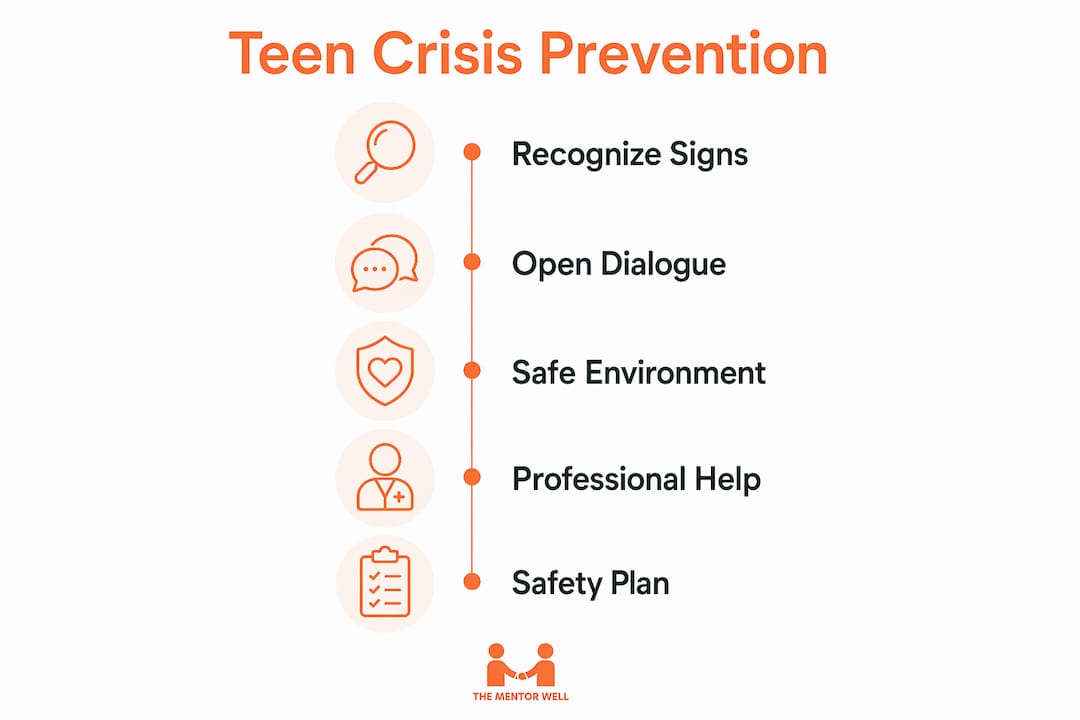
Early intervention is the single most effective approach to teen crisis prevention, and it depends on parents recognising warning signs, communicating openly, securing the home environment, and building a personalised safety plan before a crisis arrives.
| Point | Details |
|---|---|
| Recognise the pattern, not the moment | Behavioural changes lasting two or more weeks are the clearest signal that professional evaluation is needed. |
| Ask directly about suicide | Asking a teen about suicide does not increase risk. It is a protective measure recommended by medical experts. |
| Secure the home environment | Locking up firearms, medications, and alcohol reduces impulsive attempts during moments of acute distress. |
| Use warm handoffs, not cold referrals | Staying involved until your teen connects with a provider significantly improves the chance they engage with care. |
| Build the safety plan together | Plans co-created with teens using strategies they value produce better outcomes than standardised templates. |
What I've learned about silence and the cost of waiting
I built The MentorWell after losing my daughter Maddie. I am not a clinician. I am a father who spent years replaying every conversation, every quiet dinner, every moment I told myself she was just going through a phase.
What I know now is that silence is not safety. Waiting for a teen to come to you is not patience. It is a gap, and crises fill gaps.
The parents I speak with most often carry the same fear I did: that asking the hard question will make things worse. That naming the darkness will somehow invite it in. Every piece of credible research says the opposite. Asking is protective. Asking keeps the door open. And an open door is the difference between a teen who reaches out and one who doesn't.
I also know that parents are not supposed to do this alone. The weight of watching your child struggle, of not knowing whether what you are seeing is normal or serious, is genuinely heavy. That is not weakness. That is love under pressure.
The most important thing I can tell you is this: act early, even when you are not sure. The cost of acting too soon is a conversation. The cost of waiting too long is something no parent should have to carry.
If you are seeing signs in your teen right now, do not wait for certainty. Reach out. Ask the question. Get the support. The window is open. Use it.
— Chris Coulter
How The MentorWell supports families through early intervention

The MentorWell was created for parents who are paying attention and want to do something about what they see. The platform offers workshops, coaching, and the Teen Signal Check, an assessment built for parents and caregivers to identify subtle warning signs in youth aged 8 to 25. These tools are grounded in the same early intervention principles that clinical research consistently supports. The MentorWell also connects families with a global community of parents navigating the same fears and questions. You do not have to figure this out alone. Visit The MentorWell to find the resources, programmes, and community your family needs right now.
FAQ
What is teen crisis prevention?
Teen crisis prevention is the proactive practice of identifying mental health risks in adolescents early and intervening before those risks escalate. It includes recognising warning signs, securing the home environment, and building open communication with your teen.
Does asking a teen about suicide make things worse?
No. Asking a teenager directly about suicide does not increase risk and is a recommended protective measure supported by the Mayo Clinic and other medical authorities.
What are the most important warning signs to watch for?
School refusal, self-harm, social withdrawal, and mood changes lasting two or more weeks are the clearest indicators that a teen needs professional evaluation.
When should I call 988?
Call or text 988 any time your teen is experiencing severe emotional distress, not only when there is an active suicide threat. Early contact prevents escalation.
What makes a safety plan effective?
A safety plan works best when it is created collaboratively with your teen, includes coping strategies they already use, names trusted contacts, and is reviewed regularly as circumstances change.
Recommended
- Your Teen Doesn’t Need Fixing, They Need Someone Who Gets It — THE MENTOR WELL
- We Never Saw the Warning Signs: A Parent's Wake-Up Call — THE MENTOR WELL
- Helping University Students Manage Stress and Stay Connected — THE MENTOR WELL
- Your Teenager Isn't Pushing You Away. They're Testing Whether You'll Stay. — THE MENTOR WELL