
If you or someone in your programme needs help right now, call Crisis Services Canada at 1-833-456-4566 (24/7) or 911 in a life-threatening emergency. That call, made now, is the single most important step.
- Crisis Services Canada: 1-833-456-4566, available 24/7 by phone; text 45645 (4 PM–midnight ET)
- Good2Talk: 1-866-925-5454 for post-secondary students in Ontario, Nova Scotia, and other participating provinces
- Togetherall: free, anonymous online peer support at togetherall.com, accessible through many Canadian colleges
- Your apprenticeship advisor or employer EAP: your first workplace contact for non-emergency referrals
The Canadian Apprenticeship Forum (CAF-FCA) has documented that apprentice well-being directly affects completion rates and employment outcomes. Getting support is not a detour from your trade. It is part of finishing it.
Key takeaways
Supporting apprentice mental health programmes in Canada requires immediate crisis access, province-level resource mapping, peer-led design, and privacy-compliant programme structures that apprentices helped shape.
| Point | Details |
|---|---|
| Crisis access first | Call Crisis Services Canada (1-833-456-4566) or 911 for any immediate safety concern. |
| Online tools, no wait | Togetherall and TAO Self-Help offer same-day, anonymous support through most Canadian colleges. |
| Coordinator priority | Embed mental health in orientation and create a written accommodation referral route from day one. |
| Design with apprentice voice | Use pulse surveys or an advisory panel to measure uptake and iterate; CAF-FCA ePanel research supports this approach. |
| The MentorWell | Offers crisis-prevention workshops, peer mentor training, and the Teen Signal Check tool for apprenticeship programme coordinators. |
Table of Contents
- What crisis lines and 24/7 supports does every Canadian apprentice need to know?
- Where do you find province-level apprenticeship supports?
- Which online platforms can apprentices use right now?
- What can trainers and coordinators do inside an apprenticeship programme?
- How do you design an apprentice mental health programme that actually works?
- How does an apprentice or coordinator actually get help, step by step?
- Legal considerations and privacy in Canadian apprenticeship mental health programmes
- What the conventional advice on apprentice mental health gets wrong
- The MentorWell supports apprenticeship programmes at the point it matters most
- Sources
- FAQ
What crisis lines and 24/7 supports does every Canadian apprentice need to know?
911 is for immediate danger to life. Call it without hesitation.
Crisis Services Canada (1-833-456-4566) connects you to a trained crisis responder any hour of the day. You do not need to be in active crisis to call. If you are struggling and cannot sleep, that is enough reason.
- Good2Talk serves post-secondary students, including apprentices enrolled at college. In Ontario and Nova Scotia, dial 1-866-925-5454. In some provinces, texting "GOOD2TALK" to 686868 connects you to a counsellor. You do not need a referral.
- Kids Help Phone (1-800-668-6868 or text HELLO to 686868) serves anyone up to age 29.
When you call, you do not need a prepared speech. Say: "I'm an apprentice and I'm struggling. I need to talk to someone." That is enough. Calls are confidential. Counsellors are not required to contact your employer or training provider unless there is an immediate safety risk.
Where do you find province-level apprenticeship supports?
Provincial apprenticeship agencies do not provide clinical counselling directly. What they do is point you clearly toward the services that do. The Nova Scotia Apprenticeship Agency lists Good2Talk, Togetherall, and TAO Self-Help on a dedicated wellbeing page, alongside crisis numbers. That model is common across provinces.
Apprenticeship Manitoba similarly links apprentices to provincial student supports and campus resources through its registered training providers.
| Agency | Core support types | How to access |
|---|---|---|
| Nova Scotia Apprenticeship Agency | Good2Talk, Togetherall, TAO, crisis lines | nsapprenticeship.ca/apprentices/mental-health |
| Apprenticeship Manitoba | Campus counselling, provincial student helplines | apprenticeship.gov.mb.ca |
| SAIT (Alberta) | Advising, accessibility, counselling via Microsoft Teams | sait.ca/apprenticeships-and-trades/support-services |
The practical difference between an agency page and a campus counsellor matters. Agencies signpost. Campus counsellors at your registered training provider, such as SAIT's apprenticeship support services, can book you directly, often via virtual appointments that fit around shift work. Early, apprentice-specific help at the campus level has been linked to better programme completion.
Which online platforms can apprentices use right now?
Three platforms stand out for immediate, low-barrier access.
| Platform | Access route | Anonymity | Best use case |
|---|---|---|---|
| Togetherall | College registration or postal code | High | Anonymous peer support, 24/7 |
| TAO Self-Help | Through campus or employer | Moderate | Guided self-help modules |
| MHERC | Open website | High | Resource library, psychoeducation |
Togetherall is a moderated online community where you can post anonymously and read what others are going through. No appointment. No waiting room. Many Canadian colleges provide free access through enrolment.
TAO Self-Help (Therapy Assistance Online) offers structured, therapist-developed modules on anxiety, stress, and sleep. Access is usually through your college or employer's EAP portal.
The Mental Health Education Resource Centre (MHERC) is an open library of mental health information. It does not replace counselling, but it is a solid first stop when you want to understand what you are experiencing before talking to someone.
Choose online and anonymous support when you are not ready to speak to someone in person, when you need help outside business hours, or when you want to learn before you reach out. Book a counsellor when you have been struggling for more than two weeks or when daily functioning is affected.
What can trainers and coordinators do inside an apprenticeship programme?
Most of what works does not require budget approval. It requires attention and a small shift in how orientation and scheduling are handled.
- Embed mental health in orientation. Name the available services on day one. Normalising help-seeking from the start reduces stigma across the cohort. The Supporting Skilled Trades Students Toolkit recommends including substance-use awareness and naloxone kit information at this stage.
- Schedule drop-in hours that fit trades schedules. A counsellor available only 9–5 on weekdays is invisible to shift workers. Coordinate with campus services to offer at least one evening or early-morning slot per week.
- Create peer mentor pairings. Match newer apprentices with experienced tradespeople who have completed mental health awareness training. The Forge Alliance peer support model trains tradespeople with lived experience as embedded peer supporters, and the trust it builds is something a clinical poster on a wall cannot replicate.
- Standardise the accommodation referral route. Every apprentice should know, in writing, how to request a schedule adjustment or exam accommodation for a mental health reason, and who receives that request.
- Know your confidential referral steps. If an apprentice discloses distress, your role is to listen, not diagnose. Refer to campus counselling or the EAP. Document the referral, not the disclosure.
Pro Tip: Ask your campus counselling contact to record a short video introduction for your programme's orientation module. Apprentices are far more likely to contact someone whose face and name they already recognise.
For a deeper look at how managers can support youth mental health at work, the practical steps translate directly to the trades training context.
How do you design an apprentice mental health programme that actually works?
The CAF-FCA ePanel research is clear: programmes built without apprentice input tend to miss the mark. The typical apprentice respondent is aged 18–29, working long hours, and navigating financial pressure alongside technical training. Generic wellness content does not reach them.
The Supporting Skilled Trades Students Toolkit recommends a trauma-informed, anti-oppressive design framework. In plain terms, that means:
- Assume some apprentices carry histories of trauma, discrimination, or substance use before they walk in.
- Build flexibility into access: virtual options, after-hours availability, no-referral-required entry points.
- Centre peer support alongside clinical services, not instead of them.
- Measure what you build. Use short pulse surveys or an apprentice advisory panel to track help-seeking rates and service awareness each term.
The implementation sequence that holds up: plan with apprentice input, pilot one or two elements in a single cohort, measure uptake and feedback, then expand. BuildStrong by CIRP offers a useful model for programmes that need to combine clinical counselling with union or employer advocacy, particularly when workplace reintegration is part of the picture.
For coordinators building policy from scratch, the guide to building a teen mental health policy at work covers the structural steps that translate well to apprenticeship settings.
How does an apprentice or coordinator actually get help, step by step?
Step 1: Immediate safety. If there is any risk to life, call 911 or Crisis Services Canada (1-833-456-4566) now.
Step 2: Confidential counselling. Contact your campus counselling service, your employer's EAP, or log into Togetherall or TAO Self-Help for same-day access. No referral is needed for any of these.
Step 3: Workplace or accommodation steps. If your mental health is affecting attendance or performance, contact your apprenticeship advisor. You are not required to share a diagnosis. You can say: "I'm dealing with a health issue and need to discuss my schedule."
Step 4: Escalation. If a counsellor, advisor, or trainer believes there is a risk of harm, they will follow their institution's duty-to-warn protocol. In most cases, this means contacting emergency services, not your employer.
Key contacts to have ready:
- Campus counselling office phone and virtual booking link
- Employer EAP number (usually on your benefits card)
- Apprenticeship advisor name and email
- Crisis Services Canada: 1-833-456-4566
A note on privacy for apprentices under 18: In Canada, minors generally have the right to consent to their own mental health treatment when a counsellor determines they are capable of understanding the decision. Parental notification is not automatic. Confirm the specific policy with your province's counselling service.
Legal considerations and privacy in Canadian apprenticeship mental health programmes
Canadian apprentices are protected under both provincial human rights legislation and federal privacy law. Under provincial human rights codes, mental health conditions are recognised disabilities. Employers and training providers have a legal duty to accommodate apprentices to the point of undue hardship, which typically includes schedule adjustments, modified training timelines, and exam accommodations.
Privacy of health information is governed by provincial health privacy legislation (such as Ontario's Personal Health Information Protection Act) and, where applicable, PIPEDA. A counsellor at a campus or EAP service cannot share your mental health information with your employer without your written consent, except in a narrow duty-to-warn situation involving imminent risk of serious harm.
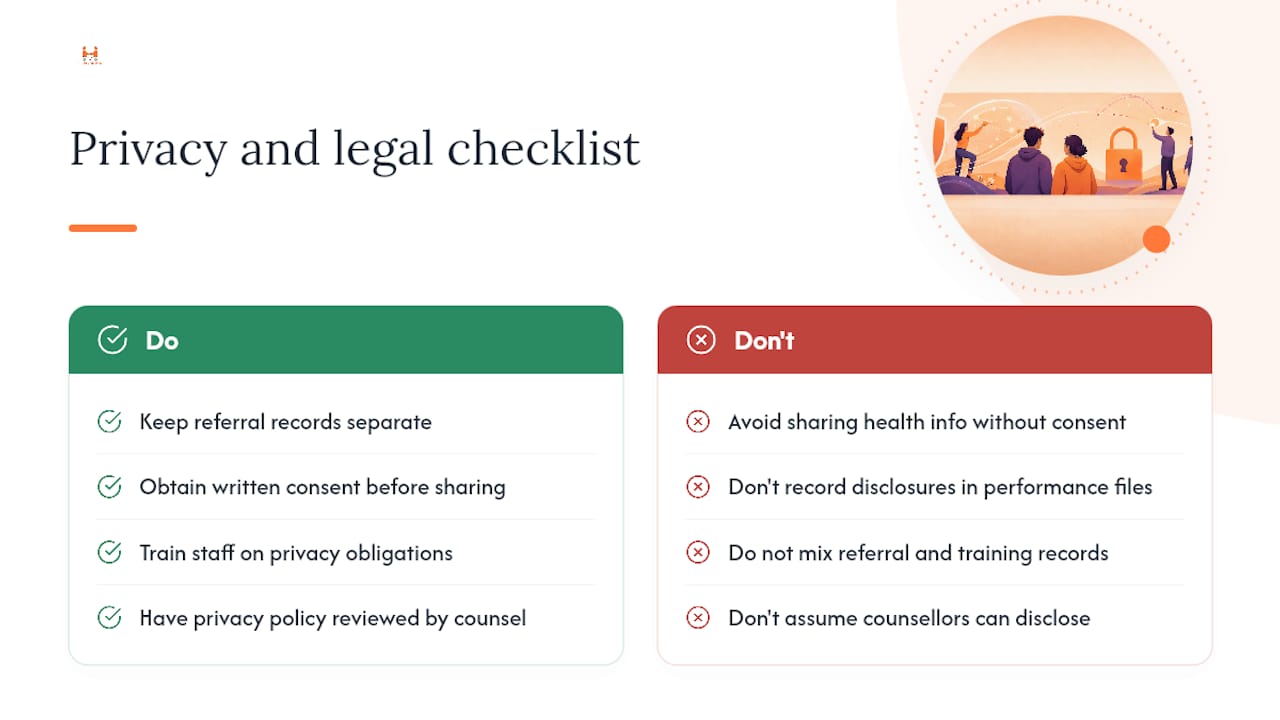
For coordinators, this means: keep referral records separate from training records, never document the content of a disclosure in a performance file, and obtain written consent before sharing any health-related accommodation details beyond what is operationally necessary.
Programmes that handle mental health data should have a written privacy policy reviewed by legal counsel, and all staff who receive disclosures should receive training on their obligations. The how to create a mental health first aid program guide covers the structural and policy elements that apply directly here.
This article provides general information, not legal advice. Confirm your obligations with a qualified employment or privacy lawyer and your provincial human rights commission.
What the conventional advice on apprentice mental health gets wrong
Most articles on this topic hand you a list of helpline numbers and call it done. The list matters. But the list is not the programme.

What I have seen, working with families and workplaces where the warning signs were present long before anyone acted, is that the gap is almost never a shortage of resources. It is a shortage of someone paying attention early enough, and a culture where asking for help feels like admitting you cannot handle the work.
Trades culture compounds this. The stoicism is real. The peer pressure to push through is real. And so the conventional advice, which is essentially "here are the services, use them," misses the actual barrier. Apprentices do not use services they learned about on a poster. They use services recommended by someone they trust, someone who looks like them and has been where they are.
That is why peer-led models like the Forge Alliance outperform clinical-only approaches in trades settings. It is not about the clinical quality of the service. It is about the door. Who opens it, and whether the person on the other side of it feels like someone who gets it.
Coordinators often ask me what the single highest-leverage change is. It is not a new platform or a new policy. It is putting a trained peer supporter in the room during orientation and letting them speak first. Before the handbook. Before the safety video. Before the schedule.
The window for early help is real. And it closes faster than anyone expects.
The MentorWell supports apprenticeship programmes at the point it matters most
The hardest moment in any apprenticeship programme is not the technical exam. It is the quiet stretch when a young person starts pulling back and no one around them knows what to do next.

The MentorWell's crisis-prevention workshops give trainers and coordinators the language and the confidence to act before that moment becomes a crisis. The Teen Signal Check assessment helps identify early signs of emotional distress in youth aged 8–25, and the on-demand coaching gives programme staff a structured way to support trainees without overstepping their role. A coordinator can integrate a MentorWell workshop into a single orientation session, pair it with a peer mentor structure, and have a functioning early-intervention layer running within one cohort cycle.
If you are building or improving a mental health programme for your apprenticeship setting, visit The MentorWell to request a workshop or book a consultation.
This article is general information, not a substitute for advice from a qualified doctor. Consult a qualified healthcare professional about your own circumstances before acting on anything here.
Sources
- Supporting Skilled Trades Students Toolkit
- Apprentice well‑being: an Apprentices in Canada ePanel report
- Support Services for Apprentices
- Wellbeing and mental health | Nova Scotia Apprenticeship Agency
- The Forge – CFBC
FAQ
How do apprentices access Good2Talk in Canada?
Call 1-866-925-5454 or text "GOOD2TALK" to 686868; availability varies by province, so check your provincial apprenticeship agency page for local access details.
What can an apprenticeship coordinator do if an apprentice discloses distress?
Listen without judgment, refer the apprentice to campus counselling or the employer EAP, and document the referral, not the content of the disclosure, to protect the apprentice's privacy.
Is mental health information shared with an employer without consent?
No. Under Canadian privacy legislation, a counsellor cannot share health information with an employer without written consent, except when there is an imminent risk of serious harm to the apprentice or others.
What funding supports mental health initiatives in apprenticeship programmes?
The CAF-FCA ePanel research and provincial apprenticeship agencies are the starting points; some provinces offer workforce development grants that cover mental health training for trades employers, and post-secondary institutions often have student wellness funds that can be accessed by registered apprentices.
Is 27 too old to start an apprenticeship in Canada?
No. Canadian apprenticeship programmes have no upper age limit, and many trades welcome career changers; the mental health supports described in this article apply equally regardless of when you start.