
Yes. Mentoring can be used for early detection and response to adolescent emotional distress, but only when it is built as therapeutic mentoring, not the buddy-system version most people picture. The distinction matters. A scoping review of therapeutic mentoring for youth mental health found that paraprofessional mentors, supervised by licensed clinicians and trained in evidence-based strategies, can genuinely widen access to mental health support for young people who would otherwise fall through the cracks.
Here is your one-hour action step. Do a plain, low-pressure check-in tonight. Ask one specific question about sleep, or school, or who they've been talking to. Then, if anything feels off, use a free tool like MHAScreening.org to get a read on whether what you're seeing warrants a conversation with a pediatrician.
A few things to keep in your pocket before you read further:
- Mentoring is not therapy. It is a bridge, and bridges only work if they lead somewhere.
- Supervision by a licensed clinician is not optional. Without it, you don't have a mental health program. You have a nice idea.
- Consistency over time tells you more than any single bad day does.
Quick fact: Programs built on the Mental Health Ambassador model, an eight-session curriculum evaluated in a mixed-method pilot, showed measurable gains in resource awareness and confidence discussing mental health, in both the youth and the adult mentors. That's the kind of program worth your time.
Key Takeaways
Mentoring works as early detection for adolescent emotional distress only when it pairs trained, supervised mentors with clear referral pathways and evidence-based practices.
| Point | Details |
|---|---|
| Check in tonight | Ask one specific question about sleep, school, or friends, then watch for a pattern, not a single answer. |
| Use a free screener | Try MHAScreening.org to get a clearer read before your next pediatrician visit. |
| Know your crisis contact | Call 988 immediately for any sign of imminent risk, and stay with the young person through the handoff. |
| Vet any program hard | Confirm clinician supervision, training, and referral pathways before you sign up or enroll a team. |
| Start with The MentorWell | Use the Teen Signal Check or book a workshop through The MentorWell as a concrete first step. |
There's no tidy ending to this. You act on what you notice, and you keep noticing.
This article is general information, not a substitute for advice from a qualified doctor. Consult a qualified healthcare professional about your own circumstances before acting on anything here.
Table of Contents
- What mentoring as employee development actually means here
- Early signs of adolescent emotional distress to watch for
- What every mentoring program needs to actually work
- How to set up a mentoring program step by step
- Boundaries, mandatory reporting, and when to escalate
- Real programs and what each one teaches us
- How to evaluate and choose the right program
- Why I keep asking what I'd do differently
- How The MentorWell can help you take the next step
- Sources
- FAQ
What mentoring as employee development actually means here
Most people hear "mentoring" and think career coaching, or a work buddy assigned on someone's first day. That's not what we're talking about. Mentoring as employee development, in the context of adolescent mental health, means something narrower and more deliberate: a trained adult, working under clinical supervision, building a relationship with a young person specifically to notice distress early and connect them to help before a crisis forms.
There are three models worth knowing.
- Therapeutic mentoring. A paraprofessional mentor, supervised by a licensed clinician, uses structured, evidence-based techniques. This is the model with the strongest research base behind it.
- Mental Health Ambassador programs. A short, group curriculum trains both adults and youth together, building shared vocabulary and confidence to raise concerns early.
- Peer mentorship. Youth-to-youth relationships, often layered on top of a clinical or school program, that widen the net of who notices when something's wrong.
Generic activity-based mentoring, sports leagues, tutoring, general "big brother" style pairings, isn't the same thing, and research backs that up. A reflection on mentoring frameworks for minoritized youth found that mentoring tied to a specific referral issue outperforms unstructured friendship-style mentoring almost every time.
A mentor who knows why they're there catches things a well-meaning volunteer never will. Purpose changes what you notice.
Early signs of adolescent emotional distress to watch for
I've sat with enough parents after the fact to know the signs were almost always there. Nobody missed them because they were invisible. They missed them because they looked like a phase.
Watch for changes, not moments. A single bad week means very little. A pattern means everything.
- Sleep that's suddenly wrong, too much, too little, or wildly inconsistent.
- Falling attendance or slipping grades that don't match the kid you know.
- Withdrawal from friends, activities, or things that used to matter to them.
- Mood swings that feel sharper or last longer than the usual teenage weather.
- Any talk, even joking, about being a burden or not being around.
Healthychildren, from the American Academy of Pediatrics, recommends bringing concrete examples to a pediatrician rather than a vague sense that something's wrong. Write down three specific instances, dates, what happened, what they said. That short list is worth more in a clinical appointment than an hour of "I just feel like something's off."
Pro Tip: A single rough day rarely means anything on its own. What matters is whether the same pattern shows up again next week. Consistency across days and weeks is the signal. One bad Tuesday is not.
A substantial number of adolescents experience diagnosable mental health conditions each year, yet most do not receive support before issues escalate. That gap between the signs and the help is exactly where mentoring is meant to sit.
What every mentoring program needs to actually work
A program without these pieces isn't a safety net. It's a hobby with good intentions.
- A real training curriculum. Mentors need structured preparation, not a weekend orientation and a handshake.
- Clinician supervision. Every therapeutic mentoring model worth trusting has a licensed clinician reviewing cases and guiding mentors.
- Evidence-based brief interventions. Mentors should be using techniques with some research behind them, not improvising.
- Clear referral pathways. Everyone involved should know, before day one, exactly who gets called when a concern crosses a threshold.
- Cultural competency. A mentor who understands a family's background and barriers to care builds trust faster and misses less.
Programs that layer mentoring on top of formal clinical services show real promise. Research on integrating community mentoring with adolescent mental health services found it adds informal, relaxed support that complements clinical care well, though matching delays and communication gaps are common failure points worth planning around.
Supervision isn't bureaucracy. It's the difference between a mentor who notices something and a mentor who knows what to do with what they noticed.
Every serious program should also have a mandated reporting protocol in writing, not implied, written. Mentors are not therapists and should never be asked to carry a safety concern alone.
How to set up a mentoring program step by step
You don't need a six-figure budget to start something real. You need sequence and discipline.
- Assess the need. Talk to teachers, HR, or your own gut. What's the actual gap you're trying to close?
- Choose a model. Therapeutic mentoring for deeper concerns, Mental Health Ambassador style curricula for building awareness broadly.
- Recruit and train mentors. Vet for maturity and judgment, then run them through a real curriculum with competency checks, not a single session.
- Match mentors to mentees thoughtfully. Fit matters more than convenience.
- Monitor regularly. Weekly check-ins between mentors and supervisors, not just between mentor and mentee.
- Evaluate outcomes. Ask what changed. Be honest if the answer is "not much."
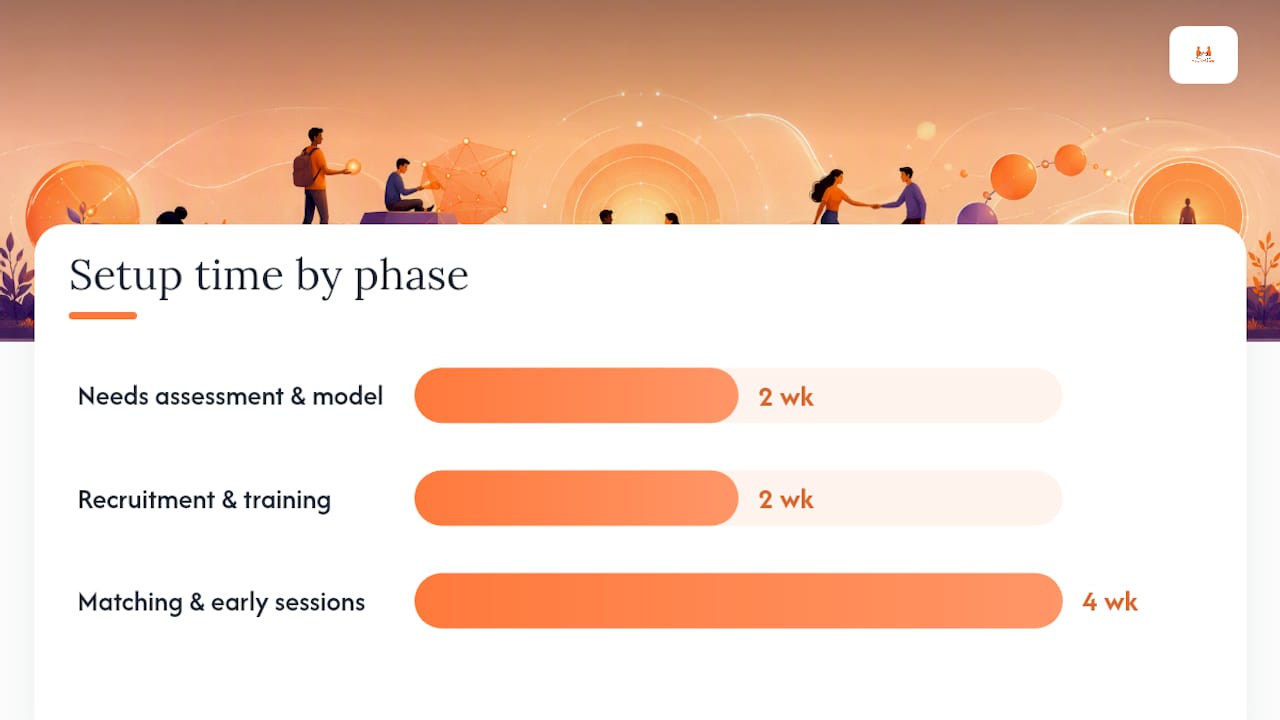
| Week | Focus | What to measure |
|---|---|---|
| 1 to 2 | Needs assessment and model selection | Number of identified concerns, stakeholder buy-in |
| 3 to 4 | Mentor recruitment and training | Training completion, competency checkpoints |
| 5 to 8 | Matching and early sessions | Session frequency, mentor and mentee comfort |
| — | Monitoring and first evaluation | Referral rate, feedback from families or employees |
Costs vary a lot. A parent group can start with free tools, MHAScreening.org for screening, and low-cost training resources. Workplaces investing in manager training or a structured pilot should expect real costs tied to supervision hours and curriculum licensing. Either way, mentor training programs built around supervision and competency checks pay for themselves the first time they catch something early.
Boundaries, mandatory reporting, and when to escalate
A mentor is not a therapist. Say that sentence out loud until it sticks. A good mentor should never promise a young person total secrecy, because sometimes that promise becomes a lie the moment it's tested.
Here's what mentors should never do:
- Never promise to keep a safety concern secret, even if asked directly.
- Never attempt to diagnose or treat. That's not the role.
- Never wait to escalate when there's any mention of self-harm or suicide.
If there's any indication of imminent risk, call the 988 Suicide & Crisis Lifeline immediately, or your local mobile crisis team, or emergency services if the situation is unfolding right now. A warm handoff, staying with the young person while making the call, introducing them directly to the crisis counsellor, matters more than people realize. It's the difference between a referral and an abandonment.
The moment a mentor is unsure whether something is serious enough, it already is. Escalate first. Sort out the details after.
Pro Tip: Document what you saw and heard in plain, factual language, dates, direct quotes if you can. Share it with a caregiver or clinician promptly. You're not betraying trust by acting on a safety concern. You're keeping the promise that actually matters.
Real programs and what each one teaches us
The Mental Health Ambassador model runs on group learning. Youth and adults train together over eight sessions, building shared language around mental health and youth-led advocacy skills. What it teaches: confidence and awareness spread faster when you stop treating kids as passive recipients of a program.
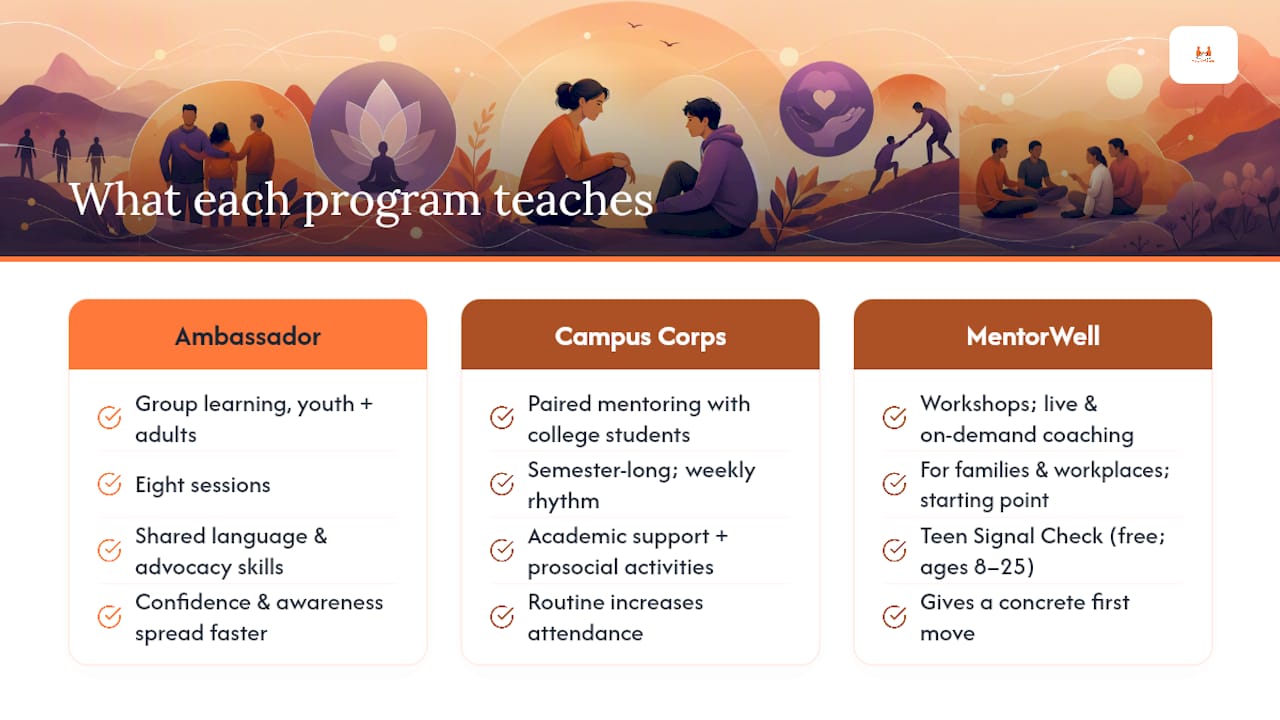
Campus Connections, also known as Campus Corps, pairs college students with youth in a structured, semester-long format that blends academic support, prosocial activities, and clinical oversight. It runs on a predictable weekly rhythm, which matters. Kids show up more reliably for something that feels like a routine, not a special occasion.
The MentorWell approaches this from a different angle, built for families and workplaces who need a starting point before committing to a full clinical relationship. Workshops for parents and managers, live and on-demand coaching, and the Teen Signal Check, a free assessment for spotting subtle warning signs in youth aged 8 to 25, give people a concrete first move instead of a vague sense of worry.
Every program on this list exists because someone noticed too late once, and decided that wasn't going to happen twice.
How to evaluate and choose the right program
Ask hard questions before you sign anything or hand your child, or your employees, over to a stranger with a nice logo.
- Who supervises the mentors, and are they licensed clinicians?
- What's the training curriculum, and how are competency checks done?
- What does the referral pathway look like when a concern comes up?
- Is there any evidence of outcomes, even a small pilot evaluation?
- How does the program handle cultural or language differences in the families it serves?
Watch for these red flags:
- Vague answers about "what happens if" something serious comes up.
- No named clinician providing oversight.
- No feedback loop from families or participants.
- Costs or session length that aren't stated plainly upfront.
If a provider can't answer the supervision question clearly in the first conversation, that tells you everything you need to know.
Why I keep asking what I'd do differently
I sit on the dock some mornings with my coffee and ask myself the same question. What would I do differently. It doesn't get easier to answer.
Maddie was funny, and sharp, and she carried things quietly. I saw pieces of what was happening. Not all of it, but pieces. I told myself the quiet moments were just her being her. I didn't push. I didn't ask the second question after the first one got a shrug.
If I could go back, I would ask again. Not louder. Just again. The second question is the one that usually gets you somewhere, because the first answer is almost always the polished one.
Small signs don't feel like emergencies when you're standing inside them. That's the trap. You wait for something big enough to justify the discomfort of asking directly, and by the time it's big enough, you've lost time you didn't know you were spending.
Sit with the discomfort. Ask the second question. Do it before you have a reason to wish you had.
How The MentorWell can help you take the next step
You don't have to build a program from scratch, and you don't have to figure out on your own whether what you're seeing is a phase or something more. The MentorWell exists because that gap, between noticing and knowing what to do, is where families and workplaces get stuck most often.

The MentorWell's workshops walk parents and managers through exactly what this article covers: how to spot the signs, how to have the conversation, and when to bring in a clinician. Live and on-demand coaching gives you a real person to ask the hard questions to, instead of another article. And the Teen Signal Check gives you a concrete, free starting point tonight, before you spend another week wondering.
A first conversation with The MentorWell usually starts with the Teen Signal Check or a short call about what your family or workplace actually needs. From there, it's a workshop booking or a coaching session, not a long sales process. Visit The MentorWell to book a workshop or start the Teen Signal Check today.
Sources
- A scoping review of therapeutic mentoring for youth mental health
- Youth mentoring as a means of supporting mental health for minoritized youth: a reflection on three theoretical frameworks 20 years later
- Healthychildren
- Mental Health Ambassadors: A model for supporting youth mental health within mentoring programmes
FAQ
Can mentoring really catch mental health problems early?
Yes, when it's therapeutic mentoring with clinician supervision and evidence-based methods, not generic activity-based mentoring.
What's the difference between mentoring and therapy?
Mentoring is a supportive, non-clinical relationship that can bridge a young person to therapy; it never replaces licensed treatment.
How do I know if my teen needs professional help right now?
If there's any talk of self-harm or suicide, or a sudden serious safety concern, call 988 immediately rather than waiting for a scheduled appointment.
What should I look for in a mentoring program?
Confirm licensed clinician supervision, a real training curriculum, clear referral pathways, and some evidence of outcomes before committing.
Where can The MentorWell help?
The MentorWell offers workshops, coaching, and the free Teen Signal Check to help parents and managers spot signs early and know what to do next.