
TL;DR:
- Suicide ranks as the second leading cause of death among Canadian youth aged 15 to 34.
- Recognizing subtle warning signs and asking direct questions can save teen lives.
Suicide is the second leading cause of death among Canadian youth aged 15 to 34. If you are asking whether your teen might be suicidal, that question alone matters. Suicidal ideation, the clinical term for thoughts of ending one's life, is far more common in adolescents than most parents realise. Youth experience suicidal thoughts at a rate three times higher than adults, with girls reporting these thoughts more frequently. Recognising the warning signs early, and knowing how to respond with calm and care, is the most important thing you can do right now.
What are the warning signs that my teen might be suicidal?
Warning signs are rarely dramatic. Most parents who look back say the signals were quiet. A shift in sleep. A comment that landed strangely. A door that stayed closed a little longer each night.
Clinically, the warning signs of suicidal risk in teens fall into several clear categories. Common warning signs include talking about suicide directly or indirectly, having a plan or expressing intent, saying goodbye in unusual ways, withdrawing from friends and family, giving away possessions, and increasing use of alcohol or drugs. Each of these behaviours signals that a teen's internal world has become too heavy to carry quietly.
Behavioural changes to watch for
- Talking about death, hopelessness, or being a burden to others
- Expressing a wish to die or disappear, even in passing or online
- Giving away valued possessions without clear reason
- Withdrawing from friends, family, sports, or activities they once loved
- Sudden drops in school performance or attendance
- Changes in sleep, appetite, or personal hygiene
- Increased use of alcohol, cannabis, or other substances
- Reckless behaviour that seems out of character
One distinction parents often miss: self-harm and suicidal behaviour are related but not the same. Self-harm is frequently a coping mechanism, a way to manage overwhelming emotion. It signals that a teen's existing strategies are failing. When self-harm becomes recurring or escalating, professional care is the right next step, regardless of whether suicidal intent is stated.
Risk does not fall evenly across all teens. Adolescent girls aged 15 to 19 have the highest rate of self-harm hospitalisations, approximately four times that of boys. And bullying and cyberbullying quadruple the risk of suicidal thoughts in youth. That number is worth sitting with. A teen being targeted online is not just having a hard time socially. The risk is measurably, significantly higher.
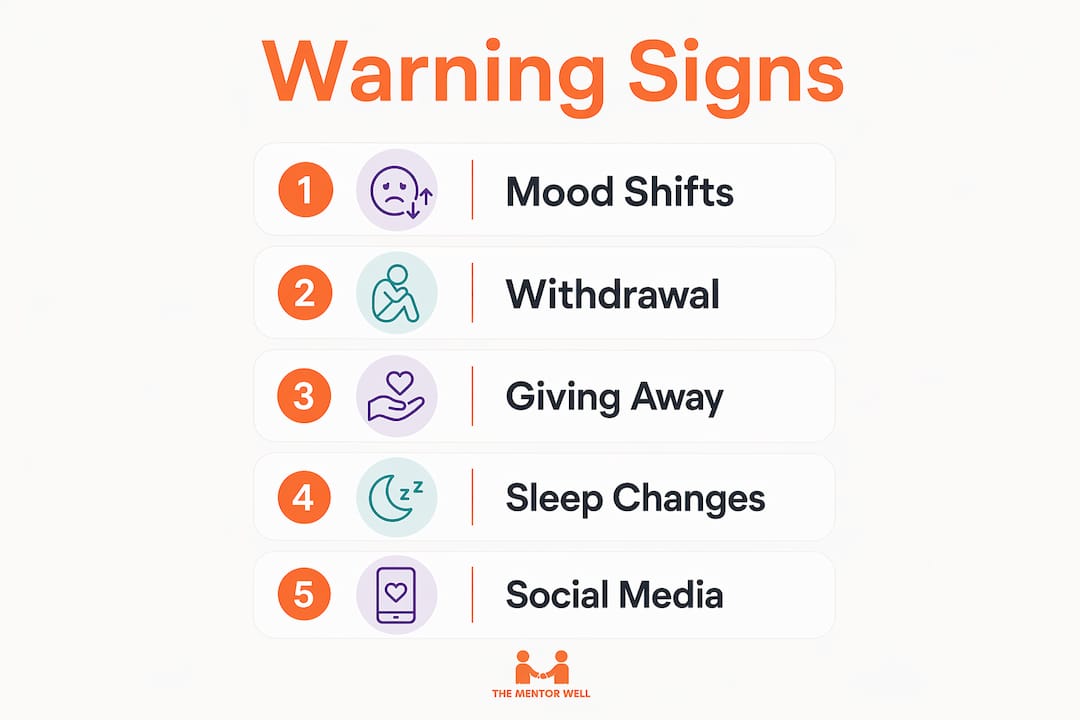
Pro Tip: Check your teen's social media not to surveil them, but to understand their world. An indirect post about not wanting to be here is a warning sign, not a phase.
How can I talk to my teen about suicidal thoughts?
The fear most parents carry is that asking the question will plant the idea. That fear is understandable. It is also wrong. Asking directly about suicide does not plant the idea. It opens honest dialogue and often provides genuine relief for the teen. The silence is the danger, not the question.
The conversation does not need to be a formal sit-down. Some of the most important exchanges happen in the car, on a walk, or while doing something side by side. Parents should shift from interrogating for answers to trying to understand their teen's lived experience calmly. That shift changes everything.
How to open the conversation
- Start with observation, not accusation: "I've noticed you seem really tired lately. How are you actually doing?"
- Use calm, private moments. A drive home. A quiet evening. Not in front of siblings.
- Ask directly if you are worried: "Are you having thoughts of hurting yourself or not wanting to be here?"
- Listen more than you speak. Resist the urge to fix or reassure immediately.
- Validate what they share: "That sounds incredibly hard. I'm glad you told me."
- If they shut down, say: "I'm not going anywhere. You can come to me whenever you're ready."
Empathy-focused language builds trust with teens overwhelmed by suicidal thoughts without escalating shame or secrecy. Avoid ultimatums, raised voices, or expressions of disbelief. "You have nothing to be sad about" closes the door. "Tell me more" keeps it open.
Learning how to listen without fixing is a skill, and it is one worth practising before a crisis arrives.

Pro Tip: If your teen has texted you something alarming, do not respond with panic. Respond with presence. The MentorWell has a resource specifically on what to do if your teen texts you that they don't want to live.
What should parents do if they suspect their teen is in crisis?
Knowing when to act, and how fast, is the part that paralyses most parents. The answer is simpler than it feels in the moment.
- If your teen is in immediate danger, take them to the nearest emergency department or call 9-1-1. Do not wait to see if it passes. Immediate danger means they have a plan, access to means, or have expressed intent to act now.
- If your teen has expressed suicidal thoughts but is not in immediate danger, contact the 9-8-8 Suicide Crisis Helpline by calling or texting 9-8-8. It is available 24 hours a day, seven days a week, in English and French.
- Contact your family doctor or paediatrician as soon as possible. They can screen your teen, provide a referral, and help you understand what level of care is appropriate. Starting with your family doctor is an effective first step, even if you do not have all the answers yet.
- Remove access to means where you safely can. This includes medications, sharp objects, and anything else that could be used for self-harm. Do this calmly and without making it a confrontation.
- Do not leave your teen alone if you believe the risk is immediate. Stay present, stay calm, and keep talking.
- Avoid blame and silence. Saying nothing because you do not know what to say is one of the most painful things a teen in crisis can experience. You do not need the right words. You need to be there.
Understanding what a mental health crisis looks like in youth helps parents distinguish between a difficult week and a genuine emergency. That distinction matters for the response you choose.
Safety planning, done with a mental health professional, gives your teen a concrete set of steps to follow when thoughts escalate. It is not a contract. It is a map back to safety, built together.
How to support your teen's mental health beyond the crisis
A crisis does not end when the immediate danger passes. What comes after is quieter, slower, and just as important.
Consistent family support is the single strongest protective factor for teens recovering from suicidal thoughts. That does not mean hovering. It means showing up regularly, checking in without interrogating, and making it clear that the door is always open. Family support strategies for teen mental health are well-documented, and the core principle is simple: connection protects.
Ongoing support looks like this
- Maintaining regular, low-pressure check-ins. A short walk. A meal together. Five minutes before bed.
- Encouraging coping strategies your teen actually finds useful, whether that is music, sport, art, or time in nature.
- Seeking counselling or teen mental health coaching when professional support is appropriate.
- Monitoring for signs of escalation, including increased withdrawal, substance use, or talk of hopelessness, without making your teen feel surveilled.
- Normalising mental health care the same way you would normalise a physio appointment or a dental check-up.
- Respecting your teen's autonomy while holding firm boundaries around safety.
For teens who have experienced suicidal thoughts, early intervention with a mental health professional, whether a therapist, psychologist, or counsellor, significantly reduces the risk of recurrence. If your teen's self-harm is recurring, escalating, or accompanied by other mental health concerns, professional care is not optional. It is the appropriate next step.
Key takeaways
Recognising suicidal risk in teens requires watching for specific behavioural changes, asking direct questions with calm empathy, and acting without delay when the risk is real.
| Point | Details |
|---|---|
| Warning signs are often quiet | Watch for withdrawal, mood shifts, giving away possessions, and indirect comments about not wanting to be here. |
| Asking does not cause harm | Asking your teen directly about suicidal thoughts opens dialogue and provides relief, not risk. |
| Know when to call for help | Call 9-1-1 for immediate danger; contact 9-8-8 or a family doctor for non-emergency concerns. |
| Connection is the strongest protection | Consistent, low-pressure family presence reduces risk more than any single intervention. |
| Professional support matters | Recurring or escalating self-harm requires professional mental health care, not watchful waiting. |
What I carry, and what I wish I had known sooner
I have sat with this question longer than most people ever will. Not as a researcher. As a father.
After Maddie died, I spent a long time going back through the moments I had missed. Not the obvious ones. The small ones. The morning she was quieter than usual. The night she said she was fine and I believed her because I needed to. The times I filled the silence with logistics instead of sitting in it with her.
Parents ask me whether they should be worried. My answer is always the same. If you are asking the question, pay attention. The fact that you are here, reading this, means something in you has already noticed something. Trust that.
The hardest part is not knowing what to say. The hardest part is staying in the room when the conversation gets uncomfortable. When your teen goes quiet. When they say "I'm fine" in a way that sounds like the opposite. Most of us were never taught to sit with that kind of silence without flinching.
What I know now is that the window does not stay open forever. Not because teens stop needing help. Because they stop believing help is available. Every time you show up without an agenda, without a lecture, without needing them to be okay, you keep that window open a little longer.
You do not need to have the answers. You need to be the kind of parent they can come to before they run out of options. That is the whole thing. That is all of it.
— Chris Coulter
How The MentorWell supports families facing teen suicidal thoughts
Recognising the signs is only the first step. Knowing where to turn next is what most families struggle with.

The MentorWell was built for exactly this moment. Founded by Chris Coulter in memory of his daughter Maddie, The MentorWell offers coaching, workshops, and digital tools designed to help parents identify early warning signs and respond with confidence. The Teen Signal Check assessment gives parents a structured way to evaluate what they are seeing in their child, aged 8 to 25, before a crisis takes hold. The MentorWell also connects families with a global community of parents navigating the same fears, so no one has to figure this out alone. If you are not sure what your next step is, that is exactly where to start.
FAQ
What are the most common teen suicide warning signs?
Common warning signs include talking about death or suicide, withdrawing from friends and family, giving away possessions, sudden mood changes, and increased substance use. These signs should never be dismissed, regardless of how your teen might react to being asked about them.
Is my child depressed or suicidal? What is the difference?
Depression and suicidal ideation often overlap but are not the same. A teen can be depressed without suicidal thoughts, and suicidal thoughts can occur without a formal depression diagnosis. If your teen shows signs of either, a family doctor or mental health professional is the right first contact.
How do I start talking to my teen about suicide?
Start with calm observation rather than direct confrontation: "I've noticed you seem really low lately. Are you okay?" Asking directly about suicide does not increase risk. It opens honest dialogue and often provides relief for the teen.
When should I call 9-8-8 versus 9-1-1?
Call 9-1-1 or go to the emergency department if your teen is in immediate danger or has a plan and means to act. Call or text 9-8-8, Canada's Suicide Crisis Helpline, for non-emergency but serious concerns about suicidal thoughts.
Where can I find teen mental health resources in Canada?
Your family doctor is the most accessible starting point for referrals and screening. The 9-8-8 Suicide Crisis Helpline is available 24 hours a day. The MentorWell provides crisis navigation guidance and coaching for families who need structured support beyond crisis intervention.