
Navigating the teen mental health crisis together is defined as a collaborative, proactive approach where parents and caregivers actively support their teenager's emotional well-being through consistent connection, early recognition of warning signs, and shared problem solving. One in five children and youth in Ontario experiences a mental health challenge, and approximately 70% of mental health conditions begin during childhood or youth. That scale means most families will face this at some point. The 5Rs framework (Relate, Recognize, Reassure, Return to Routine, Regulate) and the 988 Suicide & Crisis Lifeline are two evidence-informed tools that give parents a real starting point. You do not need to have all the answers. You need to stay present and pay attention.
How do you know if your teen needs extra mental health support?

The hardest part is knowing when to act. Parents often confuse serious warning signs with typical teen behaviour, which delays effective help-seeking. The difference matters enormously.
Typical adolescent moodiness is short-lived and does not significantly disrupt daily life. Serious distress looks different. Watch for these red flags:
- Social isolation that goes beyond a quiet weekend. Your teen stops seeing friends, drops out of activities they used to love, or refuses to leave their room for days at a time.
- Significant sleep and eating changes. Sleeping 14 hours a day or barely sleeping at all, losing weight rapidly, or eating compulsively are all signals worth noting.
- Persistent irritability or anger that feels out of proportion to the situation and does not settle down after a day or two.
- Declining school performance that appears suddenly, not gradually.
- Expressions of hopelessness, worthlessness, or statements like "nothing matters" or "I wish I wasn't here."
Emotional outbursts or withdrawal that interfere with daily functioning are red flags regardless of age. That distinction is the line between normal growing pains and a situation that needs professional eyes. When these signs persist for more than two weeks, a consultation with your teen's primary care provider is the right next step. Early evaluation keeps more doors open.
How to build resilience with your teen using the 5Rs framework
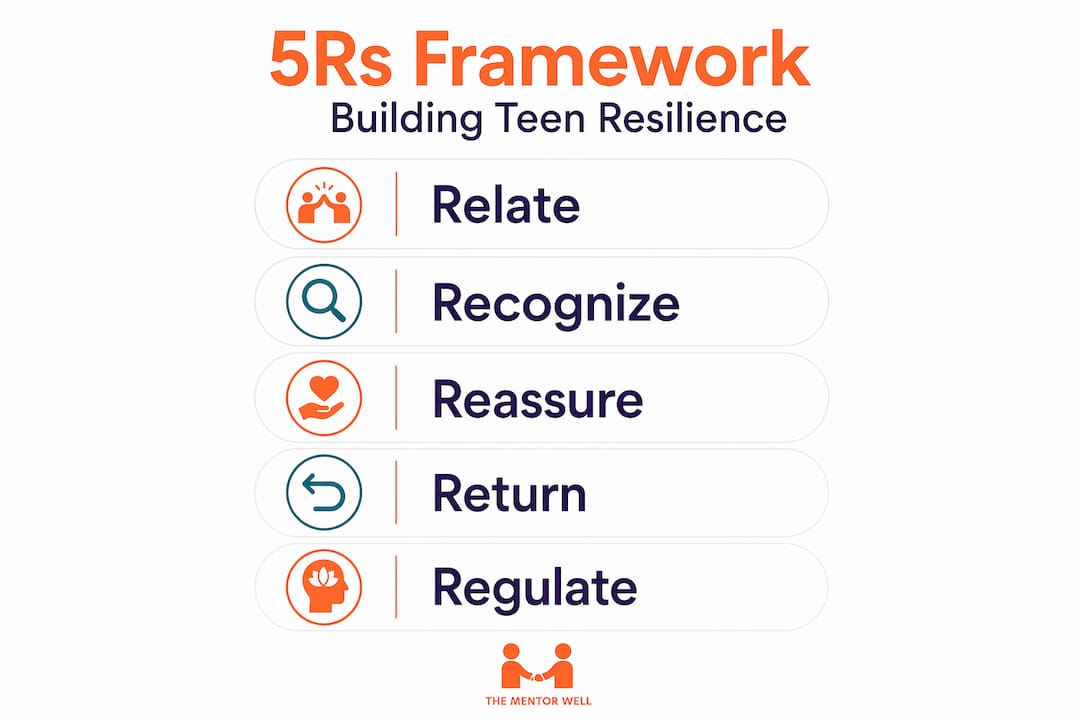
The 5Rs framework is evidence-informed and built specifically for parents supporting teens during stressful periods. Each R represents a concrete area of focus.
- Relate. Stay connected through low-pressure moments. Shared meals, a short walk, or watching a show together signals that you are present without demanding conversation. Connection does not require a deep talk every time.
- Recognize. Name what you observe without judgment. "I've noticed you seem really tired lately" opens a door. Diagnosing or labelling closes it.
- Reassure. Tell your teen directly that they are loved, that this will not last forever, and that you are not going anywhere. Teens in distress often believe they are a burden. Reassurance counters that belief.
- Return to Routine. Structure reduces anxiety. Consistent sleep times, regular meals, and predictable daily rhythms give the nervous system something to anchor to during chaos.
- Regulate. This one is for you as much as it is for your teen. A parent's emotional state directly affects their teen's ability to self-regulate. Modelling calm behaviour is more effective than any verbal instruction you can give.
The Regulate step surprises most parents. We assume our job is to manage our teen's emotions. The research says our first job is to manage our own. Before you walk into a hard conversation, take three slow breaths. Check your own emotional state. Your teen is reading you constantly, even when it does not look that way.
Pro Tip: Try a non-verbal check-in using an emoji scale. Ask your teen to point to or text you an emoji that matches how they feel that day. This low-pressure tool reduces the verbal burden and helps you track emotional patterns without putting your teen on the spot.
What communication techniques keep teens talking instead of shutting down?
The single most common mistake parents make is trying to fix the problem before their teen feels heard. Teens primarily want to be heard and understood, not fixed. When you jump to solutions, your teen learns that coming to you leads to a lecture, not a conversation.
These approaches work:
- Ask open-ended questions. "What was the hardest part of today?" gets further than "Did you have a good day?" One invites reflection. The other invites a one-word answer.
- Listen without interrupting. Let silence sit for a moment. Teens often need a beat before they say the real thing.
- Validate before you advise. "That sounds really painful" before "Here's what you should do" changes the entire tone of the exchange.
- Avoid unsolicited advice. If your teen did not ask for your opinion, offering it signals that you were not really listening. Ask first: "Do you want me to just listen, or are you looking for ideas?"
- Allow autonomy within structure. Resisting micromanagement and setting clear ground rules builds executive function skills that help teens self-regulate. Teens who feel controlled stop sharing.
The article how to listen to your teen without pushing them away goes deeper on this, with specific language you can use in the moment. Effective communication with teens is a skill, not a personality trait. It can be learned.
When should you seek professional help and crisis resources?
Early involvement prevents escalation. Early treatment tailored to teen-specific needs, including therapy and family support, improves well-being and reduces the risk of crisis. Waiting to see if things improve on their own is the most common and most costly delay.
Here is how to move forward:
- Start with your teen's primary care provider. A family doctor or paediatrician can conduct an initial assessment and provide a warm referral to a mental health specialist. This step feels less intimidating than going straight to a psychiatrist.
- Ask about therapy options. Cognitive Behavioural Therapy (CBT) and Dialectical Behaviour Therapy (DBT) are two evidence-based approaches used widely with adolescents. School counsellors can also be a first point of contact.
- Prepare for the appointment. Write down specific behaviours you have observed, with dates if possible. Bring your notes. Clinicians rely on parental observations to build an accurate picture.
- Use the 988 Suicide & Crisis Lifeline. The 988 Lifeline is available 24/7 by call, text, or chat in multiple languages. It is not only for active suicidal crises.
- Know that crisis lines cover emotional distress too. The 988 Lifeline supports families managing overwhelming situations before they reach a breaking point. Early outreach prevents escalation.
If your teen has said something that frightened you, read what would you do if your teen texted you "I don't want to live". Silence is not safety. Asking the hard question does not plant the idea. It opens the door.
Key takeaways
Parents and caregivers who act early, stay connected, and use evidence-informed tools like the 5Rs framework give their teens the best chance of getting through a mental health crisis with their relationship intact.
| Point | Details |
|---|---|
| Recognise red flags early | Persistent isolation, sleep changes, and hopelessness lasting two or more weeks warrant professional evaluation. |
| Use the 5Rs framework | Relate, Recognize, Reassure, Return to Routine, and Regulate give parents a concrete daily structure for supporting resilience. |
| Listen before you fix | Teens need to feel heard first; jumping to solutions shuts down communication and erodes trust. |
| 988 is for distress, not just crisis | The 988 Lifeline supports families managing emotional overwhelm, not only active suicidal emergencies. |
| Regulate yourself first | A parent's calm presence directly improves a teen's ability to self-regulate, more than any advice can. |
What I know now that I wish I had known then
By Chris Coulter
I built The MentorWell after losing my daughter Maddie. I have lived the version of this story where the window closes before you realise it was open. So when I write about paying attention, I am not speaking from a textbook. I am speaking from a place of grief that never fully leaves.
What I have learned, through loss and through years of working with families, is that most parents are doing more right than they realise. They are showing up. They are trying. But they are often waiting for a clear sign, a dramatic moment, a confession. The truth is that the signs are usually quiet. A slight withdrawal. A joke that lands a little too dark. A door that stays closed a little longer each week.
You do not need to be a therapist. You need to be consistent. Small actions, repeated over time, are what keep the connection alive. A shared meal. A text that says "thinking of you." Sitting in the same room without an agenda. These things matter more than the perfect conversation.
Imperfection is not failure. Asking for help is not weakness. The parents who reach out, who admit they are scared and do not know what to do, are the ones who keep more doors open for their kids. That courage is worth more than any strategy I can offer.
— Chris Coulter
How The MentorWell supports families right now
The MentorWell was built for exactly this moment. When you are not sure if what you are seeing is serious, when you want to help but do not know how, and when you need more than a Google search.

The MentorWell offers workshops, coaching, and the Teen Signal Check, a digital assessment designed to help parents and caregivers identify subtle warning signs in youth aged 8 to 25. These tools are grounded in early intervention and built around the reality that most families do not recognise a crisis until it is already underway. The platform also connects families globally, so you are not doing this alone. Visit The MentorWell to explore resources built specifically for parents who are paying attention and want to act before the window closes.
FAQ
What is the 5Rs framework for teen resilience?
The 5Rs (Relate, Recognize, Reassure, Return to Routine, Regulate) is an evidence-informed framework that gives parents concrete daily actions to support their teen's emotional well-being during stressful periods.
How do I tell the difference between normal teen behaviour and a mental health crisis?
Red flags include social isolation, significant sleep or eating changes, persistent irritability, and expressions of hopelessness lasting more than two weeks. Typical moodiness passes quickly and does not disrupt daily functioning.
When should I call the 988 Suicide & Crisis Lifeline?
Call or text 988 any time your teen, or you as a caregiver, is experiencing emotional distress that feels unmanageable. The line is available 24/7 and supports situations beyond active suicidal crisis.
How do I start a conversation with my teen about their mental health?
Use open-ended questions, listen without interrupting, and validate their feelings before offering any advice. Teens are more likely to keep talking when they feel heard rather than managed.
What should I bring to my teen's first mental health appointment?
Write down specific behaviours you have observed, including dates, changes in sleep or eating, and any statements that concerned you. Detailed parental observations help clinicians build an accurate picture quickly.
Recommended
- When One Child Struggles: The Hidden Mental Health Risk for Siblings — THE MENTOR WELL
- For Maddie: Breaking the Silence Around Teen Depression and Why LifeLine Matters — THE MENTOR WELL
- For the Teen Who Doubts Themselves | Confidence Begins with EQ — THE MENTOR WELL
- We Don't Wait to Talk About Cancer. Why Wait for Mental Health? — THE MENTOR WELL