
TL;DR:
- Families recover from mental health crises through structured support, clear communication, and self-care. Building shared meaning and practical skills helps families manage ongoing challenges and prevent burnout. Accessing tailored resources and creating a concrete post-crisis plan are vital steps for long-term stability.
Coping after a mental health crisis is defined as the coordinated effort families make to rebuild safety, communication, and daily stability once the immediate emergency has passed. This is the clinical term for what most families experience as something far messier: a mix of relief, exhaustion, confusion, and grief, all arriving at once. The Canadian Mental Health Association (CMHA) recognises that family members need structured support just as much as the person in crisis does. One in three Canadians will experience a mental illness in their lifetime, and the ripple effect on families is rarely counted in the statistics. How families cope after a mental health crisis depends on access to education, honest communication, and programmes designed to build real skills, not just reassurance.
What structured family support programmes are available?
Structured, time-bound programmes give families a framework when everything feels formless. The CMHA Fort Frances offers a free eight-session Family Education and Support Programme that covers mental health system knowledge, communication, family roles, resilience, self-care, and recovery planning. That breadth matters because families rarely struggle with just one thing. They struggle with all of it, at the same time, without a map.
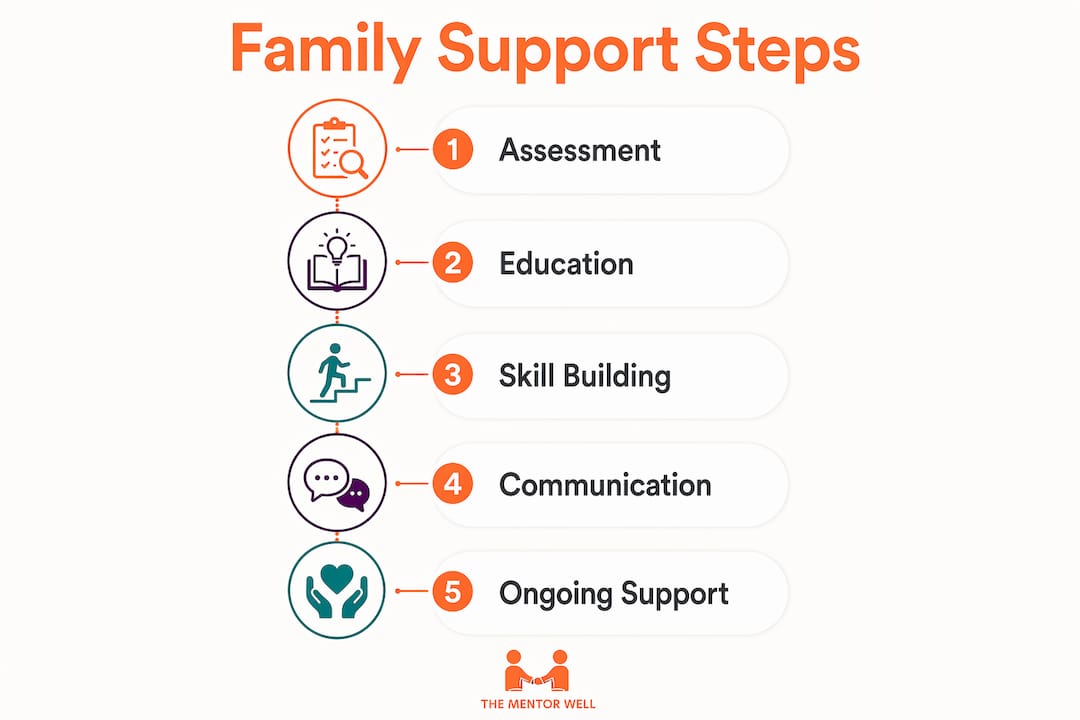
The Ontario Caregiver Organization's SCALE Together™ is an eight-week programme with weekly 90-minute sessions led by regulated health professionals. It addresses burnout, guilt, grief, stress, and boundary-setting directly. It is free for partner organisations. The fact that it names guilt and grief as programme topics is significant. Most families carry those feelings silently, assuming they are the only ones.
Psycho-educational formats like these work because they are skill-based, not open-ended. Families learn to address specific challenges: medication routines, recognising triggers, setting limits without withdrawing love. That practical skill-building translates directly into the home environment in ways that general counselling often does not.
- CMHA Fort Frances Family Education Programme: Eight sessions, free, covers communication, resilience, and recovery planning.
- SCALE Together™: Eight weeks, 90-minute facilitated sessions, focuses on burnout, grief, guilt, and boundaries.
- Family Intervention Therapy (FIT): A 12–14 week psycho-educational intervention that strengthens family relationships and reduces conflict.
Pro Tip: Ask your local CMHA branch directly whether they offer a family programme. Many are free and have no waitlist, but they are not always advertised widely.
How can families build communication and shared meaning in recovery?
Family Intervention Therapy (FIT) is a structured, weekly programme that focuses on communication, practical skills, and rebuilding connection after a mental health crisis. CMHA Toronto's FIT programme runs for 12–14 weeks and is designed specifically to reduce conflict and strengthen relationships during recovery. The structure matters as much as the content. Families need a container for difficult conversations, not just permission to have them.

CMHA Toronto's Healing Happens programme takes a different angle. It guides families through an eight-week Family Arc of Recovery, using narrative and storytelling to build shared understanding. The idea is that families heal not just by managing symptoms but by making sense of what happened together. That shared meaning becomes a foundation for trust.
Narrative methods work because they shift the focus from "what is wrong" to "what we have been through." That reframe changes the conversation in the room. It also changes how families see their own role.
Practical communication habits that support recovery include:
- Creating a regular, low-pressure check-in time, not a crisis debrief, just a standing moment to connect.
- Using "I" statements to describe your own experience rather than interpreting your loved one's behaviour.
- Agreeing in advance on what to do when a conversation becomes too charged to continue.
- Asking your loved one directly what kind of support feels helpful, rather than assuming.
Pro Tip: Avoid the instinct to fix or reassure in every conversation. Sometimes the most useful thing you can say is "I'm here, and I'm not going anywhere."
What caregiver challenges do families face after a crisis?
Caregiver burnout is not a sign of weakness. It is a predictable outcome when one or two people carry the weight of another person's recovery without rest or relief. The BC Schizophrenia Society states plainly that caregiver exhaustion is inevitable without shared responsibility and deliberate self-care. That framing matters. Burnout is not a personal failing. It is a structural problem with a structural solution.
The emotional load families carry is rarely visible. You are managing your own fear while trying to appear calm. You are setting limits while feeling guilty for having them. You are grieving the version of your family that existed before the crisis, while also trying to build something new. Psychology Today Canada notes that families need defined roles in a loved one's recovery plan, not a vague instruction to "be supportive." Vague roles create vague effort, and vague effort exhausts everyone.
Practical ways to manage the emotional burden include:
- Scheduling rest deliberately. Not waiting until you collapse. Putting it in the calendar like any other appointment.
- Sharing caregiving responsibilities across family members, even imperfectly. One person cannot hold this alone.
- Joining a peer support group. Hearing from others who are living the same reality reduces isolation faster than almost anything else.
- Setting clear limits on what you can and cannot do, and communicating them without apology.
Caregiver exhaustion often arrives right when the person in crisis begins to stabilise. The adrenaline drops. The vigilance that kept you going has nowhere to go. Without scheduled rest and boundaries, families risk conflict and withdrawal at exactly the moment recovery needs the most support. Recognising that pattern is the first step to interrupting it.
How can families access resources and build a post-crisis plan?
A post-crisis plan is not a document. It is a set of shared agreements: who to call, what signs to watch for, and what each person's role is when things get hard again. Psychology Today Canada is direct on this point. Families should ask clinicians for a concrete communication plan that defines contacts, warning signs, and response steps. Without that plan, families improvise under pressure, and improvisation in a crisis is rarely effective.
CAMH's Family Resource Centre offers disorder-specific support pathways for families dealing with conditions like psychosis. That specificity is critical. General advice about "supporting a loved one" does not prepare a family for the particular challenges of a specific diagnosis. Knowing where to find age-specific crisis services is equally important, especially for families with teenagers or young adults.
The City of Toronto's mental health resources directory lists community-based, regional crisis services for adults, with clear pathways for families navigating next steps after hospitalisation. For families outside Toronto, provincial CMHA branches maintain similar directories. The key is knowing these exist before you need them.
For emergency support, 9-8-8: Suicide Crisis Helpline is a national, bilingual, 24/7 line that has responded to over 800,000 calls and texts since its 2023 launch. That volume reflects real need. Families should have the number saved before a crisis, not searched for during one.
| Resource | What it offers |
|---|---|
| CMHA Fort Frances Family Programme | Free eight-session education and skill-building for families |
| SCALE Together™ | Eight-week caregiver support with regulated health professionals |
| CAMH Family Resource Centre | Disorder-specific information and service pathways |
| City of Toronto mental health directory | Regional, age-specific crisis services and referral pathways |
| 9-8-8: Suicide Crisis Helpline | 24/7 bilingual crisis support, call or text |
Finding family mental health resources online is a practical starting point, but the goal is always to connect with a real person who knows your local system.
Key takeaways
Families cope most effectively after a mental health crisis when they combine structured programmes, clear communication plans, and deliberate self-care, rather than relying on instinct alone.
| Point | Details |
|---|---|
| Structured programmes work | Time-bound formats like CMHA's eight-session programme build real skills, not just awareness. |
| Communication needs a framework | Family Intervention Therapy and narrative approaches reduce conflict and build shared meaning. |
| Caregiver burnout is predictable | Without shared responsibility and scheduled rest, exhaustion is inevitable, not a personal failure. |
| Post-crisis plans save time in emergencies | Concrete agreements on contacts, warning signs, and roles reduce improvisation under pressure. |
| Disorder-specific resources matter | General advice is not enough. Seek support tailored to your loved one's specific diagnosis. |
What I have learned about showing up after the crisis ends
There is a moment after the emergency passes when everyone exhales. The person you love is stable. The worst, for now, is over. And then you go home, sit down, and realise you have no idea what comes next.
I know that moment. I have sat in it. And what I have learned, the hard way, is that the crisis is not the hardest part. The hardest part is the weeks and months after, when the structure disappears and you are left holding everything alone.
Most families I have spoken with make the same mistake. They focus entirely on the person who was in crisis and forget to ask what they themselves need. That is not selflessness. That is a path to burnout, resentment, and eventually, withdrawal. The people I have seen hold up the longest are the ones who asked for help early, who joined a programme, who called the helpline not just for their loved one but for themselves.
The question I wish more families would ask is not "how do I fix this?" It is "how can I best show up, for the long run?" Those are very different questions. The first one burns you out. The second one keeps you in the room.
Recovery is not a straight line. There will be setbacks. There will be days when the progress you thought you had made seems to have vanished. That is not failure. That is what recovery actually looks like. The families who understand that from the start are the ones who stay. And staying, more than anything else, is what makes the difference.
If you are reading this and you are in the middle of that fog, I want you to know: the support for families in crisis exists. You do not have to figure this out alone. And you do not have to be perfect at it. You just have to keep showing up.
— Chris Coulter
The MentorWell: a resource for families rebuilding after crisis

The MentorWell was built for families who are paying attention and want to do more than just react. Whether you are supporting a teenager through a difficult period or trying to make sense of what happened after a crisis, The MentorWell offers education, community, and practical tools designed for real families in real situations. The platform connects parents and caregivers with mental health education and guided resources that go beyond generic advice. Visit The MentorWell to find programmes, community connection, and support built around early awareness and ongoing recovery.
FAQ
What does coping after a mental health crisis mean for families?
Coping after a mental health crisis means rebuilding daily stability, communication, and safety through structured support, education, and self-care. It involves both supporting the person in recovery and addressing the emotional needs of every family member involved.
What free programmes exist for families in Canada?
The CMHA Fort Frances offers a free eight-session Family Education and Support Programme, and the Ontario Caregiver Organization's SCALE Together™ provides an eight-week facilitated caregiver support programme at no cost to partner organisations.
How can families help without burning out?
Families can prevent burnout by sharing caregiving responsibilities, scheduling deliberate rest, joining peer support groups, and setting clear limits on what they can provide. The BC Schizophrenia Society notes that caregiver exhaustion is inevitable without these structures in place.
What is the 9-8-8 Suicide Crisis Helpline?
9-8-8 is Canada's national, bilingual, 24/7 crisis support line, operated by CAMH in partnership with local organisations. It has responded to over 800,000 calls and texts since launching in 2023 and is available by call or text.
How do families create a post-crisis action plan?
A post-crisis action plan defines who to contact, what warning signs to watch for, and what each family member's role is during a setback. Psychology Today Canada recommends asking the treating clinician directly for a concrete communication plan that includes these elements.