
Cyberbullying raises the risk of depression, anxiety, trauma symptoms and suicidal ideation in adolescents, and the longitudinal evidence says the harm doesn't fade quickly. About one in four Canadian youth aged 12 to 17 report at least one form of cybervictimization in a given year. If you suspect your child is being targeted, talk to them without judgment, preserve the evidence, and don't wait to get help. That's the whole verdict. Everything below explains how to act on it.
TL;DR:
- Strong parent-child relationships and trusted adult support significantly reduce a teen's risk of lasting harm from cyberbullying.
- Longitudinal studies show cybervictimization roughly doubles the odds of depression and nearly triples suicidal ideation four years later.
- Parents should act quickly within the first 72 hours by opening non-judgmental conversations and preserving evidence before any content is deleted.
- Schools with effective reporting and inquiry systems, along with community peer-support, are better at catching and preventing cyberbullying early.
- Immediate professional mental health support is critical when there are signs of self-harm, suicidal intent, or a sharp decline in functioning.
Table of Contents
- How cyberbullying affects adolescent mental health
- What are the signs your teen might be facing cyberbullying?
- Why do some teens handle cyberbullying better than others?
- What should parents do in the first 72 hours after discovering cyberbullying?
- How can families and schools prevent cyberbullying before it starts?
- When does cyberbullying require professional mental health support?
- How The MentorWell helps you catch it early
- Does cyberbullying affect younger and older teens differently?
- What role do social media platforms play in stopping cyberbullying?
- What legal protections exist for cyberbullying victims?
- How should you talk to your child about cyberbullying?
- An editorial take on what the evidence actually demands
- Sources
- FAQ
How cyberbullying affects adolescent mental health
I've sat with parents who found out their kid was being torn apart online for months before anyone said a word out loud. The screenshots were already deleted. The kid had already stopped eating lunch in the cafeteria. Nobody connected the dots until it was a crisis. That's the pattern researchers have been documenting for over a decade, and it's worth understanding exactly what the evidence says, because the specifics matter more than the general warning.
A widely cited review published through PMC found that adolescents targeted by cyberbullying report higher rates of depressive symptoms, anxiety, loneliness, somatic complaints, and suicidal behaviour compared to peers who weren't targeted. That's not a single study. It's a synthesis of multiple studies pointing the same direction, which is a meaningfully different kind of evidence than one survey with a small sample.
Here's where it gets more serious. A nationally representative longitudinal study of Canadian youth tracked adolescents over four years and found that cybervictimization predicted higher odds of depression, anxiety and suicidal ideation years later, independent of traditional in-person bullying. The adjusted odds ratios were substantial: roughly 2.4 times higher odds of depression, 1.3 times higher for anxiety, and nearly double the odds of suicidal ideation.
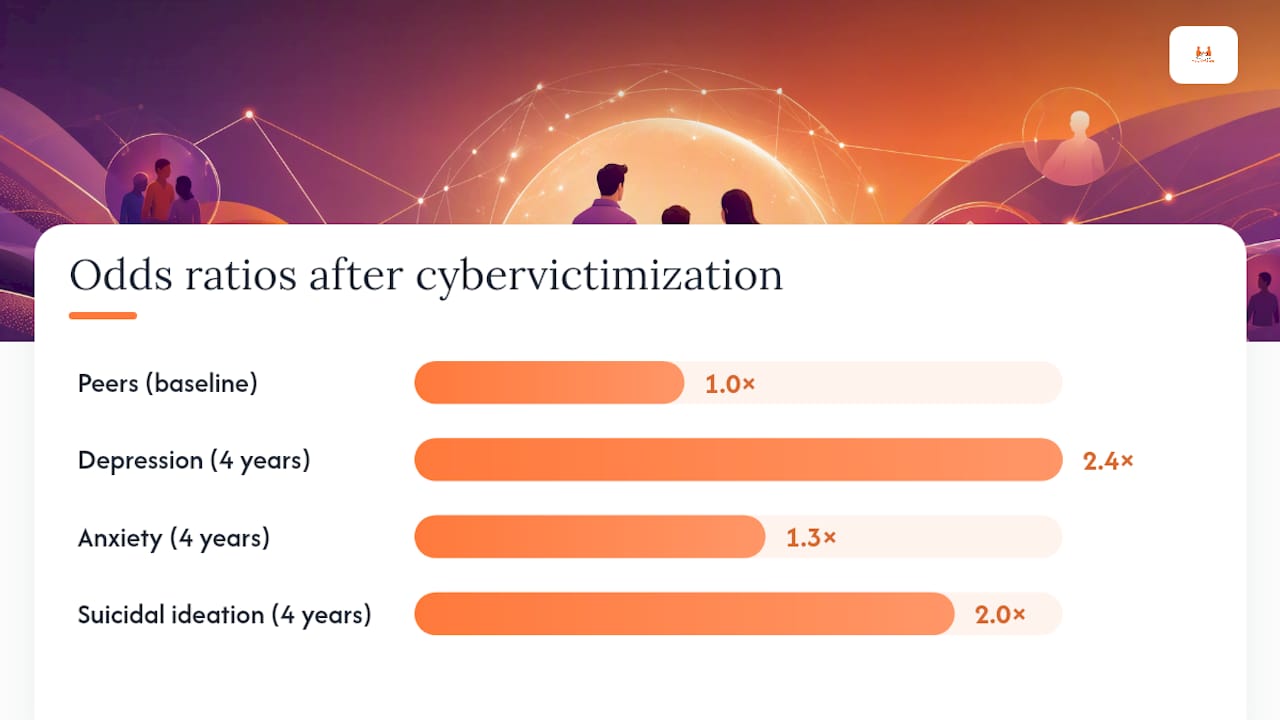
That distinction between association and causation matters here, and it's worth being honest about it. A single snapshot survey can only tell you that cyberbullying and depression show up together. It can't tell you which came first. Longitudinal research is different. When researchers measure victimization at one point and then track mental health outcomes years later in the same kids, ruling out reverse causation gets much harder, and the pattern that showed up in that four year Canadian study is exactly the kind of evidence that should worry a parent more than a single alarming headline.
NIH research summaries reinforce the suicide-related risk specifically, reporting associations between cyberbullying and suicidal thoughts and attempts among young adolescents. Separate work on bullying, cyberbullying and suicide in high school students found consistent links between victimization and suicidal behaviour, adding to a body of evidence that isn't built on one paper.
What the numbers actually say:
- A significant share of Canadian youth aged 12 to 17 reported cybervictimization in the prior 12 months, according to Statistics Canada
- Depression odds roughly 2.4 times higher four years after cybervictimization, per the longitudinal Canadian study
- Suicidal ideation odds nearly double four years later in the same cohort
- Suicidal thoughts and attempts associated with cyberbullying specifically among young adolescents, per NIH
None of this means every kid who gets a cruel comment online develops a mental illness. Most don't. But the aggregate pattern across reviews, national surveys, and longitudinal cohorts points in one direction consistently enough that it stopped being a debate among researchers years ago. The question isn't whether cyberbullying can hurt a kid's mental health. It's whether you'll catch it early enough to matter.
What are the signs your teen might be facing cyberbullying?
You know your kid's normal. That's the whole advantage you have over any checklist. But normal shifts slowly sometimes, and you miss it because you're standing too close. Here's what to actually watch for, organized by category so you're not just guessing.
- Emotional signs. Persistent sadness that doesn't lift after a day or two, increased anxiety around specific times (checking a phone obsessively, or refusing to check it at all), mood swings that seem tied to being online, and a flatness that wasn't there before.
- Behavioural signs. School refusal or sudden reluctance to go, changes in sleep or appetite, any indication of self-harm, and pulling away from friends or activities they used to care about.
- Digital signals. Secrecy about accounts or passwords that used to be shared openly, abruptly quitting a platform they loved, or deleting apps without explanation. Watch for visible evidence of harassment in messages, comments, or shared images if you have access.
- Physical complaints. Headaches, stomach aches, or fatigue with no clear medical cause, especially clustered around school days or specific times online.
If two or three of these show up together, that's worth a direct conversation, not a wait-and-see approach. Our guide to teen mental health warning signs breaks these down further if you want a fuller reference.
Pro Tip: Don't open with "Is someone bullying you online?" Try "You've seemed different this week, and I want to understand what's going on, no matter what it is." The first question invites a denial. The second invites a conversation.
A partner resource on early signs of anxiety in kids covers overlapping symptoms worth knowing, since cyberbullying-related distress often looks identical to generalized anxiety on the surface.
I missed signs once. Not with a stranger's kid. With my own daughter, Maddie. I look back now and see things I explained away at the time. That's not something you get to undo. It's something you carry, and it's why I don't write these checklists lightly.
Why do some teens handle cyberbullying better than others?
Two kids get the same cruel message. One shakes it off in a week. The other spirals for months. The difference usually isn't the message. It's what surrounds the kid when it lands.
Research on parental relationship quality found that strong parent-child connectedness moderates distress from cybervictimization, meaning kids with close relationships to a parent tend to weather the same harassment with less lasting damage. Weak bonds increase risk, and that risk doesn't distribute evenly. Boys with poor parent relationships showed especially high distress after victimization in that research, which runs counter to the assumption that boys are generally more resilient to social harm.
Risk factors that make things worse tend to stack:
- Prior victimization, whether online or in person, before the current incident
- Existing mental health conditions like anxiety or depression that lower the threshold for crisis
- Substance use, which both signals distress and compounds it
- Belonging to a group already facing social stigma, including LGBTQ+ youth and teens managing chronic health conditions
- A school climate where reporting feels pointless or where teachers minimize online harassment as "not real"
Protective factors work in the opposite direction. Parental connectedness sits at the top of that list, and it's one of the few things you can actively build starting today rather than something fixed at birth. A trusted adult outside the family, whether a coach, aunt, or family friend, adds another layer. Schools with a real reporting culture, where kids believe something will actually happen if they speak up, reduce both incidence and harm.
The practical takeaway is almost frustratingly simple: the relationship you have with your kid right now is doing more protective work than any parental control app you could install. That doesn't mean skip the app. It means don't mistake the app for the relationship.
What should parents do in the first 72 hours after discovering cyberbullying?
The first three days set the tone for everything that follows. Move too fast toward punishment or platform bans, and you risk your kid going quiet on you for good. Move too slowly, and evidence disappears along with the window to act on it.
- Start the conversation without blame. Ask open questions and let your kid talk before you react. Something like "Walk me through what happened" works better than "Why didn't you tell me sooner?" The second question makes them defend themselves instead of trusting you.
- Preserve evidence before anything gets deleted. Screenshot messages, posts, and comments, including usernames and timestamps. Save them somewhere your kid controls too, since taking their phone away to "handle it" can feel like a second violation.
- Respect their privacy while you investigate. Don't broadcast the situation to relatives or post about it. Your kid needs to feel like this is being handled with them, not around them.
- Report through the platform first. Every major platform has a harassment or bullying reporting tool. Use it and keep a record of when you filed the report.
- Loop in the school if a classmate is involved. Most schools have a designated point of contact for this now, even if it's not well advertised. Ask directly who handles it.
- Call police if there are threats of violence, sexual content involving a minor, or evidence of stalking. This isn't overreacting. It's the appropriate response to specific categories of harm.
- Build a short-term safety plan together. Decide with your kid, not for them, what changes to online habits feel manageable this week. Total device removal often backfires by cutting off their support network along with the harmful content.
Pro Tip: Ask your kid who they'd trust to talk to about this besides you, and follow up on that name. A cousin, a coach, an older sibling. Kids often open up more fully to a second trusted adult once they've told you the basics, and that's not a failure on your part. It's an extra layer of support.
Our family support strategies for teen mental health resource goes deeper on building that safety net beyond the first few days.
How can families and schools prevent cyberbullying before it starts?
Awareness campaigns feel good to run and don't do much on their own. Stakeholder research from Western Canada makes the case plainly: prevention that works goes beyond telling kids "bullying is bad" and instead builds digital citizenship and emotion-regulation skills directly into how young people are taught to handle conflict online.
At the school level, that same research found something counterintuitive. Zero-tolerance discipline policies can backfire by discouraging kids from reporting in the first place. If a student knows that flagging a problem might mean their friend gets suspended, or that the process will drag them into a punitive machine, they often stay quiet. Schools that prioritize reporting, repair, and support tend to surface more incidents earlier, not because bullying increases but because kids trust the process enough to speak up.
What actually helps, layered by setting:
- At home: set device boundaries that apply to the whole family, not just the kids, and model the online behaviour you want to see rather than just lecturing about it
- At home: run brief, low-pressure check-ins about online life the same way you'd ask about a school day, so it's normal to talk rather than a red flag when you bring it up
- At school: build reporting systems that lead to visible follow-up, since a reporting tool nobody trusts is worse than no tool at all
- At school: train staff to recognize digital harassment as seriously as physical bullying, since many still treat online conflict as less "real"
- In the community: bystander training that teaches peers how to intervene or support a target without escalating the situation
- In the community: mentoring and peer-support programs that give kids a version of connectedness outside their immediate friend group
Our preventative mental wellness guide for parents and teens walks through building these routines into a normal week, not a crisis response.
When does cyberbullying require professional mental health support?
Some situations are past the point where a parent can handle it alone, and knowing the line matters more than knowing every intervention technique.
Get professional help immediately if you see:
- Any statement of suicidal intent, even one that sounds vague or half-joking
- Evidence of self-harm, whether disclosed or discovered
- A sudden, sharp drop in functioning: skipping school entirely, not eating, not sleeping for days
- Withdrawal so complete that your kid stops responding to people they used to trust
Given that the longitudinal data shows suicidal ideation odds nearly doubling years after cybervictimization, waiting to see if things improve on their own carries real risk. Finding care usually starts with your family doctor or pediatrician for a referral, or directly through a youth mental health clinic if your region has one. A first intake appointment typically involves a clinician asking about mood, sleep, safety, and history, not a lengthy evaluation on day one.
If you're in the United States and need immediate crisis support, call or text 988 to reach the Suicide and Crisis Lifeline, available 24 hours a day. If there's an immediate safety risk, call 911. Our guide to finding family mental health resources online can help you locate ongoing care once the immediate crisis has passed.
How The MentorWell helps you catch it early
I built the Teen Signal Check because I wanted the tool I didn't have. It's a short assessment for parents and caregivers of kids aged 8 to 25, designed to surface subtle warning signs before they become a crisis, not after.
- Teen Signal Check gives you a structured first look at whether what you're noticing warrants a closer conversation or professional follow-up
- Workshops and live coaching for parents walk through exactly the kind of conversations covered above, with real-time practice, not just theory
- Employer-facing workshops help HR teams and managers recognize distress signals in young employees, since the same warning signs show up at work
- A parent peer community connects families going through this in real time, so you're not carrying it alone
None of this replaces clinical care when clinical care is what's needed. It's built to sit alongside it, as an earlier checkpoint than most families get. You can learn more and explore the full range of programs at The MentorWell.
Does cyberbullying affect younger and older teens differently?
Age changes the shape of the harm, even when the mechanism is similar. Younger adolescents, roughly 11 to 14, tend to have less developed coping skills and a stronger dependence on peer approval, which means a single humiliating post can feel catastrophic in a way an older teen might shrug off. Their brains are also earlier in developing the emotional regulation that helps absorb a social blow without spiralling.
Older teens, 15 to 18, often have more digital fluency and a wider social circle to fall back on, but they also face higher-stakes contexts: college applications, part-time jobs, relationships that carry more weight. A cyberbullying incident at 17 can intersect with existing academic or identity pressures in ways that compound the harm rather than isolate it.
The NIH research on suicidal thoughts and attempts specifically flags young adolescents as a group of particular concern, which lines up with what clinicians often see: younger kids sometimes lack the language to explain what's happening to them, so distress shows up as physical complaints or behaviour changes instead of a direct disclosure.
Practically, this means a 12 year old and a 17 year old need different conversations. The younger one may need you to name the behaviour for them, since they might not have the words yet. The older one usually needs you to ask and then actually listen, since they're more likely to already have a clear read on what's happening and just need somewhere to put it.
What role do social media platforms play in stopping cyberbullying?
Platforms have built reporting tools, content moderation systems, and age verification features over the past several years, and some of it genuinely helps. Reporting a harassing post or account is faster and more visible than it was a decade ago on most major platforms.
But moderation at scale is inconsistent. Automated systems miss context constantly, flagging harmless jokes while letting coded harassment slip through. Appeals processes are often slow, and a report filed today might not result in action for days, which matters enormously when a piece of content is actively circulating among a kid's classmates.
Platforms also have a financial incentive that sits in tension with aggressive moderation: engagement, even negative engagement, drives the metrics that make the business model work. That's not a conspiracy theory. It's a structural fact worth knowing before you assume a report will get handled quickly.
What this means practically for you: don't treat a platform report as the end of the process. File it, keep your own screenshots regardless of what the platform does, and escalate to the school or police in parallel if the situation warrants it rather than waiting on a company's internal review to resolve things.
What legal protections exist for cyberbullying victims?
Legal protections for young people facing online harassment vary by jurisdiction, and the specifics depend heavily on what actually happened. Threats of violence, sexual exploitation material involving a minor, stalking, and non-consensual sharing of images all cross into criminal territory in most jurisdictions in the United States, regardless of the age of the person doing it.
Many school districts also have policies requiring intervention when off-campus online conduct disrupts a student's ability to access their education, even though the behaviour happened outside school hours or off school property. That's a meaningful protection many parents don't know exists until they ask directly.
Civil options exist too in some cases, particularly around defamation or intentional infliction of emotional distress, though these routes tend to be slower and more expensive than most families expect.
The practical guidance here isn't a substitute for legal advice specific to your situation. If the harassment involves threats, explicit content, or sustained targeted abuse, consult a lawyer or contact local police to understand what applies where you live. Don't assume "it's just online" means there's nothing legally actionable. Often there is.
How should you talk to your child about cyberbullying?
The way you open this conversation shapes whether your kid tells you the full story or just enough to make you stop asking.
Lead with curiosity, not alarm. "What's it like online for you these days?" opens more doors than "Has anyone been mean to you on your phone?" The first treats their digital life as a normal part of their world worth discussing. The second frames the phone as a threat, which can make a kid defensive before they've said anything.

Listen for longer than feels comfortable before you respond. Parents often jump to solutions, take the phone, call the school, block the account, within the first minute of hearing something upsetting. That instinct comes from love, but it can teach a kid that disclosure leads straight to losing control over their own situation. Ask what they want to happen before you decide what you're going to do.
Normalize the conversation as ongoing, not a one-time event triggered by a crisis. A regular, low-key check-in about their online world, woven into normal conversation the way you'd ask about a friend group or a class, makes the next hard disclosure easier because it's not the first time you've asked.
And be honest when you don't know what to do next. Kids can tell when a parent is performing confidence versus genuinely working through something with them. The second builds more trust than the first ever will.
An editorial take on what the evidence actually demands
Most cyberbullying advice tells parents to install monitoring software and call it prevention. The research doesn't support that as the priority. What moderates harm most reliably is the quality of the relationship between a kid and at least one adult who stays curious instead of reactive. That's harder to package into an app, so it gets less airtime than it deserves.
The conventional advice also leans too hard on awareness campaigns and too soft on what schools do after a report is filed. The Frontiers research is blunt about it: punitive-only systems suppress disclosure. If your kid's school still treats every incident as a discipline problem first, that's worth raising directly with administration, because it's actively working against the outcome everyone claims to want.
If you take one thing from this, take the first 72 hours seriously, but take the next four years more seriously still. The longitudinal data says the damage doesn't resolve on its own timeline. Watch for it. Ask about it. Don't wait for the version of the conversation where you're finding out too late what you missed.
— Chris Coulter
This article is general information, not a substitute for advice from a qualified doctor. Consult a qualified healthcare professional about your own circumstances before acting on anything here.
Sources
- Current perspectives: the impact of cyberbullying on adolescent health — Charisse L Nixon
- Associations Between Cybervictimization in Adolescence and Mental Health Four Years Later: A Nationally Representative Study of Canadian Youth
- Recommendations for cyberbullying prevention and intervention: A Western Canadian perspective from key stakeholders
- One in four Canadian youth report experiencing at least one form of cybervictimization — Statistics Canada
- Cyberbullying linked to suicidal thoughts, attempts in young adolescents — NIH
FAQ
What does cyberbullying do to mental health?
Cyberbullying is linked to higher rates of depression, anxiety, loneliness, and suicidal ideation, with longitudinal research showing these effects can persist for years after the victimization occurred.
What do experts say about helping victims of cyberbullying?
Stakeholder research recommends listening without blame, preserving evidence, reporting through both the platform and the school, and prioritizing connectedness and support over punitive discipline, since zero-tolerance approaches can discourage reporting.
What are some tips for avoiding cyberbullying?
Strong parent-child relationships, digital citizenship skills, and clear device boundaries at home all reduce risk, and schools with trusted reporting systems catch problems earlier than schools relying on awareness campaigns alone.
Who do you contact for cyberbullying?
Report harassing content directly through the platform first, notify the school if a classmate is involved, and call police if there are threats of violence, sexual content involving a minor, or stalking; if there's a safety crisis, call or text 988 for the Suicide and Crisis Lifeline.