
Corporate social responsibility is a company's ongoing practice of taking responsibility for its social and environmental impacts while lining those actions up with its actual business purpose. That is the whole idea. Not a slogan on a wall. Not a press release timed for a bad quarter.
Companies that do this well tend to hold onto customers, employees, and investors longer than companies that treat it as an afterthought. The frameworks are not new. Carroll's four-part model has guided this thinking for decades, the UN Sustainable Development Goals give it a global shape, and organizations like The MentorWell show what it looks like when a company puts real structure behind mental health, not just good intentions.
- CSR covers environmental, ethical, philanthropic, and economic responsibility
- It is measured, not assumed
- The business case is documented, not theoretical
Key Takeaways
Corporate social responsibility works when a company ties its social and environmental commitments directly to measurable business strategy rather than treating them as separate marketing efforts.
| Point | Details |
|---|---|
| Definition anchors everything | CSR means taking ongoing responsibility for social and environmental impact while aligning it with business purpose. |
| Carroll's pyramid structures the work | Economic, legal, ethical, and philanthropic responsibilities operate simultaneously, not in sequence. |
| Purpose-driven growth is documented | Purpose-led brands grew over 175% on average over 12 years, according to Marketing Dive's reporting. |
| Governance decides survival | Programs with a named owner and board oversight outlast programs that exist only as marketing statements. |
| Measurement separates real CSR from greenwashing | Track outcome metrics, use standards like SASB or SA8000, and report shortfalls honestly. |
Table of Contents
- What is corporate social responsibility, really?
- Why does corporate social responsibility matter for business?
- What are the main types of corporate social responsibility?
- How is CSR different from ESG and sustainability?
- How do you actually implement a CSR strategy?
- How do companies measure and report CSR results?
- What are the biggest risks and criticisms of CSR?
- What does effective CSR look like in practice?
- How The MentorWell puts CSR into practice at work
- Where did corporate social responsibility come from?
- Who are the stakeholders in CSR, and what do they actually want?
- What laws and regulations shape corporate social responsibility?
- What role does governance and leadership play in CSR?
- What are the honest criticisms of CSR?
- An honest take on where CSR actually goes wrong
- Sources
- FAQ
What is corporate social responsibility, really?
Definitions vary because companies apply CSR at different scales, in different industries, with different stakes. A small business and a multinational are not doing the same work when they say "CSR," even if they use the same words. UNIDO frames it as a management concept: companies integrating social and environmental concerns directly into their operations and how they deal with stakeholders. That is the working definition worth remembering.
The clearest model for understanding CSR's layers comes from Archie Carroll, who built it as a pyramid.
- Economic responsibility — the base of the pyramid. Be profitable. Without this, nothing else is possible.
- Legal responsibility — obey the law. Not optional, not a competitive advantage, just the floor.
- Ethical responsibility — do what is right even where the law is silent.
- Philanthropic responsibility — give back, contribute, be a good corporate citizen.
Carroll's insight was that these four responsibilities are not sequential steps a company checks off once and moves past. A company practices all four simultaneously, and the pyramid shape exists to show that economic performance is the foundation everything else stands on, not a competing priority.
The triple bottom line (people, planet, profit) sits alongside Carroll's model and maps naturally onto the SDGs. A company measuring its "people" impact might track health and education goals. Its "planet" impact might track climate and water goals. The frameworks talk to each other.
Why does corporate social responsibility matter for business?
The business case is not soft anymore. It shows up in stock performance, hiring, and how customers spend.
Research reported by Marketing Dive found that brands with a strong sense of purpose significantly outperformed others in stock market growth and long-term sales growth. That is not a marketing talking point. That is a pattern serious enough to change how boards think about strategy.
The statistic that should change how you think about CSR: purpose-driven brands did not just perform slightly better. They roughly doubled the growth rate of their peers over more than a decade.
Beyond the headline number, the pattern holds across several fronts:
- Customers increasingly choose companies whose values match their own
- Employees stay longer at organizations where the mission feels real, which lowers turnover costs
- Institutional investors are watching this closely, and Wharton's ESG research documents how institutional expectations are reshaping corporate reporting
- Companies with mature CSR programs tend to weather reputational crises with more goodwill in reserve
None of this works if the commitment is hollow. The data rewards companies that mean it.
What are the main types of corporate social responsibility?
CSR breaks into four recognizable categories, and HBS Online's framework is a useful map for sorting them.
- Environmental responsibility. Cutting emissions, reducing energy use, sourcing materials sustainably. A furniture company switching to certified sustainable wood is doing this. So is a logistics company converting its fleet to electric vehicles.
- Ethical and labour responsibility. Fair wages, safe working conditions, supplier codes of conduct. A clothing brand auditing its overseas factories for safety compliance fits here, much like Friendly Home Care's compassionate approach emphasizes ethical responsibility in healthcare services.
- Philanthropic and community responsibility. Grants, employee volunteering, long-term local partnerships. Corporate giving strategies tend to work best when the cause connects to something the company actually understands, not a cause picked for optics.
- Operational and economic responsibility. Inclusive hiring, accessibility standards, product safety, honest marketing. A software company building accessibility into its product from the design stage, not bolting it on after launch, belongs here.
Community investment in the United States alone reached $592.50 billion in 2024, a figure that includes substantial corporate contributions. The scale of that number says something about how mainstream this practice has become. Companies exploring community outreach programs will find the strongest ones share one trait: they are built around something the company can sustain, not a one-time cheque.
How is CSR different from ESG and sustainability?
These three terms get used interchangeably, and that causes real confusion.
- CSR is broad and stakeholder-focused. It covers how a company behaves toward employees, customers, communities, and the environment.
- ESG is investor-facing. It scores environmental, social, and governance performance using specific metrics, largely for people deciding where to put capital.
- Sustainability is the long game. It is about embedding responsible practices into strategy so the business can operate for decades without depleting the resources or trust it depends on.
A company writing its annual CSR report speaks to employees and the public. The same company filing ESG disclosures speaks to shareholders. Both should tell the same story, just to different rooms.
How do you actually implement a CSR strategy?
Most CSR failures come from skipping steps, not from bad intentions. A working sequence looks like this.
- Define purpose and tie it to strategy. Pick issues connected to what the company actually does. A logistics company focusing on emissions makes sense. A logistics company launching a literacy program, less so, unless there is a genuine connection.
- Engage stakeholders and find what matters most. Talk to employees, customers, and community partners before deciding what to prioritize. This step gets skipped constantly, and it is why so many programs miss the mark.
- Build the program and assign real governance. Someone owns the budget. Someone owns the timeline. Without a named owner, CSR programs quietly die.
- Pilot small, then embed across the company. Test with one team or one region before rolling out company-wide.
- Scale and measure. Use a Plan, Do, Check, Improve cycle. Plan the goal, do the work, check the results against simple KPIs, then improve the next cycle based on what you learned.
Pro Tip: Start with one measurable KPI per program, not ten. A single number you track consistently for a year tells you more than a dashboard of metrics nobody reviews after month two.
Businesses building this from scratch can find a structured starting point in The MentorWell's guide to social responsibility programs, which walks through program design for organizations that have never formalized this work before.
How do companies measure and report CSR results?
Output metrics count activity. Outcome metrics count impact. A company that ran ten volunteer days measured an output. A company that tracked whether local literacy rates improved because of those volunteer hours measured an outcome. Both have value, but outcome metrics are what convince a skeptical stakeholder that the program did something real.
Several established frameworks give structure to this work:
- The UN SDGs for aligning company goals to global priorities
- SASB for industry-specific sustainability accounting standards
- SA8000 for labour and workplace condition standards
- ISEAL for credibility standards around social and environmental claims
- EcoVadis for third-party supply-chain sustainability ratings
Third-party validation matters most when a company's claims are the kind a skeptical reader would otherwise dismiss. An internal report saying "we reduced our footprint" carries less weight than the same claim verified by an outside standard.
Present results plainly. A company that shares both wins and shortfalls tends to earn more trust than one that only publishes good news.
What are the biggest risks and criticisms of CSR?
Greenwashing is the most common failure, and it is usually easy to spot once you know what to look for.
- Vague language with no specific numbers ("committed to sustainability" with no target attached)
- A cause with no connection to what the company actually does or sells
- Announcements timed suspiciously close to bad press
- No named person responsible for the program's outcomes
- Goals that are never measured again after the launch announcement
The fix is not complicated. Tie the cause to the business, name an owner, set a measurable goal, and report honestly on whether it was met.
What does effective CSR look like in practice?
A few short examples make the abstract version concrete.
- A mid-sized employer builds a workplace mental health program with structured coaching, early warning tools for managers, and a clear budget line. That is CSR functioning as employee wellbeing strategy, not a wellness poster in the break room.
- A manufacturer switches its packaging line to reduce plastic use and tracks the tonnage saved every quarter, publishing the number even in years it misses the target.
- A regional bank partners with a local housing nonprofit for five years, measuring outcomes like units built rather than dollars donated. Imagine Canada's research on corporate giving found that giving aligned to long-term strategy produces stronger returns than one-off donations.
How The MentorWell puts CSR into practice at work
I built The MentorWell after losing my daughter Maddie. That is not a detail I add for effect. It is the reason the work exists at all.
Workplace mental health support is not a benefit you bolt on. It is a responsibility, the same as safety training or fair pay.
- Workshops and live coaching give managers the language to notice when something is wrong, not just the policy to point to when something already went wrong
- The Teen Signal Check gives parents and caregivers a way to catch warning signs early, built for ages 8 to 25
- Workplace wellness resources turn CSR commitments into something a manager can actually use on a Tuesday afternoon
Where did corporate social responsibility come from?
CSR is not a recent invention dressed up in new language. Its roots go back to early 20th century debates about whether companies owed anything to the public beyond profit. Andrew Carnegie's 1889 essay on wealth argued that the wealthy had an obligation to redistribute surplus for the public good, an idea that predates the modern term by nearly a century.
The formal academic study of CSR took shape in the 1950s, when economist Howard Bowen wrote about the "social responsibilities of the businessman," widely credited as one of the first serious attempts to define what companies owed society. The 1970s brought sharp disagreement. Milton Friedman famously argued that a company's only responsibility was to increase profits for shareholders, a position that still echoes in boardroom debates today.
Archie Carroll's pyramid arrived in 1979 and gave the field its most durable structure, insisting that economic performance and social responsibility were not opposites but layers of the same obligation. The 1990s and 2000s saw CSR move from academic debate into corporate departments, driven partly by globalization exposing labour conditions in supply chains, and partly by consumer pressure following high-profile scandals.
By the 2010s, CSR had merged with sustainability reporting and, more recently, ESG investing frameworks. The core question Bowen asked in the 1950s, what does a business owe the society it operates in, has not changed. Only the vocabulary and the measurement tools have.
Who are the stakeholders in CSR, and what do they actually want?
CSR fails when it is designed for one audience and ignores the rest. Four groups matter most, and each wants something different.
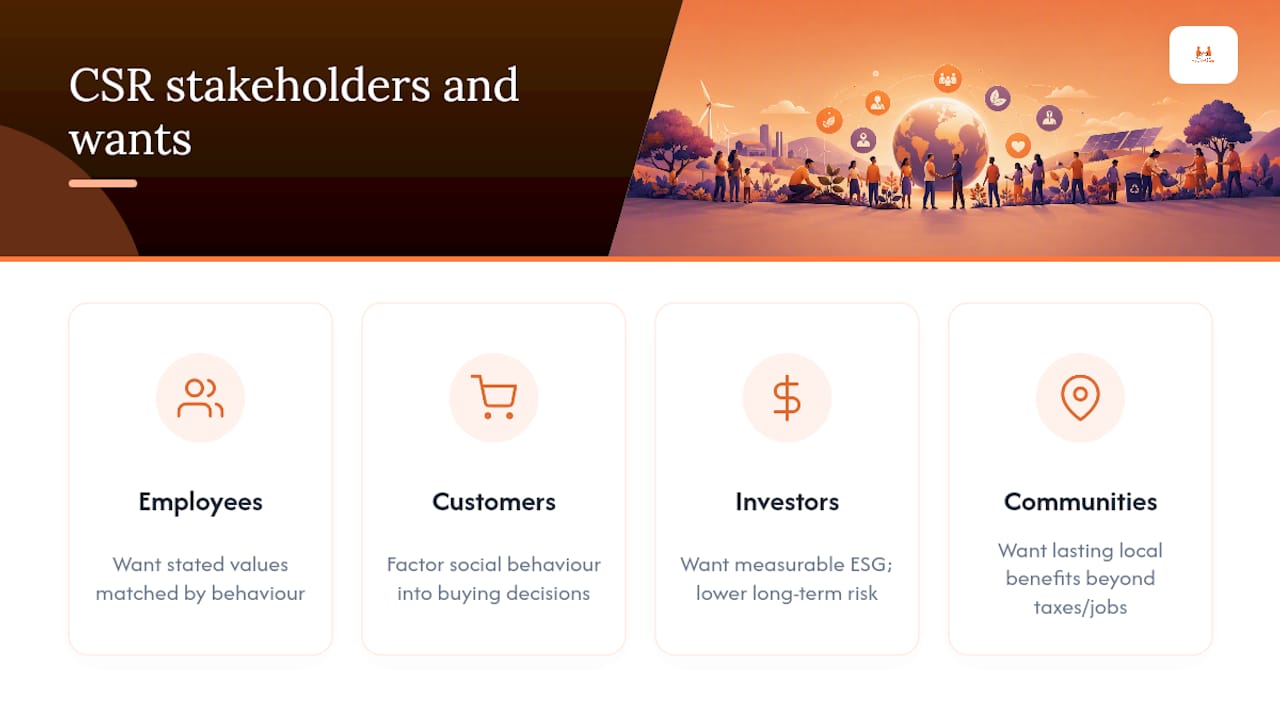
Employees want to work somewhere that matches its stated values with its actual behaviour. A company that talks about wellbeing while running people into burnout loses credibility fast, and employees notice the gap before customers do.

Customers increasingly factor a company's social behaviour into purchasing decisions, particularly for brands competing on more than just price. This is not universal across every product category, but it shows up consistently in consumer research and in the purpose-driven growth data already discussed.
Investors want measurable ESG performance because it correlates with lower long-term risk. A company with weak labour practices or environmental exposure is a company with legal and reputational risk sitting on the balance sheet, whether or not it shows up in this quarter's earnings.
Communities want proof that a company's presence leaves something behind beyond tax revenue and jobs, particularly in regions where a company's operations carry environmental or social cost.
These groups do not always want the same thing. A cost-cutting decision that pleases investors might frustrate employees. Good CSR strategy does not pretend these tensions do not exist. It names them and makes a defensible choice.
What laws and regulations shape corporate social responsibility?
CSR sits in a strange legal position: mostly voluntary, but increasingly bordered by hard requirements. The European Union's Corporate Sustainability Reporting Directive now requires large companies operating in the EU to disclose detailed environmental and social data, a shift from voluntary reporting to mandatory disclosure. France's duty of vigilance law requires large French companies to identify and prevent human rights and environmental risks across their supply chains.
In the United States, CSR remains largely voluntary at the federal level, though sector-specific rules apply. Publicly traded companies face SEC disclosure requirements that increasingly touch on climate risk, and labour law sets the floor for the "legal responsibility" layer of Carroll's pyramid regardless of whether a company calls its compliance work "CSR."
Supply chain laws are tightening globally. Modern slavery and forced labour disclosure requirements now exist in multiple jurisdictions, pushing companies to audit suppliers they once ignored. The direction is consistent everywhere: regulators are converting what used to be reputational risk into legal risk, one disclosure requirement at a time.
What role does governance and leadership play in CSR?
A CSR program without an executive sponsor is a slogan. A CSR program with a named board committee, a budget line, and a reporting structure is a strategy.
Governance structure decides whether CSR survives a bad quarter. When a company hits a rough year and looks for costs to cut, the programs with no executive owner and no measured outcomes are the first ones cut. The programs tied to a board committee, with KPIs the CEO reports on publicly, survive because cutting them carries a visible cost.
Leadership sets tone in ways that are hard to fake. A CEO who talks about purpose in the annual letter but never mentions it in an internal town hall is sending a signal, and employees read that signal accurately. The companies that get CSR right tend to have leadership that treats it as core strategy discussed in the same meetings as revenue targets, not a separate initiative reviewed once a year by a smaller committee.
What are the honest criticisms of CSR?
The biggest criticism is greenwashing, already covered above, but it is worth naming the deeper problem underneath it: CSR can become a substitute for real change rather than a driver of it. A company can fund a tree-planting campaign while its core operations remain carbon-intensive, and the campaign gets more attention than the operations do.
A second criticism, raised consistently in academic and business writing, is that CSR programs sized for a large multinational often get copied by smaller organizations without adjustment, producing programs too complex and expensive for the scale of the company running them. What drives impact in a fifteen-person company looks nothing like what drives impact in a company with fifteen thousand employees, and treating them the same wastes resources on both ends.
A third, more structural criticism: CSR can function as a shield against regulation. Companies sometimes invest in voluntary social programs specifically to argue against mandatory rules covering the same territory, framing self-regulation as sufficient. Critics argue this lets companies choose the easy commitments while avoiding the harder, legally binding ones.
None of this means CSR is worthless. It means CSR done without governance, without proportional scale, and without genuine strategic integration is vulnerable to becoming exactly what its critics accuse it of being.
An honest take on where CSR actually goes wrong
Most CSR advice tells you to start with a mission statement. I think that is backwards. Start with the budget line and the name of the person accountable for it. Everything else follows from that, or it does not follow at all.
The conventional wisdom treats CSR as a communications problem: say the right things, publish the right report, and the reputation follows. What the research on purpose-driven growth actually shows is different. The companies that outperformed did not win because they talked about purpose well. They won because the purpose was structural, built into how the business made decisions long before anyone wrote a report about it.
Here is what I would prioritize first, and it is not glamorous: pick one issue connected to what your company actually does, assign one person to own it, and measure one outcome for a full year before adding anything else. Companies that try to do CSR broadly from day one usually end up doing it shallowly everywhere. The workplace mental health example matters to me for obvious reasons. But the principle holds for any cause. Depth beats breadth, every time I've seen it tested against results instead of good intentions.
— Chris Coulter
Sources
- Carroll's pyramid of CSR (Maricopa Open Digital Textbook)
- What Is Corporate Social Responsibility? 4 Types - HBS Online
- Sustainable Development Goals (UN)
- Emerging trends in institutional social responsibility (Wharton ESG)
FAQ
What is the meaning of corporate social responsibility?
Corporate social responsibility is a company's ongoing commitment to managing its social and environmental impact in a way that aligns with its business strategy, covering economic, legal, ethical, and philanthropic obligations under Carroll's framework.
What are four examples of corporate social responsibility?
Common examples include reducing carbon emissions through sustainable sourcing, ensuring fair wages and safe conditions across a supply chain, funding long-term community partnerships, and building inclusive hiring and accessibility practices into core operations.
What are the 7 pillars of CSR?
Definitions of pillar-based CSR models vary by source and are less standardized than Carroll's four-part framework; the most widely cited academic structure remains Carroll's economic, legal, ethical, and philanthropic responsibilities.
How is CSR different from ESG?
CSR is a broad, stakeholder-facing set of practices covering employees, customers, and communities, while ESG is a narrower, investor-facing scoring system measuring environmental, social, and governance performance for capital allocation decisions.
What is the biggest risk in a CSR program?
Greenwashing, where vague claims or unrelated causes get promoted without measurable goals or a named owner, is the most common failure and the fastest way to lose stakeholder trust.