
Corporate social impact is how a business uses its resources, operations, and influence to produce measurable social and environmental outcomes, not just goodwill. The first move for any leader reading this is small: put a social-impact metric, one that tracks a real outcome, on the agenda for the next board or leadership meeting.
That's the whole point. Not a mission statement. Not a values slide. A number someone is accountable for.
Here's the business case in one sentence: companies that treat social impact seriously see it show up in retention, in productivity, and in the trust that keeps customers, employees, and investors from walking away when things get hard. Skip it, and you don't avoid the cost. You just pay it later, usually in a form that's harder to see coming.
I've spent years watching what happens when organizations wait too long to name a problem. It rarely ends with a dramatic collapse. It ends quietly, someone disengages, someone leaves, someone's kid at home is struggling and nobody at work ever asks. The pattern is the same whether we're talking about a teenager or a workforce.
A few things to act on immediately:
- Add one measurable social-impact indicator to your next leadership meeting agenda, not a plan to add one later.
- Run a short psychosocial risk check across a team or department this quarter.
- Name a single owner for social impact reporting, even if it's a part-time responsibility for now.
- Decide now whether mental health belongs inside your ESG social pillar or sits disconnected in HR. It shouldn't sit disconnected.
Key Takeaways
Corporate social impact succeeds when leaders treat employee mental health as a material, board-level metric rather than an HR side program measured by outputs alone.
| Point | Details |
|---|---|
| Define outcomes, not outputs | Track measurable change (turnover, psychological safety scores) instead of activity counts like workshops delivered. |
| Mental health sits inside ESG | Psychosocial risk belongs in the social pillar with board oversight, not siloed in HR. |
| Pick one archetype to start | Choose philanthropy, wellbeing prevention, business-model integration, or community investment, not all four at once. |
| Assign a named owner | Governance without a specific accountable person rarely survives past the pilot stage. |
| The MentorWell as a starting partner | Employers can pilot manager workshops and the Teen Signal Check before scaling a full program. |
This article is general information, not a substitute for advice from a qualified doctor. Consult a qualified healthcare professional about your own circumstances before acting on anything here.
Table of Contents
- What corporate social impact actually means (and where mental health fits)
- What neglecting mental health actually costs a business
- Four ways companies approach corporate social impact
- How to measure impact without drowning in vanity metrics
- Making social impact a governance responsibility, not a side project
- Six steps to build a real social impact program in 12 months
- Four frameworks worth using instead of building your own
- What The MentorWell has learned from building this work
- What the law expects from corporate social impact claims
- What actually matters here, and what doesn't
- How The MentorWell partners with employers on this work
- Sources
- FAQ
What corporate social impact actually means (and where mental health fits)
Corporate social impact covers the measurable social and environmental outcomes a business produces through its operations, its workforce practices, its supply chain, and its community relationships. It's the umbrella term. Corporate social responsibility, or CSR, is the older, narrower cousin, usually describing the policies and commitments a company makes. Social purpose is narrower still, referring to how deeply a company's actual business model, not just its side programs, is aligned with a social outcome.
None of that matters much if the words become a wall between good intentions and real change. What matters is scope: what counts, and what doesn't.
Employee mental health belongs inside the social pillar of environmental, social, and governance (ESG) frameworks, not off in some separate wellness silo. The Stress-ESG Business Impact Framework makes this explicit: psychosocial risk (things like chronic overwork, poor job design, and unclear roles) is a material issue that connects directly to prevention actions, business performance, and governance oversight. It isn't a "nice to have" bolted onto the social pillar. It's structurally part of it.
This is where most companies get tripped up: confusing outputs with outcomes.
Statistic to sit with: The World Health Organization identifies workplaces as critical settings for preventing mental health crises, recommending primary prevention through job design, manager training, and stigma reduction, not reactive support after someone is already in crisis.
An output is "we ran four wellness workshops this year." An outcome is "absenteeism dropped" or "employees reported feeling safer disclosing a mental health concern to their manager." Boards, investors, and increasingly regulators want outcomes. Outputs are activity. Outcomes are proof.
- Output: number of volunteer hours logged.
- Outcome: measurable change in a community condition or employee wellbeing indicator.
- Output: a mental health policy exists.
- Outcome: fewer psychosocial-risk incidents reported, verified through employee survey data.
Get this distinction wrong early, and your entire reporting structure inherits the problem.
What neglecting mental health actually costs a business
The dollars are real, even if they rarely show up on a single line item. The World Health Organization documents that poor workplace mental health drives measurable productivity losses through absenteeism, the days people simply don't show up, and presenteeism, the days they show up and can't function. Improving workplace conditions reduces both.
I think about this in terms of what I've watched happen to families, because the pattern transfers directly. A parent misses the signs in a teenager, not because they don't care, but because nobody told them what to look for. A manager misses the same signs in an employee for the exact same reason. Silence isn't safety. It just delays the moment the cost becomes visible.

Statistic to sit with: WHO's guidance frames workplaces as one of the most effective intervention points for preventing mental health crises before they escalate, precisely because organizations have direct influence over job design, workload, and manager training. That's not abstract policy language. That's a lever leaders already hold and mostly aren't pulling.
Here's what improves when a company takes this seriously:
- Retention. Employees who feel their organization takes their wellbeing seriously are less likely to quietly disengage and eventually leave.
- Recruitment. Candidates, especially younger ones, screen employers on this before they screen for salary.
- Customer trust. Consumers increasingly research how companies treat their own people before deciding whether to buy from them.
- Investor relations. ESG-literate investors treat psychosocial risk as a governance and materiality question, not a soft metric to skip.
None of this requires a massive program to start moving. A single manager-training initiative, focused on recognizing early warning signs and knowing what to do next, tends to be one of the highest-leverage investments a company can make relative to its cost. It's also one of the interventions the Frontiers in Public Health research points to when cross-functional coordination between HR, occupational health, and sustainability teams actually works, versus when it doesn't.
The cost of doing nothing rarely announces itself. It shows up as a resignation letter that surprises everyone but the person who wrote it, or as an employee survey score that quietly slides for two years before someone finally asks why.
Four ways companies approach corporate social impact
Not every company needs the same model. Size, maturity, and resources all shape which archetype fits, and trying to run a large enterprise's playbook inside a fifty-person company usually produces nothing but frustration and a line item nobody can defend at budget season.
- Philanthropy and volunteering. The traditional model: cash donations, matched giving, employee volunteer days. It's the easiest entry point for smaller or newer organizations, and it still has value when done with intention rather than as a once-a-year press release.
- Employee wellbeing and psychosocial-risk prevention. This is the archetype most companies underinvest in relative to its return. It includes manager training, workload redesign, mental health benefits, and early-detection tools built into HR practice. It fits any company with employees, which is to say, all of them.
- Business-model integration. Here, the social outcome isn't a side project, it's built into what the company sells or how it operates. Fewer companies can genuinely claim this archetype, and claiming it without substance is the fastest way to attract scrutiny.
- Community investment and partnerships. Long-term, trust-based relationships with nonprofits and local organizations, ideally co-designed rather than dictated from the corporate side. Imagine Canada's research on nonprofit partnerships found that community partners consistently value sustained commitment over sporadic, large one-off gifts.
Most mature organizations run a blend of two or three of these, not all four. Trying to do everything at once is how you end up with four disconnected initiatives that never add up to a coherent story.
The two failure modes worth naming directly: tokenism, where the program exists to be photographed rather than to change an outcome, and disconnected silos, where HR runs a wellness initiative that nobody in the ESG or sustainability function even knows exists. Both are avoidable with one simple habit: before launching anything, ask who else in the organization needs to know this exists, and who will actually see the data six months from now.

Pro Tip: Before choosing an archetype, ask your team which one you could actually sustain for three years without a champion leaving and killing it. Sustainability of effort beats ambition of scope almost every time.
How to measure impact without drowning in vanity metrics
Every credible social-impact program can be sketched as a simple logic model: inputs lead to activities, activities produce outputs, outputs (if designed well) produce outcomes, and outcomes, sustained over time, produce impact.
Here's what that looks like applied to workplace mental health:
- Inputs: budget, staff time, a manager-training program, a digital screening tool.
- Activities: running the training, deploying the tool, holding regular check-ins.
- Outputs: number of managers trained, number of assessments completed.
- Outcomes: reduction in reported psychosocial risk, increase in employees who say they'd disclose a struggle to their manager.
- Impact: measurable, sustained improvement in workforce wellbeing and, downstream, productivity and retention.
Most companies stop measuring at outputs because outputs are easy. Outcomes require patience and a willingness to ask harder survey questions. Impact requires years of consistent tracking. That's not a reason to skip straight to claiming impact language you haven't earned.
Recommended indicators worth tracking, split by type:
- Quantitative: absenteeism rate, voluntary turnover rate, employee assistance program utilization, survey-based psychological safety scores, manager training completion rate.
- Qualitative: exit interview themes, focus group feedback on manager responsiveness, open-ended survey comments coded for recurring concerns.
The Sopact impact-measurement guide makes a point worth repeating here: the right mix of quantitative and qualitative measures depends on what stakeholders actually need to see, not on what's easiest to collect. A single satisfaction score tells you less than a small number of well-designed qualitative questions asked consistently over time.
Set targets that are honest about your starting point. A realistic target, say a five to ten point improvement, tracked consistently, builds more trust with a board than an inflated one that quietly gets abandoned.
Avoid vanity metrics: total dollars donated, total volunteer hours, total workshops delivered. These describe effort, not change. They belong in an appendix, not on the summary slide.
Making social impact a governance responsibility, not a side project
Social impact stays fragile as long as it lives in one department's budget with no one above it paying attention. It becomes durable the moment it has governance behind it.
Start with a materiality check: does psychosocial risk, or whatever social-impact issue you're evaluating, rise to a level that could affect financial performance, regulatory standing, or reputational risk? If the answer is yes, and for most organizations with more than a handful of employees, it is, it belongs on the board's radar, not buried three layers down in an HR quarterly update.
A workable governance structure usually includes:
- A named owner accountable for the program, even part-time, so responsibility doesn't diffuse into nobody.
- A cross-functional team spanning HR, ESG or sustainability, and occupational health, so the same data doesn't get collected twice by two teams who never talk.
- A committee or board subcommittee that reviews aggregate results at a set cadence, quarterly is reasonable for most organizations.
Dashboards should report aggregate, privacy-safe data, never individual employee-level detail. Nobody should be able to reverse-engineer who reported what in a survey of twelve people. Report trends, cohort-level patterns, and year-over-year change instead.
Pro Tip: If your psychosocial risk dashboard could identify a specific individual by process of elimination, your sample size or aggregation level is wrong. Fix that before you publish anything.
This is the piece a lot of companies skip: reviewing the data doesn't mean anything if nobody has the authority to act on what it shows. Governance without an owner is just a meeting.
Six steps to build a real social impact program in 12 months
You don't need a five-year strategy document to start. You need a sequence.
- Convene stakeholders and set one measurable goal. Pull HR, ESG, and a senior leader into a room. Agree on a single outcome you're targeting this year, not five. A specific, measurable psychological safety score improvement beats a vague commitment to "employee wellbeing" every time.
- Assess psychosocial risks and community priorities. Run a short, anonymous survey internally. If community investment is part of your scope, talk to the nonprofit partners you're already working with about what they actually need, not what's convenient for you to give.
- Pick an archetype and design interventions. Choose from the four described earlier. Design two or three specific interventions, not ten. A manager-training program and one community partnership beat eight scattered initiatives every time.
- Set KPIs and simple data collection methods. Decide what you'll track before you launch, not after. A quarterly pulse survey and a turnover dashboard are enough to start.
- Pilot and iterate. Run it with one team or department first. Something will break or underdeliver. That's expected, not a failure.
- Disclose results and seek partner feedback. Publish an honest summary, including what didn't work. Ask nonprofit or community partners how the relationship felt from their side.
Pro Tip: Set a calendar reminder for month six, not month twelve, to check whether your pilot is actually producing the data you need. Waiting a full year to find out if your survey questions were wrong wastes an entire cycle.
Somewhere around step four is where most programs quietly die, not because leaders lose interest, but because nobody assigned a specific person to own the data collection. Assign that person by name in step one, not step four.
Four frameworks worth using instead of building your own
You don't need to invent a measurement framework from scratch. A handful of existing tools cover most of what a mid-sized or large organization needs.
| Framework | Best used for |
|---|---|
| WHO workplace mental health guidance | Designing primary prevention: job redesign, manager training, stigma reduction |
| PRISM Practices (Imagine Canada) | Structuring trust-based nonprofit partnerships and community investment |
| Social Purpose Assessment | Benchmarking how deeply purpose is embedded across governance, people, operations, and reporting |
| Sopact impact-measurement guidance | Designing indicators and choosing quantitative versus qualitative measurement mixes |
WHO's mental health at work guidelines are the starting point for anything touching psychosocial risk. They're specific about what primary prevention looks like in practice, not just a general endorsement of "wellness."
PRISM Practices work best once you've already decided community investment is one of your archetypes. They cover strategy, partnership design, measurement, and reconciliation practice, useful structure for a company that's serious about long-term relationships rather than annual cheque-writing.
The Social Purpose Assessment is the right tool when leadership wants a benchmark: 25 practices spanning strategy, governance, people, operations, and reporting, useful for identifying where your organization is furthest behind.
Sopact's guidance is the one to reach for when you're stuck on indicator design specifically, less about strategy, more about the mechanics of building a measurement system that produces credible, comparable data.
Pick based on your actual gap. If you don't know where you stand, start with the assessment. If you know where you stand but can't measure it, start with Sopact. If your gap is community relationships specifically, start with PRISM.
What The MentorWell has learned from building this work
We built The MentorWell around a specific belief: that early intervention, catching the quiet signs before they become a crisis, works in families the same way it works in workplaces. That's not a metaphor we reach for. It's the literal design principle behind everything we do.
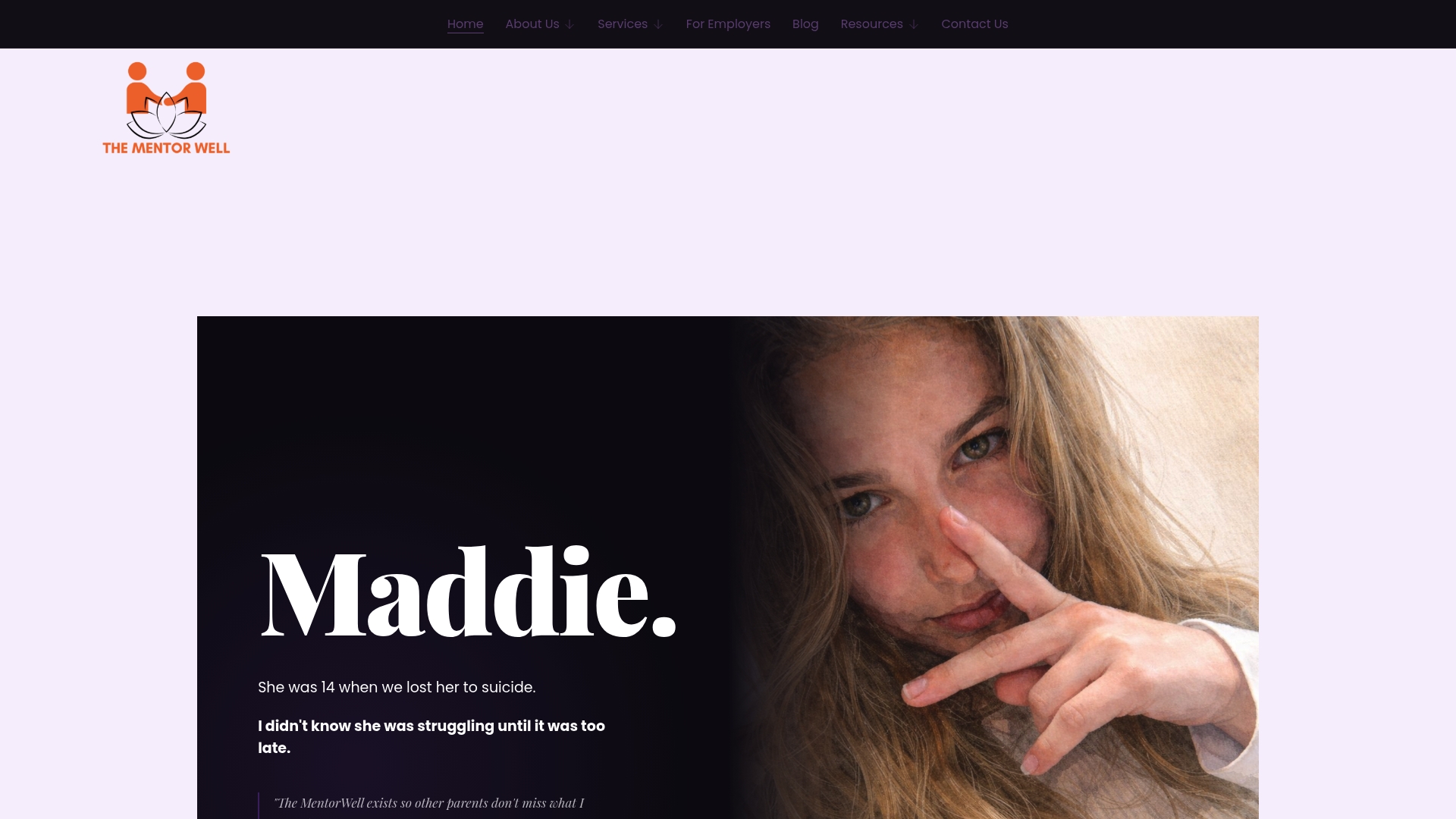
I started this because of my daughter, Maddie. I won't walk through the details here. What I'll say is that the version of me who existed before, the one who thought he was paying attention, was wrong about what attention actually required. Corporate social impact programs make the same mistake constantly: they assume awareness is the same thing as detection. It isn't.
When employers bring us in, it's usually for manager training, workshops that teach leaders what early emotional distress actually looks like in a person who hasn't said a word about it yet. We also make our Teen Signal Check, an assessment tool built for parents and caregivers of youth aged 8 to 25, available as a resource for employees managing this at home. It's not a corporate wellness perk in the traditional sense. It's recognition that an employee struggling with their kid's mental health at 2 a.m. brings that exhaustion to work at 9.
The families who reached out to us after losing someone almost always say the same thing: there were signs. Not dramatic ones. Quiet ones. A door that used to stay open starting to stay closed. The tragedy isn't that nobody cared. It's that nobody knew what they were looking at.
The lesson for any leader building a program like this: don't let it live only in HR's benefits binder. Tie it to your governance structure. Measure whether it changes anything, not just whether people showed up.
What we've watched go wrong elsewhere:
- Programs launched with a press release and no follow-up measurement six months later.
- Wellness benefits that exist on paper but that no manager has ever mentioned in a one-on-one.
- Community partnerships announced once and never revisited.
The pattern is always the same. Attention given once isn't attention. It's a gesture.
What the law expects from corporate social impact claims
Regulation in this space is tightening, and the direction is consistent: away from voluntary, vague claims and toward disclosure that can be verified. Securities regulators in several jurisdictions are increasing scrutiny of ESG disclosures specifically to catch "greenwashing," inflated or unsubstantiated claims about social or environmental performance, and the same scrutiny is extending to social claims, sometimes called "social washing."
Occupational health and safety law in most jurisdictions already covers psychosocial hazards, not just physical ones, meaning employers can carry legal exposure for failing to address chronic workplace stress or unsafe workloads, separate from any voluntary ESG commitment they've made. This is worth taking seriously: a psychosocial risk that shows up in your ESG report as "monitored" but isn't actually being addressed operationally can become both a reputational and a legal liability at once.
Disclosure frameworks are also evolving quickly. Depending on your jurisdiction, size, and sector, you may face mandatory sustainability reporting requirements that include social metrics, not just environmental ones. The direction of travel across most regulatory environments is toward more specificity and less room for aspirational language without evidence behind it.
None of this should be read as legal advice, specific obligations vary significantly by jurisdiction and sector. What's worth internalizing is the general trend: claims made publicly now need data behind them, and that data needs to be defensible if someone asks to see it.
What actually matters here, and what doesn't
Most corporate social impact advice treats mental health as a soft add-on to a harder ESG strategy. I think that gets the priority backwards. The evidence, WHO's own guidance on workplace prevention, the Stress-ESG framework's treatment of psychosocial risk as material, points the other direction: this belongs at the centre, not the edge.
The conventional advice tells leaders to start with a strategy document. I'd start with a single honest survey question instead: do your employees believe they could tell their manager they're struggling? If you don't know the answer, nothing else in your social-impact plan is standing on solid ground.
Prioritize this first: name one owner, pick one outcome, measure it honestly for a year. Everything else, the frameworks, the dashboards, the community partnerships, works better once that foundation exists. Skip it, and you're just decorating a program that has nothing underneath it.
— Chris Coulter
How The MentorWell partners with employers on this work
The MentorWell gives employers a way to act on psychosocial risk that doesn't stop at a policy document. Where most workplace wellness programs stay generic, ours is built specifically around early detection, the same discipline we apply to families, applied to your workforce and their households.
We offer manager workshops focused on recognizing early signs of emotional distress before they escalate, live and on-demand coaching for both parents and people managers, and our Teen Signal Check as a resource employees can use at home for the young people in their lives aged 8 to 25. For organizations building out a community-facing component, we also support family mentorship programs that connect struggling households with people who've been through it.
The natural first step isn't a company-wide rollout. It's a single pilot workshop with one team, paired with a short internal check on psychosocial risk. That gives you real data before you commit budget to anything larger. If you're ready to talk about what that could look like inside your organization, visit The MentorWell to see current workshop options and start a conversation about a pilot.
Sources
- Guidelines on mental health at work — World Health Organization
- How companies can strengthen nonprofit partnerships with the PRISM Practices — Imagine Canada
FAQ
What is a company's social impact?
A company's social impact is the measurable effect its operations, workforce practices, and community engagement have on people and the environment, spanning everything from employee wellbeing outcomes to community investment results.
What is CSR and what are examples?
Corporate social responsibility (CSR) refers to a company's voluntary commitments to ethical, social, and environmental practices. Examples include employee volunteer programs, charitable giving, workplace mental health initiatives, and sustainable sourcing policies.
How do you measure corporate social impact?
Measurement follows a logic model moving from inputs and activities to outputs and, ultimately, outcomes, using indicators like turnover rate, psychological safety survey scores, and community partnership results rather than simple activity counts.
What is corporate responsibility and social impact?
Corporate responsibility describes the policies and commitments a company makes toward ethical conduct, while social impact refers to the actual, measurable outcomes those commitments produce, including workforce wellbeing, which platforms like The MentorWell help employers address through manager training and early-detection tools.