
Most corporate purpose initiatives can work, but only when three things are in place: real governance, honest measurement, and integration into how the business actually runs. If your program is missing any of those, it is probably producing goodwill and little else.
The evidence backs a cautious yes. A 2026 industry report found that many companies kept their purpose work alive even under political pressure, though many redirected budget toward communications and trust-building rather than new programming. At the same time, Harvard Business Review points out that leaders are facing public criticism, political scrutiny, and investor scepticism they were not built to withstand, and that the fix is rarely more messaging. It is timing, governance, and measurement.
Here is what to do before anything else. Run a short diagnostic this week:
- List every initiative that carries the word "purpose" and name its accountable owner.
- Check whether any KPI tied to it existed before launch, not after.
- Ask whether it has ever been reviewed at the board or senior leadership level.
Quick signal check: if two of those three come back empty, you have a communications project wearing a purpose label. That is fixable, but only once you can see it clearly.
Key Takeaways
Purpose initiatives create real value only when governance, measurement, and operational integration are all present at once.
| Point | Details |
|---|---|
| Run the diagnostic first | Check intent, ownership, and integration before adding new programming or budget. |
| Measure across four groups | Track employee, community, reputational, and financial indicators with a real baseline. |
| Governance is the inflection point | Assign explicit board oversight and a senior owner with budget authority. |
| Watch for purpose-washing | Fix it by changing one real operational process within a quarter, not another statement. |
| Pilot mental-health workshops | The MentorWell's workshops and coaching give managers early-detection skills you can measure against a baseline. |
Table of Contents
- What is a practical framework for evaluating corporate purpose initiatives?
- Which KPIs actually show whether purpose initiatives are working?
- Where should purpose sit in the organization?
- What are the warning signs a purpose initiative is failing?
- What trends should leaders plan for now?
- How do you build a roadmap to test, scale, or stop an initiative?
- What has The MentorWell learned about purpose and mental health at work?
- What matters most when judging whether purpose initiatives are real?
- How The MentorWell supports a workplace purpose pilot
- Sources
- FAQ
What is a practical framework for evaluating corporate purpose initiatives?
A 30 to 90 minute diagnostic session, run with the right people in the room, tells you more than a year of anecdotes. The goal is to test alignment, ownership, integration, and outcomes, in that order, because each one depends on the last.
Start with intent. Ask plainly: does this initiative connect to a real business need or a genuine stakeholder demand, or did it originate from a marketing brief? Purpose that is bolted onto strategy after the fact rarely survives budget season. Purpose that grows out of what the business already depends on, its talent, its supply chain, its customer trust, tends to outlast leadership changes.
Next, check ownership. Who holds the authority to reprioritise resources for this initiative when quarterly pressure hits? If the answer is "the communications team" or "no one specifically," you have found your first gap, highlighting the importance of corporate healthcare branding in aligning purpose initiatives with strategic communication efforts. Real ownership means someone can say no to a competing budget request because the purpose work has protected status.
- Map intent. Write one sentence connecting the initiative to a core business outcome or stakeholder need.
- Name the owner. Identify the person with budget authority and the standing to defend it.
- Trace integration. Follow the initiative through HR, operations, and communications, and note where it stops.
- State the hypothesis. Write down what you expect to change, for whom, and by when.
Integration is where most programs quietly die. A purpose initiative that lives only in the communications calendar, with no touchpoint in hiring, performance reviews, or operational planning, is a campaign, not a discipline. Academic work on corporate social responsibility and financial performance suggests the initiatives that create durable stakeholder value are the ones woven into daily operations, not the ones announced once and revisited annually.
Finally, map outcomes. For each stakeholder group, employees, community partners, customers, write a single hypothesis: "If this works, we expect X to change for Y group within Z months." Vague aspirations do not survive contact with a skeptical CFO.
Pro Tip: Run this diagnostic with someone outside the initiative's original team. Insiders default to defending the program; a fresh set of eyes will spot the gaps in ownership and integration faster.
Which KPIs actually show whether purpose initiatives are working?
Vanity metrics are the fastest way to convince yourself a program is succeeding when it is not. Attendance counts, social impressions, and press mentions feel like progress, but they measure visibility, not change. Real measurement systems track outcomes across four groups, and they resist the temptation to report only the numbers that flatter.

Employee experience indicators matter first, because purpose programs live or die on whether staff believe in them. Retention change among participants versus non-participants, internal survey shifts on trust and belonging, and manager-reported engagement all give you a defensible signal, provided you have a baseline from before the program launched.
Community outcome indicators should come from the community partner, not your own team. A skills-based volunteering program that reports "500 volunteer hours" tells you effort, not impact. A partner report documenting job placements, skill gains, or service delivery improvements tells you something closer to the truth.
Reputational indicators are the most misused category. Media sentiment and follower growth are easy to game and easy to misread. Third-party trust surveys and stakeholder interviews carry more weight, even though they take longer to collect.
Financial linkage indicators are where leaders get nervous, and rightly so. Academic evidence on CSR and financial performance finds that stakeholder value and operational efficiency gains are real, but short-term financial impacts vary widely by initiative type. Do not promise your board a revenue line from a mental-health workshop. Promise reduced absenteeism, better retention among trained managers, or fewer escalated HR incidents, and measure those instead.
Set a cadence before you set a target. Quarterly pulse surveys, annual partner reports, and a controlled pilot design (a comparison group that did not receive the program) turn a nice story into a defensible one. Where possible, bring in a third party to validate community-level claims. Self-reported numbers from the team running the initiative are the weakest form of evidence you can bring to a board meeting.
Where should purpose sit in the organization?
Purpose that has no home at the top table stays symbolic no matter how well-intentioned it is. Governance is the difference between an initiative that survives a leadership change and one that quietly disappears with the executive who championed it.
Board-level responsibility needs to be explicit, not assumed. Research into large-firm governance structures shows that a meaningful share of companies declare public purpose statements without ever assigning board-level oversight, which leaves the work aspirational rather than operational. If your board charter does not mention purpose or social impact oversight by name, that is a governance gap worth raising directly.
Below the board, you need a senior owner with real authority, supported by a cross-functional steering group that includes HR, operations, and finance, not just communications. A program that only communications people attend meetings for will only ever produce communications outputs.
- Assign explicit board or committee oversight language, reviewed at least annually.
- Name a senior executive owner with budget authority, not just a program manager.
- Build a steering committee spanning HR, operations, finance, and communications.
- Link purpose targets to at least one executive scorecard metric.
- Publish progress in a format that can be audited, not just narrated.
Recent ESG disclosure research shows more companies pairing social and environmental metrics with executive compensation, and more board committees taking explicit responsibility for these issues. That pairing is what turns purpose from a slide in the annual report into something leadership is accountable for between now and the next review cycle.
What are the warning signs a purpose initiative is failing?
Some failures are loud. Most are quiet, which is exactly why they last so long before anyone addresses them.
- Purpose-washing. The clearest sign is a values statement with no corresponding operational change: same supply chain, same hiring practices, same incentive structure, new tagline. The remedy is fast and uncomfortable: pick one operational process and change it to match the stated value within the next quarter, publicly if you can.
- No operational integration. If HR, procurement, and operations cannot each point to a specific way the initiative touches their work, it is not integrated. Fix this by assigning one integration task per department, with a deadline, rather than one more all-staff email about "living our purpose."
- Underestimated political and reputational risk. HBR's analysis is blunt about this: initiatives launched without stress-testing for public criticism or investor pushback are increasingly exposed. Before launch, ask who might object and why, and have an answer ready.
- Weak or opaque reporting. If your annual report describes the initiative in adjectives rather than numbers, or if the numbers only ever move in one direction, that is a credibility problem waiting to surface. Bring in independent verification before a journalist or activist investor does it for you.
None of these are fatal on their own. Left unaddressed for two or three budget cycles, they compound into the kind of program that gets cut entirely rather than fixed.
What trends should leaders plan for now?
Scrutiny is not going away, and pretending otherwise is the riskiest strategy on the table. Purpose work has become politically contested territory, and leaders who treat it as neutral, feel-good programming are the ones most likely to be caught off guard.
Despite that pressure, most companies are not retreating. The same 2026 industry report that found 78% continuation also found the largest budget increases went toward communications and trust-building, a sign that leaders are choosing to explain their work better rather than abandon it.
Statistic to watch: communications and trust-building spending is rising faster than program spending itself, which tells you where boards currently believe the risk sits.
- AI is now doing real work inside purpose programs: automating impact reporting, scaling stakeholder engagement, and flagging sentiment shifts early, though it cannot substitute for genuine community relationships or verified outcomes.
- Volunteering programs are shifting from generic hours logged toward skills-based engagement tied to measurable workforce development, which gives HR a stronger case for keeping the budget.
- Disclosure norms are tightening, with more firms pairing ESG metrics to executive compensation and boards taking explicit ownership of the reporting process.
Treat 2026 as the year purpose work gets asked to show its receipts, not the year it gets abandoned.
How do you build a roadmap to test, scale, or stop an initiative?
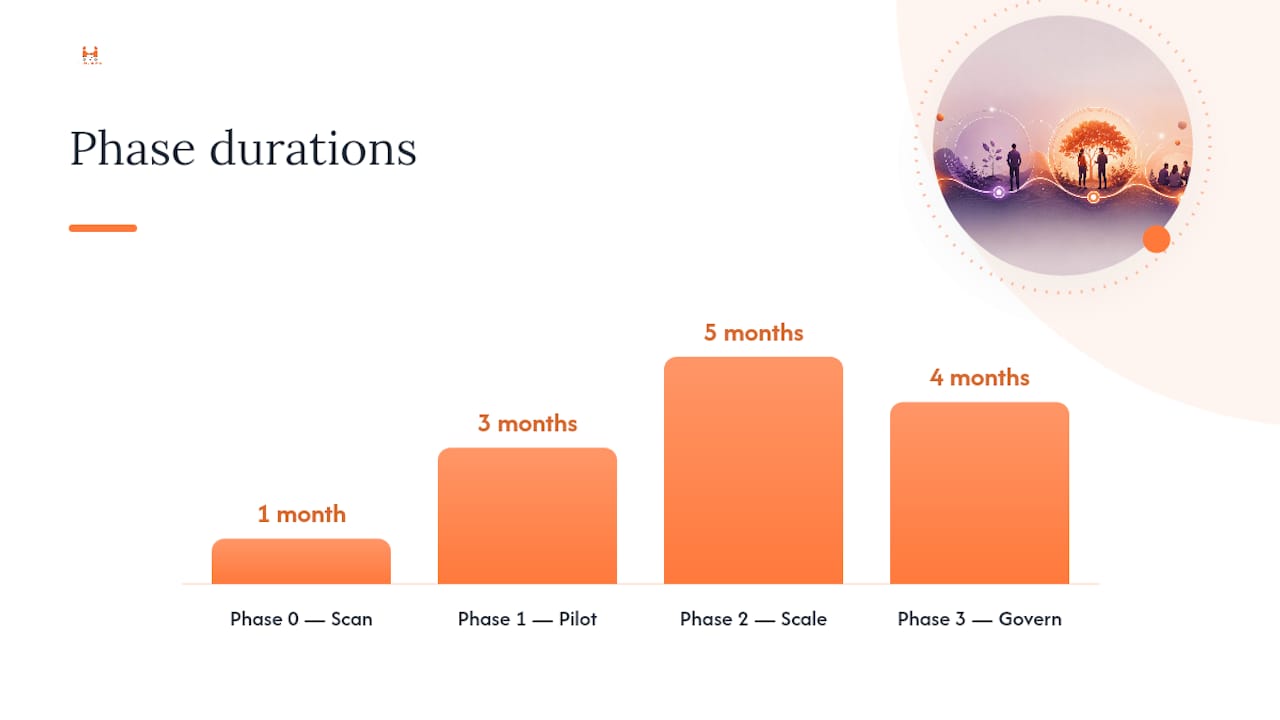
A phased approach keeps you from either killing a promising program too early or funding a dead one too long. Four phases, spread across roughly a year, give you enough data to make a defensible call at each stage.
- Phase 0, weeks 1 to 4: quick scan. Run the framework diagnostic above on every active initiative. Sort results into stop, test, or scale based on whether alignment, ownership, and integration are present.
- Phase 1, months 1 to 3: short pilots. For anything landing in "test," design a time-boxed pilot with a comparison group and two or three pre-agreed metrics. Resist the urge to add more metrics mid-pilot; that is how programs quietly redefine success.
- Phase 2, months 3 to 8: scale with structure. Programs that clear the pilot bar get a real budget line, a named process owner, and integration checkpoints in HR and operations, not just a bigger marketing push.
- Phase 3, months 8 to 12: disclose and govern. Bring results to the board, publish what you can verify externally, and tie at least one metric to an executive scorecard for the following year.
Pro Tip: Design your Phase 1 pilot with a control group from the start, even a rough one. A pre and post survey on the participating team, compared against a similar team that did not participate, produces a far more defensible signal than "engagement felt higher this quarter."
Resources on workplace wellness program design and step-by-step volunteering rollouts are useful references when you reach Phase 1 and need a structure to borrow rather than build from scratch.
What has The MentorWell learned about purpose and mental health at work?
I started this work because I missed something. Not once, but in the slow way you miss things when you are busy and tired and telling yourself the kid is fine. Maddie was fine, until she wasn't, and the space between those two facts is where this company lives now.
What I have learned since is that workplace purpose initiatives around mental health only mean something when a manager can actually name what a warning sign looks like, and knows what to do in the next five minutes, not the next quarterly review.
The workshops we run are not there to make anyone feel good about their culture page. They exist because a manager who has sat through one is more likely to notice the quiet kid on their team, the sudden withdrawal, the joke that lands wrong. That noticing is the entire point.
The Teen Signal Check grew out of the same instinct: give parents and caregivers a way to see subtle signs early, before the window closes.
What matters most when judging whether purpose initiatives are real?
The conventional advice tells leaders to "communicate purpose consistently." That advice is backwards. Consistency in messaging without consistency in governance is exactly what produces purpose-washing, and it is the single most common failure I see in this space.
What the evidence actually supports is smaller and less comfortable: purpose initiatives work when someone with real authority is willing to be measured against them, publicly, on a timeline that outlasts the current news cycle. Everything else, the values statements, the campaign videos, the volunteer day photos, is downstream of that one condition.
If you take one thing from this article, prioritise the governance conversation before the measurement conversation. A program with weak metrics but a genuinely accountable owner will improve its metrics over time. A program with perfect metrics and no owner will simply stop existing the first time someone asks an inconvenient question.
Silence isn't safety, in a boardroom or at a kitchen table. Say the uncomfortable thing about your own program before someone outside the company says it for you.
How The MentorWell supports a workplace purpose pilot
If your organization is testing whether a mental-health-focused purpose initiative is worth scaling, The MentorWell gives you a way to pilot it without building a program from zero. Where generic wellness vendors sell a one-off seminar, our workshops are built around early detection, the same skill set behind the Teen Signal Check, and they come with practical coaching for managers who need more than a slide deck to act on what they notice.

A pilot typically starts with a single workshop for managers or HR leads, paired with our on-demand coaching for follow-up questions that come up weeks later, not just on the day. That structure gives you the time-boxed, measurable format your Phase 1 roadmap calls for: a defined group, a clear starting point, and outcomes you can actually track against a baseline. Our mental health education resources outline what a first session covers.
If you are ready to test this inside your own team, book a workplace workshop and tell us what you want to measure. We will help you set the baseline before day one.
Sources
- State of Corporate Purpose 2026
- Are Your Company's Purpose Initiatives Working? (HBR)
- The impact of corporate social responsibility on corporate financial performance
FAQ
What is corporate purpose?
Corporate purpose is the stated reason a business exists beyond profit, tying its operations to a stakeholder benefit such as employee wellbeing, community outcomes, or environmental stewardship. It only functions as strategy, rather than messaging, when it is governed and measured.
Can you give an example of a corporate purpose initiative?
A workplace mental-health program that trains managers to recognize early warning signs, paired with measurable outcomes like reduced absenteeism or improved retention, is one working example. The MentorWell's manager workshops and the Teen Signal Check follow this model for family and workplace settings.
What are corporate social initiatives?
Corporate social initiatives are structured programs, such as employee volunteering, community partnerships, or wellness programming, that a business runs to create stakeholder value alongside its core operations. The strongest ones connect directly to a real business need rather than sitting apart from it.
What are the four main pillars of a corporate strategy?
Definitions vary across frameworks, but most treat strategic alignment, governance and accountability, operational integration, and measurement as the core pillars a purpose initiative needs to succeed. Missing any one of these is the most common reason initiatives stall.
How do you know if a corporate purpose initiative is failing?
Weak or opaque reporting, no operational integration outside communications, and no board-level oversight are the clearest warning signs. If two of these are true for your program, treat it as a signal to redesign before scaling further.