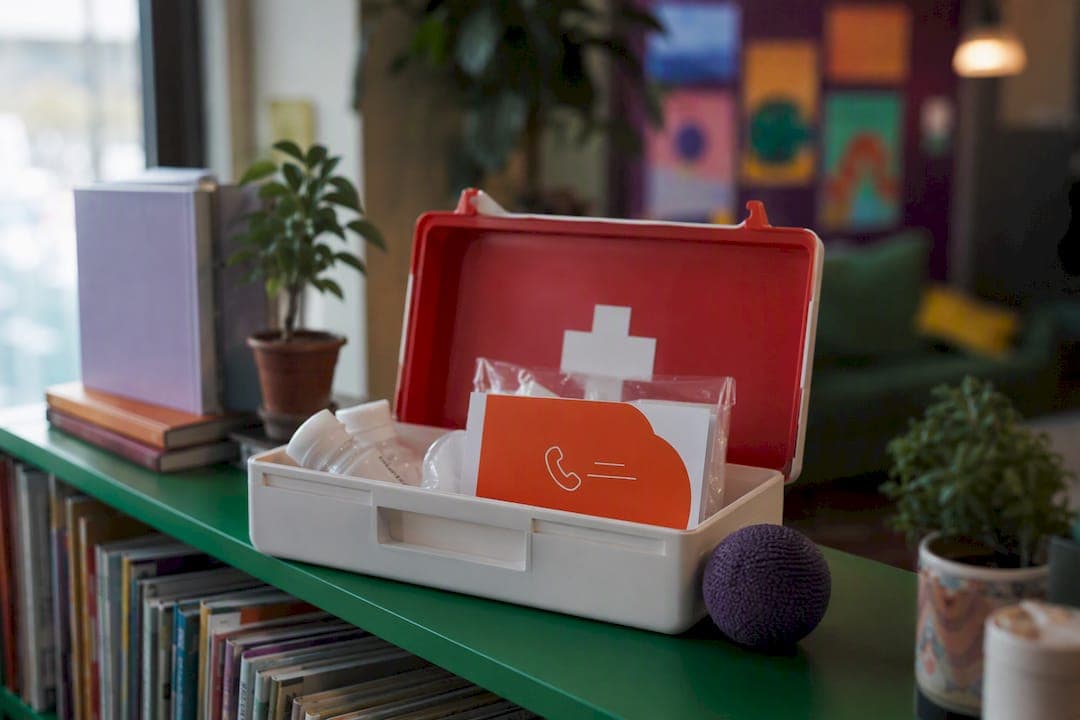
Call 9-1-1 if the danger is immediate. If an employee is suicidal or in acute crisis and there's no immediate threat to life in the room, call or text 9-8-8, the suicide and crisis lifeline available 24/7 across the US and Canada. Everything else, the paperwork, the policy, the follow-up conversation, comes after that.
Here's the short version, the one you tape inside a desk drawer:
- Danger to life right now? Call 9-1-1. Tell dispatch it's a mental health crisis.
- No immediate danger, but they're in crisis? Call or text 9-8-8, or stay with them while they call.
- Stay if it's safe to stay. Don't leave someone alone in crisis unless staying puts you or them at greater risk.
- Clear the room if needed. Other employees don't need to witness this.
- Notify HR and your EAP once the immediate danger has passed, not before.
Organizations like SAMHSA, the Mental Health Commission of Canada, and NAMI all converge on the same order of operations: safety first, connection second, paperwork last. The MentorWell built its manager training around that same sequence, because it's the one that actually holds up when someone's hands are shaking and the office has gone quiet.
Key Takeaways
Responding well to an employee mental health emergency depends on knowing the call order, staying present without trying to fix it, and following up long after the ambulance leaves.
| Point | Details |
|---|---|
| Call the right number first | Dial 9-1-1 for immediate danger; call or text 9-8-8 for suicidal crisis without imminent risk to life. |
| Don't try to fix it | Stay present, ask direct safety questions, and avoid arguing, minimizing, or giving advice. |
| Document facts, not diagnoses | Record observable behaviour and actions taken, and share details only with HR, EAP, or legal counsel as needed. |
| Know the accommodation basics | Duty to accommodate generally requires exploring schedule changes or leave before any disciplinary action. |
| Build readiness before the crisis | The MentorWell trains managers on scripts, de-escalation, and crisis-response protocols so the first real emergency isn't the first rehearsal. |
Table of Contents
- What to do first when you're facing an employee mental health emergency
- What to say to someone in crisis: de-escalation scripts that work
- When should you call 9-1-1 versus a crisis line?
- What to document (and what to leave out)
- What are your legal obligations after a workplace mental health crisis?
- How to connect an employee to help after the immediate crisis
- Building a crisis-response policy before you need one
- Planning a safe return to work after a mental health crisis
- Why a simple protocol saves lives (and why managers freeze without one)
- A father's perspective on why this can't wait
- Getting your team ready before the next crisis hits
- Where to go for more guidance
- Sources
- FAQ
What to do first when you're facing an employee mental health emergency
The hardest part isn't knowing the phone numbers. It's trusting yourself enough to use them without waiting for permission.
Here's the sequence, in order, no skipping ahead:
- Assess for immediate danger. Is there a weapon, a stated plan, an attempt already underway, or a medical emergency (overdose, injury)? If yes, call 9-1-1 immediately.
- If there's no immediate danger but the person is in visible crisis (panic, dissociation, expressing suicidal thoughts without a plan or means), stay with them and call or text 9-8-8, or help them call.
- Move the conversation somewhere private if you can do it without leaving the person alone or escalating the situation.
- Remove other employees from the immediate area, quietly. A curious crowd makes everything worse.
- Once emergency responders or crisis support are engaged, notify HR. They need to know before the end of the day, not necessarily before the ambulance arrives.
When you call 9-1-1, say the words "mental health crisis" early in the call. Many dispatch centres, though not all, can route mental-health-trained responders or co-respond with a crisis clinician. Give the address, describe what you're observing in plain terms ("employee is expressing suicidal thoughts," "employee appears to be having a panic attack and can't catch their breath"), and stay on the line until told to hang up.
What to say to coworkers nearby: Keep it short and free of speculation. Something like, "There's a health situation, I need everyone to step over here for a few minutes." Don't narrate what you think is happening. Don't use the word "crazy" or anything close to it, even in a whisper.
A short safety checklist worth memorizing:
- Do I need to physically remove myself or others from harm?
- Is there anything in the environment (sharp objects, medication, exits to a stairwell) I should quietly move or block?
- Have I called for help, and does that help know it's a mental health situation?
- Am I staying calm enough to be useful, or do I need someone else to take the lead?
Pro Tip: Keep a laminated card with the 9-1-1 script and the 9-8-8 number in every manager's desk drawer, not buried in an HR portal nobody opens under stress. In a real moment, you will not remember where the PDF is.
If the person is behind a closed door and won't respond, don't kick the door in. Call 9-1-1, describe the situation, and let trained responders assess entry. Your job in that moment is to keep everyone else safe and keep the line open.
What to say to someone in crisis: de-escalation scripts that work
Most managers freeze because they think they need the right words to fix the moment. You don't. You need to stay present and get out of the way of expertise that's coming.
NAMI's guidance on workplace crises is blunt about this: the goal isn't resolution, it's stabilization until the right help arrives. That reframe changes everything about how you talk.
Opening the conversation
Try something low-key and non-confrontational:
- "I noticed you seem really overwhelmed right now. I'm here, and I'm not going anywhere."
- "You don't have to explain anything to me. I just want to make sure you're safe."
- "Can we step somewhere quieter for a minute?"
Avoid opening with "Are you okay?" It invites a reflexive "I'm fine," which shuts the door you're trying to open.
Asking the safety question directly
This is the part managers dread most, and it's the one that matters most. If you have any concern about suicide, ask directly:
- "Are you thinking about suicide?"
- "Are you thinking about hurting yourself?"
Asking does not plant the idea. It signals you're willing to hear the truth, and it's often the first time anyone has asked plainly. If the answer is yes, follow with: "Do you have a plan?" and "Do you have access to [means]?" These aren't interrogation questions. They're triage questions that tell 9-8-8 or 9-1-1 responders what they're walking into.
Tone, posture, pacing
Lower your voice slightly rather than matching an escalating one. Slow your speech down. Sit or stand at the same level as the person rather than looming over them. Leave space, physically and conversationally, don't crowd them or fill every silence.
What to avoid, always:
- Don't argue with what they're feeling ("That's not a big deal" or "You're overreacting").
- Don't minimize ("Everyone gets stressed").
- Don't offer unsolicited advice or try to problem-solve the underlying issue in the moment.
- Don't promise confidentiality you can't legally keep, especially around safety risks.
- Don't touch someone without asking first, even a hand on the shoulder can escalate distress.
The Mental Health First Aid guidance on panic attacks offers a useful parallel: your job is to help someone regulate their breathing and reduce stimulation, not to talk them out of what their body is doing. The same restraint applies to a mental health crisis broadly. You are a bridge to care, not the care itself. Managers who try to fix the situation with advice or a pep talk usually make the person feel more alone, not less.
Pro Tip: If words aren't landing, stop talking. Sit with them in silence for thirty seconds. Silence rarely escalates a crisis. Forced conversation sometimes does.
When should you call 9-1-1 versus a crisis line?
The line between "call 9-1-1 now" and "call 9-8-8 first" comes down to one question: is there an active, immediate threat to life?
Call 9-1-1 when:
- There's a weapon involved, anywhere in reach.
- The person has taken an overdose, is injured, or shows signs of a medical emergency.
- There's a stated plan and immediate means to act on it.
- The person is a danger to others, not just themselves.
Call or text 9-8-8, or connect to your EAP's crisis line, when:
- The person is expressing suicidal thoughts without an immediate plan or means.
- They're in acute emotional distress (panic, dissociation, an anxiety spiral) but not in physical danger.
- You need guidance on how to talk to them before deciding whether more urgent help is needed.
When you do call dispatch, whether for 9-1-1 or campus/building security, be specific: describe the behaviour you're observing, state clearly whether weapons are present or absent, and say the words "mental health crisis" so responders know what they're walking into.
Coordination checklist for a welfare check or escorted transport:
- Loop in your building security team or site lead before, not after, responders arrive on scene.
- Designate one person to meet emergency services at the entrance so they aren't searching the building.
- Keep HR informed in real time if the situation is unfolding over more than a few minutes.
- Assign someone to stay with any coworkers who witnessed the incident, they may need support too.
- Avoid a crowd forming near the point of contact. Redirect foot traffic quietly.
If police are involved, be prepared to correct course if you sense the response is escalating rather than de-escalating. You can and should ask if a crisis intervention team or co-responder model is available in your area.
What to document (and what to leave out)
Write down what you saw, not what you think it means. "Employee raised their voice and stated they wanted to die" is documentation. "Employee seemed suicidal" or "employee has depression" is a diagnosis you're not qualified to make, and it can create legal exposure later.
Record objective facts:
- Date, time, and location of the incident.
- Specific behaviours and statements, in the employee's own words where possible.
- Who was contacted (9-1-1, 9-8-8, EAP, HR) and at what time.
- Any immediate actions taken (removed from workspace, accompanied to a private room, transported by ambulance).
Confidentiality isn't optional here, it's the difference between supporting someone and exposing them. Medical details, diagnoses, and speculation about the cause stay out of the written record entirely. Share only what's operationally necessary, and only with people who need to know to keep the person safe or manage the workplace response.
| Who | What they need to know |
|---|---|
| HR | That an incident occurred, what actions were taken, and any immediate follow-up required. |
| EAP or crisis counsellor | Relevant safety context to provide appropriate support, shared with the employee's knowledge when possible. |
| Direct coworkers | Minimal information. A general statement that a colleague needed support is enough. |
| Occupational health / legal counsel | Involved only if accommodation, leave, or liability questions arise. |

The notification flow generally runs: immediate safety contacts (9-1-1, security) first, HR next, EAP as part of the referral, and occupational health or legal counsel only if the situation touches accommodation, leave, or potential liability. If you're unsure who owns that last step, that's usually an HR-and-manager shared decision, not one a single manager should make alone.
What are your legal obligations after a workplace mental health crisis?
You are not expected to be a lawyer in the moment. You are expected to know the four or five things that get organizations sued, and to call someone before you do them.
Here's the high-level checklist:
- Duty to accommodate. If the crisis relates to a disability (mental illness qualifies), employers generally have an obligation to explore reasonable accommodations, schedule changes, modified duties, or leave, before considering discipline.
- Discrimination protections. You cannot discipline, demote, or terminate someone because of a mental health crisis itself. Doing so risks running afoul of protections under laws like the ADA, and can trigger claims under human rights codes in Canadian jurisdictions.
- Limits on questioning. You can ask what an employee needs to do their job safely. You generally cannot demand a specific diagnosis. The Ontario Human Rights Commission's guidance on duty to accommodate is explicit on this: focus on function and needs, not labels.
- Medical documentation. Employers can often request confirmation that an employee is fit to return to work, but usually cannot demand full medical records or a specific diagnosis without a much higher bar being met.
Common reasonable accommodations after a crisis include a temporary reduction in hours, a modified workload, a short medical leave, or a change in reporting structure if the crisis involved a conflict with a specific manager. None of these require you to know the clinical details. They require you to know what the person needs to function.
Red flags that mean it's time to call legal counsel or your disability management provider: any situation involving potential termination near the time of the crisis, any request for medical records beyond fitness-for-duty, or any pattern where accommodation requests have been denied more than once. The US Department of Labor's fact sheets on workplace mental health are a useful starting reference, but they don't replace a conversation with counsel when the stakes are this high.
Pro Tip: Write down the accommodation request and your response in plain, functional language ("employee requested flexible start time; approved for 30 days") rather than clinical language. It protects the employee's privacy and protects you.
How to connect an employee to help after the immediate crisis
The emergency response ends. The person still needs somewhere to land.
Your Employee Assistance Program is usually the fastest, lowest-barrier next step. EAPs typically provide short-term counselling, crisis counselling, and referral services at no direct cost to the employee, and many can be reached the same day.
- Ask the employee if they'd like help contacting the EAP right now, don't just hand them a phone number and walk away.
- If they're willing, offer to stay while they make the call, or make a three-way call with the crisis line yourself if the situation still feels precarious.
- Confirm they have a same-day or next-day appointment if the crisis was acute, not a two-week-out slot.
- Ask if they have someone at home, a partner, family member, or friend, who knows what happened and can check in tonight.
Build a simple safety plan before they leave the building: who will check in with them (a specific person, at a specific time), how they'll reach help if things worsen overnight, and what the plan is if they can't be reached. This mirrors the Psychological First Aid framework used broadly in post-crisis support: stabilize, connect to resources, follow up.
A workable follow-up timeline:
- Within 24 hours: A manager or designated HR contact checks in by phone or in person, not by email.
- Within 72 hours: Confirm the employee attended their EAP appointment or made contact with a clinician.
- At one week: A brief, low-pressure check-in on how they're doing and whether any workplace adjustments are needed.
Assign ownership of each check-in to one specific person. "Someone will follow up" is how people fall through the cracks.
Building a crisis-response policy before you need one
Every organization thinks it will never need this, until the day it does. By then it's too late to write the policy calmly.
A workable crisis-response policy needs a few non-negotiable elements:
- A crisis contact list posted where managers can find it in under ten seconds, not buried three folders deep in a shared drive.
- Clearly assigned roles: who calls 9-1-1, who notifies HR, who manages the coworkers in the room, who talks to leadership.
- A communication protocol for what gets said to the rest of the team, and what doesn't.
- A designated EAP or crisis-line contact embedded directly in onboarding materials, not just an annual email nobody reads.
Training matters more than most organizations budget for it. A half-day Mental Health First Aid session or a scenario-based manager briefing, SAMHSA's workplace resources are a solid public starting point, changes how confidently a manager acts in the actual moment. The gap between a manager who's rehearsed a scenario and one who hasn't is the gap between freezing and acting.
After any incident, run a short post-incident review: What worked? What took too long? Did anyone not know their role? Feed that directly back into the policy. Psychological safety at the leadership level isn't built in a single training session, it's built by organizations that actually update their practices after something goes wrong.
Pro Tip: Run one tabletop exercise a year where managers walk through a fictional crisis scenario out loud. The first real crisis should not be the first time anyone has said the words "call 9-1-1" in front of their team.
Planning a safe return to work after a mental health crisis
The employee comes back. The team is still watching. This part gets rushed more often than any other stage, and it's where trust is won or lost.
A workable return-to-work plan includes:
- Staggered hours for the first one to two weeks, rather than a full return on day one.
- Modified duties if the crisis was linked to specific work tasks or stressors.
- A defined check-in schedule (weekly for the first month is common) with a named person, not "check in as needed."
- Privacy safeguards, meaning the plan itself is documented in functional terms ("modified hours through [date]") without medical detail attached.
Document accommodations the same way you'd document any operational change: what changed, for how long, and who approved it. Skip the diagnosis. Skip the backstory. "Employee approved for remote work Tuesdays and Thursdays through end of month" is a complete, compliant, respectful record.
- Meet privately with the employee before their first day back to align on what, if anything, gets communicated to the team.
- Prepare a brief, neutral statement for coworkers if needed ("Alex is back and easing into things, appreciate you giving them space").
- Check in with the wider team separately if the incident was witnessed, they may be carrying their own reactions.
- Revisit the accommodation plan at 30 days to confirm it's still working, rather than letting it quietly expire.
The team around that employee needs support too, without turning them into spectators of someone else's crisis. A short, factual note from a manager acknowledging that "something happened" and that support is available goes further than silence, and further than detail.
Why a simple protocol saves lives (and why managers freeze without one)
The evidence on this is consistent across very different institutions: crisis lines, EAPs, and early intervention reduce immediate harm and shorten the distance between a person in distress and a person receiving actual care. SAMHSA's clinical guidance and the Mental Health Commission of Canada's postvention framework both point to the same mechanism: the faster someone in crisis is connected to trained support, the better the outcome tends to be. None of this requires a manager to diagnose or treat anything. It requires a manager to recognize the moment and move.
The managers who freeze aren't the ones who lack compassion. They're the ones who've never rehearsed the moment. A protocol doesn't replace care, it removes the decision paralysis that keeps a caring person from acting fast enough. That's the whole function of a checklist in a crisis: it does the thinking so you don't have to, right when thinking is hardest.
Picture a mid-level manager on a Tuesday afternoon. An employee doesn't show up for a two o'clock meeting. Someone finds them in a stairwell, crying, unable to speak in full sentences. The manager doesn't have training. What they have is a laminated card in a drawer with three numbers on it and four bullet points. They call 9-8-8 first, stay on the floor with the employee, and text HR once the call connects. Nobody in that stairwell needed the manager to be a therapist. They needed someone who knew which number to dial and had the nerve to dial it.
That's the whole model. Not expertise. Readiness.
A father's perspective on why this can't wait
I've spent years going back over the moments I missed with Maddie. Not the big dramatic ones, the small ones. A shift in tone. A door that stayed closed a little longer than usual. I didn't have a checklist then. I didn't know what I was looking at.
That's the thing about a crisis at work. It rarely announces itself. It looks like someone being "a little off" until suddenly it doesn't.
Managers are not therapists, and I'd never ask one to try. What a manager can be is the person who notices, who stays, and who knows which number to call before the moment demands it. That's not a small job. It might be the only job that matters in that hour.
If your organization wants to build that readiness before you need it, The MentorWell works with employers on exactly this.
Getting your team ready before the next crisis hits
There are other ways to build this readiness. Some companies write their own internal one-page guide. Some rely entirely on their EAP's crisis line and hope managers remember the number when it matters. Both can help. Neither builds the muscle memory that comes from actually practising the moment out loud, before it's real.

The MentorWell runs manager coaching and workshops built specifically around the scenario above, the stairwell, the closed office door, the coworker who doesn't know what to say. Instead of a policy binder nobody opens, you get scripts your managers can actually use, a crisis-response framework tailored to your workplace, and live coaching that walks teams through the exact decisions covered in this guide. It's built for employers who'd rather train for the moment than react to it. If you're ready to bring this training into your organization, book a workshop consultation with The MentorWell and get your managers prepared before the next Tuesday afternoon stairwell moment.
Where to go for more guidance
- 9-1-1 — immediate emergency response for danger to life.
- 9-8-8 — the suicide and crisis lifeline, available 24/7 by call or text.
- SAMHSA — clinical guidance and crisis resources for individuals and employers.
- NAMI's workplace crisis guide — practical de-escalation language and manager scripts.
- Mental Health Commission of Canada — postvention and workplace suicide prevention guidance.
- US Office of Personnel Management on EAPs — what an Employee Assistance Program actually provides.
- FitRX's mental health resource list — additional referral links for employers building out a resource page.
| Source | Best for |
|---|---|
| SAMHSA | Clinical guidance and crisis line rationale |
| NAMI | Manager scripts and de-escalation steps |
| Mental Health Commission of Canada | Postvention and workplace policy |
| US OPM | Understanding EAP scope and services |
For workplace-specific training built around these exact scenarios, The MentorWell offers manager coaching and crisis-response workshops.
This article is general information, not a substitute for advice from a qualified doctor. Consult a qualified healthcare professional about your own circumstances before acting on anything here.
Sources
- Canada
- SAMHSA — mental health resources (anxiety disorders)
- Navigating a mental health crisis at work — NAMI
- Employee assistance programs — U.S. Office of Personnel Management
- Mental health — U.S. Department of Labor fact sheets
FAQ
What should you do when an employee is having a mental health crisis?
Assess for immediate danger first. Call 9-1-1 if there's a threat to life; call or text 9-8-8 if the person is in crisis without imminent danger, stay with them, and notify HR once the immediate situation is stabilized.
What's the general rule for responding to any mental health emergency?
Prioritize physical safety, stay calm and present rather than trying to solve the underlying problem, and connect the person to trained help through 9-1-1, 9-8-8, or your EAP as quickly as possible.
Can an employer fire someone for having a mental health crisis?
Generally no. Employers typically have a duty to accommodate under disability protections, and disciplining or terminating someone because of a mental health crisis can expose the organization to discrimination claims; consult legal counsel before any disciplinary action tied to a crisis.
How do you respond to someone in crisis without making it worse?
Lower your voice, slow your pace, avoid arguing or minimizing what they're feeling, and ask direct safety questions like "Are you thinking about suicide?" rather than avoiding the topic.
Should managers try to counsel an employee through a mental health crisis themselves?
No. A manager's role is to stay present, ensure safety, and connect the employee to professional support such as an EAP or crisis line, not to provide therapy or advice.