
FMLA protects your job. Short-term disability, or STD, replaces part of your income while you're out. They are two different systems built by two different rulebooks, and when you qualify for both, they typically run at the same time, not one after the other. File both applications the moment you know you'll need leave, and learn more about how to use FMLA for rehab in our detailed guide at Sylmar Treatment Center. Waiting on one to see if you need the other is how people lose weeks they can't get back.
TL;DR:
- You should file both FMLA and STD claims immediately to prevent losing weeks of potential protection or benefits, as their timelines run independently.
- FMLA applies only to eligible employees at employers with at least 50 employees within 75 miles, and offers up to 12 weeks of unpaid, job-protected leave, possibly intermittent.
- STD is an insurance benefit with variable payment rates, elimination periods, and definitions of disability that depend on the specific policy, not law.
- Approval of an STD claim does not guarantee job protection, which is only provided by FMLA; both must be confirmed separately for full coverage.
- Noncompliance or delays in paperwork, especially regarding FMLA designation, can cause significant problems after leave ends, so detailed documentation is essential.
Table of Contents
- STD vs FMLA: what FMLA actually guarantees
- STD vs FMLA: what short-term disability actually pays
- STD vs FMLA: the differences that trip people up
- How STD and FMLA run together in practice
- A checklist for the first week of leave
- When FMLA runs out but disability pay keeps coming
- If your claim gets denied or FMLA gets mishandled
- Why I keep coming back to paperwork
- How The MentorWell helps employers get leave right
- Sources
- FAQ
STD vs FMLA: what FMLA actually guarantees
FMLA is a federal law, not a company perk. It applies only to employers with 50 or more employees within 75 miles of the worksite, and only to employees who've worked there at least 12 months and logged at least 1,250 hours in the past year. Meet both bars, and you're entitled to up to 12 workweeks of unpaid, job protected leave in a 12 month period, along with continued group health coverage under the same terms you had while working, according to the Department of Labor.
That entitlement covers more ground than most people realize:
- Your own serious health condition
- Caring for a spouse, child, or parent with a serious health condition
- Bonding with a new child
- Military caregiver leave, which extends to 26 weeks for eligible family members of a covered service member
Pro Tip: FMLA doesn't have to be taken in one solid block. If your condition or your family member's condition qualifies, you can use intermittent or reduced schedule leave, say, half days for chemo, or a few hours a week for therapy appointments, as long as it's medically necessary.
The guarantee is specific: job restoration to the same or an equivalent position, not a demotion dressed up as "equivalent." Employers who blur that line are violating the law, not making a judgment call.
STD vs FMLA: what short-term disability actually pays
STD is not a law. It's insurance, either bought by your employer, offered as a voluntary benefit you pay into, or mandated by a handful of states, including California, Hawaii, New Jersey, New York, and Rhode Island, according to OneDigital. That distinction matters because a law applies to you automatically once you're eligible. A policy only pays what its contract says it pays.
Most STD plans work the same basic way:
- An elimination period, often about one to two weeks, during which you get nothing
- A benefit rate, commonly 40% to 70% of your regular wages
- A benefit duration lasting several weeks depending on the policy, after which some plans transition into long-term disability
Elimination periods and benefit rates vary widely between policies, according to FMLADocs, so the number on your plan summary is the only number that matters for your situation.
Documentation differs from FMLA too. FMLA certification uses statutory definitions of a "serious health condition." Your insurer uses its own policy definition of "disabled," decided by its own claims reviewers, according to J. Price McNamara. The same medical chart can satisfy one and get flagged by the other.
STD vs FMLA: the differences that trip people up
Here's the plain version. FMLA holds your job. STD replaces part of your paycheque. Neither one does the other's job, and confusing them is where most leave problems start.
- Purpose. FMLA is about employment protection. STD is about income replacement. A person can have one without the other.
- Eligibility gate. FMLA eligibility depends on your employer's size, your tenure, and your hours worked. STD eligibility depends entirely on whether a policy exists and whether you meet its own definition of disabled.
- What triggers each one. Childbirth usually qualifies for both, bonding time under FMLA, recovery time under STD. Surgery generally works the same way. Caring for an aging parent, though, is a classic gap: it can qualify you for FMLA, but most STD policies won't pay a cent, because STD covers your disability, not theirs.
- The misconception that causes real damage. People assume that if their STD claim is approved, their job is safe. It isn't. STD approval is a payment decision made by an insurer. FMLA protection is a legal status decided separately, according to LeaveRights. You need both boxes checked, not one.
Pro Tip: If HR tells you your disability pay "covers" your leave, ask them directly whether they've also designated the absence as FMLA. Get the answer in writing. Verbal reassurance doesn't hold up later.
How STD and FMLA run together in practice
Here's the timeline most people actually live through. Day one of your absence, your employer should designate it as FMLA leave if you qualify, and the 12 week clock starts immediately, whether or not the paperwork is finished. Separately, your STD claim starts its own clock, running through the elimination period before any payment begins, according to FMLADocs. Neither clock waits for the other.
- Day 1: absence begins, FMLA designation should start, STD claim gets filed
- Days 1 to 14 (roughly): elimination period, typically unpaid unless PTO bridges it
- Week 2 or 3 onward: STD payments begin, FMLA weeks continue accruing in the background
- Week 12 (or 26 for military caregiver leave): FMLA protection ends, STD may continue if the policy allows
The two systems don't share paperwork by default. HR professionals often describe FMLA and STD as one combined "leave package" for planning purposes, syncing medical certification dates so you're not filling out the same form twice for two audiences, according to Paycor.
Pro Tip: Ask your doctor's office for two copies of every certification form on the same visit, one for HR, one for the insurer. Chasing down a second copy two weeks later is where delays start.
A checklist for the first week of leave
- Notify your employer in writing that you need leave, and specifically request FMLA designation. Don't rely on a verbal conversation with your manager.
- File your STD claim immediately, don't wait for FMLA paperwork to clear first. Insurer deadlines run on their own schedule.
- Check whether accrued PTO can bridge your elimination period, since most plans pay nothing during that window.
- Keep copies of every form, every email, every date you called HR or the insurer.
- Request written confirmation of your FMLA designation, not just a benefits summary. If it's not written down, it's hard to prove later.
When FMLA runs out but disability pay keeps coming
Twelve weeks pass fast when you're recovering from surgery or chemo. Once FMLA protection ends, your employer can legally fill your position, even while your STD cheque keeps arriving. Those are two separate contracts: one with your employer, one with an insurer.
- STD payments continue based on policy terms, independent of your job status
- ADA may require a reasonable accommodation, including additional leave in some cases, but that's decided case by case, not guaranteed, according to the Department of Labor
- Some states and some company policies offer leave protections beyond FMLA's 12 weeks, worth checking before week 10 arrives, not week 13
If your claim gets denied or FMLA gets mishandled
STD denials come with an insurer appeal process and a strict deadline, often tied to ERISA procedures if it's an employer-sponsored plan. Miss the window, and you may lose the right to appeal at all.
- Preserve every medical record, denial letter, and claim number
- Report FMLA misdesignation or unreasonable employer delay to the Department of Labor
- Log dates, forms, phone calls, and names, contemporaneous notes hold up far better than memory
- Talk to an employment lawyer once internal appeals are exhausted or if you suspect wrongful termination
Pro Tip: A denial letter almost always states the appeal deadline in the first or last paragraph. Read it the day it arrives, not the week you get around to it.
Why I keep coming back to paperwork
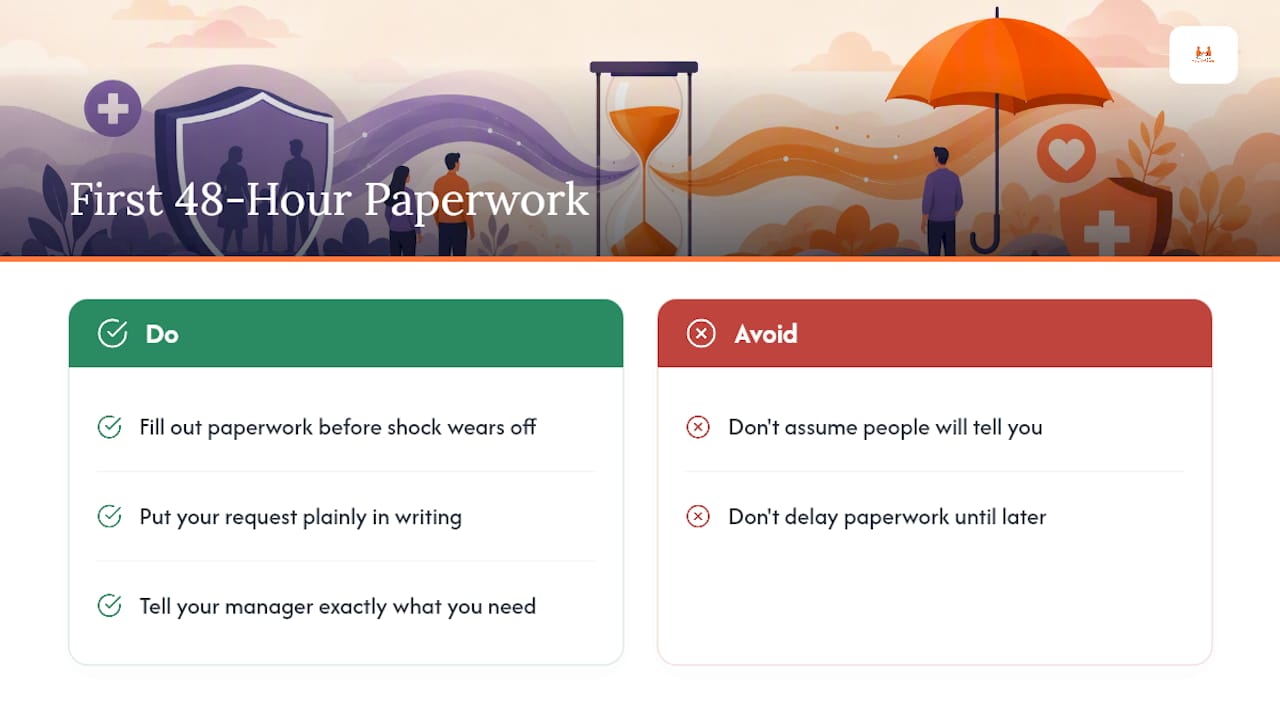
I think about the parents I've talked to who missed something, not because they didn't care, but because nobody told them what the first 48 hours actually required. Leave doesn't announce itself politely. It shows up as a phone call from a hospital, or a diagnosis you weren't ready for, and suddenly you're supposed to know form numbers and elimination periods.
Fill out the paperwork before the shock wears off. Tell your manager exactly what you need, plainly, in writing. And if you're an employer reading this, understand that how you handle someone's leave says more about your workplace than any wellness poster on the break room wall.
— Chris Coulter
How The MentorWell helps employers get leave right
Most of the FMLA and STD confusion we've walked through doesn't happen because policies are badly written. It happens because managers are never trained to spot the moment an employee needs to start that paperwork, and by the time HR gets involved, weeks of protection have already slipped away. That's the gap The MentorWell was built to close for employers.

The MentorWell runs manager training on how to recognize when an employee is struggling before a crisis forces a leave request, alongside employee mental health workshops that build the kind of trust that gets someone to say "I need help" earlier rather than later. Paired with assessment tools designed for early detection, these programs mean fewer missed deadlines, cleaner documentation, and stronger outcomes when someone returns to work. If you manage people and want fewer surprises during leave season, explore The MentorWell's employer resources and see which workshop fits your team.
Sources
Save these for HR and legal follow-up:
- Family and Medical Leave Act (FMLA) — U.S. Department of Labor
- FMLA vs short-term disability — FMLADocs
- Can you use FMLA and short-term disability together? — J. Price McNamara
This article is general information, not a substitute for advice from a qualified lawyer. Consult a qualified legal professional about your own circumstances before acting on anything here.
FAQ
Is it better to use FMLA or short-term disability?
Neither replaces the other. FMLA protects your job, STD replaces part of your income, and when you qualify for both, you use them together rather than choosing one.
Does STD count as FMLA?
No. STD is an insurance payment decided by a policy; FMLA is a legal job protection decided under federal eligibility rules, and approval for one doesn't guarantee the other.
Is FMLA the same as STD?
They're related but separate systems: FMLA guarantees job restoration and health coverage continuation, while STD guarantees a percentage of pay, commonly 40% to 70% of wages, for a limited time.
Can I use STD without FMLA?
Yes. If you don't meet FMLA's eligibility requirements, such as working for a smaller employer, you can still collect STD payments if your policy approves the claim, though you won't have federal job protection during that leave.