
TL;DR:
- Teen grief is characterized by unpredictable emotional and behavioral changes, not just visible sadness.
- Parents should watch for signs like withdrawal, irritability, and declining academic performance, and seek help if necessary.
Adolescent bereavement, the clinical term for how teens grieve, is defined as a grief process that looks fundamentally different from adult mourning and is far less predictable than most parents expect. A teenager who just lost someone they love might laugh at dinner, fail a test, pick a fight over nothing, and then cry alone at 2 AM. None of that is wrong. None of it means they are fine. Understanding what is actually happening beneath the surface is the first step toward knowing how to help.
How do teenagers typically express grief?
Teens express grief through behavioural changes, physical complaints, and risk-taking far more often than through visible sadness. That distinction matters enormously. A parent watching for tears might miss the real signal entirely.
The adolescent brain is still developing emotional regulation. Grief hits it hard. What comes out often looks like something else: irritability, defiance, sudden academic decline, or a complete withdrawal from friends. Parents should interpret these behavioural changes as grief signals, not just typical teenage rebellion.
Common signs that a teen is grieving include:
- Mood swings that feel disproportionate to the moment
- Pulling away from friends, family, or activities they used to love
- Complaints of headaches, stomach aches, or fatigue with no clear physical cause
- Declining grades or difficulty concentrating at school
- Increased risk-taking, such as reckless driving or substance use
- Disrupted sleep, either sleeping far too much or barely at all
- Irritability or anger directed at people who feel safe
Teens often mask their pain deliberately. Silence or withdrawal is frequently not an absence of grief but a protective mechanism. They do not want to burden the adults around them, especially if those adults are also grieving. They become the "strong one" without anyone asking them to.
Pro Tip: Watch for changes in patterns, not just dramatic moments. A teen who used to text friends constantly and now goes quiet for days is telling you something. You do not need them to say the words.
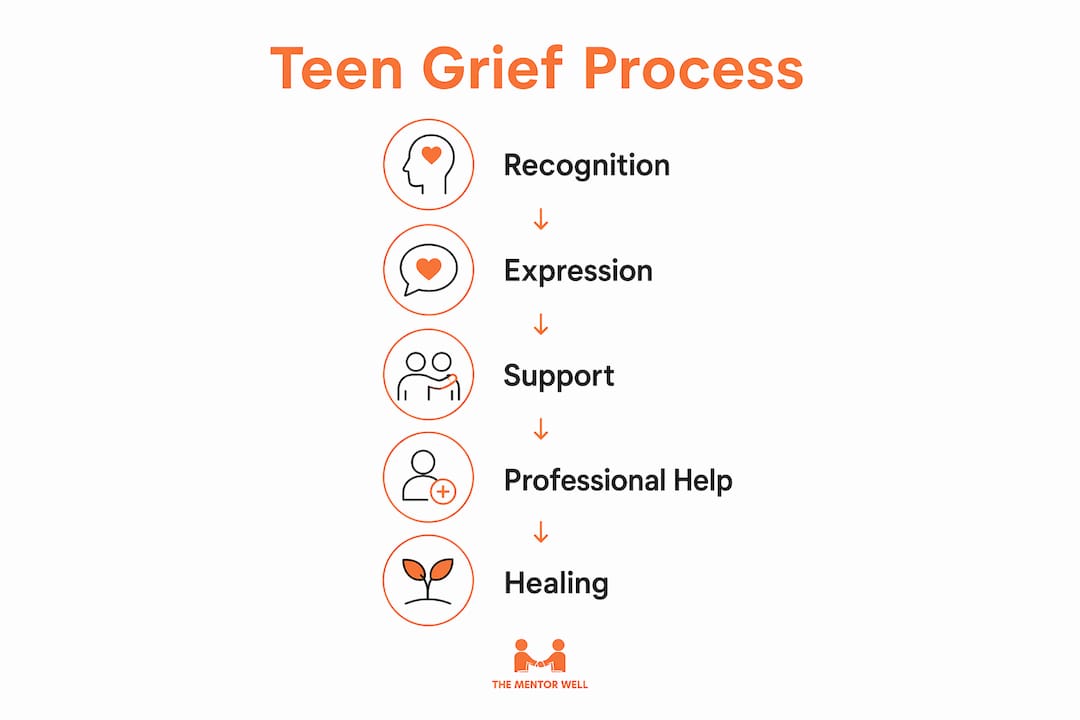
When does teen grief need professional support?
Grief has no fixed timeline. It can persist intensely for months, ease, and then resurface sharply during life transitions like graduations, anniversaries, or new relationships. That is normal. What is not normal is a steady worsening with no relief.
Parents should seek professional counselling when they notice the following warning signs:
- The teen mentions self-harm or expresses that life is not worth living
- Severe social isolation that lasts weeks without improvement
- Substance use that is escalating or becoming a coping pattern
- Complete inability to function at school or at home
- Increasing hopelessness, not just sadness
Professional grief counselling reduces emotional distress and helps teens build real coping skills. It is effective at any stage of grief, including years after a loss when something triggers it again. Seeking help is not a sign that you failed your child. It is the opposite.
| Warning sign | Appropriate response |
|---|---|
| Mentions of self-harm | Seek immediate help from a physician or crisis line |
| Severe isolation lasting weeks | Book a counselling appointment promptly |
| Escalating substance use | Contact a family physician for referral |
| Persistent inability to function | Request school accommodations and counselling |
| Recurring hopelessness | Engage a grief counsellor or psychologist |
Many provincial health plans in Canada cover grief counselling. A family physician is often the best starting point for a referral. Private practice counsellors are also accessible, and many now offer telehealth appointments, which can feel less intimidating for teens.
Pro Tip: Frame counselling to your teen as a place to talk to someone who is not in the middle of it with you. Neutral ground. Not a sign that something is broken.
How can parents support a grieving teen at home?
Consistent, non-judgmental presence is more effective than any conversation you could force. That is hard to accept when you want to fix things. But grief is not a problem to solve. It is something to sit beside.

Routine matters more than most parents realise. Keeping regular mealtimes, bedtimes, and family rituals gives a grieving teen something stable to hold onto when everything else feels uncertain. You do not need to talk about the loss at every meal. You just need to show up at the table.
Supportive activities that create space without pressure include:
- Going for a walk together without an agenda
- Watching a film or series they choose, side by side
- Cooking or baking something they used to make with the person they lost
- Driving them somewhere and letting the car ride carry the silence
- Encouraging journaling or curating a music playlist as a private emotional outlet
Honest, age-appropriate communication helps. You do not need to have answers. Saying "I don't know either, and I miss them too" is more useful than any reassurance you could manufacture. Sharing your own grief, without making your teen responsible for managing it, models that grief is survivable.
Avoid platitudes. "They're in a better place" or "time heals everything" closes doors. It tells a teen that their pain is inconvenient. What opens doors is simpler: "I'm here. You don't have to talk. I'm not going anywhere."
Pro Tip: The concept of 'safe harbour' parenting means being the one constant your teen can return to. You do not need to be perfect. You need to be present and predictable.
What Canadian resources are available for grieving teens?
Canadian resources for grieving teens include the Canadian Alliance for Children's Grief (CACG) and YouthGrief.ca, both of which offer free, peer-based support and practical toolkits for young people and their families. These are not clinical services. They are community spaces where teens hear from other teens who have been through loss.
Schools play a critical role in supporting grieving teens, though this role is often overlooked. Parents should inform the school of the loss as soon as they are able. Teachers and counsellors can then offer tailored support, including assignment extensions, reduced workload periods, and access to the school counsellor. Coordinating with schools after a loss facilitates academic accommodations that recognise the real cognitive impact of grief.
| Resource type | Format | Cost | Accessibility |
|---|---|---|---|
| CACG / YouthGrief.ca | Online peer support, toolkits | Free | Nationwide, any device |
| School counsellor | In-person, ongoing | Free | Through school |
| Family physician referral | In-person or telehealth | Covered by provincial plan | Province-dependent |
| Private grief counsellor | In-person or telehealth | Paid, some sliding scale | Most urban centres |
| Hospice bereavement programmes | Group or individual | Often free or low-cost | Community-based |
Hospices across Canada offer bereavement programmes that extend well beyond end-of-life care. Many run youth grief groups that meet regularly and are facilitated by trained counsellors. These groups reduce isolation in a way that one-on-one therapy sometimes cannot, because teens realise they are not alone in what they are carrying.
Proactive engagement with these resources matters. Waiting until a teen is in crisis narrows the options. Reaching out early, even when things seem manageable, keeps more doors open.
Key takeaways
Teen grief requires consistent parental presence, early recognition of behavioural warning signs, and timely access to Canadian counselling and community resources.
| Point | Details |
|---|---|
| Grief looks different in teens | Watch for behavioural changes like withdrawal, irritability, and academic decline, not just visible sadness. |
| No fixed timeline exists | Grief can resurface years later; support is effective at any stage of the process. |
| Warning signs need action | Self-harm mentions, severe isolation, or escalating substance use require professional help immediately. |
| Presence outweighs conversation | Consistent, non-judgmental presence is more effective than forcing a teen to talk. |
| Canadian resources are accessible | CACG, YouthGrief.ca, school counsellors, and hospice programmes offer free or low-cost support nationwide. |
What I've learned about sitting with a grieving teen
I did not know how to do this. I want to say that plainly.
When Maddie died, I thought I understood grief because I was inside it. I did not understand that the people around me were inside it too, and that they were watching me to see if it was safe to fall apart. Teenagers do that. They read the room. They decide whether the adults can handle it before they say a word.
The thing I got wrong, for a long time, was thinking that showing up meant having something useful to say. It does not. Showing up means being in the kitchen when they come downstairs at midnight. It means not flinching when they say something angry or strange. It means staying in the long grief without needing it to resolve on a schedule that makes you more comfortable.
I have talked to a lot of parents since losing Maddie. The ones who reached their kids were not the ones with the right words. They were the ones who stayed. Who did not disappear into their own pain so completely that their teen felt alone in the house. Who noticed the small things, the playlist that changed, the food left untouched, the light still on at 3 AM.
Silence from a teenager is not peace. I know that now. It took me too long to learn it. If your teen has gone quiet, that quiet deserves your attention. Not alarm. Not interrogation. Just attention.
If your teen isn't talking to you, that is worth sitting with. Not as a failure. As information.
— Chris Coulter
How The MentorWell supports grieving families
Grief does not follow a calendar, and neither does the need for support. The MentorWell was built for exactly this: the long stretch after loss, when the casseroles stop coming and the world expects everyone to be fine.

The MentorWell offers workshops, coaching, and the Teen Signal Check, a practical assessment tool for parents and caregivers who want to understand what their teen is carrying beneath the surface. Whether you are in the early weeks of loss or years down the road and noticing something shift, The MentorWell's programmes are designed to meet you where you are. You do not have to figure this out alone.
FAQ
What is adolescent bereavement?
Adolescent bereavement is the grief process experienced by teenagers after the death of someone significant. It differs from adult grief in its expression, often appearing as behavioural changes rather than visible sadness.
How long does teen grief typically last?
Grief has no fixed timeline and can resurface during major life transitions years after the loss. Support is effective at any stage, from days after the death to much later.
When should a parent seek grief counselling for their teen?
Seek professional help immediately if your teen mentions self-harm, shows severe isolation, or is escalating substance use. Persistent inability to function at school or home also warrants a counselling referral.
Why won't my teen talk to me about their grief?
Teens often stay silent to protect the adults around them, not because they are fine. They may speak more openly with a neutral third party like a counsellor than with family.
What free grief resources exist for Canadian teens?
The Canadian Alliance for Children's Grief (CACG) and YouthGrief.ca offer free peer support and toolkits. School counsellors and hospice bereavement programmes are also available at no cost in most communities.
Recommended
- If Your Teen Isn’t Talking to You, Who Are They Turning To? — THE MENTOR WELL
- Grief Doesn’t Have an Expiration Date: Here’s What to Expect — THE MENTOR WELL
- What’s Going on in Their Head? When Therapy Isn’t an Option and Parenting Isn’t Enough — THE MENTOR WELL
- How Mentorship Helps You Parent Through Divorce with Wisdom, Not War — THE MENTOR WELL